

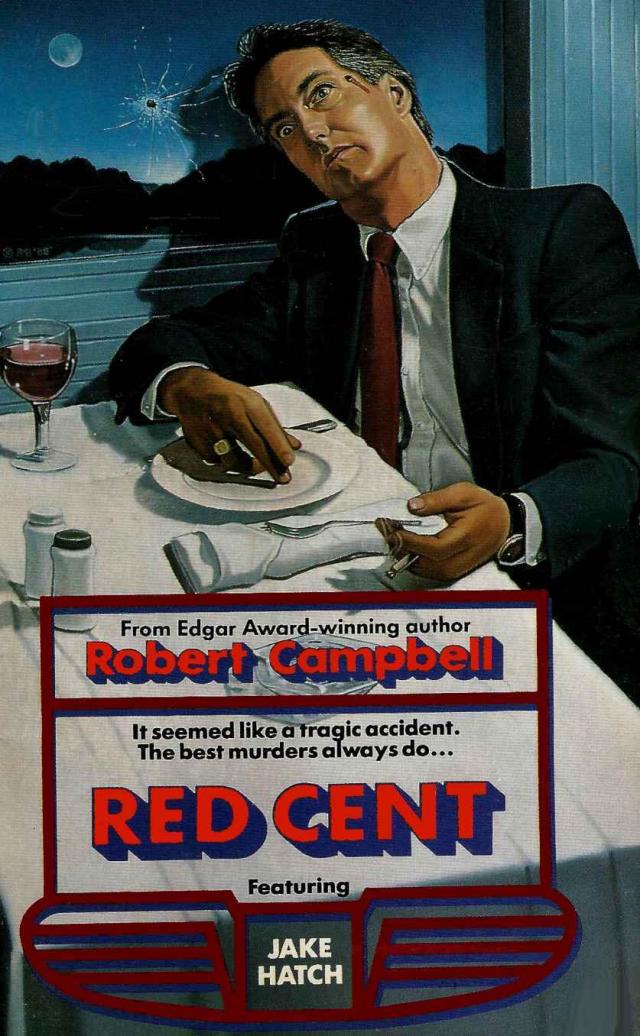
Red cent, p.1
Red Cent, page 1
part #2 of Jake Hatch Series


Contents
Praise
Title Page
Copyright
ONE
TWO
THREE
FOUR
FIVE
SIX
SEVEN
EIGHT
NINE
TEN
ELEVEN
TWELVE
THIRTEEN
FOURTEEN
FIFTEEN
SIXTEEN
SEVENTEEN
EIGHTEEN
NINETEEN
TWENTY
TWENTY-ONE
TWENTY-TWO
TWENTY-THREE
TWENTY-FOUR
TWENTY-FIVE
TWENTY-SIX
TWENTY-SEVEN
TWENTY-EIGHT
TWENTY-NINE
THIRTY
THIRTY-ONE
THIRTY-TWO
THIRTY-THREE
THIRTY-FOUR
THIRTY-FIVE
Praise for Jake Hatch
“Plugged Nickel is a good one. . .The main attraction is the wonderful cast of ordinary but unique people. Campbell’s characters have the true ring of authenticity that distinguishes fine crystal from window glass.
—— Cincinnati Post
Campbell is a heckuva a storyteller; Plugged Nickel clickety-clacks along the tracks like a Burlington-Northern freight train.
—— Criminal Record
Praise for Edgar Award-Winning Author Robert Campbell
“Campbell writes with wit and vigor. The comparison not unflattering is to Elmore Leonard.”
—— Los Angeles Times
“Robert Campbell is an awfully good writer.”
—— Elmore Leonard
“Robert Campbell is one of the most stylish crime writers in the business.”
—— New York Times
Praise for Edgar Award Winner
The Junkyard Dog
“Dialogue so breezy it stings your eyeballs, spirited characterizations of Jimmy’s proud ethnic neighbors, and the ward healer’s cocky defense of the old ways, the old politics . . . You can’t help liking Jimmy Flannery.”
—— New York Times Book Review
“This truly innovative private-eye character moves credibly through a brawling, tough-guy atmosphere in a plot that’s both twisty and witty.”
—— ALA Booklist
“Written in an appealing argot, this mystery has full characters, a satisfying ending and a nice balance of hardboiled action and romantic tenderness.”
—— Publishers Weekly
RED CENT
Robert Campbell
Publisher’s Note
This book is a work of fiction. Names, characters, places, and incidents either are the product of the author’s imagination or are used fictitiously, and any resemblance to actual persons, living or dead is entirely coincidental.
Copyright © 1989 Robert Campbell
All rights reserved.
Ayeshire Publishing
ONE
EVERY ONCE IN A WHILE I get to feeling moody, just like everybody else. I start brooding about my time of life, what I've accomplished with it so far and what I can squeeze into the years left to me. A sense of my mortality descends on me like a blanket, blocking out the sun and making me melancholy.
I think about the Christmas trees I haven't decorated and the traditions I haven't carried on and the picnics I haven't organized as the head of a family. I think about having no one to carry on my name. There'll be plenty of Hatches, I suppose, but I don't know if there'll be any Jake Hatches, Jacob being an old-fashioned name that's fallen out of favor.
You come to a certain age and you start thinking about your roots.
You can hardly help it.
You start regretting that you hadn't listened harder when Aunt Jen or Uncle Frank told the familiar stories about how it was and where we all came from. Not even talked, just listened. But first there was radio and then television and the old ones in families got listened to less and less. It was all old news and nobody gave much of a damn.
I've got to go see my sister one of these days and ask her can I have duplicates made of all the family pictures. Me holding on to a toy wheelbarrow the year I broke my leg when I was six and hobbling around in a cast. The summer we all went to the seashore all the way over to Atlantic City. Ma and Pa's wedding picture. The picture of my old man squinting in the sun when he was small, with my grandmother standing behind him. And the picture of her when she was an infant sitting on her mother's knee.
My great-grandmother.
I don't boast about it, but I'm proud of the fact that there is more than a drop of Mohawk in my veins from my great-grandmother on my mother's side. She was called Moon of Spring. She trekked, the stories tell, into the wilderness of Canada with her husband, Adam Hatch, hunting and trapping.
They were wintering on the shores of Lake Winnipeg when my grandfather, the first Jake Hatch, was born. It was a hard birth and it looked like mother and child would die. But Adam journeyed with them down the Red River of the North to Fargo, North Dakota, where they settled for a while until both were well recovered. They became storekeepers in Pierre, South Dakota, then a small town on the banks of the Missouri.
When my grandfather was grown, he adventured throughout Nevada, Utah, Wyoming, and the Dakotas until he met my grandmother, who convinced him that Chadron, Nebraska, her hometown, was the place to take up the blacksmith's trade and raise a family. When my own father was old enough to decide for himself, he turned his back on the forge, although he'd been trained in its use since the age of nine, and became first a brakeman and then an engineer on the Burlington Northern. After he married, my mother and father settled just outside Ottumwa, Iowa. That's where I was born and raised. That's where I learned of my Mohawk blood. I already knew railroading was in my veins.
They're gone now, my mother and father.
I have two sisters and a brother. They live in other parts of the country. None of them wanted to work for the railroad like I did.
I worked a dozen different jobs on and around the trains until I sort of fell into what I've come to love best. I'm one of that dying breed—at least that's the way romantic writers describe us—the railroad detective.
I rent the second floor of a three flat in Omaha from Mrs. Dunleavy, who seems to appreciate my solitary habits and takes care of my cat when I'm away, which is often. She's just that much older than me that she feels free to share a stew now and then without being afraid that I'll think she's setting her cap.
I ride the route in the ordinary way about twice a week, which is to say I pretend to be a passenger and keep my eye out for ticket thieves, pickpockets, unauthorized vendors, and the like. It gives me an opportunity to stop off here and there and visit with some ladies of my acquaintance and other friends.
The rest of the time—about two full days—I catch up on paper work back in the office while my boss, Silas Spinks, nods off at his desk beside the window where the afternoon sun pours in and warms his back. But it was well past the hour of any sun, Spinks asleep and me tapping away on the typewriter, putting in overtime without pay, because neither of us had any special place to go or anybody waiting dinner for us at home, when the telephone on his desk jarred him awake.
He picked up, looking none too pleased, and grunted into the mouthpiece, mumbling what passed for a greeting, then uh-huhing and boo-booing for a couple of minutes.
"Oh, yeah, he did the right thing," he said, finally speaking English, "but you'd better ask the front office if they want the train delayed until one of us gets there. Seems to me the right thing to do would be to back the California Zephyr into Ottumwa and detach the dining car, get the Ottumwa police to seal it off and ask them, as a courtesy, not to be too fast jumping on the investigation until"—his eyes landed on me—"Hatch arrives."
He went back to grunting gibberish and then hung up.
"A passenger was having his dinner in the dining car about twenty minutes ago," he informed me. "Just outside Ottumwa going west. Some men in two pickups traveling parallel through the tulles along the right-of-way started firing off some rifles. One of the bullets came through the window and struck the passenger in the head."
"Dead?"
"As a doornail."
"I never heard of such a thing."
"Sure you have," Spinks said, casual as you please. "We ain't got but a few Indian reservations and settlements, but down along the southern Amtrak route, where there's plenty, Indians take random shots at the train all the time."
"Out to kill the Iron Horse?" I said.
"Something like that. So why don't you drive on over to Ottumwa in a company car and see what you can do?"
"What makes you think these men were Indians? Anybody get that close a look?"
"Well, I didn't say I thought they was Indians. I just said it happens down along the southern route that reservation Indians take potshots at the trains."
"They catch them?"
"The dispatcher didn't say."
"Well, if they caught them, that's that, and if they haven't, I don't know what I can do about it."
"We got to show the flag."
"Will this trip count as overtime?"
"How about we count it on your vacation?"
"The company already owes me eight or nine months accumulated."
"So, you ever decide to get married, look at the honeymoon you'll have."
TWO
I LEFT OMAHA without any supper about eight-fifteen, the front office having taken the
They would arrive around ten-ten, forty minutes late. I'd get there about nine-fifteen by road, which meant I had a whole hour to spend along the way. There was no reason I could think of why I shouldn't stop in on Rose Palou, a widowed lady of my acquaintance who lives in a neat little cottage she owns in Van Meter.
Rose is a calm woman of generous disposition and outspoken honesty. The only thing a person might hold against her is her fondness for cats. There are always a half dozen or more draping themselves across the furniture, curling around your ankles, and leaving cat hairs on your dark suit. You can have a relationship with one cat. When they come in bunches they're nothing but a burden.
She never seems to mind it when I appear without warning, being of the mind that life is one long series of chance encounters anyway so why bother getting annoyed when something happens because it happens.
She met me at the door, having been alerted that someone was walking up the path by one of her sentry cats, and gave me a hug, which is something I tend to miss a lot, living alone the way I do.
"That," I said, "is just what the doctor ordered."
"Have you been ailing because deprived?" she said, letting me go and leading me into the parlor.
"It ain't the quantity of the embraces but the quality of them that counts," I said.
"My God, Jake, if I were a bird I'd've just fallen out of the tree and bonked my head. Are you here for a quickie?"
I couldn't believe my ears. What had Rose been getting up to, learning such language?
"I didn't quite catch your last remark, Rose."
"I asked did you stop by for a quick tumble in the feathers."
"For Lord's sake, where are you picking up words like that?"
"Don't you watch the television? Don't you go to the movies?"
"Well, I do sometimes, but that's that and—"
"What's what? I was asking if that was your idea, because the answer is no."
"Not that I came visiting for any such thing, Rose, but why did you say what you just said?"
"Because you're a careless, wandering vagabond, Jake, and that could lead to troublesome, even deadly, complications nowadays."
"Well, I can see precautions are called for in certain segments of the society to guard against fatal ailments, but I doubt if the crowd we run around with has much to fear."
"I don't run around in a crowd, Jake. It's you that has a crowd."
"I don't get your meaning."
"Well, you do, Jake. I've learned that when you say I don't get your meaning that's just when you got the meaning exactly."
"Where does that leave us, Rose?"
"It leaves us good friends, hugs and apple pie. Any more than that calls for a commitment you've not yet given."
"You know I'm not a marrying man, Rose."
"Fine. Now how would you like your pie, with or without whipped cream?"
"What do you think I should have?"
"Without. Then you can have a bowl of the fresh vegetable soup I've got simmering on the stove and some of my oatmeal bread."
Rose's vegetable soup is a poem and her oatmeal bread an essay on good eating. Sitting there at the kitchen table having such a meal made me think about the things we give each other, men and women. Love and comfort and support and kindness and sex and good things to eat and drink. I sometimes wonder, past a certain age, which is the greatest proof of affection.
"What brings you this way this time of night?" she asked, as she watched me eat.
"Trouble on the Zephyr. Some youngsters apparently boo-rahed the train and took a couple of shots at it. A bullet killed a man sitting in the dining car having his dinner."
"I never heard of such a thing."
"I said the same thing, but Silas Spinks reminded me that it happens now and then along the southern route."
"What's to be done about it?"
"I don't know. It's like the cages they have to put on the walkways over highways and freeways in the city to keep people from tossing bricks and stones through the windshields of the speeding cars. Can't build concrete walls the length of the railroad on both sides to protect them. Sometimes I think it's all got out of hand."
Rose shivered and looked away, past the frilly curtains at the window, out into the darkness of her garden where the oak leaves chattered in the wind.
"What is it?" I asked. "I didn't mean to distress you."
"Whenever I hear something like that or hear about it on the news, it makes me feel so unprotected. Even in a small town like this, where there's so little crime and violence, you think about how it only takes one creature passing through to take your life or hurt you so your life's changed forever after."
Every once in a while, when a woman of my acquaintance expresses such fears, it reminds me all over again how hard it must be for a woman to have to live her life with such anxieties as men only experience in small portion and then usually only when they're very young or very old.
"Well, I've got my tiger cats," she said, laughing and shaking her head until her curly hair bounced.
I finished my pie and a second cup of coffee.
"That's twice tonight you saved my life," I said. "Now I got to go and, poke my nose into things I'd rather not poke it into."
"I doubt that," she said, walking me to the door, where she hugged me again and kissed me on the mouth. Still holding me, she said, "You ought to think about getting married, Jake, the state of the world and your health and all else considered." She placed her hand on my cheek. "Stop back if it's not past midnight, or in the morning if you stay over."
I went out, got in the company car, and drove off.
That's the first time she'd ever approached the subject of marriage head on. It made me nervous, not because she'd expressed her needs and desires but because I feared she might be expressing mine.
I thought about it during the short drive into the train yards where the dining car waited and decided to talk it over with my cat when I got back home.
THREE
THE YARD WAS DARK except for the carousels on two police cars and an ambulance splashing red light around.
Lights also shone out of the dining car, which had been separated from the train and shunted off to a spur. It looked like the funeral car of some great man waiting to be pulled a long way through the states while people stood along the right-of-way, waving flags and weeping.
I had no idea if the dead man inside was a great man or just a commonplace one like myself, riding the train home from some pleasure or business trip to Chicago, with maybe a wife and some kiddies waiting for him.
I parked alongside a sheriff's car and set the brake. It was cold enough to wear a topcoat but not cold enough to button it up. Flu weather.
There were places I'd've rather been.
A young uniformed officer got out of the car and stepped over to me the way they do, moving at a speed that I call aggressive though not threatening.
I held up a hand, palm out, as I went for the wallet in my hip pocket.
"Don't get nervous, son. I'm a railroad detective."
He got loose, but not all at once. It was only after he saw my badge and I.D. that he took his hand off the butt of his gun.
"I shouldn't be so jumpy," he said.
"I'm jumpy and I ain't even seen the corpse yet. He still inside?"
"Sergeant Atterbury told the people from the morgue to wait until somebody from your office had a look."
"Well, I don't know what good me having a look is going to do. But I suppose it's better to look wise than foolish, so I might as well go in there, purse my lips, and cluck my tongue a little bit. Atterbury the man on the scene?"
"Well, it happened in county, so I guess he's the man."
"Didn't happen in this county. Happened in Monroe."
"Oh."
"I see a car from the Osceola Police Department is here. What's their particular interest?" I said.


