

The moon and the desert, p.7
The Moon and the Desert, page 7
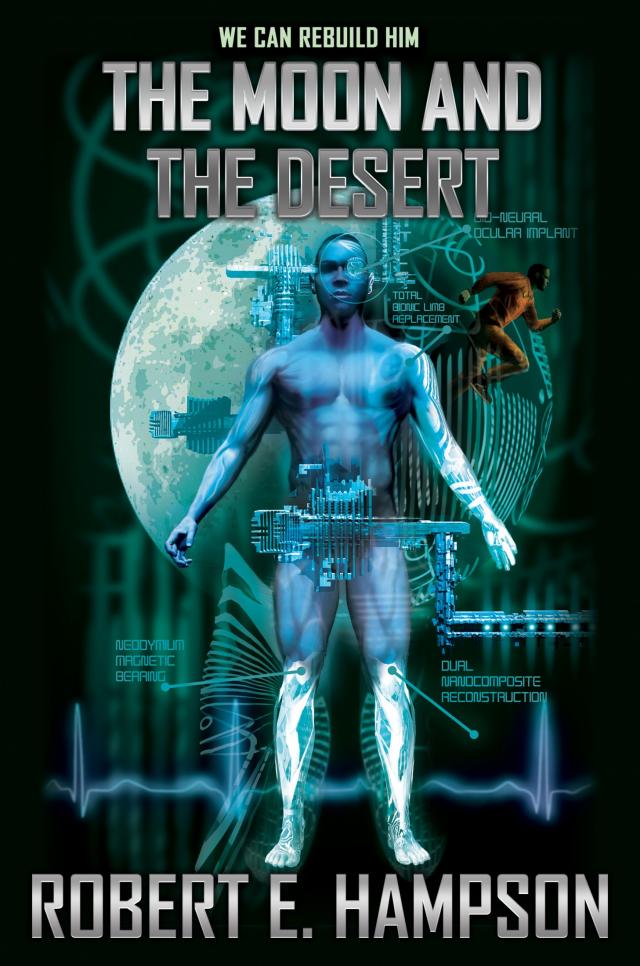


“Clearly, you fixed the problems. What were they?”
“You had cells growing between the electrode and retina, and pressure on the cochlear nerve. We fixed that without having to do much surgery. The rest of the time was just making sure the electronics were okay.”
Glenn looked up at Marty and smiled—something that had been rare these past few weeks. “So, now the rest of me works. What’s going to keep it from happening again, though?”
Marty sighed. “Well, actually, it’s my fault. The membrane in your eye grew because I waited too long to let you try to use vision. The hearing issue was from not looking at the whole pathway; we found the remains of a clot and were able to remove it. I can’t guarantee that you won’t have more problems, but I can guarantee that it won’t take so long to find the problem as long as you are using sight and sound every day.”
Marty sat in silence for a moment, and Glenn began to worry that there was bad news his doctor was reluctant to share. “Spit it out, Marty. You’ve got bad news. It can’t be too bad because you fixed everything else.”
“It’s not bad—not to me, and not for you. It’s more a matter of it being in your medical record.”
“What’s so bad about something in my record. Space Force retired me, so it’s not like they’re recertifying me as a pilot.”
“It’s more complicated.” Marty paused then blurted out the next bit, “You have a cooling problem, so we put in an Ell-Vad.”
“As in L-V-A-D? A Left Ventricular Assist Device? I have an artificial heart pump?”
“Not so much for your heart. The bionics generate heat. Your body has plenty of ways to get rid of waste heat, as do the arm and leg components, but where any of that is in contact with your biology, you pick up additional heat. The solution is to boost blood and lymph circulation. We used an LVAD pump, but it’s not supporting the left ventricle of your heart, it’s lower down and connected to the lymph circulation.”
“But . . . my medical record now shows that I have what amounts to an artificial heart.”
“Right. Air Force and Space Force fitness regulations have been pretty lenient with respect to artificial limbs, but heart surgery? Even something as benign as boosting lymph circulation could block your flight status.”
“Oh, hell, Marty. I’m half machine as it is, and they already retired me. We’ll just have to cross that bridge when we come to it. We could even argue that the LVAD improves my gee-tolerance!”
“That’s true, I hadn’t thought of it that way. Alright, then.” Marty got up and headed for the door, then turned with a sly smile. “Get some rest and sleep off the anesthetics. Tomorrow we have to go over the radio, recording and remote systems.”
“What are you doing, trying to turn me into some sort of spy?”
“No, not at all, but we still want to get you back into space, LVAD or not. These functions are specifically for that purpose.”
“As you just said, presuming they let me go.”
“They will. You and I just need to make sure Command sees it. It’s time to get you out of the hospital and back to work. You’re going to be officially discharged soon. General Boatright is trying to get you attached to the civilian Space Program, and he’s arguing that you should rejoin astronaut training to show them what you can do. The question is whether you’ll go to Astronaut Basic in Houston at Johnson Space Center, or MarsX crew training in Tucson.”
“Well, okay. Just so I don’t have to go back to Spacer Basic, again.”
“What, you don’t like twenty-mile ruck marches? Didn’t you get the memo? You’re never going to have trouble with those again,” Marty laughed as he exited the room.
CHAPTER 8:
More than Human
Beth L @SpaceNewsNetwork
Hey folks, did you see this? US Space Force today announced new opportunities in physiology, pharmacology, neuroscience, rehabilitation medicine and tissue engineering. It’s for that new Office of Scientific Integration we’ve heard about.
George J @SpaceFan
@SpaceNewsNetwork, new opportunities, sure, but you realize @USSFActual still haven’t told us what happened to the astronaut injured on the Moon.
ChirpChat, May 2041
“Nik, dude, an orange track suit? What is this, the Seventies?” Glenn looked more closely at the outfit he’d just been handed. “Polyester? Damn it, it’s going to be hot. It’s May and San Antonio is already in the nineties. In Virginia we don’t do nineties until the depth of summer.”
“Hey, the orange tracksuit is traditional, and that’s the only one I could find, Shep.”
“Uh huh. Right. You have an odd taste in retro TV shows for a psychiatrist.”
“Ah, but you know it’s from an old TV show, which means you’ve seen it, too.”
“Okay, you’ve got me there. In my defense, it seemed relevant.”
“Yeah, well, you’re not him. Keep that in mind.”
“Yes, Doctor.”
Nik mimicked Glenn, “Yes, Doctor.” He continued in a normal voice, “No, I’m telling you as a friend. You can push yourself a little but don’t overdo it, smartass. Now get in there. Marty’s waiting for you and the physical terrorists have tests to run.”
For the next eight hours, the physical therapy team put Glenn on a treadmill, then an indoor track. They had him doing squats, jumps, and lunges. Following today’s physical tests of his legs, there would be additional days of testing for his arm, eye, and ear. By the end of the day, he was tired and sore.
The results were . . . interesting. There was a common misconception that fully integrated bio-electric prosthetics would convey abilities that were well above the normal human ability range. Much to his chagrin, Glenn had even believed it, but the results showed that he was not a superhuman—although his abilities were considerably improved from the average human.
For example, in 2008, and again in 2012 and 2016, Jamaican runner Usain Bolt had shocked the world with his winning times in the Olympic one-hundred- and two-hundred-meter sprints. He already held a world record in the one-hundred-meter sprint prior to his Olympic debut. In his day, he was called the “World’s Fastest Man,” with sprint speeds of over twenty-three miles per hour.
During the same time period, Oscar Pistorius reached a record speed of twenty miles per hour on spring-like “running blade” prosthetics. Glenn thought that surely, he would be able to surpass Bolt’s and Pistorius’ speeds given the nanocomposite “bones” and bioelectric “muscles” in his new legs. Hell, he might even manage sixty miles per hour, like the character from the old TV show Nik joked about. Thus, it came as quite a disappointment that Glenn’s top speed on both treadmill and open track rarely exceeded twenty-one miles per hour.
One of the testing staff was a runner and trainer who had worked with athletes competing in World Championship and Olympic trials. Keith Miller had even run in the Boston Marathon and consistently placed in the top three for his age group in other races. Now retired from competition, he consulted with runners and trainers alike. Marty had brought him in to work with his prize—and stubborn—pupil.
“You know there’s many reasons why you aren’t going to beat record sprint times, right?” Keith was massaging Glenn’s upper thighs to help prevent cramps from the rigorous testing. “You aren’t starting from the ‘spring’ starting position that gives a runner that extra burst of distance, you haven’t been training for this, and frankly, you don’t have the cardiovascular conditioning that allows you to focus all of your energy into the sprint.”
“Yeah, I get that,” Glenn grunted as Keith dug a thumb into a particularly tight spot on the iliotibial band. “It’s just that my legs don’t rely on blood, oxygen, glucose, or any of those cardiovascular components. For the parts that do, I’ve got a booster pump.”
“Oh, really? Well, for one, your prosthetics are still attached to flesh, blood, and bone. Your knees and lower legs are artificial, but they still have to interact with muscle at your hips. Like this one—” Keith dug his other thumb into Glenn’s hip, right between gluteus maximus and gluteus medius.
“Ow!”
Unfazed by Glenn’s reaction, Keith continued, “For another, I want you to start doing planks, and there’s a core crunch you can work on. Your abdominal muscles are important to endurance, and frankly, you’re getting a little flabby around the middle.”
“Hey!” Glenn protested as Keith slapped him lightly on the stomach with the back of a hand. “I’m not fat. The extra poundage is all machinery.”
“So you say, but there’s a fair amount of jiggle in that belly. If you’re going to go back into space, you need to tighten your core to compensate for positive and negative g-forces. It will allow you to pull more gees, especially since you don’t have all of the extra cardiovascular plumbing to worry about.”
The massage was finished, and it was time for Glenn to transfer to the “chiller” to reduce swelling in his purely biological muscles. It looked like a regular bed, but with a hard top cover that encased the whole body except for his head. While the prosthetics were rated for low temperature, the heat-absorbing clamshell would work overtime trying to chill the continually heat-producing bionics. Usually, Keith just helped him disengage the magnetic couplings in the arm and legs and lay them on a table to the side of the chiller.
Not today.
“We’re going to work on your emergency moves. Take off your left leg, and stand up. You’re going to hop over to the chiller, then seat yourself, and lay down.”
“Hop? You want me to not only balance, but hop?”
“Exactly. You never know when you might have to move yourself around with damaged bionics. Accident or on purpose, you need to be self-sufficient.”
“Um, okay.” Glenn took off his left leg and tried to stand. He had to catch himself with his hands several times, but he was finally able to keep his balance.
Keith moved up beside him. “Now, I’m going to be right here, but what I want you to do is think about a pogo stick. The co-processor for your bionics works as much on movement intention as on the movement signals from your motor cortex.”
“I got that, Torquemada, it’s a different part of the brain. Premotor cortex, Brodman’s Area 6.”
Keith grinned at the reference to history’s infamous torturer. It was a running joke between them. “Your co-processor will handle balance. Now. Hop.”
Glenn waited until he felt settled, then flexed his knee and made a small lurch forward.
Keith put an arm in front of him to stop him from toppling forward, but surprisingly, Glenn felt the artificial muscles in his ankles make the adjustments to maintain his position. He waved off the offered arm, and hopped again.
This time it was easier, and with growing confidence, he hopped the remaining three feet to the chiller table.
“Great. Good work. Tomorrow we do it again, then you’ll do the left leg, then repeat without your arm.”
“Gee thanks, Keith. You’ll make me into a one-armed hopping bandit.”
“The scourge of Dodge City, Shep.”
Once Glenn was in the chiller, Keith pulled over his tablet and began reading the results of the tests. Marty and Nik entered the room and Keith handed over the tablet to share the results with everyone. “Okay, so you aren’t the world’s fastest human on the one-hundred- and two-hundred-meter sprints,” Marty began. “You managed right around twenty point six miles per hour, which is awfully close to the record for the four-hundred-meter. The thing is, you maintained between nineteen and twenty miles per hour for almost two hours on the treadmill. Did you realize that?”
“Actually, no. Is that good?”
“It’s fantastic. World record speeds drop down to fifteen miles per hour at any distance over a mile. You ran a marathon in an hour-and-a-half, and you were fifty percent faster than record pace.”
“So, I’m a tortoise, not a hare.”
“That’s well, actually, that’s not a bad analogy,” Nik said in agreement as Marty held the tablet out for him to scroll down through the results. He looked up at Marty and nodded as he handed the tablet back.
“Keith says your cardiovascular performance was pretty good. Both leg and core muscles use a lot of oxygen and glucose during a run, but not having to completely supply your legs meant that your heart rate never exceeded one-forty beats per minute, and your blood oxygen saturation stayed around ninety-four percent. That’s without the LVAD ever kicking in. There were a few rhythm irregularities and dips in pulse-ox that could be smoothed out with it turned on continuously, so we’ll look into that. You did extremely well.”
“Yup, slow and steady wins the race.”
“Twenty miles an hour for nearly two hours isn’t slow.”
“No, but I’m not going to be outracing a speeding bullet or leaping over tall buildings.”
“Well, to start with, you look terrible in spandex, Shep. Superhero costumes are my schtick, anyway,” Nik admonished. “Still, your performance was certainly more than human.”
“More than human?” Glenn said. “I’m not sure how I feel about that. I’m still working on getting back to human.”
The following days involved tests for his arm: weight lifting ability, speed, and precision of motion. Despite being right-handed, Glenn was pleased to learn that he could now lift deadlift hundred-pound weights one handed, throw a baseball at speeds up to one hundred twenty-five miles per hour, and throw a shot-put a distance of one hundred feet with his left hand.
In the weightlifting tests, Glenn excelled at any task that emphasized leg and lower back strength such as squats, deadlifts, pulls, carries, and drags. As long as he could manage most of the effort with his artificial leg muscles, he could lift and carry near world-record weights of up to a thousand pounds. Dragging, pulling, or carrying heavy weight was all handled by his prosthetics, much like the endurance run on the first day.
More tests of arms and legs ensued. In cycling, Glenn was able to reach a top speed of nearly one hundred miles per hour, about twenty percent faster than the prior unassisted human record of eighty-three point three miles per hour. More importantly, he could maintain forty miles per hour for more than two hours, and in one test, didn’t vary by more than five percent for six hours. Those numbers were more than double the prior endurance and distance records by unaugmented humans.
Keith said it was because those efforts could be accomplished almost exclusively by the bionics with minimal involvement of mere flesh and bone. Such comments were usually followed by a physical therapy session that almost hurt worse than the physical exertion. Deep tissue massage relieved the strain and tightness around his hips and thighs, but left the muscles feeling bruised and sore. His ribs also ached, considering the amount of oxygen he’d been taking in to supply the rest of his body during the exertion.
His high jump height was more than ten feet, and his long jump over forty feet—all more than twenty-five percent better than the current world records. Keith had a particular way of digging his thumbs into the intercostal muscles that Glenn swore resulted in him levitating off the table. The therapist said it was good for him, and at least he wasn’t suffering from shin splints, plantar fasciitis, or lower back pain. In all, the patient should suck it up and remember that he volunteered for this.
Another day was devoted to sensitivity and acuity of his bionic eye and ear. The ultimate test was being placed in a lightless room configured to dampen sound and eliminate all noise. It was a huge facility the size of several large aircraft hangars and used for environmental testing. Glenn was instructed to disable his bionics, then was blindfolded, hooded, and spun repeatedly to confuse his sense of position and direction. He was then placed in the center of the room and instructed to activate his bionics and find the exit despite a complete absence of sight and sound.
To make things even more difficult, for each test, the room—and his body—were pre-conditioned to temperatures ranging from minus ten to one hundred twenty-five degrees Fahrenheit. The first time, Glenn walked out of the facility in seven and a half minutes. By the third test he was exiting in just over thirty seconds. Marty, Nik, and the testing team were quite pleased.
On the evening after the final test, Marty and Nik visited Glenn in his quarters. “One more day with us here and then transfer. The general did it; you’re headed to Houston for two weeks, and then the Mars Terrain Simulator in Hawaii,” Marty informed him.
“Well hooray for sunshine and tropical breezes.”
“You know it’s cold on top of the volcano, right?” Nik asked.
“Well, sure, but the last time I trained there I got to stay in Lahaina for a week after we came down.” MTSH utilized the ten-thousand-foot-elevation Haleakalā volcanic crater on the island of Maui to simulate the dry rocky conditions found on Mars. Additional facilities took similar advantage of other volcanic features on the big island of Hawaii, such as the Hawaiian Island Simulated Long-Orbit and Planetary Exploration habitat located inside a dormant volcanic cinder cone near the summit of Mauna Kea. The location was used to test low-pressure and arid environments, and to simulate the isolation of a long interplanetary voyage. The rocky walls and floors of the Halemaumau and Kilauea Iki craters at Hawaii Volcanos National Park were used to test all-terrain rovers, EVA suits and autonomous exploration vehicles for both lunar and Mars use.
Marty cleared his throat. “Well, don’t be expecting to do much sunbathing. The skin on your legs and arm isn’t going to match any skin color changes. The DoD isn’t going to pay for an all-new covering of SymSkyn just so you can look like a tabloid star.”
“I bet he does it, anyway,” added Nik.
Glenn just raised an eyebrow at the light-skinned surgeon and dark-skinned psychiatrist. “Well, when I stand between the two of you, we look like an ad for copier toner. If I’m two-tone, we’ll just call it a bad photo edit.”


