Siren song, p.40
Siren Song, page 40


‘You don’t have to keep on trying,’ she said. ‘Not now. I knew what I was doing. I’m sorry you feel used by me, by us, but I’m not sorry about any of the rest of it.’ She paused, thinking. ‘I wish I could have stayed by her bed, with her, a little longer, especially now, but that’s all. It might sound ridiculous to you, but I honestly think she was the only person who I ever truly loved, and who ever truly loved me in return. Listen to me. I’m thirty-nine, for Christ’s sake.’
‘It doesn’t sound ridiculous at all,’ I told her.
‘No?’ She looked at me hard.
‘No,’ I said.
‘Helen once told me that part of the resentment she bore against me was because she believed that neither my mother nor I had ever properly loved her – especially me – and that my mother had loved only me.’
‘Exactly what you felt about your mother and Helen after your mother remarried and Helen was born.’
‘I know.’
‘It was your name she wrote around the edge of the chart,’ I said.
She laughed. ‘No, it wasn’t. She told me that if the baby was a girl, then she’d call it Lulu. I could never decide whether it was her first attempt at some kind of reconciliation, or if it was just another of her sick jokes, something to go on mocking me for another thirty years into the future.’
‘I’d guess at the first,’ I said.
‘Thanks,’ she said.
We were interrupted again by Brownlow banging on the doors and by his shouting. After a moment of silence, a spray of sparks appeared between the handles as someone began using an oxyacetylene cutter. We both watched this for a moment, both of us reminded of the salvage yard and the man who had died there. Little of the heat remained concentrated on the crowbar holding the doors shut, and the flame rose and fell in a fountain of sparks with each small movement of the torch.
We both continued watching this, mesmerized by the cascade of dying lights and by the way they bounced and scattered on the roof.
Last night’s rain had fallen for less than an hour, and there were shallow puddles where it had not yet evaporated in the rising heat. The sky was again clear and cloudless, and in the short time we had been up there the haze had lifted completely from the Humber. Vessels waiting to enter the docks manoeuvred into position in the Hull Roads and in the deeper channels on the far side. The traffic on the Humber Bridge glinted and flashed as it crossed the narrow span.
I finally rose from where I sat.
She looked down at me. ‘I’m glad it’s just you,’ she said.
‘Come back down,’ I said. ‘Please.’
She shook her head. She shuffled forward until her toes were an inch beyond the edge. She closed her eyes.
‘I know what you think,’ she said, surprising me. ‘About my mother and John Maxwell. About me.’
‘What did she tell you?’
‘Nothing. Neither of us ever mentioned it. We both lived with our imperfect understanding for all those years.’
Just as Alison Brooks and John Maxwell had lived with theirs.
‘She loved him and he loved her,’ I said.
‘I know.’
She raised her arms slightly – either to steady herself against whatever up-draught rose against the building, or simply because it was what people about to throw themselves off high places to their deaths below did.
Behind us, some part of the door was finally severed, and fell to the ground.
We both turned to look at this.
When I turned back to her she was again facing me.
At the doors, someone cheered. A gap appeared and was pushed wider.
I wanted to call to Brownlow and tell him to stay where he was, but I remained silent, my eyes fixed on hers.
‘It looks as though they’re through,’ she said.
I said nothing.
She nodded once, looked quickly around her, took a single deep breath and said, ‘Goodbye.’
And because I still couldn’t answer her, I simply raised my hand to her.
She saw this and raised her own in reply.
And then she stepped forward and was gone.
There might have been a small involuntary cry as she fell, a final reaching out or pointing of her hands as though she were a diver on a board, but I could swear to neither of those things – just that one instant she was there, her hand raised briefly in farewell to me, and the next she was gone and there was only silence.
I waited where I stood, and seconds later, fourteen floors beneath me, someone screamed, and a few seconds after that the men at the door behind me stopped cutting and shouting and they too fell silent.
49
I CALLED JOHN Maxwell an hour later and told him what had happened. The first thing he said to me was that Louise Brooks was not his daughter. Despite what her mother might have told me, or what I might want to believe, she was not his.
After that, he wanted me to leave him alone so that he might go somewhere else in his empty house and grieve for Alison Brooks properly. I promised to let him know when the funeral was arranged. He thanked me and hung up.
I wondered who there was left in the world who might now console him, or if he would even thank anyone for trying. His affair with Alison Brooks had been his one shameful secret, and the guilt he felt at this had not diminished in the slightest by the loss of his own wife, whom he had loved for forty years until her own death in the same hospital.
Further enquiries were made in both Hull and Leeds concerning the disappearance of Jane Nicholson.
I called her sister in Leeds, but the woman had heard nothing. She knew of Nicholson’s death and the destruction of his home, and there was something close to both relief and satisfaction in her voice as she spoke to me. She asked me to tell her honestly if I thought her sister was still alive, and I told her I believed Jane Nicholson had been killed on the day Nicholson had arrived in Leeds pretending he wanted to take her home with him. Despite what she’d said, she was not prepared for what I told her, and she began to cry uncontrollably. She fumbled with the phone she held and then the line went dead.
I gave Brownlow my statement, starting with Alison Brooks’s first appearance at Humber Street and ending with Louise stepping silently off the hospital roof. He had tried to detain me at the hospital, but I had easily avoided him. He was suddenly out of his depth and struggling to stay afloat. I told him I hoped the oxyacetylene torch he’d used hadn’t burned all the incriminating evidence from the crowbar.
Afterwards, I went to Alison Brooks’s home and let myself in. I found the envelopes Louise had told me about and I posted them. One of them was addressed to John Maxwell, written by Alison Brooks. I’d hoped Louise might have left something for me, but there was nothing.
The bodies of Helen Brooks and the Albanian trafficker were never found. No one ever expected they would be. Fowler had seen to that all those months earlier.
In one of Louise’s letters – the one addressed to a local funeral director – she asked for a Service of Remembrance to be held for her dead sister at Victoria Pier, close to Humber Street and the marina. The funeral director called to tell me of this and I told him I’d attend.
Fowler’s death did little to delay the rebuilding and renovations he had planned. Webster offered to buy what remained of his empire and then guaranteed to the city council that everything they had planned together, he would now see to completion.
It was suggested at one of the council’s hastily arranged meetings to confirm these arrangements that one of the new courts or apartment blocks might be named in memory of Fowler. The motion was voted through unanimously.
Three days after the death of Louise Brooks, I went with Sunny, Yvonne and Irina Kapec to the airport to see off Irina and her daughter on the first part of their journey home.
I had seen Yvonne on each of the previous three days.
She had arrived at my home with a bottle of brandy less than two hours after Louise stepped off the hospital roof. We divided up and cancelled out our regrets and our apologies, and then we drank them into the past. When she told me about Irina’s imminent departure, she too cried uncontrollably. The next morning she asked me if she’d cried, and I told her she hadn’t. Good, she said, because she wasn’t one of those women who cried over things like this.
At the airport, the two women held each other and Yvonne cried again. Irina Kapec’s eight-year-old daughter stood with her arms around them both. From Humberside Airport they would fly to Amsterdam, and from there to Zagreb.
And at some point after that, Irina would be shown the bagged remains of her murdered husband and she would then be able to bury him, and for the first time in many years she would be able to think about her own life ahead.
I stood with Sunny and watched them. Irina shook my hand and kissed both my cheeks. Her daughter did the same. And as the girl stepped away from me, I hoped that they might both go back to being the people they themselves had once hoped to be.
Yvonne cried as the plane took off, and then again as she drove with Sunny and me back across the river and into the city.
Fowler and Nicholson lay in the Spring Street morgue, the inquiry into their deaths still in progress.
Another of Louise Brooks’s letters had been addressed to the Hull police. It was a thick envelope, containing a detailed account of everything she’d done, and why. At the end of it she asked that her own body be released and buried alongside that of her mother. The same funeral director had already been sent instructions.
Alison and Louise Brooks were buried together at the end of August in the Western Cemetery. Their graves lay side by side, their headstones simple and identical. I laid flowers on each grave.
As promised, I told John Maxwell about the ceremony, but he didn’t attend.
Brownlow was there, still angry that Louise had evaded him. He asked me where I thought Marco might now have gone to ground, and I told him that I thought Marco was already dead, that he’d been killed and disposed of shortly after Nicholson had been killed. Marco believed Fowler had killed Nicholson, and Fowler thought Marco had done it, and couldn’t afford to have him reappear in the future pointing his finger. Brownlow told me I was wrong. I told him to believe what he wanted.
Four days after the joint burial, Laura Lei called and told me she’d destroyed the model of Helen Brooks. She was leaving Hull and going to live in London. She’d been offered a job at an advertising agency, and she sounded excited and happy.
I told her about the memorial service being held for Helen a week later.
‘I’ll be gone by then,’ she said.
She told me that when she’d been a baby, her family’s name for her had been ‘Li-Li’, and that Helen Brooks had known this and had sometimes called her by the name when they were drunk or stoned together. I asked her if she thought this was why Helen had decided to call her own child Lulu.
‘It’s what she once told me,’ she said, hesitating.
‘But?’ I said.
‘But she lied a lot,’ she said.
We both laughed.
She told me the ashes of the model, including the pregnancy-testing kits, lay in a mound in the small rear garden at Park Grove. They’d had a party around the fire in celebration of Helen, she said.
I told her it sounded more appropriate than the memorial service her sister had planned.
‘It was,’ she said, and hung up.
THE END
About the Author
©Jerry Bauer
Robert Edric was born in 1956. His novels include Winter Garden (1985 James Tait Black Prize winner), A New Ice Age (1986 runner-up for the Guardian Fiction Prize), A Lunar Eclipse, The Earth Made of Glass, Elysium, In Desolate Heaven, The Sword Cabinet, The Book of the Heathen (shortlisted for the 2001 WH Smith Literary Award), Peacetime (longlisted for the Booker Prize 2002) and Cradle Song, the first book in the Song Cycle Trilogy. Siren Song is the second book in the trilogy, the final book, Swan Song, is now available from Doubleday.
Also by Robert Edric
WINTER GARDEN
A NEW ICE AGE
A LUNAR ECLIPSE
IN THE DAYS OF THE AMERICAN MUSEUM
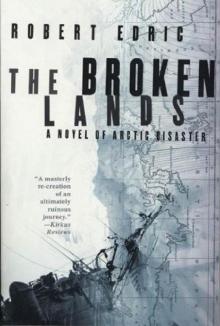
THE BROKEN LANDS
HALLOWED GROUND
THE EARTH MADE OF GLASS
ELYSIUM
IN DESOLATE HEAVEN
THE SWORD CABINET
THE BOOK OF THE HEATHEN
PEACETIME
CRADLE SONG
TRANSWORLD PUBLISHERS
61-63 Uxbridge Road, London, W5 5SA
transworldbooks.co.uk
Transworld is part of the Penguin Random House group of companies
whose addresses can be found at: www.randomhouse.co.uk/offices.htm
Originally published in Great Britain by Doubleday,
a division of Transworld Publishers
Black Swan edition published 2005
Copyright © Robert Edric 2004
The right of Robert Edric to be identified as the author of this work has been asserted in accordance with sections 77 and 78 of the Copyright Designs and Patents Act 1988.
All the characters in this book are fictitious, and any resemblance to actual persons, living or dead, is purely coincidental.
Version 1.0, Epub ISBN: 9781407038872
A BLACK SWAN BOOK : 9780552771436
This ebook is copyright material and must not be copied, reproduced, transferred, distributed, leased, licensed or publicly performed or used in any way except as specifically permitted in writing by the publishers, as allowed under the terms and conditions under which it was purchased or as strictly permitted by applicable copyright law. Any unauthorised distribution or use of this text may be a direct infringement of the author’s and publisher’s rights and those responsible may be liable in law accordingly.
1 3 5 7 9 10 8 6 4 2
Robert Edric, Siren Song