

Long time coming retai.., p.1
Long Time Coming - Retail, page 1
part #18 of Robert Goddard Series
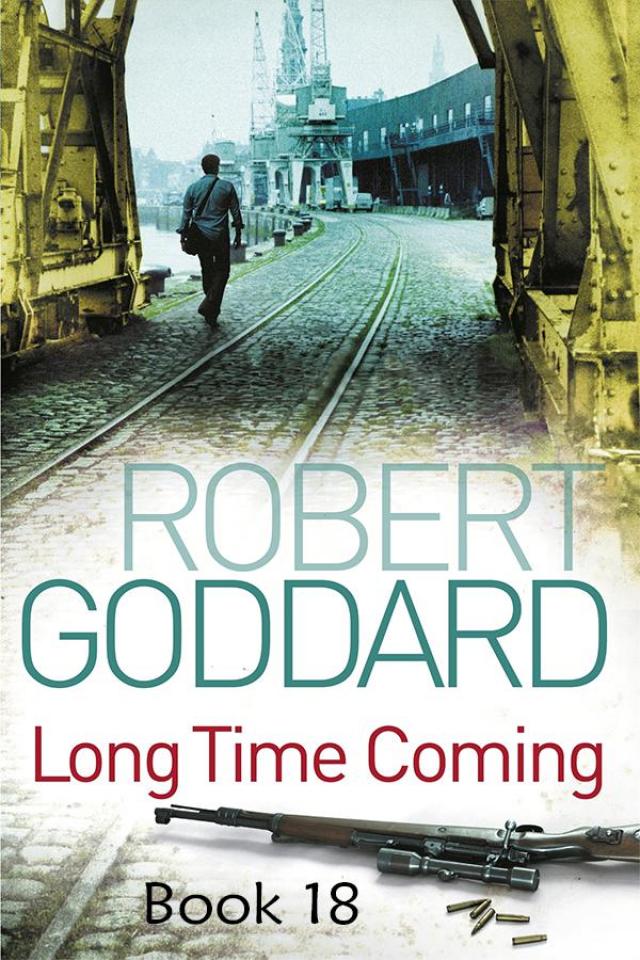


Long Time Coming
Robert Goddard
Published: 2011
Tags: Historical Mystery, Early 20th Century, 1940s
Historical Mysteryttt Early 20th Centuryttt 1940sttt
* * *
SUMMARY:
Eldritch Swan is a dead man. Or at least that is what his nephew Stephen has always been told. Until one day Eldritch walks back into his life after 36 years in an Irish prison. He wont reveal any of the details of his incarceration, insisting only that he is innocent of any crime.His return should be of interest to no-one. But the visit of a solicitor with a mysterious request will take Eldritch and his sceptical nephew fromsleepy seaside Paignton to London, where an exhibition of Picasso paintings from the prestigious Brownlow collection proves to be the starting point on a journey that will transport them back to the Second World War and the mystery behind Eldritchs imprisonment.In 1940, he was personal assistant to a wealthy diamond dealer in Antwerp, whose collection of modern art was the envy of many. The subsequent disappearance of those paintings began a trail of murder and intrigue which was to have a catastrophic effect on Eldritchs life. But untangling the web of murky secrets, family ties and old betrayals that conceals the truth will prove to be a dangerous pursuit for Eldritch and Stephen. Before long, a mysterious enemy is doing everything possible to stop the truth emerging at whatever cost
LONG TIME
COMING
Robert Goddard
Contents
Cover
Title
Copyright
By the Same Author
1976
Chapter One
Chapter Two
Chapter Three
Chapter Four
1940
Chapter Five
Chapter Six
Chapter Seven
Chapter Eight
1976
Chapter Nine
1940
Chapter Ten
1976
Chapter Eleven
Chapter Twelve
1940
Chapter Thirteen
Chapter Fourteen
1976
Chapter Fifteen
Chapter Sixteen
1940
Chapter Seventeen
Chapter Eighteen
1976
Chapter Nineteen
Chapter Twenty
Chapter Twenty-One
1940
Chapter Twenty-Two
Chapter Twenty-Three
1976
Chapter Twenty-Four
Chapter Twenty-Five
1940
Chapter Twenty-Six
Chapter Twenty-Seven
1976
Chapter Twenty-Eight
Chapter Twenty-Nine
Chapter Thirty
Chapter Thirty-One
Chapter Thirty-Two
1940
Chapter Thirty-Three
1976
Chapter Thirty-Four
Chapter Thirty-Five
Chapter Thirty-Six
1940
Chapter Thirty-Seven
1976
Chapter Thirty-Eight
Chapter Thirty-Nine
1940
Chapter Forty
1976
Chapter Forty-One
Chapter Forty-Two
Chapter Forty-Three
1922
Chapter Forty-Four
2008
Chapter Forty-Five
Author’s Note
This eBook is copyright material and must not be copied, reproduced, transferred, distributed, leased, licensed or publicly performed or used in any way except as specifically permitted in writing by the publishers, as allowed under the terms and conditions under which it was purchased or as strictly permitted by applicable copyright law. Any unauthorised distribution or use of this text may be a direct infringement of the author’s and publisher’s rights and those responsible may be liable in law accordingly.
Version 1.0
Epub ISBN 9781407067759
www.randomhouse.co.uk
TRANSWORLD PUBLISHERS
61–63 Uxbridge Road, London W5 5SA
A Random House Group Company
www.rbooks.co.uk
First published in Great Britain in 2010 by Bantam Press an imprint of Transworld Publishers
Copyright © Robert and Vaunda Goddard 2010
Robert Goddard has asserted his right under the Copyright, Designs and Patents Act 1988 to be identified as the author of this work.
This book is a work of fiction and, except in the case of historical fact, any resemblance to actual persons, living or dead, is purely coincidental.
A CIP catalogue record for this book is available from the British Library.
ISBN 9780593060254 (cased) 9780593060261 (tpb)
This book is sold subject to the condition that it shall not, by way of trade or otherwise, be lent, resold, hired out, or otherwise circulated without the publisher’s prior consent in any form of binding or cover other than that in which it is published and without a similar condition, including this condition, being imposed on the subsequent purchaser.
Addresses for Random House Group Ltd companies outside the UK can be found at: www.randomhouse.co.uk The Random House Group Ltd Reg. No. 954009
The Random House Group Limited supports The Forest Stewardship Council (FSC), the leading international forest-certification organization. All our titles that are printed on Greenpeace-approved FSC-certified paper carry the FSC logo. Our paper procurement policy can be found at www.rbooks.co.uk/environment
Typeset in 11/14pt Times New Roman by Falcon Oast Graphic Art Ltd.
Printed and bound in Great Britain by Clays Ltd, Bungay, Suffolk
2 4 6 8 10 9 7 5 3 1
By the same author
Past Caring
In Pale Battalions
Painting the Darkness
Into the Blue
Take No Farewell
Hand in Glove
Closed Circle
Borrowed Time
Out of the Sun
Beyond Recall
Caught in the Light
Set in Stone
Sea Change
Dying to Tell
Days without Number
Play to the End
Sight Unseen
Never Go Back
Name to a Face
Found Wanting
1976
ONE
My mother surprised me when she announced that my uncle was staying with her. It was the first of many surprises that were shortly to come my way. But of all of them it was probably the biggest. Because I’d only ever had one uncle. And I’d always been told he’d died in the Blitz.
I’d phoned her from Heathrow, to give her an idea of when I’d be arriving. I didn’t have the change for a long call. ‘We’ll have to make this quick,’ I said. Maybe that was what prompted her to spring it on me. We’d spoken a couple of times over the previous week, while I was still in Houston. She’d said nothing about Uncle Eldritch then. Maybe her nerve had failed her. Maybe she’d doubted if I really was abandoning what she regarded as my glamorous existence in Texas. If not, I could be spared the revelation, at least for a while, that the old man wasn’t dead after all. But I’d gone ahead and left. So now I had to be told. And the lack of immediate opportunity for cross-questioning was a bonus.
‘I ought to have mentioned it sooner, dear. You uncle’s come to stay.’
‘My uncle?’
‘Eldritch. Your father’s elder brother.’
‘But … he’s dead.’
‘No, dear. That’s what your father always insisted we should pretend. But Eldritch is very much alive.’
‘How can he be? Where the hell’s he been all my life?’
‘In prison. In Ireland.’
‘What?’
‘I’ll explain when you get here.’
‘Hold on.’ But already I was talking over the pips. ‘Let’s just—’
‘See you soon, dear,’ my mother shouted. And then she put the phone down.
Perhaps I should have been grateful. But for Mum’s bombshell, I’d probably have spent the journey down to Paignton, as I had the overnight flight from Houston, wondering just how I’d allowed a disagreement with the corporate finance director at Sanderstead Oil to become a resigning issue, with disastrous consequences for my engagement to his daughter. Because I’d wanted to would have been the honest answer. Because the job and the engagement were both too good to be true and I was young enough to find worthier versions of both. But naturally I had my doubts about that. Part of me was gung-ho and optimistic. Another part reckoned I’d been a damn fool.
I was pretty confident, nonetheless, that I’d be able to get back into the oil business whenever I chose. With the North Sea fields coming on-stream, there were plenty of openings for a geologist with my qualifications. First, though, I planned to spend a few weeks in Paignton, unwinding and taking stock. I hadn’t seen as much of my mother as I should have in the two years since my father’s death. The guesthouse kept her busy, at least in summer, but I wanted to reassure myself that she was coping as well as she claimed.
After the news of my uncle, all such thoughts went out of my head, of course. My mother’s matter-of-fact tone couldn’t disguise the enormity of what she’d actually said. Eldritch Swan of the exotic Christian name and raffish reputation had not been among the thousands of Londoners killed by the Luftwaff e in 1940. His death was a lie. And it soon occurred to me that his life might be a lie too. Nothing I’d been told about him accounted for several decades of imprisonment in Ireland. Evidently my father had decided I was better off not knowing the truth about his brother.
Or maybe he’d decided he was better off by my not knowing. A dead relative is more socially acceptable than an imprisoned one. I might have shot my mouth off to the neighbours about dear old banged-up Uncle Eldritch. And that would never have done. Grandad might have insisted on blanking his son out of the family, of course. That was a distinct possibility. But he’d been dead for more than twenty years. And the record had never been set straight. Until now.
My paternal grandfather, George Swan, was an engineer who rose to the higher echelons of management with the East African Railways and Harbours Administration, first in Kenya, then Tanganyika. His eldest son was christened Eldritch on account of his mother’s maiden name. His second son, my father, received the more conventional Neville as his label in life. The difference turned out to be prophetic, since Eldritch ‘racketed around Europe’, according to Dad, until the outbreak of war forced him to return to his homeland, only for a German bomb to score a direct hit on the Mayfair gambling den where he happened to be hunched over the baccarat table one night in the autumn of 1940. Meanwhile, my father, favoured, he’d often point out, with a less expensive education than his brother, worked for a shipping agent in Dar-es-Salaam and fought for his country with the Eighth Army in north Africa and Italy. At the end of the war, he transferred to the agent’s London office, where my mother was working as a typist. Courtship, marriage, parenthood and suburbia duly followed.
My earliest memories are of our house in Stoneleigh. It backed on to the railway line and on fine mornings Mum would take me into the garden after Dad had left for the station so we could wave to him as the Waterloo train rumbled past. The scene changed for good when Grandma and Grandad died within a few months of each other the summer I was eight. Dad inherited what he’d never describe more specifically than ‘a tidy sum’. It was enough for him to quit the shipping business and buy a guesthouse in Paignton, the seaside resort where we’d spent several summer holidays. He needed a lot of persuading by Mum to take the plunge, though. She was always the more enterprising of the two. My father was a cautious man, fretful with the slightest encouragement. But deceitful? I’d never have said so. Until now.
Paignton was a wonderful place to be a child. Zanzibar, as Dad named the guesthouse, was only a few minutes from the beach. Sun, sea and sand were my summer-long companions. The sideshows on the pier; travelling fairs on the green; open-top bus rides to Torquay; rock-pooling at low tide: the real winner from the move to Devon was me.
Ordinarily, I’d have needed to fix that thought firmly in my mind when I got off the train in the middle of a chill grey March afternoon. Torbay Road, running between the station and the Esplanade, is a depressing drag to the adult eye of bucket-and-spade shops and slot-machine joints. A walk along it, rucksack on back, suitcase in hand, had promised to test my spirits. Never were the oily charms of Houston likely to seem more bountiful.
As it was, though, I barely noticed my surroundings as I made my way towards the seafront. A dead uncle was waiting for me at Zanzibar. And a mother with a lot of explaining to do.
Zanzibar started life as one of a terrace of Victorian houses in a cul-de-sac off the Esplanade. Like most of its neighbours, it subsequently acquired the standard trappings of the local tourist trade: dormer window in the roof, striped awnings over the other windows and porch, palm tree out front (supplemented in the season with pot plants and hanging baskets), AA and other accreditations prominently displayed, illuminated vacancies sign suspended in the ground-floor bay. It had been my home from the age of eight to eighteen and in many ways still was. It was stuffed full of memories. It held a part of me, however far or long I strayed.
The awnings were currently retracted. The palm wore a weather-beaten look. And the fully lit NO VACANCIES did not signal brisk business. But it did have one guest, of course – one very special guest. Unless you regarded him as a member of the family, which I wasn’t sure I did.
My mother must have been looking out for me. The front door opened as I approached and she appeared, pinnied and permed as ever, smiling her wide, toothy smile at the sight of her only child. ‘There you are, dear,’ she called. ‘Come along in.’
We hugged in the hallway, the lingering fragrance of her lily-of-the-valley soap summoning the past with instant ease. How had the journey been? Was I hungry? What could she get me? It was the usual home-coming litany, recited with no reference to the news she’d broken over the phone. I opted for tea and a slice of Dundee cake and followed her into the kitchen, which Bramble, the waste-of-space cat she’d acquired since my father’s death, vacated as we entered, with the hint of a glare in my direction.
‘Where is he, then?’ I asked as she switched the kettle on, sensing she might launch blithely off into a series of questions about my career and the former fiancée she’d never met (and now never would) if I didn’t set the agenda.
‘You mean Eldritch?’
‘No, Mum. I mean the other ex-con you’ve taken in.’
‘There’s no need to be sarcastic.’ She spooned tea into the pot. ‘And don’t call him an ex-con.’
‘But that’s what he is, isn’t it?’
‘He’s not here at the moment. He goes to Torquay most days. I think he finds it more … sophisticated … than Paignton.’
‘I suppose he has a lot of sophistication to catch up on.’
Mum sighed. ‘I’m sorry it had to come out of the blue, Stephen. I really am. It’s not my fault. Your father was adamant. So was your grandfather. They were ashamed of Eldritch. And what was I to do? I’d never even met him. I had no idea what it was all about.’ The kettle had come to the boil as she spoke. She poured water into the teapot and rattled the lid back into place. ‘They said he’d never be let out. So, it was better to pretend he was dead.’
‘But now he has been let out. Unless you’re going to tell me he’s on the run.’
‘Don’t be ridiculous, dear. He’s an old man.’
‘How did he wind up here?’
‘He had nowhere else to go. I wrote to the Irish Prison Service when your father passed away, asking them to let Eldritch know. That’s how he was able to contact me. He wrote just before Christmas, saying they were going to release him and could he come and stay here until he’d found his feet. Well, I couldn’t turn him down, could I?’
‘That depends.’
‘What on?’
‘What he was in for, to start with.’
‘Well, I really don’t know.’ She spoke airily, as if the nature of Eldritch’s offence was a trivial matter. But I’d mulled it over on the train and couldn’t see him serving such a long stretch for anything short of murder. ‘Your father never said. I’m not sure he knew either.’
‘He must have done.’
‘You’d think so, I agree. But …’
‘But what, Mum? Tell me you’re sure you haven’t got a mass murderer living under the same roof.’
‘Oh, he didn’t murder anyone, dear. I can set your mind at rest on that. Now, cut yourself a slice of cake and bring it into the sitting-room.’ And at that she set off with the tea tray.
The gas fire was wheezing into action when I caught up with her, the tea already poured. I took a sip and swallowed a mouthful of cake.
‘What kind of food do they have in Texas, dear?’ Mum casually enquired as she stroked Bramble, who’d plonked himself on the sofa and showed no sign of moving on this time.
‘Don’t try to change the subject, Mum. How do you know Eldritch didn’t murder anyone?’
‘He told me so.’
‘Just like that?’
‘Well, he obviously thought I might worry about it, so he made the point in his letter. “I didn’t kill or injure anyone.” His exact words. You can read the letter if you want. I kept it.’
‘I’d like to see it, yes. But how can you be sure he’s telling the truth, since apparently he didn’t go on to say what he had done?’
‘Well, they censor prisoners’ correspondence, don’t they? They wouldn’t have let him lie to me.’
My mother knew as much as I did about the Irish Prison Service’s censorship policy, of course: precisely nothing. But there was nothing to be gained by pointing that out. I tried an appeal to reason. ‘Doesn’t it seem odd to you that he won’t say what he did to land himself behind bars for … however many years it was?’


