

The throne of darkness, p.1
The Throne of Darkness, page 1
part #4 of The Counterfeit Sorcerer Series
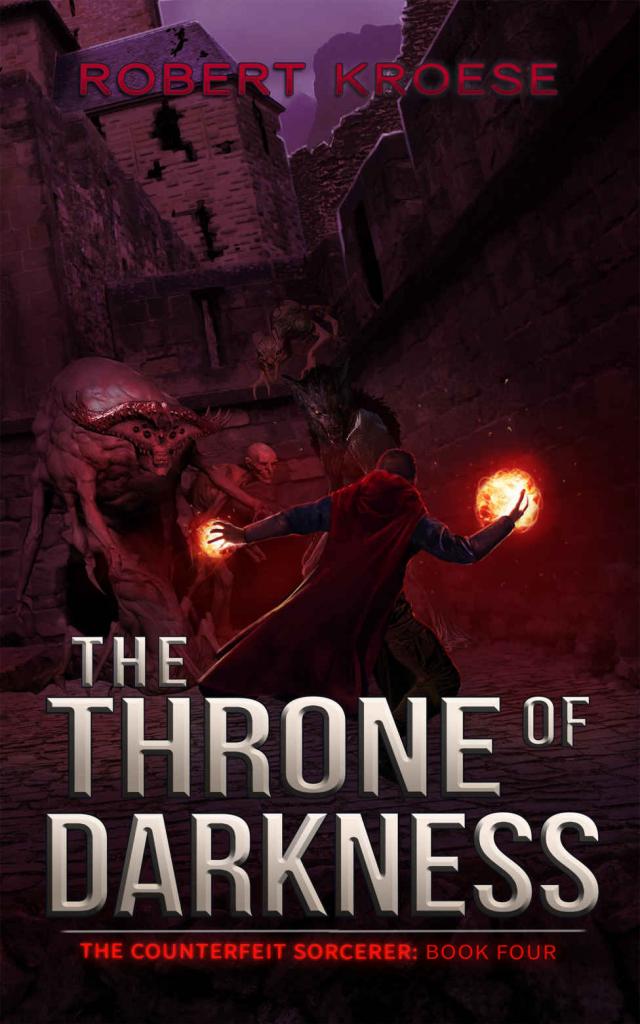


THE THRONE
OF DARKNESS
BOOK FOUR OF THE
COUNTERFEIT SORCERER
A Novel by Robert Kroese
Copyright ©2019 Robert Kroese. All rights reserved. No portion of this book may be reproduced, stored in a retrieval system, or transmitted in any form or by any means—electronic, mechanical, photocopy, recording or other—except for brief quotations in reviews, without the prior permission of the author.
Prologue
The woman ran across a carpet of pine needles, skirt hitched up above her knees, her closely cropped hair whipping about in the wind. A full moon guided her steps. Her heart pounded from exertion but not from fear—although she had much to fear. The woman’s name was Turelem.
She had led her people across the sea and over a hundred miles of wilderness to this place so that they could be safe, and now those people hunted her. Not all of them, to be sure. Some remained true to her, remembering her leadership and trusting her vision. But they were too few and too fearful of the mob to save her—the mob that now chased Turelem through the pine forest south of Telepules.
Turelem was no longer young, but she could escape the mob if she wished to. She might trade on her knowledge of herbs and medicine to convince one of the nomadic tribes to the south to take her in. Or she might flee with those who remained true to her and start another settlement, perhaps a hundred miles farther north along the Zold. But she would pursue neither of those options. Telepules had been her creation, her vision. A place where those who aspired to live a life of purity could thrive without fear of persecution. If she had failed, she would accept her fate.
So she led the mob not to the southeast toward the people called Torzseki, but due south, toward a bend in the Zold. She would not give her people the option of exiling her. Being driven from Telepules meant her death, and she wanted the mob to know it.
By the time she emerged from the pines, she had begun to flag, and she reached the bluff only a few seconds ahead of her pursuers. A few of them held torches, although these were hardly necessary in the moonlight. There was a moment of indecision as the three men in the lead left the trees and stood, bathed in the light of the moon, realizing their quarry was cornered. Turelem stepped to the edge of the bluff and turned to face the mob. From far below, Turelem heard the rushing of the Zold. The three men traded glances and she thought she sensed a hint of shared regret, a recognition of what they had been reduced to. Bron the blacksmith, Thalm the brewer, and Debrusk the farmer. Perhaps if it had been just the three of them, she might have appealed to their sympathy or their reason. But then two dozen others poured out of the woods behind them, and the moment was gone. There was no individual will to appeal to anymore; only the mob.
“Begone, Turelem!” Debrusk shouted. “You’ve been a blight on our home long enough!” Others shouted their assent. The mob was some thirty strong, at least a third of them women.
“What sin have I committed in your eyes?” Turelem demanded.
“Listen, friends,” jeered one of the women. “Now she wants a trial!”
Turelem clenched her jaw, remaining defiant but silently acknowledging the point. She could have resolved this situation earlier by submitting to justice, but she had insisted that as the founder of Telepules, she was not subject to trial by jury. That, she knew, had left the people with few options. Had she been too stubborn? Perhaps. If she had been accused of some crime against the faith or the people, she might have stepped down and trusted them to select a worthy replacement. But what they had been accused of was essentially adhering too strictly to the original precepts of their movement. Ceding to their demands meant abandoning their founding ideals.
Her predicament, she had reflected on numerous occasions, was ironic: in her homeland, idiosyncratic women were sometimes accused of using magic and persecuted as witches. Her supposed crime was the opposite: she had forbidden any involvement by her people in magic.
Many of the settlers had been disgruntled before the current troubles, of course: life in this untamed land was harder than they had anticipated. But the real problems began when the sorcerer, Bolond, appeared. She did not know where Bolond had come from, but he had impressed the settlers with various illusions and other tricks and then announced his intention to build a temple that would act as a gateway between this world and another. Bolond told wondrous stories of this other world, claiming that the union of the two worlds would lead to prosperity and wealth for the people of Telepules. He promised good wages to anyone willing to help build the temple.
Many of the settlers, who had spent several years eking out a meager existence, were tempted by this new prospect. Some even suggested that the promised bounty was a divine reward for their hard work and perseverance.
Turelem considered Bolond’s offer and rejected it. Even if everything he said about the riches of this other world was true—which she doubted—she had brought her people here to be free of worldly influences, not to establish a nexus of trade. Where many saw a reward, she saw a test.
Bolond seemed to accept her rejection gracefully, but over the next several weeks he continued to visit Telepules frequently, often using his magic to assist the settlers in various mundane tasks. Turelem suspected that Bolond was trying to turn the people against her, and she ultimately decreed that he was to be barred from Telepules in perpetuity. She went so far as to forbid the use of magic, in case Bolond had taught some of his tricks to some of the settlers.
But by this time, it was too late; the seed had been planted. The following winter was exceptionally harsh, and the people began to grumble that only Bolond could save them from starving to death in the spring. Owing to Turelem’s proscription, Bolond had not been seen since the previous summer, but some began to whisper that he might return to save them if Turelem were dealt with. Whispers turned to grumbles, and grumbles turned to secret meetings, and now here they were, an angry mob having driven her to a bluff two hundred feet above the frigid waters of the Zold.
“We only want to live,” Bron pleaded.
“As do I,” replied Turelem.
“Then leave us!” cried Bron’s wife, Sarai, from somewhere behind him. “Can’t you see your leadership has failed? Go make your home among the Torzseki!”
“Throw her in the Zold!” a man growled. “Let’s be done with this.” Several grumbled in agreement.
Bron stepped forward. “Come, Turelem,” he said, holding out his hand. “Submit to a trial. I’ll see that you’re treated fairly.” But the hisses and shouts from behind him belied this claim. “It’s too late for that!” someone shouted. “Throw her in the Zold!”
Turelem knew that those in the crowd spoke the truth. It was too late for a trial. She would not allow herself to be exiled, and they could not afford to keep her imprisoned when food was so scarce. Besides, as long as she was alive, Bolond would not return.
As the mob grew more agitated, Bron took another step forward. If he came any closer, he might be able to grab her before she could step off the bluff. She shook her head. “Stay back, Bron.” He regarded her silently. Turelem knew she would die tonight, but she didn’t want Bron to be the one to force her to step off the bluff.
The mob pressed forward around him. Bron was a big, burly man, but even he could not stand against that mob. And Turelem knew in her heart that he would not, in any case. He felt sorry for her, but he was as dedicated to their mission as any of them. He had three young children, one of whom was sick with a terrible fever. They had prayed for a miracle, but it had not come. If there was a possibility Bolond might return to save his son, he would not let Turelem stand in the way. The settlers continued to shout and jeer, and Bron cast his eyes to the ground. Turelem turned away, closed her eyes, and stepped off the bluff.
Chapter One
I had been imprisoned in the small cell with walls made of blocks of salt for three days when Katalinn, the new Reverend Mother of the Cult of Turelem, came to see me.
She was accompanied by two male guards, as she had been the last time I had seen her, but they seemed less on edge this time. They knew it was not only the walls of salt that kept me imprisoned below Regi Otthon: I would not attempt to escape as long as Ilona’s life remained in the hands of the Cult.
I had brought Ilona here, hoping the Cult could heal her of the wounds inflicted by Eben the warlock. I assumed that she remained alive, somewhere in Regi Otthon, but for the past three days I had been told nothing of her condition. I had little choice but to be on my best behavior and hope that the acolytes would use their power to heal her broken bones and hemorrhages.
So far, I had managed to convince the Reverend Mother to let me live, and that had been no small feat. During my previous visit to Regi Otthon, I had killed a member of the Council and probably a dozen men-at-arms, destroyed a large section of the building, and in the process allowed their greatest enemy, the sorcerer Bolond, to escape from captivity. To say that I was not popular among the leadership of the Cult would be a significant understatement.
On the other hand, the new Reverend Mother struck me as the shrewd type, unlikely to have me murdered out of anger or vengeance. The Cult did not take killing lightly, and they would want to keep me alive in case I might still prove useful against Bolond. My greater fear was that I would once again be thrown into the terrible dungeon called Nincs Varazslat, where I had already spent six years of my life.
But hope kindled inside me when the Reverend Mother entered my cell. She would not have come persona
“To be clear,” I said when she had finished telling me of the reports that had reached her, “you want my help in vanquishing a ghost?”
“The word ghost implies the presence of a spirit of a deceased person,” the Reverend Mother said. “Please use the word apparition.”
“And these apparitions have been seen at a bluff overlooking the Zold?”
“Turelem’s Bluff, yes. There is a shrine there that is visited by many pilgrims. The past two nights, a ghost-like figure has been seen walking to the edge of the bluff and then leaping into the river. We have received several independent reports.”
“An apparition of Turelem,” I said, unable to completely keep the amusement out of my voice.
“I will warn you not to blaspheme,” the Reverend Mother said coldly. “Turelem is not dead, and she would not cause her spirit to manifest in this way.”
“I understood that she was thrown into the Zold.”
“And three days later was miraculously resurrected. She spent a year among her people, planting the seeds of the Cult. When her work was finished, she crossed the Zold and went west to establish a new domain at the far end of the world, where she reigns eternally.”
“Perhaps her gho—apparition has come to tell you that it’s time for you to travel west.”
“No. I will forgive your ignorance because you are not familiar with the higher teachings of the Cult, but what you suggest is blasphemy. Only a very few are called to travel west, and those that do never return. The rest of us—even those as high in the Cult hierarchy as myself—must wait for death before we see the new domain.”
“Yes, well,” I started uncertainly, glancing at the men standing just inside the cell door. “Prohibitions on blasphemy are all well and good, but you have come seeking my expertise as a sorcerer, have you not?”
“The apparitions are presumably manifestations of some sort of magic. Although I find the matter distasteful, sometimes one cannot catch a rat without getting her hands dirty. I am not asking you to perform magic, but only to advise me in how this trick can be exposed for what it is.”
“And you think you know what it is?”
“I know what it is not.”
“I have read a few things about Turelem myself, in a book I found in the tunnels beneath Nagyvaros.”
The Reverend Mother regarded me sternly for a moment, then turned to the men standing behind her. “You are dismissed.”
“But Your Holiness,” said the man on the right. “The prisoner—”
“The prisoner is no threat as long as his friend depends on us for her care. Go!”
The men bowed and left the room, closing the door behind them.
“You speak of the Book of the Dead,” the Reverend Mother said to me.
“What do you know of it?”
“I have heard rumors. Some say it is Bolond’s writings on necromancy. You have seen it?”
“I have. Turelem features prominently in it.”
“More blasphemy.”
“Then you do not believe Bolond raised Turelem with his magic?”
“Certainly not!”
“Then how do you explain the book?”
“Do I have to explain it? Perhaps the woman depicted in the book was not Turelem. Perhaps the book is a recent forgery, created by some enemy of the Cult. Perhaps Bolond wrote it with the intent of discrediting the Cult, and it was lost until you retrieved it. I do not claim omniscience. What I do know is that such a book is dangerous, and it should be destroyed. Where is it now?”
“It is back in the hands of Bolond, who does not need it. If it is any reassurance to you, I think he is occupied with other projects at present.”
“The rebuilding of the Temple of Romok.”
“Yes. If I were you, I would be more concerned about that than reports of apparitions along the Zold. This is what I was trying to tell you when I arrived here three days ago. When the Temple of Romok is complete, it will open a gateway between Orszag and another world, called Veszedelem. Veszedelem is a bleak, dismal place, and the gateway will cause the vitality to drain from Orszag until it is much like Veszedelem. Bolond intends to unite all the worlds into one, and to rule over the unified kingdom. At that point your little Cult will be little more than an annoyance to him. He will crush you as an afterthought. And that is not the worst of it. A demon called Arnyek intends to destroy our world and every other world along with it, and I believe that the rebuilding of the temple will only facilitate his plans. Bolond believes he can stop Arnyek, but I think we know better than to rely on Bolond’s judgment.”
“And what would you have me do about all of this?”
“The Cult has given its tacit approval to the rebuilding of the Temple of Romok in the Maganyos Valley. You must withdraw your approval and denounce the project.”
“To what end? Bolond and his Torzseki henchmen already hold the valley. The Cult’s power is largely symbolic. We command only enough men-at-arms to defend Delivaros. If we had acted decisively when Eben first came to us, we might have exerted enough pressure on the local counts to forestall the project, but now it is too late. Besides, if we were to denounce Bolond now, he would see that the Book of the Dead is widely circulated amongst the nobility in the area. Enough of them would believe the lies contained therein to significantly weaken our position.”
“Then you plan to sit idly by while Bolond sets about to destroy the Cult and perhaps the rest of the world with it?”
“No, I plan to do what I can about things I can control. To begin with, I want to find out who or what is causing these apparitions and stop them before they cause me more problems. Does it not strike you as a coincidence that these apparitions began to appear just as Bolond began work on rebuilding the temple?”
The idea had occurred to me as well. “You think they are related? How?”
“I do not know, but Bolond has his hands busy, and you claim to have killed Eben. As far as I know, you are the only other sorcerer still alive in Orszag. Assuming that these apparitions are the work of sorcery, then there is still one sorcerer unaccounted for. I assume that this person is either a friend of Bolond’s or an enemy of his. Either way, it would behoove us to investigate, would it not?”
I nodded. The Reverend Mother was indeed the shrewd sort.
“If you assist me in this and promise not to cause any more problems for the Cult, I will see that you are released and that your friend is well cared for and returned to you when she is in full health.”
“You would make Ilona’s care contingent on my assistance?”
“No. I would see her healed in any case. But she is guilty of abetting a sorcerer, among other crimes. There are many empty cells in Nincs Varazslat.”
I nodded, understanding. “Very well,” I said. “I will find out what I can about these apparitions.”
Chapter Two
We left the next day at dawn. There were eight of us in total: six men-at-arms, a dour, middle-aged acolyte named Reka, and me. Reka was to be the Reverend Mother’s official representative; the Reverend Mother had many other matters to attend to.
We were to make the four-day journey by horse to the aptly-named Turelem’s Bluff, investigate the site, and then proceed as directed by Reka. Ideally we would witness the apparition ourselves, but failing that, we would interrogate witnesses and look for clues indicating sorcery. This latter was supposed to be my forte, but of course I knew almost nothing about conjuring apparitions. My facility with magic had grown by great leaps over the past few weeks, but I still often felt like an ersatz sorcerer. I only hoped I could prove myself useful enough to convince the Cult to release Ilona. I couldn’t even begin to think about how I was going to rescue Rodric from Bolond. As far as I knew, he remained in the Torzsek camp in the Maganyos Valley, where I had left him after my hasty departure with Ilona.
Rather than travel incognito, as I strongly recommended, Reka insisted that the men-at-arms wear their usual uniforms identifying them as agents of the Cult. This had been standard practice for decades; generally even brigands and nomads steered clear of making an enemy of the Cult. But that was before the Barbaroki, fresh from their sacking of Nagyvaros, violated a longstanding taboo by laying siege to Delivaros. The Barbaroki had been soundly defeated, thanks to an apparently miraculous hailstorm, but the taboo had been broken. Any Barbaroki expecting the hailstorm to be followed by a plague or some other form of divine retribution were relieved to find that Turelem seemed either incapable of or uninterested in punishing them further.


