

No one dies from love, p.1
No One Dies from Love, page 1


Contents
Critical Acclaim for Robert Levy’s No One Dies
No One Dies from Love
Other books by Robert Levy
Frontmatter
Epigram
Introduction by Paul Tremblay
Little Flea, Little Flea
The Closet Game
The Oestridae
The Cenacle
Ceremonials
Conversion
The Rental Sister
My Heart's Own Desire
Giallo
DST (Fall Back)
The Vault of the Sky, the Face of the Deep
Anaïs Nin at the Grand Guignol
Author's Note
Acknowledgments
Publication History
About the Author
Critical Acclaim for Robert Levy’s No One Dies from Love
“Levy delivers a viscerally unsettling collection of 12 horror shorts rooted as much in human psychology as in the fantastical and speculative… Levy’s stories are made all the more powerful by his unwillingness to shy away from the illicit. By embracing the taboo with the tools of horror and speculative fiction, he at once demystifies these subjects while imbuing them with a magic of his own… The result is a triumph.”
—Publishers Weekly, Starred Review
“Robert Levy’s No One Dies From Love may well end up being the book of the year for me. There is a frankness, a boldness, and a compassion in these stories that give real weight to the darkness they hold. It’s easy to caricature human pain and vulnerability in service to a horror story, but Levy writes with honesty and depth, and it makes all the difference. I saw some of my own dark corners reflected back to me in this book, and felt the peace that comes from recognition. And that, to me, is what stories are all about.”
—Nathan Ballingrud, author of The Strange
and North American Lake Monsters
“Robert Levy’s No One Dies From Love is a masterful collection of dark fiction—a consecrated and intimate ceremony of human loss and longing. With sumptuous prose and a keen understanding of how grief reshapes us, it’s impossible to not be enthralled with Levy’s macabre vision.”
—Eric LaRocca, author of
Things Have Gotten Worse Since Last We Spoke
“No One Dies From Love is one of the most original collections I have read in recent years. Again and again I found myself stunned by Levy’s stories: their depth and range at making the heart expand to encompass the wonders of the world.”
—Morgan Talty, National Bestselling author of
Night of the Living Rez
“Shocking, erotic, and horrific. Robert Levy proves that, one way or another, love will be the end of us all.”
—Priya Sharma, Shirley Jackson Award-winning author of
Ormeshadow
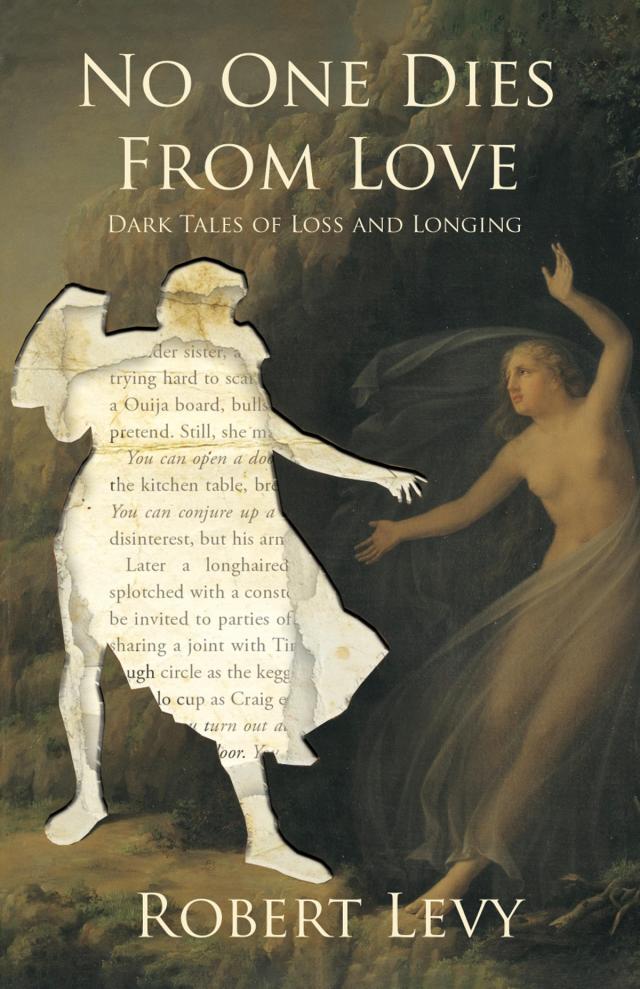
No One Dies
from Love
Dark Tales
of Loss and Longing
Robert Levy
Word Horde
Petaluma, CA
Other books by Robert Levy
The Glittering World
No One Dies from Love
© 2023 by Robert Levy
This edition of No One Dies from Love
© 2023 by Word Horde
Cover art and design © 2023 by Matthew Revert
Edited by Ross E. Lockhart
All rights reserved
An extension of this copyright page appears on page 245
First Edition
ISBN: 978-1-956252-06-4
A Word Horde Book
www.wordhorde.com
No one dies from love
Guess I’ll be the first
—Tove Lo
Introduction
By Paul Tremblay
If the first story we’re told as a child isn’t a horror story (the fun kind with all manner of human or beastie threatening to eat children) then we’re told a love story. Most of us, even the unfortunate ones who grow up trapped in a cruel and real version of a horror story, are taught to view the world through the distorted lens of love. Or, more accurately, the lens of distorted love. It would be an understatement to say Western mainstream culture celebrates and projects simplistic, moralistic, problematic, non-inclusive love stories, ones that often serve as the worst models for adult relationships. Beyond the baked-in cisgendered, patriarchal themes, even as a child, after watching a Disney-fied love story, I remember thinking, okay, great, the heroes are wed, but then what? Won’t there be more dragons and poison apples to deal with in their happily ever after? Wouldn’t it be disappointing if there weren’t? And how long does happily ever after last anyway? (Yes, I was an annoying child.) What about my grandparents, the ones who’d been married for fifty years, or my other grandfather who lost his wife in the mid-1960s and never again dated never mind remarrying, and what about my parents who sometimes fought and ignored each other and sometimes hugged and laughed and hid in their bedroom (ew), and what about my aunt and her partner and why couldn’t they (at the time) be married, and what about the quiet uncle who lived with my grandparents and had never been on a date, and what about my divorced aunt? What about me and the rest of us, who aren’t princes and princesses? I can’t say that the child-me understood the glimpse of awe, horror (what is a love story without horror?), and beauty within the existential binding of desire, love, and loss, but I could sense I had yet to be told anything close to the full story.
As adults, we learn that love is both complex and simple. Love is ephemeral and perhaps more precious because it can be lost so easily. Love is also, if not eternal, then spiritually akin to it. One can’t describe love (like I’m trying to in my own hackneyed way) in a line. We better communicate love and loss and their ineffability in art and in story. Most stories are love stories.
Robert’s brilliant collection, No One Dies from Love, gives us a glimpse at love’s fuller, gloriously messy and harrowing story. The title itself is a bold statement of literary purpose and a dare to the reader. Is it a lie? Is it a truth? The unity of effect will fill and ache your heart.
“Little Flea, Little Flea” opens the collection with a brief, heartrending glimpse at the vastness of grief at love’s loss and how it shapes our lives. Later in “The Cenacle,” the weight of a widow’s grief becomes an obsessive, haunting, self-destructive vigil. Queerness and who are we when we love or when we deny it are themes Robert expertly explores throughout the collection, including the erotic dark fantasy of “My Heart’s Own Desire;” a man’s desperate visit to an ex-partner of his newly missing lover that veers into cosmic horror in “DST (Fall Back);” and “The Closet Game,” a wrenching coming-of-age story as a teen’s denial of his desires and his denial of self echoes throughout his possible pasts and futures. “The Oestridae,” “The Vault of the Sky, the Face of the Deep,” and the haunting “The Rental Sister” pose difficult questions about the lengths we might go to in defending and defining the bonds of familial love. In “Ceremonials,” feminine desire and righteous rage flower into grotesquely beautiful vengeance. “Conversion” is an utterly disturbing, unflinching extrapolation of the horror of gay conversion therapy. “Giallo” is a show-stopping fever dream in which desire runs gloriously amok.
These stories showcase Robert’s breathtaking range as a writer, equally adept within historical and grounded settings as he is in the fantastic. He writes the quiet, exquisite character piece as well as unleashing grotesque visions that could make a splatterpunk blush. He writes with a fearless integrity of vision, yet as dark or as heavy as the stories get, they’re still fun to read. How does he do that? I wish I knew. What I admire most about Robert as a writer is the humanity he imbues within his characters, all of whom are outsiders, just like us. If all stories are love stories, the best ones are always about outsiders.
I haven’t even gotten to his tour de force novella yet.
Presented as a lost collection of her famous diary entries, “Anaïs Nin at the Grand Guignol” begins with an ending, the end of Nin’s relationships with Henry Miller and his wife June. Distraught that she won’t see June again, Nin seeks solace in the Grand Guignol theater, where she meets actress Paula Maxa, “The Most Murdered Woman of All Time.” She also meets Maxa’s destructive demon lover. The voice and writing style are revelations; a perfect amalgam of Nin’s and Robert’s. The story is as thrilling and titillating as it is ingenious. The novella encapsulates the collection’s themes and concerns and is as empowering in the dual faces of love and grief as it is horrifying. The novella is the full story, and demands more than a single reading.
While reading this collection, I found an old saying about joy/love and grief was rolling around in my dusty head. I don’t know where the saying originates, but it goes something like this: grief shared is divided and joy/love shared is multiplied. Sentimental, yes, but also, true. Or it’s true enough that I want it to be always true. In the context of story, dividing grief and multiplying joy/love is an apt description of what writers at their best, at their most challenging and formidable can achieve.
I’d like to thank Robert for sharing his stories with us.
Paul Tremblay
12/29/22
LITTLE FLEA, LITTLE FLEA
The last time I saw my father I was five years old. After a series of abortive stays with various acquaintances and increasingly distant relations, the two of us found ourselves up in Seal Rock, crashing at the beachfront timeshare of his old college roommate; it was only later that I learned we were in fact trespassing, that my father had shimmied his way in through an unlocked window. He was already far gone by then. Major recalcitrance, off his medication, a typical recidivist bipolar case with a severe paranoiac streak to boot. We spent much of that summer scream-singing “Manic Depression” as we collected driftwood along our small stake of the Oregon coastline.
His latest obsession was aliens. It was the late ’70s, and alien-related conspiracy was everywhere—abduction, invasion, Close Encounters, you name it. Dad considered himself an ambassador to our inevitable interplanetary visitors, someone who could best explain humankind’s myriad customs and foibles. Many mornings he’d take to the beach to draw what he called pictograms in the sand, akin to cave drawings and large enough to be seen by Those Watching From Above. “So they know we’re a civilized people,” as he put it, a staged smile on his face that indicated they might be listening as well.
“I believe you,” I told him. And I did.
Of course, back then I had no idea he was sick. I thought he was a blast, at least when he was capable of getting out of bed to meet the day. One of our favorite games was our own version of Marco Polo called Little Flea, Little Flea, where the seeker would exclaim “Little flea, little flea, where can you be?” to which the hider would reply “Big flea, big flea, you’ll never find me!” I was the one who hid, and upon finding me he’d shout “You can’t fool me!” and spin me in the air until we’d both crash laughing together down to the water. Sunburnt and delirious, we would play for what felt like hours, until it was too dark to go on.
Little flea, little flea, where can you be?
I awoke one morning to find the house empty and trundled out to the deck. Dad was at work on his pictograms, this time of assorted tools, hammers and screwdrivers and wrenches and the like, rows of them in the sand. He shielded his eyes from the sun and waved me down, drawing stick in hand. When I reached him, I could tell he was more off than usual, his eyes wide and round as half-dollars.
“I wanted you to be here. For this. Don’t you see? Here.” He pulled me over to examine one of the drawings. A bulldozer, perhaps, or maybe some kind of scale? I couldn’t say.
“Is that another tool?” I asked. He laughed, the sound broken and brittle, like ice cracking.
“It is, Donnie, it is.” He chewed furiously at his lip. “Last night, in a waking dream? They came to me. Sent me a vision, to show how they’re going to take me.” He tapped the picture with his stick. “The name is unpronounceable, but it’s essentially a sophisticated transporter device. It’s going to reduce me to energy, then beam me up, up through the clouds and inside their ship. I’m supposed to meet them, out there,” and he pointed the stick toward the ocean and the horizon beyond.
“Can I come?” I asked.
He laughed that odd laugh again, and bent to kiss the crown of my head. “You’re a good kid,” he said, his eyes ticking away, toward the water and the waves. “But I need you to stay here and protect the pictograms until I’m gone. Otherwise they won’t know where to find me. Can you do that?”
I nodded. He handed me his drawing stick, peeled off his T-shirt and shorts, and ran naked into the water.
“Isn’t it amazing?” he shouted from the surf. “They chose me.”
I watched as he swam out, unsure of where exactly he was going, and when he was going to return. He soon grew invisible, the sun rising brilliant over the water until the entire ocean was one massive sheet of silver, like freshly fallen snow.
I sat in the sand, looking away from the water only to check on the pictograms, the tools in their proper place. We are a civilized people, I thought, and rested my head on my knees, the sun yellow and swollen in the sky. I stood to ward off curious gulls, swung at them with the stick, and by late afternoon I grew drowsy. Eventually, I fell asleep.
I awoke past nightfall to a low rumble, to bleach-white lights approaching from the lip of the shore, so bright against the darkness that I threw my arms over my face before I could be swallowed whole. The hard sound of metal on metal, of a hatch opening and shutting, of unsteady movement scuttling across the sand. Water lapped at my feet, the pictograms breached—had I protected them enough? Was it enough for my father to be found?
A new beam fell upon me, stark and blue and carrying an unearthly heat; I didn’t know just how cold I was until it found me. Beyond the brightness, the suggestion of an approaching figure wending its way from a large transport of some kind, shadows against the waves. I fumbled for the drawing stick, but it was gone.
You can’t fool me, I thought, and squinted into the light.
“Son?” He knelt down. I could make out the dim outline of his ranger hat, the glint of the flashlight, his metal badge. “You all alone out here?”
I looked up and past him, up toward the night sky and moon and planets, to the many stars above.
THE CLOSET GAME
You know the game, don’t you? All you need is a closet, and a book of matches—and a willing participant. Not much to it, considering. Jesse first heard about it at twelve from his older sister, after she came home drunk from a party and was trying hard to scare him. Sleepover shenanigans when you lacked a Ouija board, bullshit kid stuff, he knew that much. A game of pretend. Still, she managed to strike a nerve.
You can open a door to another dimension, she whispered across the kitchen table, breath thick with the tang of spiked Red Bull. You can conjure up a demon from hell. He smiled with an air of disinterest, but his arms goosefleshed nevertheless.
Later a longhaired spindleshanks at seventeen, forehead splotched with a constellation of acne, Jesse is popular enough to be invited to parties of his own. Up in Craig’s parents’ bedroom sharing a joint with Tina and Beth, the four of them seated in a rough circle as the kegger rages below, he takes a slug of beer from his Solo cup as Craig explains the rules.
First, you turn out all the lights. Next, you stand inside the closet and close the door. You wait for at least five minutes, and if it’s time, you hold out an unlit match and say,
Show me the light, or leave me in darkness.
How will you know when it’s time? Tina asks, and Beth reaches over and takes hold of Jesse’s hand. Beth is not the one whose hand he wants to hold. What are you supposed to be waiting for?
You’re listening. For something inside the closet. His eyes tick toward Jesse, who looks away, shifts in place on the spongy carpet. You might hear whispering, or scratching. Or maybe something else. But when you do, you have to light the match as quickly as possible. If you don’t…
If you don’t, what?
Craig taps the joint into the ashtray. If you hear something and you don’t light the match, they say you’ll be plunged into everlasting night.
We could play seven minutes in heaven instead, Beth says, and slides Jesse’s hand into her lap.
I’ll do it. Jesse grabs the matches and leaps up, wipes his damp hands on the seat of his jeans. I’ll go.
He enters the closet in darkness. Barely large enough to call a walk-in, but he can stand inside well enough, the airy flutter of clothing and the cling of dry-cleaning plastic lapping from their hangers. He closes the door, rocks on his heels, and he waits. Okay, he thinks, this is going to be, like, nothing. Pulse loud in his ears, his brain judders back in time, to last week and making out with Beth on a dilapidated lawn chair behind her house. The hungry way she straddled him, the pasty icing taste of her lipstick as she fumbled with his belt buckle.
Don’t, he’d said, and grabbed hold of her wrists. Let’s wait until Saturday night, okay? At Craig’s party. We’ll do it then.
And soon the intrusive thought appears. The one his mind has conjured too many times: Craig’s mouth pressed to his instead, the smell of his best friend’s beery breath as his tongue snakes its way between Jesse’s teeth. The very thing he has wanted for over two years now, but will never fully admit, not to himself or anyone else. God, he wants Craig so bad he thinks it might kill him. Everything is so fucked up.


