

The worlds fair goblin, p.1
The World's Fair Goblin, page 1


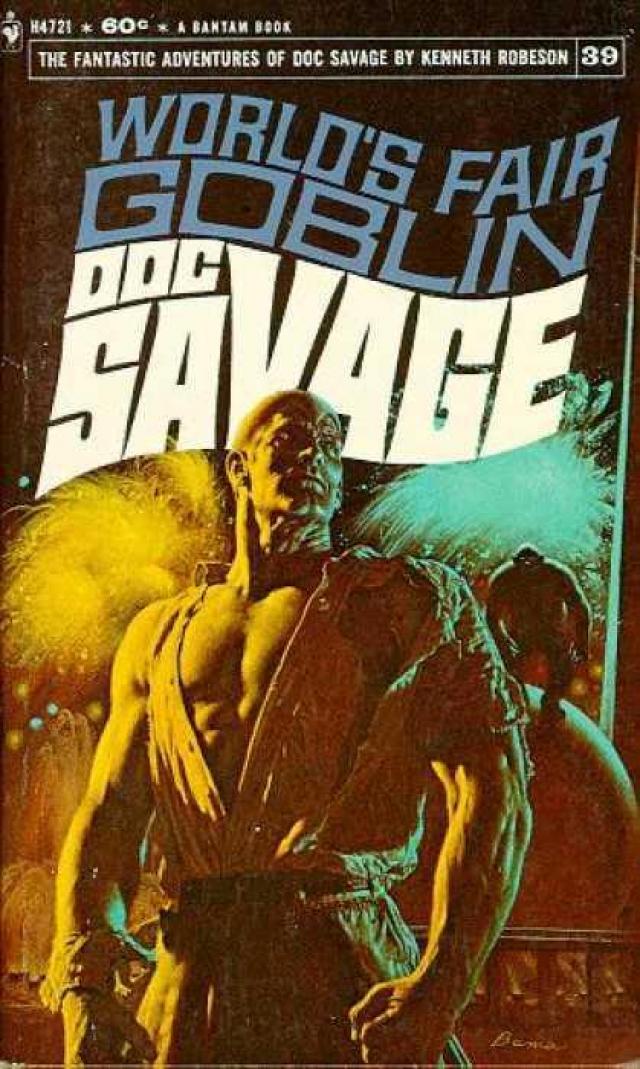
World's Fair Goblin
By Kenneth Robeson
Published April 1939
Doc Savage Magazine #74
by Street & Smith Publications
Table of Contents
I THE MEN THE GOBLIN GOT
II HIDDEN TRAIL
III GOBLIN
IV GARGOYLE ON THE ROOF
V MAN WITH THE SCAR
VI THE THING CHUCKLES
VII MONK'S MEMORY IMPROVES
VIII LONESOME
IX CURTAIN CALL
X DEATH WITHOUT MUSIC
XI STRANGE EYES
XII ONE-WAY EXIT
XIII ADAM ASH IS MISSING
XIV STORM CLOUDS GATHERING
XV STAIRWAY TO DOOM
XVI MAD MENACE
XVII THE GENERATOR STARTS
XVIII UNMASKED FIEND
XIX DEATH STRIKES HIGH UP
I
THE MEN THE GOBLIN GOT
MAYBE there is nothing to superstition. Maybe it just happened to be the thirteenth day of the World's Fair in New York City. The Fair management spent hundreds of thousands of dollars for publicity to let the universe know that this World's Fair was big, bigger, biggest. It covered more acres of ground, offered more means of amusement, had more scientific exhibits. It was worthy of that worn-out word--colossal.
To give some idea:
Doc Savage--scientific man of mystery, muscular marvel, also reported to be an amazing person in other ways--was to give a series of demonstrations of ultramodern surgical skill. Ordinarily, such an event would have been printed on the front pages of the newspapers in the United States, and cabled abroad. But this time, it was just a part of the World's Fair daily program.
Incidentally, Doc Savage's first surgical demonstration by mere chance happened to be scheduled for the thirteenth day after the opening of the Fair, which was the day the goblin walked.
Additionally, the Doc Savage demonstration was given before a convention of surgeons and doctors exclusively, which disappointed a lot of people who had heard that the lifework of Doc Savage was really righting wrongs and punishing evildoers in various parts of the earth, a career that had led the Man of Bronze, as he was sometimes called, into some fantastic adventures.
The public had heard that Doc Savage did fantastic things, and it would have liked to see a demonstration of some fantastic feats. But Doc Savage had a great dislike for publicity, and he never cut capers for the public's entertainment.
However, the goblin getting loose was not the first mysterious thing that happened.
Two men had disappeared. That was the initial mystery.
On another day prior to this thirteenth day after the opening of the World's Fair, two hundred thousand visitors paid admission. Exactly two hundred thousand. And exactly two less than that came out.
They had automatic mechanical checking turnstiles at all the gates, and a head gatekeeper whose job was collecting the figures. The head gatekeeper saw from the readings that two less people came out than went in. He decided one of the mechanical contraptions had made a mistake. He was wrong.
Two people went into the Fair grounds and never came out--and it wasn't any mistake of any mechanical contraption.
The goblin got them.
THE white-haired man in the long rubber apron, when he appeared, acted as if the goblins were after him, too.
The white-haired man was Professor Martin Uppercue, reported to be one of the world's greatest scientists. His specialty was electrotherapeutics--he had discovered some remarkable things about how diseases of the human body would react to electrical treatment.
He was a small man, thin, with thick white hair on top of a large head. He made you think of the type of musician slangily called a "long-haired boy."
There was nothing long-haired or old-fashioned about his scientific discoveries. He was fifty years ahead of his time, maybe a hundred. Men of science knew Uppercue as a quiet-mannered, soft-voiced person with keenly bright-blue eyes and a sedate deportment. Especially sedate. He was always dignified.
There was nothing sedate about the way Professor Martin Uppercue came out of his laboratory. Nor dignified, either.
Professor Uppercue's laboratory was situated near the center of the Fair Grounds close to the huge ball of a structure called the Perisphere. It was only a few yards from the laboratory to the landscaped gardens along the Court of Communications. Professor Uppercue dashed wildly into this garden, which was crowded with people.
The natural first thought was that Professor Uppercue was chasing something.
As soon as they saw his face, they knew he was not chasing anything. His face showed terror. His eyes popped until they looked like small saucers stuck, bottoms out, on his face.
He ran headlong, knocking astounded people out of his way. There was blood on his face, quite a bit of it. His mouth was also open, open like the mouth of a dog that has been backed into a corner and is being whipped.
Professor Uppercue wheeled his head in different directions as he ran. He seemed to be looking everywhere, hoping, it was suddenly apparent, for a place to which to flee. He was carrying two articles.
One object that he carried seemed to be his laboratory apron. It was a long rubber apron and he had it in his left hand.
The second item was carried in his right hand, and it was more unusual. It was a cylinder, apparently made of aluminum. It was about three inches in diameter and as long as an average man's arm, and capped at each end.
He kept running, and glaring about in search of some place to run to.
There did not seem to be anything chasing him.
The crowd made the natural mistake. They decided that Professor Martin Uppercue had gone insane. So an effort was commenced to seize the madman.
The attempt to seize Professor Uppercue failed, but it did accomplish two things.
A man snatched Professor Uppercue's rubber apron, and kept it, and later turned it over to the proper authorities, and it proved very important.
Secondly, they learned something about that aluminumlike cylinder that Professor Uppercue carried. He whacked different people over the head with it--the thing was light, and did not greatly damage the recipients of the blows. But several persons were able to testify that a whispering sound came from inside the cylinder.
The sound from inside the cylinder was generally described as a whisper. One man testified it was more like the scuffling of a shoe across a bare floor.
Professor Uppercue got away and ran. He clutched the mysterious aluminumlike tube with both arms.
THE flamboyant heart of the Fair Grounds had been called the Theme Center. Here was locked the great spherical Perisphere that was like a mammoth white tennis ball two hundred feet in diameter, from around its base shooting upward great sprays of water that made it appear the huge ball of steel was floating on a fountain, and circling these fountains was a white, circular promenade bordered by heavy shrubs and foliage.
Professor Uppercue dived into this expensively landscaped brush patch.
There were two impressive structures in this Theme Center. One, of course, was the globular Perisphere--the two-hundred-foot white tennis ball of a thing. The other impressive item was the Trylon, a spike of steel seven hundred feet high coming to a needle point at the top. The minds that conceived the theme of the Fair had been unable to imagine anything more modernistic than this ball-shaped Perisphere and the needle-shaped Trylon, and the two were connected by a rising ramp--a wide sidewalk that spiraled up under the base of the massive ball of steel.
When Professor Uppercue next was seen, he was streaking along this ramp.
He now seemed hardly able to run. He was an elderly man, unused to much physical activity, and the wild running already had him near exhaustion. Once he banked into the side banister of the rising ramp, but he kept going. He was headed for the point where the elevated structure entered one side of the towering Trylon.
The Fair police--the Fair cops wore neat uniforms similar to the New York State troopers--and members of the crowd now set out in pursuit of Professor Uppercue. The crazed scientist--and the impression that everyone now held was that the scientist was insane--had a head start.
A number of people distinctly saw Professor Uppercue disappear into the Trylon.
A few moments later the police and more fleet-footed members of the crowd arrived at the Trylon. Everyone was wheezing from the terrific race up the incline. Puffing pursuers crowded into the Trylon.
There was gloom about them, strange modernistic semitwilight. Stretching upward until it disappeared in the needle point several hundred feet above their heads, was the silent network of steel girders which supported the great Trylon. The spot where the pursuers stood was a platform built approximately a hundred feet above the spire's three-sided base.
"Where'd he go?" a man yelled.
They had all become aware of a strange sound--noise as if several carpenters had gone to work simultaneously sawing boards.
"Where'd he go!"
The words literally crashed back at them. Everyone jumped, shocked by the increased volume, the impact of the sound.
"Great grief!" a man muttered. "Some echoes."
The sound illusion of carpenters sawing wood, they realized now, was the noise of their own breathing that had traveled upward into the space, and sounded back greatly magnified by the unusual acoustics of the Trylon.
A cop explained, "It's the way the place is built, I guess. But where'd that nut go to?"
"Search me!" grumbled another cop.
They did not search him, but they did search the Trylon--those parts of it where it seemed conceivable that a man might be hidden--and then went over the surrounding grounds.
There was no trace of Professor Martin Uppercue or his aluminumlike cylinder.
THEN the goblin walked.
It happened not over fifteen minutes later. Immediately surrounding the Theme Center of the Fair--the huge ball of the Perisphere and spike of the Trylon--were the most important buildings, which housed exhibits having to do with branches of modern science. These structures were large and, of course, modernistic. They were brilliantly colored, for color was the theme of this vast World's Fair, if one was to believe the words of the men who had conceived the thing.
Prominent among the centrally located Fair buildings was the Hall of Mines.
It was inside the Hall of Mines that the goblin walked.
Men and women spectators began to come out of the Hall of Mines, yelping at every jump. They were frightened. Not as scared as Professor Martin Uppercue had been, but almost.
A Fair cop grabbed one of the runners. "What's gone wrong now?"
The man jerked a thumb at the Hall of Mines. "Dud-dud-dud-damnedest thing in there!"
The cop ran in to see. The Hall of Mines was an enormous structure, well-lighted; it contained exhibits intended to depict the progress of mining and metallurgy from the beginning of things down to the present. There were hundreds of exhibits and as many scared people. A great deal of confusion, in fact.
The cop jumped on top of an ore-processing mill where he could be seen.
"What's going on here?" he yelled.
"Over here," voices told him. "In the mine!"
The mine they referred to was a reproduction of one of the famous gold shafts of the old West. It had been a popular spot, for the artists who had created it had done a very lifelike job. The shaft sloped into an embankment and disappeared into the depths of the earth. There were shovels and picks stacked about.
If the mine shaft had unexpectedly turned into a tiger den, the vicinity could not have been more deserted.
The cop planted himself in front of the shaft. He did not know what to think.
"It come out," someone yelled for his information. "Then it went back in again."
"What did?"
"It looked like a hobgoblin."
"A what?"
"You get a look at the thing," the informant told the cop, "and you'll understand."
At this point, the cop heard the sound--and the short hairs on the back of his neck began to want to get up on end. The noise came from the mine shaft. It was a whimpering, a hoarse throat-tearing whimper.
The cop rubbed a hand over his head to make his hair lie down again.
"Hell, that's a dog!" he said. "There's just a stray dog in there."
The cop got a flashlight and a gun and three other cops and went into the shaft. It was very dark. At various points in the old mine, there stood wax figures of miners and these wax men were equipped with miners' caps which bore lights--electric lights that imitated the old-time miner's kerosene lamp. It was observed that none of these lamps were lighted; and the current seemed to be off.
"It was a dog, of course," the cop said, although they had not seen any.
"The people who saw it don't describe any dog," another cop told him.
"Listen, I'll show you. I'll call the dog. Here, doggie--here, doggie--"
That cop never called another dog again. As long as he lived, his vocal chords would freeze when he started to call a dog--because he could not help remembering what he got when he called this dog.
It was probably eight feet high. It was not that wide. It had arms, legs, body. It had eyes that were great and awful, and it had strength that was the most awful of all.
They saw it only an instant, not very clearly at that, for it hurled rocks at them, boulders as large as barrels.
The policemen fled around the corner.
When the policemen had gathered their courage--and ten more cops and four submachine guns, riot equipment and tear gas--they advanced. They found nothing.
No goblin, no way the goblin could have gotten out. No nothing.
II
HIDDEN TRAIL
RUNNING north and east from the Theme Center of the Fair--the spot where the Perisphere and Trylon were located--were broad avenues and malls branching out like the spokes of a wheel.
The Hall of Medicine was on one of these spokes. It was a long, yellow-colored structure just north of the circular walk bordering the mammoth Perisphere. Inside was the operating amphitheater, built like a small theater, with circular tiers of seats forming an observers' balcony. Seated tense and silent, white masks over their own faces, visiting medical men watched in awe. They were seeing one of the most amazing things of their lives.
Other than the weird panting sounds that came from a mechanical device that looked similar to a punching bag, located near the head of the operating table, there was no other sound. That bag pulsated as oxygen mixed with anesthesia was fed to a small, still form on the white operating table--the figure of a boy from the slums of New York.
A tumor was being removed from the boy's brain. It was a type of operation never done before.
Motion-picture cameras whirred, recording the procedure.
Above that still form only the surgeon's eyes were visible. Amazing eyes. The eyes were magnetic, and like restless pools of rich flake gold. Set well apart, they were compelling and clear, holding the attention of each assistant. No words were spoken. Instead, those eyes directed, gave almost a sharp command when a nurse was a fraction of a second too slow. There was need for swift, sure speed. Remainder of his face was hidden behind a mask of white.
In the observers' balcony, a doctor whispered to a colleague.
"This particular penetration of the ethmoid cribriform has never been accomplished to date. Bet you he don't make it!"
The second doctor said softly, "But that surgeon is Doc Savage!"
"Sure, but the boy's been on the table a half hour now."
It did not seem to those seated above in the tiers that the figure of Doc Savage was unusually large. Standing alone, the bronze man's size was deceptive, which was perhaps caused by the symmetry of his physical development--so well proportioned that he seemed no taller than an average six-foot man. But whenever a nurse, who was tall herself, came close, his unusual size was evident. Doc Savage was a physical giant.
Close over Doc Savage's head, a cluster of round operating-room lights sent down powerful light.
A doctor seated in the topmost tier whispered, "Listen!"
Everyone could hear the commotion. An excited man had stopped to yell at the doorman, probably not realizing what a serious thing was going on inside.
"A scientist named Uppercue went crazy, and they're huntin' 'im!" the man yelled. "And they saw some kind of a goblin in the Hall of Mines!"
The skeptical doctors in the tiers breathed, "Good Lord. He'll never pull that lad through now. That'll distract him."
At the operating table, the nurses jerked worried glances toward Doc Savage. But apparently the bronze man had not heard a sound. His capable fingers moved swiftly. His hypnotic gaze flicked to the tiny instruments in the nurses' hands, indicating them as he needed them. For the first time, he made a direct statement.
"Almost through," he said.
But then the cluster of brilliant operating table lights overhead went out.
ONE nurse could not suppress her cry of horror as the big operating amphitheater with only small windows high above, was thrown into gloom down where Doc Savage was working. The bronze man was ready to suture--sew up--the incision close to the boy's brain. One slip now--
A nurse leaped to a wall phone, frantically called the engineer's room in the basement of the Hall of Medicine, announced, "Something mysterious caused the transformers to burn out."
Doc Savage ordered quietly, "Watch the oxygen closely." He stepped swiftly from the room. He always tried to foresee emergencies; there was a flashlight in his equipment case outside in the sterilizing room. He came back in a moment and passed the light to the assistant.


