

After things fell apart, p.1
After Things Fell Apart, page 1


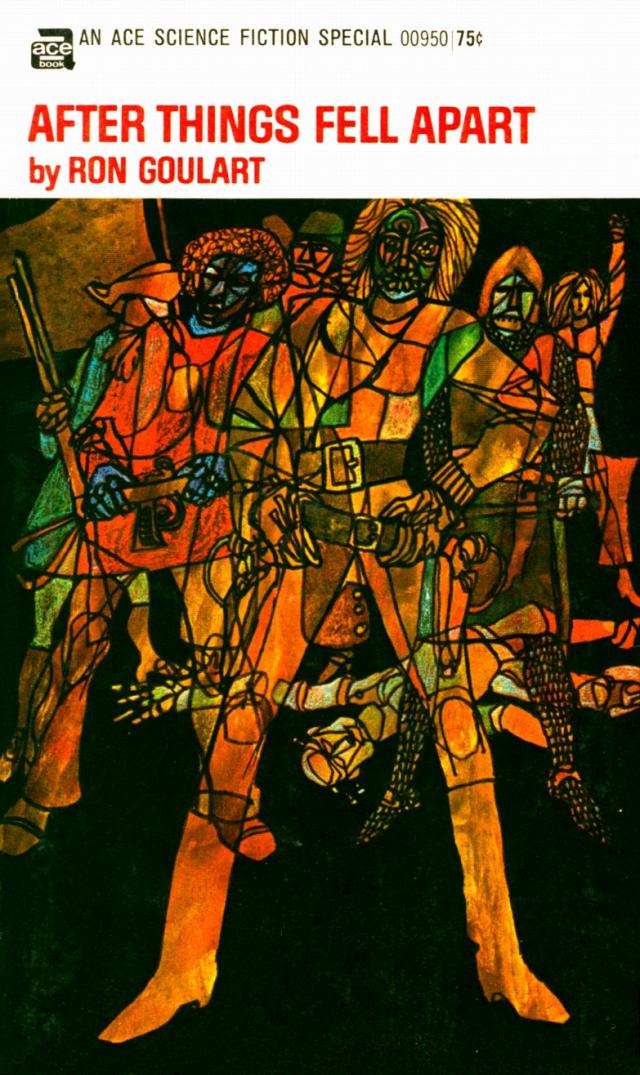
The time is a few decades from now; the place is what used to be the United States, now disrupted ;by internal factionalism as well as a short-lived ;foreign invasion.
Out of this chaotic background Ron Goulart has produced a swift-moving, witty and constantly delightful novel, a story of a future odyssey through:
• the Nixon Institute, where aging former rock ;stars reminisce about the days when they still had ;hair;
• the wide-open sin-town of San Rafael, run by ;the Amateur Mafia (no Italians allowed);
• Vienna West, a detailed replica of Sigmund ;Freud's 19th Century city where psychiatric ;patients live and abreact together;
• the Monterey Mechanical Jazz Festival, featuring ;the music of pinball machines, jack hammers and ;laundromat washers ...
All this plus a dozen or two of the oddest characters you're ever likely to meet. AFTER THINGS FELL APART is a very funny book.
RON GOULART says:
I have a redhaired wife and, at the moment, one son. We live a somewhat sprawled out and freelance life in rural Connecticut, along with two cats, a stray dog and a horse, whom we rent. 1 was born in Berkeley, California in 1933 and grew up there. Berkeley wasn't very radical then, at least not on our side of the tracks, and I had a quiet, conventional childhood.
Anthony Boucher also lived in Berkeley and while I was in high school I started attending one of his writing classes. He held the thing in his living room and charged a dollar a session. Boucher was helpful and that's why my first professional stories began appearing in The Magazine of Fantasy & Science Fiction. After graduating from college in 1955 I spent the next few years in the advertising business; my speciality was what was then called offbeat copy. I had a crewcut and wore a gray flannel Brooks Brothers suit. This was in San Francisco, and later in Los Angeles.
Some three years ago I was able to say goodbye to all that and have been doing only books and stories since. My stories and pieces have appeared in Galaxy, Playboy, Show, Rogue, Ellery Queen, Police Gazette, Crawdaddy, Saturday Review and even more unlikely markets. My published books include an anthology of pulp detective stories (THE HARD-BOILED DICKS), a book about kids and the mass media (THE ASSAULT ON CHILDHOOD) and a science fiction novel (THE SWORD SWALLOWER). There will be another eclectic batch of books out this year.
AFTER THINGS FELL APART
by RON GOULART
AN ACE BOOK
Ace Publishing Corporation
1120 Avenue of the Americas
New York, N. Y. 10036
after things fell apart
Copyright ©, 1970, by Ron Goulart
An Ace Book. All Rights Reserved.
Printed in U.S.A.
I
The money had just been piled on the desk when the earthquake came. Jim Haley slapped a hand over it and waited for the swaying to stop. The office coffee machine hopped off its stand, bounced twice along the bank of data boxes and hit the floor. Unground soy beans tumbled out of its side and began jiggling on the vinyl. The walls of the building groaned faintly and odd sounds came from the lagoon.
“These quakes always scare the swans,” said Darnell McGuinness. He ran and braced himself in the open door. Glossy photos, microcards and the canvas petty cash bag clutched against his sweatered chest. A big round-edged man.
The thousand dollars crackled less under Haley’s hand. “Not a bad one this time.” He was tall and lean, all bones and weather-tanned skin. Under thirty with unobtrusive brown hair cut, hastily, short.
McGuinness was watching the wide, tree surrounded lagoon outside. “Nothing ruffles those seagulls.” He stepped out onto the gravel, then bent to the right and squinted. “It’s still . . he began.
“Arf, arf,” said one of the data boxes.
“Your data box is barking,” Haley called at the doorway.
“Too many earthquakes. It makes them goofy. Ignore it. Where was I? Yes, I was remarking that it’s still there and intact.”
Haley fished his flat wallet out of his inside jacket pocket and filled it with money. The quake seemed about over. “What is?”
“The Golden Gate Bridge,” said the Chief of the Intelligence and Investigation Office. “I remember the big San Francisco quake of 1976. A lot of people thought the bridge would fall that time. Well, I’ve never really liked bridges. Or the Bay itself, for that matter. But the government of San Francisco Enclave insists on our keeping our offices in the Palace of Fine Arts here. A small fortune was spent restoring this dreadful building and nobody wants to abandon it.” He crossed back to his desk as the quake gave a final dim rumble. “We’re much too close to the water, historic landmark or not.”
“Woof woof,” said the third data box from the left.
Haley returned his wallet to his inside pocket. He left his chair and bent over the fallen coffee machine. “Didn’t somebody propose filling in the lagoon at the last meet of the S.F. Enclave governing board?”
“Oh, I like this lagoon. It’s artificial,” said Chief McGuinness. “San Francisco Bay and the Pacific Ocean are what annoy me. I keep expecting a tidal wave.”
“You actually lived down in the Republic of Southern California for awhile, didn’t you?” said Haley.
He righted the machine and scooped up the scattered soy beans.
“Bow wow,” said the same data box.
“The earthquakes jiggle them out of whack,” said Chief McGuinness. “It’s no use requesting a repair man. That takes a month. So I usually fix them myself. There’s a little manual that came with them. These are the old Datzrite/3000 models. In the manual it explains, you know, what all the different malfunctions are. I forget what barking means. Last week one of them was whistling like a canary bird and that means a blown fuse.”
“Can’t you look in the repair manual?”
“I filed it in one of the data boxes and now they won’t give it back to me,” explained McGuinness. “What were you asking me? Oh, about the Republic of Southern California. Yes, I more or less lived there. Nobody can really live down there. It was like that even before the Chinese Commandos invaded and everything fell apart. You’re too young to remember that.”
Haley, as he sat down again, pointed at the photos McGuinness was still clutching. “Why did you send for somebody from the Private Inquiry Office?” “Back to business, right.” The chief dropped into his chair, spread out six pictures of dead men. “I’m glad PI sent you, Jim. You’re efficient, know how to get information. Though you’re a little too eccentric. There’s another PI man nearly as good as you, but he’s too horny. La Penna.”
Haley grinned, which gave his face a momentarily sunken look. “You want me to work on the Lady Day thing, don’t you?”
McGuinness had been studying the photos upside down. He swallowed and nodded his head. “You’ve heard the name?”
“Sure, but nothing concrete,” said Haley. “I move around outside of S.F. a lot, through most of the Enclave controlled counties. Down as far as Big Sur and over to the Napa Valley and the San Joaquin. I’ve heard the name, heard it linked with these killings.” Haley absently touched the place in his coat where the money was. “Enclave police can’t handle this?”
Chief McGuinness said, “The cops are not usually too successful outside of San Francisco proper. There have been other killings beside these in the city. This Lady Day business has spread out all over Northern California. An organization like the Private Inquiry Office, financed in part by private money-agricultural money, I hear—you can do things the police can’t. Get information, buy it, in places cops aren’t welcome. We’ve got to stop this slaughter of our prominent men.”
Haley brought the photos into one pile. “Professor Takahashi,” he said of the top photo. “Kidnapped from his office in the ruins of old S.F. State and then shot the following day on the revolving bar at the Fairmont Hotel. Three girls, masked, wearing black clothes, did it, according to witnesses.” He turned to the next picture. “Admiral Burly, retired. He was set fire to in Children’s Storyland at Frisco Zoo.”
“You younger people say Frisco, I notice,” put in Chief McGuinness. “That was a taboo when I was a kid. A carryover from when we’d been part of the state of California, part of the U.S.A.”
Haley shuffled through the rest of the photos, stopped at the sixth. “Hey, this is Fortalanza, from the S.F. governing board itself. When was he killed?”
McGuinness blinked. “Only this morning. Stabbed in the parking lot of Grace Cathedral during an outdoor seance.” Reluctantly the chief reached out and pushed one of the yellow buttons inset along the lefthand side of his desk. “The information on his death is in one of the data boxes. Excuse me, Jim, I’ll have to use them.” He poked at the button again.
A data box, half man size and gunmetal in color, rolled out of line and across the purple vinyl floor. “Arf, arf,” it said.
“I knew I’d get that one.”
The square box rolled over Haley’s left foot and bumped into the Chief’s desk. “Data Box 45A reporting for duty, bow wow.”
“Stop that silly barking.” McGuinness scowled at the data box’s slightly askew speaker grid. “Give us what you have on the assassination of Dante B. Fortalanza.”
“That’s a good subject,” said the box. “Now, I’ve been worrying a lot about these killings and about the senseless violence rampant in our culture in general. The problem is, everyone these days is too cerebral. I think we need a turning back to the simple virtues of the past, a turning back to the glorious days whe n each citizen of San Francisco was responsible for law enforcement. In those golden vigilante days of yore it was relatively—”
Chief McGuinness kicked the box in the side. “Give us the damn data and don’t editorialize. Not verbally either. Print me the info.”
“Arf arf,” replied the data box. “Okay, but you guys ought to listen to what we men in the street have to say.” It whirred and dropped a manila folder into the wire basket attached to its right side.
Chief McGuinness snatched up the folder and opened it on his desk top. Three dance bids and a tinted wedding photo were on the top of the data. He examined one of the bids. “S.F. Enclave Free University’s Come As Your Favorite Third World Leader Dance, April 5, 1984. What is this stuff?” Haley stretched and extracted the photo. “This is my mother and father’s wedding picture. I didn’t know you had a file on me.”
“Who are all these other people in the wedding picture?”
“The Free Speech Movement,” said Haley. “My folks met at a sit-in at Cal. My father was much more liberal in those days.”
“You sure went to a lot of dances, for a criminology major,” said the chief. To the data box he said, “Where did you get this material?”
The box said, “Haley, James Sheridan. Born 3 March 1964, Berkeley, California, then U.S.A.”
“I don’t want to know that.”
The box ratcheted. “Directive 5234B requires background material on all operatives working on Intelligence and Investigation Office assignments.”
McGuinness gave the box another kick. “Okay, okay, file the damn stuff, then. Now give me what you have on the latest assassination.”
The machine whirred and a yellow plastic pistol dropped into its basket.
“I thought you said he was stabbed,” said Haley.
“Yes. That’s apparently one of your old toys, Jim,” said the chief apologetically. “The guys who do backgrounding for us are awfully thorough.”
Haley took up the toy gun, hefted it. His initials were scratched into the handle. “It shot darts with plastic tips.”
“We have those, too,” the data box told him. “And your baby shoes.”
Chief McGuinness snorted and hit another desk button with his balled up fist. The data box rolled back into its place against the wall and made a turning off sound. “I’ll simply tell you what we know, Jim, and send you a written report later. I depend too much on these gadgets. I ought to toss them all out. Let’s see. Yes, when Fortalanza died he muttered, ‘Lady Day.’ He also added, ‘They’re going to take over.’ ”
“According to the Examiner-Chronicle, Judge Vet-terlein mumbled a name. I assume it was Lady Day.”
“Yes.”
“Do you have anything else you’ve held back? Anything on these Lady Day raiders that wasn’t in the paper or on the TV station?”
“Precious little.”
“Three or four girls each time, in pants and pullovers, at most of the kidnappings and at these flash public killings.’' Haley, with one bony hand, placed the photos back on the desk so they faced toward Chief McGuinness. “Was it the same girls each time?” “We don’t think so. Witnesses usually don’t agree much, but there’s such a variance here I figure we may have as many as a dozen different women involved.”
“Women or girls? The paper said they were young.” “Mostly in their early twenties,” said the chief. “Girls, yes. From what you’ve heard, Jim, is Lady Day a person or a movement?”
“Probably both,” answered the PI operative. “The methods, the uniform clothes. This sounds like one of those militant women’s rights outfits out of the 1960s and 70s, only more out of hand.”
“How’d you hear about the 1960s and the 1970s?” "At SFEFU,” Haley said. “I minored in Nostalgia and Pop Culture, which interested me then.” “You’ve never mentioned it before. We’ll have to talk about situation comedies and light shows sometime. Two of my favorite nostalgia topics,” said Chief McGuinness. “Some of those female equality people took to killing men in the 70s, though.”
“On a small scale. A lot of times for personal reasons. There doesn’t seem to be anything like that involved here.”
“Right. The only thing linking these dead men is their prominence in S.F. Enclave life.” The chief rubbed his elbow. “I’m worried, Jim. There could be a war against men brewing. Six men killed right in San Francisco in the past month, not to mention others in Northern California. Three men killed last week and this and today is only Tuesday.”
Haley said, “Okay. What do you want done?” Chief McGuinness tore the top sheet from a memo pad. “A lead has turned up, Jim. It seems legitimate, though not something our cops can run down too well. Start with this and see where it leads you. Spend as much of that cash as you have to, going places and buying information.” He waved the memo slowly a few times. “A man across the Golden Gate Bridge in Olden Town says his niece has been living with his family for the last few weeks. He’s certain she was involved with this Lady Day thing and then quit. I’d like you to meet this girl and talk to her.” He gave Haley the name and address of the suspicious uncle. “Take all the time you need following this business. Keep in mind the fact that more prominent men will be getting killed while you’re investigating. I’m hoping the next time a batch of these girls surfaces the cops can trail them. So far we haven’t had any luck there at all. They show, kill, disappear.”
Haley grinned his moderately frightening grin and got up. “You’re probably not prominent enough to be a target. So relax.”
McGuinness said, “The thought does keep occurring to me, Jim. I don’t know. Assassins, earthquakes, the ocean. My life seems pretty joyless at times.”
“You ought to transfer to an outside job.” Haley folded the memo page into his trouser pocket and strode from the office. He’d left his electric motor bike parked and locked up a grassy slope and across the lagoon from the Palace of Fine Arts. He ambled slowly up to the bike, glancing back at the quiet water and at the antique brown domed building, leftover from a long forgotten exposition. It was rich with imitation pillars and draped statuary.
There was a riot in progress on the Golden Gate Bridge when he drove up to it
II
A paper-wrapped roll of quarters spiraled from the hip pocket of the Enclave policeman as he came diving for Haley’s electric motor bike. He slammed down, hard on his knees, next to the ducked over Haley and said, “Sometimes I think our society is too fragmented, Jim.”
Rifle balls were whizzing in the misty air. Homemade bombs exploded all around. “Another dispute about the second half of the bridge, huh?” Haley remarked.
The bridge cop said, “This week the Fort Baker bunch are supposed to run the half of the bridge that doesn’t belong to the S.F. Enclave. But those guys from Black Sausalito claim they missed a turn last Easter and they want to collect secondary tolls this week.”
The row of cars trying to leave San Francisco was twenty vehicles long and a man in about the tenth car, a vintage gas engine Mustang, jumped out angrily. He tugged at a six shooter in the side pocket of his business jumpsuit, shouting, “Why cant all this factionalism be ended?” He wrenched the revolver completely free and waved it in the direction of Haley and the cop.
They both shrugged, the cop calling, “Put away that weapon or I’ll have to arrest you.”
“I’m a doctor,” said the blond man. “I have to carry a gun when I make house calls over to Marin County.” He gestured at the fogged over country across the orange bridge. “The head of the San Anselmo Amateur Mafia is having a serious attack of asthma right now.”
“Tell them,” said the cop. He nodded at the hundred or so men struggling on the span. “Too much splitting up,” he said to Haley. “Those Natty Bumpo Brigade guys from Fort Baker and the Black Sausalito crew and the Amateur Mafia and the real Mafia. Too much splitting up.”


