The first and last adven.., p.1
The First and Last Adventure of Kit Sawyer, page 1


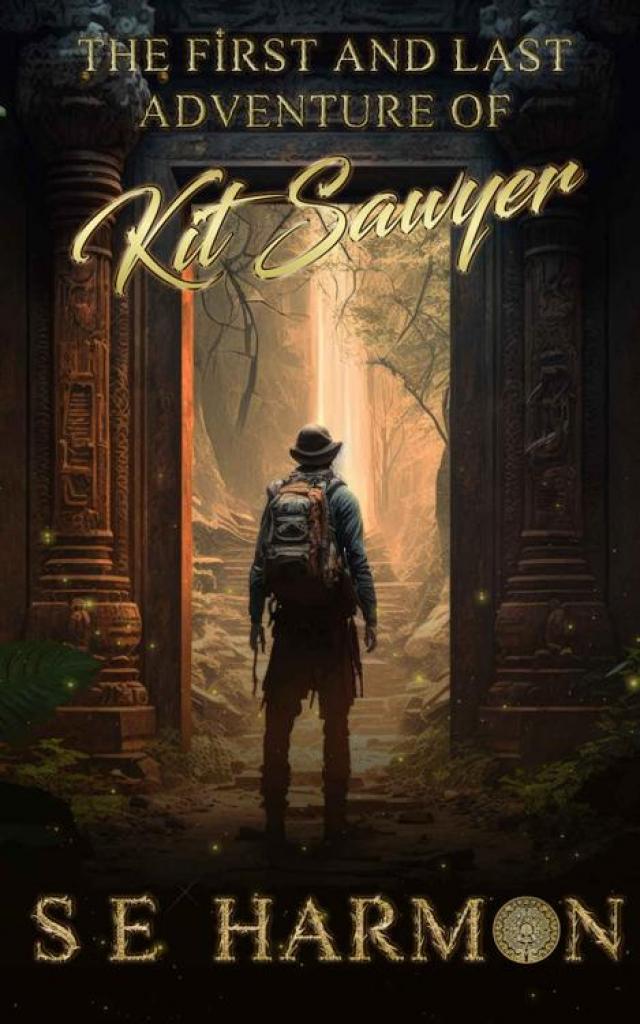
THE FIRST AND LAST ADVENTURE OF KIT SAWYER
S.E. HARMON
This is a work of fiction. Names, characters, places, and incidents either are the product of the author's imagination or are used fictitiously. Any resemblance to actual persons, living or dead, events, or locales is entirely coincidental.
The First and Last Adventure of Kit Sawyer © 2023 by S.E. Harmon.
Cover Art © 2023 by S.E. Harmon.
Cover content is for illustrative purposes only and any person depicted on the cover is a model.
All rights reserved. This book is licensed to the original purchaser only. Duplication or distribution via any means is illegal and a violation of international copyright law, subject to criminal prosecution and upon conviction, fines, and/or imprisonment. Any eBook format cannot be legally loaned or given to others. No part of this publication may be used or reproduced in any manner whatsoever, including but not limited to being stored in a retrieval system or transmitted in any form by any means, electronic, mechanical, photocopying, recording or otherwise, without the written permission of the author.
For Angel
I only want two things in this world... I want you and I want us.
ANONYMOUS
CONTENTS
Chapter 1
Chapter 2
Chapter 3
Chapter 4
Chapter 5
Chapter 6
Chapter 7
Chapter 8
Chapter 9
Chapter 10
Chapter 11
Chapter 12
Chapter 13
Chapter 14
Chapter 15
Chapter 16
Chapter 17
Chapter 18
Chapter 19
Chapter 20
Chapter 21
Chapter 22
Chapter 23
Chapter 24
Chapter 25
Chapter 26
Chapter 27
Chapter 28
Chapter 29
Chapter 30
Chapter 31
Chapter 32
Chapter 33
Chapter 34
Chapter 35
Chapter 36
Chapter 37
Chapter 38
Chapter 39
Epilogue
Afterword
Acknowledgments
About the Author
Also by S.E. Harmon
1
The natives were getting restless.
When I began the lecture, the students had been hanging on my every word. Now that I hadn’t covered any of the topics they were interested in, I’d lost favor. They didn’t care about my past as a top-notch history professor or my current position on the board of directors at SAF, the Sawyer Archaeological Foundation.
They seemed to care a bit about my research on the lost city of Chipanya and the possible existence of an ancient temple...then I lost them again when I started prattling on about the history of decoding glyphs of lost languages. The general attitude in the room was kill me now, but if not, then at least hurt me good enough to send me to the hospital.
I sighed.
If I had to guess, they’d probably expected something with a little more…octane. Due to some impressive accomplishments by my family, the Sawyer name held a lot of weight in the field. My grandfather, the indomitable Christopher Sawyer—nicknamed Remi for the lost Remington he’d found as a young man—was a world-famous archaeologist. My father, also Christopher Sawyer, had followed in his footsteps.
My mother, Gabrielle, had been a well-known archaeologist in her own right. She’d acquired her pilot’s license early in life and wouldn’t have been able to spell the word fear if I’d spotted her three letters. She’d died after a mechanical failure on her Cessna resulted in crashing her plane in the mountains. With every fiber of my being, I knew she wouldn’t have done a thing differently…even if she’d known that flying would eventually lead to her death.
Live well, Kit, she always used to say, tangling a hand in my curls. Don’t worry about how long.
So I came from adventurous stock, no doubt about it.
Then there was Ethan Stone, my grandfather’s protégé and all-around irritant, who was also a rockstar in the field. He and Remi had recovered a ruby necklace that dated back to the 1600s, one that had belonged to a royal family of the status of the Medicis. Even my ex-boyfriend, Paul, was in the field. He wasn’t that well-known yet, but he was currently in talks with a TV network for a discovery show.
Given all that, it was no surprise this group of young archaeology hopefuls were a little disappointed they’d gotten the boring Sawyer. Too bad, so sad. I doubled down, as any good lecturer who doesn’t give a fuck does, and clicked to move on to the next slide on my carefully prepared PowerPoint.
“Central Mexican Aztecs left fascinating ruins. Modern Mexico City is located on what once formed the Aztec Empire’s principal city, Tenochtitlán,” I said, slipping the clicker back into my pocket. “My grandfather used to tell me a story about the lost city of Chipanya, an Aztec city ruled by jaguar people.”
Just the slight mention of Remington Sawyer got a few people sitting up in their seats, almost as if they were saying, fucking finally. One student pulled a pen out of his bookbag for the first time and clicked the top.
I gritted my teeth.
This was all Liam’s fault. Most people knew him as a professor of history at Edgewood University, a top-tier private school in Maine. I knew him as my best friend and a major pain in the ass, who’d never hesitate to guilt me into a favor. That led me to filling in for a guest speaker in front of a class of wide-eyed hopefuls who’d thought I was Remington Sawyer, the sequel.
I was not.
I could understand the appeal. My entire life, I’d looked up to my grandfather as this larger-than-life figure, always coming back from his adventures with souvenirs and tales of wonderous things, his handsome face lit with joy.
Even my look was more sedate than Remi’s. He kept his wavy hair longer, down to his shoulders, usually because he couldn’t be bothered to cut it. Once dark as a raven’s wing, like mine, it was now completely silver, and he usually had some sort of hat crammed over it. He rarely stood on ceremony with dress, preferring to live in his sturdy khakis, chambray shirts, and boots. Like he’d just stepped off a dig. As for me, well, I suppose I was a tad preppier than that. Like today, I’d paired my taupe slacks with a white button-down shirt and a houndstooth vest.
Alright, fine, I was a little starchy. But starch is good. You don’t have to take my word for it, either. Just go ask a potato.
A girl in the front raised her hand and when I nodded, she asked, “What happened to the Chipanya? I read in a study on Aztec lore that their exile had something to do with sacrifice.”
“Well, sacrifice was an important part of Aztec culture, Miss….”
“Taylor.”
“Miss Taylor.” I adjusted my frameless glasses, which had slipped down my nose a bit. “Proper worship of Huitzilopochtli, the most important Aztec God, required appropriate venama, which means sacrifice. The more important the venama, the more favored you would be by the gods. Warriors would actually volunteer for the honor.”
“The honor of being murdered?” Taylor frowned, tossing back a wealth of golden-brown hair over her slim shoulder. “It’s nothing I’d sign up for, but whatever.”
I stifled a laugh. A hand shot up in the back and I looked over my glasses. “Yes?”
“What was the method of sacrifice?”
“That would depend on the particular culture, but that’s a very good question, Mr….”
“Henry. Henry Marks.”
“Mr. Marks.” I smiled at him and he blushed a little. Guess not everyone thought I was a boring fossil. “The Eloxochitl would generally remove the still beating heart from the chest of the sacrificed and toss it into the mouth of a statue of Huitzilopochtli, the God of War.”
I certainly had their attention now. “The Chipanya considered themselves a peaceful people and preferred to honor their gods with bloodletting on an altar rather than human sacrifice.”
“Could they refuse to participate?”
I wasn’t sure who’d asked the question, but I shook my head. I wasn’t about to get picky about raised hands and such nonsense. They were learning and no one was on fire. I’d take the W.
“To not provide a sacrifice would be considered dishonorable. Those selected as venama were chosen by the gods. Refusing such an honor would risk the wrath of the gods and pose a threat to the entire village. Apparently, the Chipanya refused a sacrifice at some point.”
I could hear murmuring around the room and I hid a grin. Note to self, start with the death and destruction part of the lecture next time. “The Eloxochitl deduced that the gods were displeased and only by exiling the Chipanya could they regain their favor.”
From there, things got a bit murky. Not much was known about the lost city of Chipanya except what we’d found in records from Eloxochitl. Needless to say, those records were a bit biased, especially as they continued to have trouble with the crops. It was hard to know if they’d wanted a scapegoat for their struggle or genuinely believed their hardship was at the hands of the exiled Chipanya.
Another hand shot up in the back and I nodded. “So what happened to Chipanya?”
“They thrived. The land they settled on was undesired by the Eloxochitl because it wasn’t level or fertile enough for farming. Turns out that was because it was on top of a mine.”
Aztec gold. Even without saying the words, I had ’em eating out of the palm of my hand. Now if I was a mean person, I’d bring back up my slides of decoding Aztec language with a rebus and watch them wilt like forgotten lettuce. But I forged on.
“Rumors began of the unbelievable wealth and fortune of the Chipanya. Before long, they were a target of Eloxochitl rage. The Chipanya prayed for protection from Tlaloc, the God of Rain and Thunder.”
“Like Thor?” A guy in the front row ventured.
I chuckled. “Not exactly. He was worshipped as a giver of life and sustenance. But also feared for his power over the elements.”
I clicked the controller and another slide appeared with an image of Tlaloc. He was tall, broad-shouldered with heavy muscles and massive pecs. His face was jaguar-like, almost like he’d been caught mid-shift, with human eyes and long, sharp canines displayed by his snarl. It was a depiction, nothing more, but he was fierce enough to strike fear in the heart of even an Aztec warrior.
“Tlaloc assured them protection and in return, they built him a temple called The Hall of Yolia. Or Hall of Souls. It was there that he kept watch over their gold with the help of his treasured guard. And that worked. For a while.”
I took a sip from my water bottle. I was pretty sure they tracked the path of water down my throat. An elephant could tap dance across the floor and they would hiss at him that they couldn’t see the projector screen. I clicked on the next slide, which was a painted image of a flooded village.
“Tlaloc’s half-human son was lost to illness and he was driven to depression and grief. He blamed the village for not treating his son in time and refused to provide rain for their crops. The land went dry and their crops died. The village begged for help from the other gods, and eventually, Tlaloc was urged to fulfill his promises to the people. He did so by flooding the land and wiping out the entire village.” A few gasps accompanied my words. “Enraged, the other Gods stripped him of his power, only to be given back when he’d proven his worth.”
“But what about the Chipanya?” Taylor, the girl who’d started this particular line of questioning looked aghast. “He left them unprotected. Wouldn’t the Eloxochitl attack?”
“That’s exactly what they did.” I showed another slide, a dramatic depiction of Aztec warriors prepared for war and outfitted with spears, bows, and arrows. “Trying to fulfill his promise, Tlaloc used the last of his power to bury the city and seal off his temple to protect their gold. The spirits of his treasured guard, now jaguar warriors, were tasked with protecting his temple. No one ever saw Chipanya again.”
“Gods and curses and shifted jaguars make for a nice story.” A red-haired girl who had two glitter pens stuck in her messy bun sent me a skeptical look. “But how confident are you that this city really existed?”
Miss Skeptical Face had a lot of company in the archaeology community, folks who thought the city of Chipanya and the gold-filled temple of Tlaloc were made-up nonsense. I couldn’t speak to the workings of the universe and religion, but I knew that man was capable of doing a lot of things in the name of religion. So while the man of science in me didn’t know what to make of an ancient jaguar god protecting Aztec gold, I wasn’t ready to discount the existence of the mythical city of Chipanya. And maybe even the Hall of Yolia.
“Anything is possible,” I said casually.
They continued to stare at me, clearly waiting for proof. I had something—maybe—but it wasn’t anything I was ready to share, and it was in my temporary office under lock and key. Rumors about the relic had been floating around but I didn’t plan to confirm.
“A team of explorers claimed to find the Hall of Souls in 1968,” a squeaky voice near the back piped up. If I had to guess, it was the thin, small guy in the back who seemed to be scribbling down everything that came out of my mouth since the moment I walked in the door, up to and including, Good morning, my name is Dr. Christopher Sawyer. “Do you believe their claims?”
“I do not,” I said unequivocally. I hated to bash someone else’s research, but the expedition of Shonni and Sparks had been flawed from the beginning. “I think they found a temple dedicated to Tlaloc. Not his temple.”
I exited the PowerPoint and cleared my throat. “Any questions?”
Nearly every hand shot up.
I blinked. That was a lot of participation for students whose eyes had been so glazed, they were almost ready to use as pottery. I guess I’d really brought the house down with this lost city of gold business. “You in the front?”
“Were you present when your grandfather and Ethan Stone found the ruby cross of the Ludovisi family?”
“I was not,” I said shortly. “Any more questions about something other than Remington Sawyer?”
Quite a few hands went down, but Henry’s stayed up, a study in determination. “Are you hoping to ever look for the city yourself?”
Explorers and treasure hunters had been looking for the mythical Hall of Yolia for centuries. The kind of Aztec gold that would be in the temple would probably be worth three to four hundred million, easily. Better had come before me and failed, including my parents.
“The short answer? No. My contribution to the topic is finding the research that will help others who specialize in the field. Anyone else?”
Henry seemed to think his name was Anyone Else. “So do you do any field work at all? And if not, is it because of the seizures?”
“I do not do any field work, no.” I smiled pleasantly even as an angry buzzing took up residence in my stomach. Field work wasn’t everything. I also had no intention of addressing the medical part of that question. It was invasive and inappropriate.
“Leave the real work for the other guys, right?”
Henry again. I could tell from the little smirk on his face that he knew he’d hit a sore spot. I guess I shouldn’t be all that surprised—he was training to work in our field, and my name had certainly been disparaged before.
We had another brief stare down while I rejected every acerbic response that came to mind—the top of the list being you motherfucker—and bit my tongue six kinds of ways. I wanted to punch his little smirking face in, but he was going to have to get a little bit wiser and more experienced to get under my collar. Even if the vein in my temple was threatening to pull a Pompeii.
“I think every young person enters this field with dreams of making the next big discovery. You’re the type that still wants to discover the lost city of Atlantis. Find the Hope diamond. Right now, you’re still a little green.” I tilted my head and looked Henry up and down from head to toe. “A lot green, actually. What are you now, nineteen? Twenty?”
“Twenty-four,” he snarled.
I wasn’t that much older than him at thirty-two, but I widened my eyes comically anyway. “I would’ve never guessed. In any case, finding The Big One isn’t why we do what we do. Yes, we want to discover lost wonders before they’re absorbed back into the earth. But not for treasure. If that’s your goal, you’d do better to dress up as Lady Croft and strap a pair of pistols to your thighs.”
His face was red as fire as the class tittered and laughed. “We look for these lost artifacts to learn from them. To walk where our ancestors walked and touch the things they’ve touched,” I said. “We stood on their shoulders to achieve advances in technology, intertwining their lives and ours inexplicably. It would be wrong to forget them.”