Axis crossing, p.1
Axis Crossing, page 1


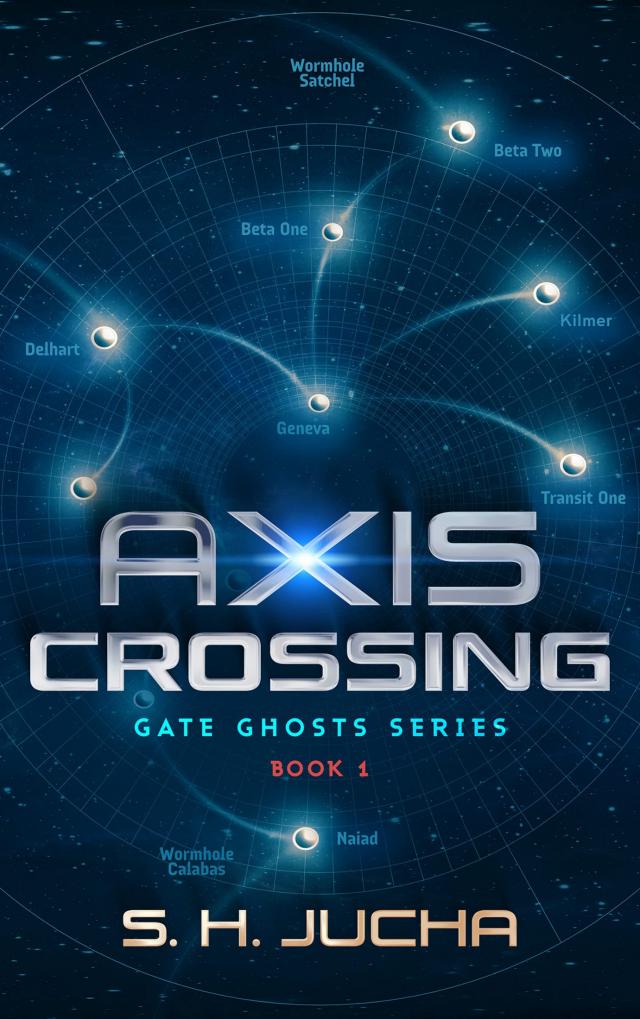
AXIS CROSSING
Gate Ghosts Book 1
S. H. JUCHA
This book is a work of fiction. Names, characters, places, and incidents either are products of the author’s imagination or are used fictitiously. Any resemblance to actual events or locales or persons, living or dead, is entirely coincidental.
Copyright © 2021 by S. H. Jucha
All rights reserved, including the right to reproduce this book or portions thereof in any form whatsoever. Please do not participate in or encourage piracy of copyrighted materials in violation of the author’s rights. Purchase only authorized editions.
Published by Hannon Books, Inc.
www.scottjucha.com
ISBN: 978-1-7344707-8-9 (e-book)
ISBN: 978-1-7344707-9-6 (softcover)
First Edition: July 2021
Cover Design: Damon Za
Acknowledgments
Axis Crossing is the first novel in the Gate Ghosts series, which relates the stories of the descendants of Earth’s fourth colony ship.
Gate Ghosts is a continuation of the Earthers’ saga. Readers and listeners are advised to enjoy the preceding twin series, The Silver Ships and Pyreans, to better understand the nuances in this third series.
I wish to extend a special thanks to my independent editor, Joni Wilson, whose efforts enabled the finished product. To my proofreaders, Abiola Streete, David Melvin, Ron Critchfield, Pat Bailey, and Tiffany Crutchfield, I offer my sincere thanks for their support.
There are many physicists to credit for their inspirations about wormhole theories. A few of the many are: Stephen Hawking, Kip Thorne, Daniel Jafferis, Ping Gao, Aron Wall, John Preskill, Juan Maldacena, Leonard Susskind, Douglas Stanford, Zhenbin Yang, and Ying Zhao.
Despite the assistance I’ve received from others, all errors are mine.
Glossary
A glossary is located at the end of the book.
Contents
Prologue
1: Abductions
2: Friend or Foe?
3: Three Crats
4: Jasper’s Plan
5: Confrontation
6: Two Cids
7: Escape
8: Welcome!
9: It’s Done What?
10: First Contact
11: We Need Your Leader
12: Arrest Me
13: The Deal
14: Change of Plans
15: No Coincidences
16: Naiad Council
17: Justice Hall
18: Council’s Prerogative
19: Scan and Retire
20: Here They Come
21: Influence Campaigns
22: Alexander
23: Axis Crossing
24: The Bottom Line
25: Mickies and Clones
26: Who Goes?
27: Forty-Two
28: Unrest in the Ranks
29: Clones for Sale
30: Knock, Knock
31: Trapped
32: Crèches
33: Offensive Move
34: Family Reunion
35: Miriamal’s Opportunity
36: Homeward Bound
Glossary
My Books
The Author
Prologue
Earth’s fourth colony ship, Destiny, launched outward on its long voyage from a construction station near the home world’s moon.
The ship was a Con-Fed construction built with the credits of the European-Indian conclave, comprising the old EU, India, Singapore, and Thailand. The Destiny was the second of three ships that the conclave would manage to build and launch.
Another organization, the North American Confederation had successfully launched two colony ships to the stars.
The only other association that had touted intentions to send its citizens to the stars was the Russian-Chinese Concord. Unfortunately, its launches never came to fruition.
Like every other colony ship, the Destiny’s passengers were placed in stasis.
The target star, identified as KL-1372, was a far reach for the ship. The crew count was upped from one thousand to two thousand. One hundred crew members were on duty for a year. In this way, the crew members lost only a year of life expectancy every twenty years.
Each team of crew members was tasked with the vigil to keep safe the fifty thousand citizens aboard.
Fortune favored the crew and the passengers of the Destiny. They made their target star without mishap.
As the Destiny’s present captain approached KL-1372, she unveiled the name of the new home world that the passengers had selected by their votes. Naiad, the note said. The planet had been named for a Greek mythology water nymph said to have inhabited a river, spring, or waterfall.
The name had been chosen as a hope for the new home world. The starlight that fell on the rotating planet was weak, less than a quarter of Earth’s Sol. Much of the water and the gases that layered the surface was frozen.
However, many other characteristics of the planet were desirable. There was atmosphere, if thin, and the gravity was ninety-six percent that of Earth.
In the first century, the colonists grew their numbers through natural conception for the initial generations. Afterward, they used the genetic material stored aboard the Destiny. This had been a requirement of the contract they signed for the privilege of spreading humankind to the stars.
New construction was concentrated around the planet’s equator. The colonists inhabited domes and struggled to develop their industries in the brutal subzero temperatures. Slowly, the heat from the various activities warmed the ice sheets near the domes, releasing water vapor and gases into the atmosphere. This accelerated the atmosphere’s density and the planet’s warming.
By no means did Naiad become the pearl that had been Earth, but the planet did present a robust opportunity for human life.
The domes, the underground transport tubes, and the above-surface sky bridges kept the population safe. Wherever possible, the infrastructure of buildings and transport hubs were placed aboveground, and heavy use was made of viewplates that transmitted the weak starlight and prevented heat loss.
Dangerous pastimes developed, such as ice racing. Drivers navigated their powerful vehicles through a maze of turns laid out across huge ice sheets.
There was never an audience at the races. The viewers were comfortably ensconced in their warm domiciles or offices. They watched the races on their viewing devices or through their implanted eyewear. The latter process involved receiving the vid transmissions and transferring the imagery to a viewer’s optic nerves.
As the centuries passed, medical enhancements provided a way for the colonists’ descendants to make the most of an environment that kept them indoors.
The ability to manipulate a human’s genetic code led to various issues. Originally, the techniques developed to eliminate genetic weaknesses associated with diseases. Later, they led to modifications for pleasure. For the most part, these mods weren’t overt. An ostentatious enhancement display was socially frowned on, except for the ice racers, who proudly sported theirs.
Individuals’ secure identification measures quickly became obsolescent and necessitated the need to develop a simple and effective means of identifying each person.
Whether it was a smart decision or not, Naiad’s governing body chose to have every newborn implanted with a chip.
C-chips, named for their inventor Edward Cullen, became the Naiads’ personal identification system. The chips were encoded with the baby’s original DNA strings, and government databases recorded the information.
In time, the tiny cids, as they came to be called, were embedded under the back of the hands of every citizen. They were the means by which humans identified themselves for financial transactions, security clearances, passports for travel between the stars, and many more mundane purposes.
By the sixth century after landing, the burgeoning population, which had already mined the system’s moons and rings, chose to explore beyond the Gelus system.
The first survey attempts directed probes toward a strange phenomenon, whose energy emanations powerful arrays had detected. Over four years, several probes approached the seemingly distorted area of space and promptly disappeared. There were never explosions. The probes’ signals were there, and then they weren’t.
It would take nearly thirty years for Naiad physicists to identify the anomaly as the mouth of a wormhole. Thereafter, probes and small automated ships were sent into the wormhole’s mouth to collect information but to no avail.
Slowly, interest was lost in attempting to discover a means by which objects sent into the wormhole could return.
A physicist by the name of Althea Hailey was undaunted by the failures. She continually harangued the scientists and engineers who governed the decisions about what objects would be sent through the wormhole and when. Unfortunately, her ideas were continually rejected.
A corporate CEO, Francois Axis, was intrigued by Hailey’s concept, and he invested the funds to launch his own vehicles. Hailey developed a quantum-coupled system that linked two small transports. One ship would remain on the Gelus side of the wormhole, and the other would carry the quantum-link through the wormhole.
The instantaneous link between ships would allow the far ship to signal when it had passed through the wormhole. Then the far ship would collect data on the starfield. After receiving a report of the completed assignment, the Gelus-side ship would message the far ship to return.
Prior to the experiment, nearly the entire Naiad populat ion laughed at the Axis-Hailey enterprise. When the second transport popped out of the Gelus side of the wormhole two days later, the laughter abruptly stopped.
Francois Axis and Althea Hailey held the patents on her concept and implementation. There was some wrangling on the part of Naiad’s government to relieve the pair of their patents, but the courts upheld Axis and Hailey’s rights.
Passage experiments through the wormhole were tried with cultures of complex proteins and bacteria, which were continually destroyed.
The data the ships collected explained the phenomena. The cultures received huge doses of radiation, identified as originating from the wormhole.
Althea provided a solution to Francois.
Several probes later, one of the transports returned successfully. The bacteria cultures had flourished in their mediums.
The small probe that was sent had floated within a pair of spinning rings. The whirling rings provided a magnetic field that suspended the probe in the center and protected the tiny single-celled passengers from the wormhole’s radiation.
A full-sized transport was launched three years later. It carried an assortment of plants and experiments using human blood and tissue samples. The media dubbed the transport, with its whirling rings, an Axis-ship. Every plant and culture survived.
Looping through a wormhole proved possible and safe, and Axis-ships were built to carry humans. Although the ships appeared extraordinary in size, it was the rings spinning around the central core that gave that impression. That core, floating within the magnetic field, served as a universal transport between the stars, carrying humans, personal goods, freight, and raw materials.
Naiads discovered a wealth of wormholes in their region of the galaxy, which resulted in an explosion of probe surveys, explorations, and, eventually, dome settlements.
Humankind’s outward expansion from Naiad required Axis-ships and quantum-coupled stations at each end of a wormhole to manage message and data communication. However, the construction of the ships and stations were atrociously expensive.
The Naiad government found itself unable to compete with the corporations that invested enormous credits to fund their explorations.
When a corporate survey ship found a lucrative resource, a planet, a moon, or an immense asteroid, the company claimed the entire body. Without a presence in the faraway systems, the Naiad government could hardly object to the corporations’ claims.
Corporate worlds, with their domes and mining processes, became the dominant entities among the rim stars. They migrated outward from Naiad via the wormholes.
Five wormhole loops outward from Naiad, the companies found a confluence of wormholes congregated around a single system. The collective area became known as Axis Crossing.
1: Abductions
GENEVA, FILIUM SYSTEM
RAW METALS PLANET
Escher slipped out of bed. He dressed as swiftly and quietly as he could, hoping not to wake Ceda. The effort was doomed to fail. Ceda’s assigned below-surface cubicle was barely three by four meters. As usual, her hand slipped from beneath the covers, and Escher squeezed it gently before he exited the cubicle.
Gaining the wide corridor that ran under the dome and connected the other domes, Escher walked with a strong gait. Filium’s starlight would soon strike the administrative dome, and he wanted to be in bed before his parents woke. In doing so, he hoped to eliminate the usual questioning about where he’d spent the night. At twenty-five years old, he didn’t appreciate the lectures.
Escher understood his parents’ concerns. Geneva was a corporate world owned by Raw Metals. Everyone on Geneva worked for the company. On this world, there were corporate rules and corporate norms. He was breaking a corporate norm.
In the Filium system, four known wormholes existed, earning the area of space the name of Axis Crossing.
Escher’s parents, Timor and Dahlia Talons, were senior management. They were specialists in locating ore deposits and researching new mineral combinations. As company executives, they were always concerned about appearances, and they wouldn’t approve of their son sleeping with a clone.
The Talons family arrived on Geneva when Escher was ten. The family was assigned a corporate asset, a clone called Ceda, who was two years older than Escher. Ceda was assigned to be a companion to Escher and his sister, Allie. This was a common practice on corporate worlds, where families frequently transferred between mining worlds, and children became upset at the repetitive loss of their playmates.
As a teenager, Ceda had the additional duties of preparing meals, shopping, and cleaning the family domicile. It wasn’t until Escher finished his online university degrees in advanced computer design that Ceda and he became lovers.
Walking the wide tunnel corridor in the early morning hours, Escher overheard the conversation of two mining supervisors in front of him.
“Heard security arrived. Looks like a takeover,” one supervisor said.
“What kind of takeover has security arriving with mods and sidearms?” the other asked.
“What does it matter?” the first individual asked rhetorically. “Nothing will change for us. It’s the crats who have to deal with the fallout.”
A nudge in the side by the second man to his partner and a twist of the head had the first man glancing behind him.
“Sorry,” the supervisor mumbled when he saw Escher. “Didn’t mean anything.”
Escher smiled and replied, “Didn’t hear anything.”
The supervisor tipped his head appreciatively. He’d been forgiven for the slur. Mining personnel frequently and privately referred to corporate management as crats, corporate rats.
Escher saw personnel far in front of him parting like waves to the tunnel’s sides. It didn’t occur to him that he should do the same. Management children had privileges.
Suddenly, Escher faced four security personnel, who halted as a unit. There were many things wrong with what Escher saw.
One, they were augmented. That was unusual. Takeover security arrived planetside wearing uniforms, indicating the new company, and made polite conversation with the local authorities.
Second, the agents were linked. That was indicated by the way they walked and stopped as one unit.
Third, an agent pointed his arm at Escher. An image projected above the back of his hand. It was Escher’s face.
Everything about the moment scared Escher, and he did the one thing that he’d never considered would be necessary. He ran from corporate security.
Behind him, Escher heard the pounding of boots, as the augmented agents gave chase. While one part of his brain screamed this was all wrong, the other part thought for a way to evade his pursuers. His sole purpose was to get home. His parents would sort this out, and then everything would be fine.
The thought occurred to Escher that the only way to reach ground level, where corporate management and their families lived, was via elevator, and the security force would catch him while he waited for a car to arrive.
There was a second option, and Escher embraced the opportunity like a lifeline.
Chutes, revolving conveyors, moved mining personnel one at a time up and down the many tunnel levels beneath a dome.
Escher spotted a nearby chute, but there was a queue of eleven or more people waiting to ride it down. Despite the shouts of the security team leader ordering him to halt, he kept running.
The next chute had three people waiting, and Escher realized this was his last chance to evade capture. Apologizing loudly to the waiting miners, Escher shoved his way past them and jumped onto the moving chute. There was room for his feet on a metal ledge and not much more, and he gripped the chest-high hand bar tightly.
Behind him, he heard the three miners curse his privileged action. Then he heard their gasps and shocked utterances, as the security force arrived.
Escher rode the chute down two levels before he jumped off. The miners, who were servicing equipment in the tunnel, stared at him. Apparently, crats didn’t visit their location. He nodded at them and asked, “Where’s the nearest elevator to the surface?” To which, he received dumbfounded expressions.
“Passenger elevators don’t service below the main corridor, sir,” a young woman replied.