Chaotic futures, p.1
Chaotic Futures, page 1


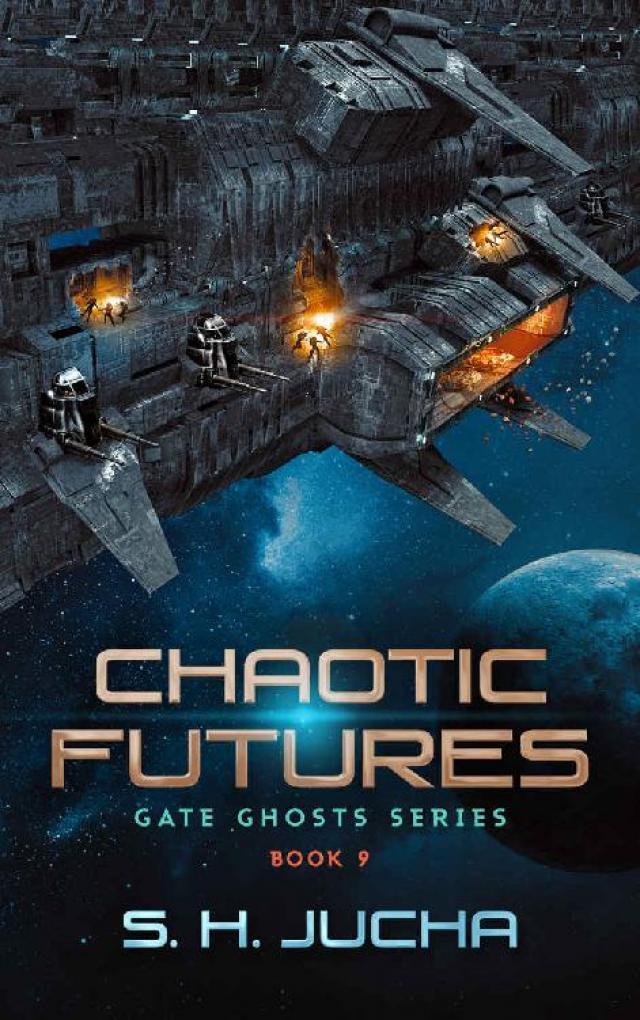
CHAOTIC FUTURES
Gate Ghosts Book 9
S. H. JUCHA
This book is a work of fiction. Names, characters, places, and incidents either are products of the author’s imagination or are used fictitiously. Any resemblance to actual events or locales or persons, living or dead, is entirely coincidental.
Copyright © 2023 by S. H. Jucha
All rights reserved, including the right to reproduce this book or portions thereof in any form whatsoever. Please do not participate in or encourage piracy of copyrighted materials in violation of the author’s rights. Purchase only authorized editions.
Published by Hannon Books, Inc.
www.scottjucha.com
ISBN: 979-8-9875305-4-2 (e-book)
ISBN: 979-8-9875305-5-9 (softcover)
First Edition: June 2023
Cover Design: Damon Za
Acknowledgments
Chaotic Futures is the ninth novel in the Gate Ghosts series, which relates the stories of the descendants of Earth’s fourth colony ship.
I wish to extend a special thanks to my independent editor, Joni Wilson, whose efforts enabled the finished product. To my proofreaders, Abiola Streete, David Melvin, Ron Critchfield, and Tiffany Crutchfield, I offer my sincere thanks for their support.
Pat Bailey read The Silver Ships, my first novel, and he became a huge supporter of my books. I accepted his offer to become a proofreader, and he was always diligent in searching out my errors. As happens in life, it’s often too early to say goodbye to friends. Pat, thank you for the time we spent together and your efforts on my behalf. I’ll miss you.
Despite the assistance I’ve received from others, all errors are mine.
Glossary
A glossary is located at the end of the book.
Contents
1: Dakargk’s Onus
2: A Gleaming City
3: Chiefs’ Revenge
4: Plebiscite
5: Projects One, Two, Three
6: Dangerous Elevens
7: Failure Isn’t an Option
8: Revenge
9: An Amended Agenda
10: Territorial Eviction
11: Resolute
12: Elder Challenge
13: Death to Invaders
14: Where’s the Warship?
15: Unwelcome Rival
16: State Your Business
17: AI Retaliation
18: Understand Who You Are
19: Elders’ Secret
20: It’s Getting Crowded
21: We’ve More Visitors
22: AI Challenge
23: It’s Open
24: Gurderg’s Opportunity
25: New Darmian City
26: Free Choice
27: Challenge Accepted
28: New Sentients
29: Time’s A-Wasting
30: Time to Wake
31: What Do You Want?
32: Quellers’ Secret
33: What to Tell the Citizens?
34: Grievous Error
Glossary
My Books
The Author
1: Dakargk’s Onus
IMPERIUM, PALTUR SYSTEM
KRACKUS HOME WORLD
Elation filled Executor Dakargk. He envisioned the moment he would have his revenge on an individual who had irked him for much too long. The morning’s assembly meeting would begin with the presentation by the four commanders who had been tasked with destroying the warship raider.
The governor’s records, downloaded from three different flagships, clearly demonstrated that the raider hadn’t been wiped from Imperium space.
Under the decree placed on the commanders and their advisors by Dakargk himself, the fleets weren’t to return to the Imperium home world until their task was accomplished.
Commanders Deckus, Gretren, Fastark, and Goskerk would share the assembly’s judgment. In addition, Imperator Doktorg and advisors Tarbar and Ragirt would be included in the decision.
What happened to six of the individuals didn’t matter a whit to Dakargk. It was Inquisitor Tarbar’s fate that occupied every fiber of his being. The executor ached to hear the assembly’s announcement. He anticipated Tarbar’s crest flattening in defeat. At the same time, he wanted the inquisitor to see his crest rise in triumph.
Dakargk was so sure of the outcome that he’d planned a lavish meal at his residence with some close associates. The extravagant display of Krackus specialties would demonstrate his domination of an irritant — an inquisitor, no less.
The transport delivered Dakargk early to the assembly hall, and he ascended to his place on the dais. His orbs gleamed, as he regarded the few executors who were present.
As the time to start drew close, Dakargk noted that two executors had yet to arrive. This wasn’t unusual. However, the pair was Presiding Executor Rebtar and Executor Gaketork. The lateness of one or the other might have caused Dakargk some minor concern. But, more than likely, the pair was speaking privately, and Dakargk was disturbed by what that might mean. He glanced at the empty tables and chairs in front of the dais, and his elation withered, to be replaced by burning anger.
Rebtar and Gaketork finally arrived and took their seats. They had brief discussions with their senior admins. Then they turned forward, and Rebtar opened the proceedings.
Dakargk noted that neither executor looked his way, which didn’t bode well for his moment of revenge.
An assembly staff member led the seven presenters into the hall. The four commanders sat at one table, and Doktorg, Tarbar, and Ragirt occupied the other.
Fleet imperator crests were held stubbornly upright, while Doktorg’s and Ragirt’s were hesitantly half-raised.
It bothered Dakargk that Tarbar appeared confident. Then again, the executor considered that the inquisitor was putting on a false front for his benefit.
“Our first presentation concerns the fate of the raider warship,” Rebtar announced. “The commanders may speak first.”
To the surprise of the assembly, Goskerk, the most junior commander, rose to address the executors. “By general agreement, I’ve been selected to deliver our presentation,” he said. “One reason is that my flagship was acting as a spotter in the Monforth system when the raider arrived. The other is that our peacekeeper’s position allowed us to observe most of the raider’s actions, including its final state.”
“Is this really necessary?” Dakargk interrupted. “Our committee was clear that these four commanders weren’t to return to Imperium unless the raider was destroyed. I assume that every executor has seen the preliminary images supplied by the governor. Clearly, the raider was under power when it exited the Monforth system. There’s only one decision that the assembly can reach.”
Dakargk expected a swell of support for his outburst, but the assembly remained eerily quiet. Of particular note was Rebtar’s silence.
“Presiding Executor Rebtar,” Gaketork said, “I would like to hear the executors’ preferences as to whether they want to see the complete presentation before a decision is reached.”
Rebtar queried the assembly. Dakargk and three of his most ardent supporters were the only dissenters.
“Commander Goskerk, continue,” Rebtar instructed.
Gaketork’s admin cued the first vid for Goskerk.
“When the alien warship arrived, the call was placed to the fleets to rendezvous in the Monforth system,” Goskerk began. “During the coming cycles, our peacekeepers arrived on the far side of the inhabited planet to hide their energy signatures from the raider. Of the one hundred twenty-eight ships in our combined fleets, sixty arrived before the warship made its move. It’s believed that the raider imperator detected our peacekeepers’ energy signatures.”
“If that were so, then why did a battle take place?” an executor asked. “Why didn’t the raider flee?”
When Goskerk paused, the executors were taken aback that he deferred to Imperator Doktorg.
“Are we not to hear from our vaunted commanders?” Dakargk groused. It was a sign of the assembly’s mood that no one paid attention to his interruption.
Even Doktorg started as if he hadn’t heard Dakargk. He was intent on laying out the facts. “We’ve stated previously that the extent of the warship’s capabilities was unknown,” he said. “However, a committee of executors heard from a construction platform that aliens from the raider gained access to our peacekeepers. The aliens knew exactly our peacekeepers’ capabilities.”
Several executors, who’d recently returned to Imperium, listened intently to their admins, who updated them on what had transpired in their absence.
“Obviously, the raider imperator reached the decision that his warship could deal a crippling blow to our ships,” Doktorg finished. Then he sat down, while Gretren took his place.
“Of the four commanders, only Fastark and I were on the planet’s far side, when the raider attacked,” Gretren said. “We formed the six spears that we believed would give us an advantage over the warship’s armament.”
“It’s evident to all of us that your strategy was an unmitigated disaster,” Dakargk challenged. “Your failure to employ standard fleet maneuvers cost the empire ships and crews.”
Gretren raised a hand and pointed toward Gaketork’s admin. “The projection scenario, if you would?” he asked.
As the graphics rolled, Gretren narrated, “We thought this question might arise. Our data records detail exactly the amount of weaponry expended against us in the fractions of time in which we passed the raider. Typically, a fleet would have formed a wall. As there were but sixty ships, they were divided evenly between Commander Fastark and me. This is our projection of what would have happened with a standard tactic.”
The executors watched a wall of peacekeepers encounter the raider. Most of the wall was too distant to be of use in the fight. In the limited time allowed, only a few peacekeepers were able to launch on the raider. However, the raider was able to spread its armament in a wide swath and devastate a circle of ships as it passed through the wall.
“We estimate a loss of eight to nine peacekeepers, with possibly a few more damaged,” Gretren said. “In this engagement, we would have done limited damage to the warship, and we’d have lost the element of surprise.”
“But with your strategy, your six spears lost you twenty-one peacekeepers,” a Dakargk supporter pointed out.
Tarbar rose to stand beside Gretren. “Did we misunderstand the committee?” he asked. “The commanders were told to destroy the raider. No thought was given to the inordinate amount of time we spent trying to locate the warship. We attempted a trap, but we were outwitted. Only our unusual formation managed to deal enough damage to the raider to prevent it being a problem for the Imperium Empire.”
“How did you reach that conclusion?” Rebtar requested.
Goskerk stood to reply, and Gaketork’s admin cued the next vid.
“My flagship followed the raider as it sought to exit the Monforth system and escape into the dark,” Goskerk said. “We recorded every manner of data that we could capture, and I won’t bore you with the details. Instead, I want you to pay attention to the raider’s engines.”
A second vid replaced the one in the projection.
“This is time-lapse with the accompanying thrust measurements,” Goskerk continued. “You’ll notice that by the time the raider clears the system’s gravitational pull, it’s lost nine of its twelve engines. Furthermore, the outputs of the three remaining engines are fluctuating. They’re in danger of shutting down.”
Another vid started.
“To ensure that the raider hadn’t flung mines at us as we chased it, my flagship took evasive measures,” Goskerk narrated. “From these different perspectives, we were able to collect imagery about the raider’s hull. You can see the damage.”
“The ship appears intact,” Dakargk argued. “That means it’s still capable of harming our worlds.”
The standing participants sat down, and Ragirt stood. That was the admin’s cue for the engineer’s part of the presentation.
From Gaketork’s point of view, the seven participants had spent a great deal of time thinking through the possible objections to their actions and the results. Then they had studiously set out to refute each and every one of them.
“These are a series of stills with image enhancement,” Ragirt said.
The assembly watched shots of raider shuttle doors go past until they grew bored.
“Could we have the point, Engineer Ragirt?” Rebtar asked in annoyance.
“But there are many more, Executor Rebtar,” Ragirt offered in mock lament. “Oh, well, the rest are all the same anyway.”
“All the same what?” Rebtar pressed.
“Your pardon, Executor,” Ragirt replied. “I thought the point was obvious. Every pair of doors I’ve showed the assembly demonstrates minor to major buckling.”
Suddenly, the executors were alert.
“The aliens can’t launch their shuttles from those bays,” an executor commented aloud.
“That’s correct,” Ragirt responded. “Now I’d like you to look at this next sequence.”
Ragirt’s casual approach had caught the executors’ interest. They were prepared to study the next series. He didn’t bother to offer an explanation. Instead, the final image froze in the display, and he waited.
“What are those large tubular items that appear trashed?” an executor asked.
“More than likely, they’re generators,” Ragirt replied. “A ship requires many generators to power its systems. Typically, the generators and engines work in tandem.”
“Then you’re telling us that the raider’s engines are failing, and it’s lost much of its generators,” Gaketork surmised.
“That’s correct,” Ragirt replied.
“Anything else?” Gaketork inquired. He saw the participants laying a powerful argument for the raider’s ineffectualness.
Ragirt nodded, and the next series played. “These images were collected from the battle and our trailing ship,” he explained. “The first stills are blurry because of the velocities with which the objects were moving, but we’ve no doubt that what you’re seeing are bodies.”
“Despite the lack of definition, it’s obvious that these bodies aren’t of the same alien race,” Dakargk exclaimed, thinking he’d found an error in the presentation.
“No, they aren’t, are they?” Ragirt replied. “Did you expect them to be?”
The executors’ widened orbs indicated that they’d assumed a single race occupied the ship. They worked to correct their thinking, wondering what the revelation meant.
“Regardless of the origins of these races,” Ragirt finished, “the warship spewed bodies during the battle, as it exited the system and as it made for the dark.”
“What does this tell you?” Gaketork inquired.
“Even as the raider made its way out of the system, it continued to experience structural failures, which opened bays, corridors, and cabins,” Ragirt replied. “The result was explosive decompression that threw bodies, equipment, and odd material into space.”
“All this evidence is fine,” Dakargk interrupted again. Immediately, he was shouted down. Rebtar and he were taken aback by the anger evident from a vast majority of the assembly.
The presenters saw a glimmer of hope that the assembly might give them a reprieve from Dakargk’s onerous requirement.
“Please, continue, Engineer Ragirt,” Gaketork requested politely into the eerie quiet.
“The sum of our information is that the raider is heavily damaged — engines, generators, hull, and bay doors,” Ragirt summarized. “In addition, the ship has lost numerous individuals, and I’m not referring to just those who were ejected. It’s more than likely that an equal or greater number have died within the ship.”
“What does all this data lead you to presume about the warship?” Rebtar asked. He was keen not to be associated with Dakargk, who was quickly becoming a pariah among the executors.
Ragirt resumed his seat, and Fastark rose.
“We were tasked with eliminating the raider, who proved far more dangerous than any of us could have presumed,” Fastark stated with barely controlled anger. “In the brief moment that we passed the warship, we lost twenty-one peacekeepers. However, our six-spear strategy, which I credit Imperator Doktorg with originating, managed to heavily damage the raider. I believe we’ve done our duty.”
Fastark sat down heavily. He didn’t think he’d fully expressed his thoughts, but he was loath to continue speaking for fear of lashing out at the executors.
The presenters could hear grumbling conversations between the executors and their admins.
Gretren moved to stand, but Deckus held his forearm.
When Deckus stood, he drew the executors’ attention from their admins.
“My flagship and accompanying ship weren’t at the battle,” Deckus said. “My pair arrived soon afterward. However, I’ve spent many cycles reviewing the imagery collected by the surviving peacekeepers. Undoubtedly, you’re mulling over the success or failure of our mission. I would ask you to consider these questions. Where will the raider go to resupply and get repairs? With its engines in shambles, can the raider even reach that destination?”
Tarbar rose quickly. “I would add this question,” he said. “Who in the empire is prepared to help these aliens? They must not only want to aid them, but they also must have the technology.”
This wasn’t the only thing Tarbar would get wrong in his lifetime. But, with the knowledge that any Krackus possessed, he could be forgiven for offering these thoughts.
The presenters were excused to wait the assembly’s deliberations.
In the anteroom, Ragirt inquired, “How does anyone think we did?”