Vortex incursion, p.5
Vortex Incursion, page 5


“It’s everyone’s opinion what the SADEs will do if we repeat the exercise using the final Tritium set,” Korvath explained. “Why can’t we use that?”
“How?” Deckus asked, intrigued by the idea of demonstrating Krackus superiority to the SADEs.
“I’m not sure of the final machinations, Imperator Deckus,” Korvath replied. “We’re sure the SADEs will remove the dissidents. What if we primed the Tritiums with a message for the SADEs?”
“A message?” Deckus inquired.
“A message, a proposal, or some questions,” Korvath temporized.
“I see your meaning, Korvath,” Deckus replied. “At this point, we can’t find a way to test our probe’s vulnerability for life support, but we’ll have an opening in which to learn things about this race. The Tritiums will tempt the SADEs to respond to us. Is this feasible, Ragirt?”
“Without doubt, Imperator Deckus,” Ragirt replied. “We know the SADEs can manipulate our systems, and Kreus has assured us that they’ve learned our language. I imagine they’ll record their responses on our telemetry systems.”
“Now the question becomes what to tell the Tritiums,” Deckus mused. “In the meantime, Ragirt, prepare the probe for another launch. Korvath, Kreus and you will communicate our offer of an Imperium pardon to the Tritiums, but not before you and I discuss strategy. I must think of this, and I’ll let you know when I’m ready.”
The comms officer silently signaled to Gretren that the fleet commander had dropped off the conference.
“End of discussion,” Gretren announced.
“It can’t be,” Hobar insisted.
“Hobar, you’re welcome to call Imperator Deckus and tell him that you’ve more to say,” Gretren replied.
Hobar glared at Korvath and then stormed off the bridge with her scientists in tow.
Ragirt touched Korvath on the shoulder. “On the one hand, your ideas are imaginative and further our goals. On the other hand, your relationship with Hobar is deteriorating.”
“Through no effort of my own, I think it began to crash the moment I met her,” Korvath replied disappointedly.
Ragirt patted Korvath’s shoulder companionly. Then the engineers left the bridge with Ragirt.
Korvath regarded Gretren with a dispirited expression.
“Imperator Deckus will protect you, Korvath, as long as he’s fleet commander,” Gretren said. “However, never seek an Imperium appointment. Hobar will destroy any possibility you have of receiving one.”
“Understood,” Korvath replied. He had to wait out his entire duty rotation before he could speak to Kreus, and he chose to order food before he connected.
“You did well, Korvath,” Kelter, the Gorder, said when the link with Kreus occurred.
Korvath assumed that was going to be the future’s default connection. He’d be speaking with Kreus and Kelter.
“It proceeded fine up to the point when Deckus announced that he and I would strategize together,” Korvath responded in irritation. Then he heard Kelter’s soft hissing.
“It’s not humorous,” Korvath pointed out. “I’ve no idea what to say to the imperator.”
“And you don’t think Deckus will spot your queries?” Korvath inquired.
“That will be our task,” Kelter replied. “There will be a sufficient number of them, and we anticipate Deckus will eliminate some of them. In the event that he asks you why a question is included, you can say that you wanted to provide him with as many options as possible from which he could pick and choose.”
Korvath was mollified by the clever excuse that Kelter had offered him.
“Kreus, knowing that you heard about the pardons, I suppose you communicated them,” Korvath said.
“Then this experiment is going to happen,” Korvath lamented. “This despite not knowing if the first Tritium set survived.”
Kreus replied.
“How did you come by that decision?” Korvath asked, his head snapping upright to listen.
“For endangering small sentients,” Korvath interjected.
“The SADEs might not have had sufficient time to communicate the Tritiums’ passing,” Korvath ventured. His comment was met with silence, and he considered who Kreus had described as inhabiting the alien ship. “Mobile digital sentients would have had the time,” he concluded.
“There you have it,” Kelter said. “I believe as Kreus does that we’re dealing with an extremely advanced culture in their technology and in their social structure.”
Korvath sat looking at the remains of his meal. He ended the call and ordered the tray to be removed. Then he curled into his nest to think. Sleep did come, but it was restless. In his dreams, tiny Tritiums were flung into the cold and dark of space.
In the middle of a particularly bad spate of images, Korvath jerked awake. He climbed out of the nest, struggled to the refresher, relieved himself, and lay back down. When sleep finally came, he managed to get several hours of rest before he was required on the bridge.
“You look like you haven’t slept,” Gretren commented to his declinator. “Worried about your upcoming conversation with the fleet commander or is it something else?”
Korvath grimaced. “I think I’m a decent second-in-command, but I’m unprepared to be the fleet commander’s advisor or to direct these probe experiments,” Korvath replied.
“Let me first say that you’re an excellent declinator, Korvath,” Gretren remarked. “It won’t be long before you’re promoted to peacekeeper imperator. As to advising the fleet commander, would you rather Hobar do that in your place?”
Gretren gurgled when he saw the distasteful expression on Korvath’s face. “I thought as much,” he said. “I have one piece of advice for you, Korvath,” and he beckoned with a single digit.
Korvath leaned close, and Gretren placed his beak close to Korvath’s tympanum membrane.
“Do your best to keep your advice private,” Gretren whispered.
When Korvath pulled back, he witnessed Gretren’s brief wink.
“You’re relieved of duty, Declinator,” Gretren announced clearly. “Your conference with the fleet commander takes precedence. Be sure that you don’t disappoint him.”
“Yes, Imperator,” Korvath replied smartly. Then he exited the bridge, returned to his cabin, and crawled into his nest. Sleep came, and no Tritiums died in vacuum.
In the afternoon, Korvath woke, dressed, and checked his messages.
Kreus had provided a link to a document, and Korvath transferred it to his service. Then he opened it. He was stunned to see a list of several hundred topics. Beneath each header were a series of questions and comments designed to elicit the SADEs’ responses.
Korvath checked the message’s header. Kreus had said, “We suggest you winnow these headers to not more than thirty or forty and reduce the ancillary details to two to four. That will appear as if you’ve been hard at work.”
A gurgle escaped Korvath’s beak. His thought was that if he’d worked hard he might have come up with ten or twelve questions, without subheadings.
“Importantly,” Kreus continued, “you’ll note that the headings are color coded. Provide an even mix of the two colors in your final submission.”
Selecting two headers, one green and one blue, Korvath studied the header categories and their additional questions and comments. He had to give Kreus and Kelter credit. He found it difficult to say which color indicated an approach Deckus would prefer and which color interested the dissidents.
While studying the lengthy document, Korvath received a call from Kreus.
“Conditional?” Korvath queried. That didn’t make sense to him.
“What’s the condition?” Korvath inquired.
“The probe won’t be programmed to return?” Korvath asked.
Korvath considered the SADEs’ capabilities, which he hadn’t done previously. He realized that the digital sentients could record the conversations, edit them, and return the final product to the probe. Then they had the wherewithal to launch it through the vortex.
The conversation with Kreus had no sooner finished than the fleet commander called.
With trepidation, Korvath accepted the link.
“How is the work going, Korvath?” Deckus asked congenially.
Korvath decided to blend truth with recent circumstances. “I wrestled with the approach last evening, and nothing occurred to me. After some restless sleep, I found this afternoon has been productive.”
“Good to hear, Korvath. I’m counting on you,” Deckus said. “I must admit that I’ve been intrigued by your suggestion. However, it won’t work if we can’t ensure that an exchange will take place and we’ll get a summation.”
“On those points, I’ve a few ideas,” Korvath replied.
“That’s what I like to hear,” Deckus replied happily. “If we can get the aliens to think that we’re willing to communicate, it could open doors for us. Who knows, Korvath? They might be foolish enough to make us an offer to share access to their worlds and their tech.”
Deckus gurgled at the thought that the SADEs might fall into the trap that he thought Korvath had suggested.
“Well, Korvath, when will you be ready to share?” Deckus inquired.
“I’ll be ready tomorrow, Imperator,” Korvath said.
“Then we’ll meet aboard my peacekeeper at mid-cycle,” Deckus replied. “Notify me before you board your transport.”
After the fleet commander ended the call, Korvath stared at his monitor and the document it displayed. “How did I get myself involved in things so far over my head?” he muttered.
When Korvath informed Gretren of his appointment with Deckus, he was excused from duty for the entire rotation.
The next day, Korvath approached Gretren to request permission to exit the ship.
“Be smart, Korvath,” Gretren warned. “Deckus isn’t a fool. You need to play the role of declinator, not Imperium appointee.”
“I understand,” Korvath replied. He’d already sent his version of the document to the fleet commander. Then he requested a comms officer inform the commander’s peacekeeper that he was en route.
Korvath was met by the ship’s declinator, who led him to Deckus’s suite. The salon was spacious with comfortable furnishings for the fleet commander.
“Come, sit, Korvath,” Deckus invited.
A crewperson offered Korvath food and drink, which he placed on a small table by Korvath’s side.
“I’ve been reviewing your document, Korvath, and I must tell you that I’m impressed,” Deckus said, motioning the crewperson away with his fingers. “I’m especially pleased with your idea on how to entice SADEs to respond to the Tritiums’ queries. Now we must convince the Tritiums to follow the plan.”
“Your pardon, Imperator, I’d thought that was part of my duties,” Korvath replied. “I took the liberty of speaking to Kreus about the need for the Tritiums to agree to this requirement as part of the conditions for their passage through the vortex.”
Part of Korvath’s brain yelled at him, Liar, liar.
For just an instant, Deckus’s mouth opened. Then he closed his beak. “If this ploy works, Korvath, you might have your own peacekeeper sooner than you think, and I want you in my fleet. What do you think of that?”
Korvath’s mind was spinning. The only thing he could think to say was, “I’d be honored, Imperator.”
“Of course, you would,” Deckus replied. “Now to work. Here’s my first question. Should we cut the document down, or do you think we should prep the Tritiums with the entire list? We don’t know how much time there will be for the exchange.”
Korvath saw the opening Kreus had wanted, and he seized on it. “I think the SADEs are as curious about us as we are about them,” he replied. “In this case, I think they’ll engage the Tritiums for as long as our dissidents have questions.”
“Understandable, Korvath, but will we get a copy of the entire exchange?” Deckus inquired.
“Hard to say, Imperator,” Korvath replied, remembering Gretren’s warning to play the part of the lowly declinator in the fleet commander’s presence. “Based on the SADEs’ exchange with Kreus, I believe they’ll take the chance that we’re willing to communicate.”
“We did fill space with our missiles in an attempt to eradicate them,” Deckus pointed out.
“And they didn’t retaliate,” Korvath reminded Deckus.
“True,” Deckus said, nodding. “Then we’ll give the Tritiums the entire document, Korvath. Well-done! Now let’s enjoy the food and drink. I had my special reserves raided for you.”
When Korvath boarded the transport for the return to his peacekeeper, he was in a daze. Part was due to the drink Deckus had provided, which Korvath found to be superb, as befitting the commander’s status. The other aspect of his whirling thoughts was the feeling that he was a mere game character, and the players moved him about, as it suited their purposes.
Korvath knew who the players were and what they wanted. What he dearly wanted was to resign his position as a game piece, but, at this late date, that was impossible. He recognized his duty to the fleet and his imperator, but his conscience warred with that commitment.
The conversations with Kreus and Kelter had convinced Korvath that the dissidents had their citizens’ rights arbitrarily usurped by the Imperium. If the fleet represented the Imperium, he wondered what that meant about his duties as a declinator. He reached the conclusion that, as a fleet senior officer, he was partially responsible for the dissidents’ persecution.
At the present time, there was nothing for him to do. He had to play the parts assigned to him. To his relief, Kreus made the pieces work.
A peacekeeper traveled to Helgart and collected the Tritium set.
Korvath was relieved of duty to manage the dissidents. Gretren had assumed that was what the Tritiums would want, and Korvath hadn’t argued.
“Korvath,” the young Tritiums had chorused when they saw his face peer into their carrier case.
“I sincerely hope you’re joined with your elders,” Korvath whispered.
“Be of good heart, Korvath,” the Tritiums replied. “We understand the risks, and we embrace them.”
Throughout the engineering and medical processes, Korvath had the opportunity to engage the youthful set more than he did the elders. The more he chatted with them, the more he admired their resolve.
To the Tritiums, it wasn’t just about facing the dangerous vortex passage. It was much more than that. They sought an opportunity to engage a race who might be willing to face the Imperium Empire. To three small dissidents, that was worth any amount of risk.
“What of the document you received?” Korvath had inquired at one point, while they waited for medical to process their samples from the Tritiums. He’d received the high-pitched sound that indicated their amusement. “What don’t I understand?” he’d queried.
“Many Helgart inhabitants contributed to the document,” the Tritiums replied. “It was an intensive effort. After it was sent to you, we enjoyed guessing which of the headers you’d keep. We were encouraged that you selected some of ours. Although, no one could compete with Kelter and his friend, Baltart. Together, they represented half of the suggestions you kept.”
“Then you’ve no need for a copy,” Korvath surmised.
“Do you see a device among us?” the youthful dissidents inquired.
Korvath didn’t, and he realized what had occurred. The fleet commander chose to drive the experiment, and the usual responsible parties had been left out of the communications loop. It left the dissidents free to be the drivers of the machinations.
“Do you think you’ll manage to convince the SADEs to participate?” Korvath asked. Again, he heard their mirth.
“You’re forced to maintain balance between your duties and your thoughts for the Helgart population, Korvath,” the Tritiums replied. “We’ve no such restrictions.”
“What does that mean?” Korvath asked.
“It’s best that you display surprise at the SADEs’ response,” the Tritiums chorused.
The conversation was interrupted by the chief medical officer’s return. He pronounced the trio fit to journey through the vortex. Immediately afterward, engineers prepped the probe for flight, and Korvath transferred the Tritiums inside the probe. They cheerfully waved goodbye to him, and Korvath did the best he could to show cheer.
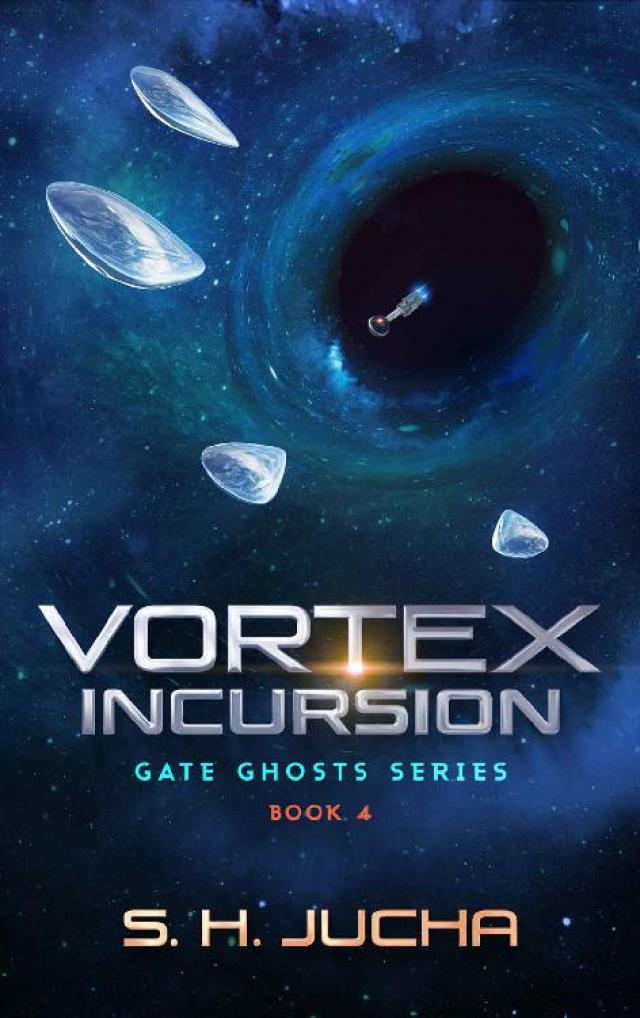
An hour later, the second triplet of Tritiums entered the vortex, which flared with its usual burst of energy.
5: The Forty-Five
CARRIER AQUARIA
DELHART PLANET
The mickie had been on the Alexander’s controller with Gat’r, who was showing his companion the intricacies of the vast data library.