

Station six, p.1
Station Six, page 1


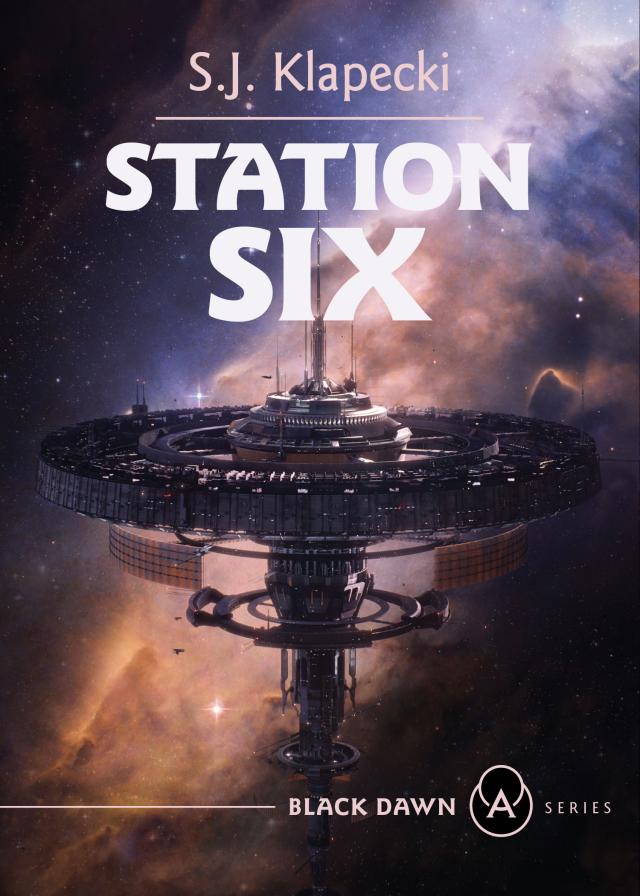
S.J. Klapecki
STATION
SIX
About
With the Black Dawn series we honor anarchist traditions and follow the great Octavia E. Butler’s legacy, Black Dawn seeks to explore themes that do not reinforce dependency on oppressive forces (the state, police, capitalism, elected officials) and will generally express the values of antiracism, feminism, anticolonialism, and anticapitalism. With its natural creation of alternate universes and world-building, speculative fiction acts as a perfect tool for imagining how to bring forth a just and free world. The stories published here center queerness, Blackness, antifascism, and celebrate voices previously disenfranchised, all who are essential in establishing a society in which no one is oppressed or exploited. Welcome, friends, to Black Dawn!
To Joan; thank you
STATION SIX
Chapter One
Some sixty-million miles away from Earth, Max was hungry, nearly broke and standing in line for an ill-advised Everything Burrito. “Everything,” of course, still meant there was no meat; only off-brown, tasteless soy protein. But that was the price they paid for not being wealthy enough to go to the proper restaurants. They were still tabulating the money in their head, how they had three days left until payday but needed to eat before work and just didn’t have the damn time to make breakfast that morning. Their mind broke their current balance, plus payday, up into portions for rent, bills, HRT, food, and that meager sum just shrank further.
“That’ll be seven twenty-three,” mumbled the employee through his exhaustion. Poor man didn’t even have the time to cock his hat right. Max extended their hand, the corp-mandated pay-pad on the heartline of their palm passing under the laser reader. The machine beeped a merry tune, and Max turned around without saying thanks, hurrying off to work.
A twinge of guilt pulled at them as they considered their bank account shrinking: the debt they had to pay to LMC; the rent they had to pay to Kallihan Housing; a dozen more tiny costs and infractions and hits to whatever they made. In theory, there was a saving’s account—one they hadn’t checked outside an automated email cheerily informing them that at the current rate, they’d have “enough to retire by 2856! Only 723 years left!”
Fucking joke.
And overhead, as they moved through the food court, was the station owner. Not in person, of course. On the massive screens that flanked each side of the food court there was a blond man with chiseled features, a butt chin and so much product in his hair it looked like a congealed mass of platinum dye in the light. Mr. Ashe, CEO of LMC and personal overseer of this Station Six, was speaking his pre-recorded announcements.
“Hello, my LMC family.” Max wished they hadn’t broken their earbuds—what they would give for some chance to let electrodrone albums drown out his words. But they supposed the world hadn’t been fair thus far and wouldn’t start now. “I am pleased to report that because of our hard work, preparations for the future have been going along quite well. The Automated Future Plan is in full swing—all thanks to you. New vistas to explore are opening. New worlds are being made. And you all are vital to that. Remember: LMC leads the future. The future that we all build together. Any concerns about your coming employment opportunities may be directed to the relevant offices.”
Max concealed their rage. If they had just an ounce less restraint, an iota less fear, they would throw the burrito at the screen and start ranting. They couldn’t, of course. That’d get them arrested, searched, security would get involved. It would be a whole mess. They bit their tongue as they walked.
Seven weeks ago, automation had been announced. Seven weeks ago, Max felt the floor of the world fall out from under them. The entire station was going to be converted, made into a resort and vacation destination with exactly as few human personnel as it needed to stay functional. Every damn worker was going to be given a new “employment opportunity” elsewhere. Hearing that, reading the words, seeing over and over again the jobs available, struck Max like a harpoon to the heart. Mars. Io. Europa. The Asteroid Fields.
The writing was on the wall. If automation went through, LMC would just send them deeper into the solar system, trap them in another contract, another binding set of legal chains. Everything they had built here, such as it was, would be uprooted again. They had been displaced once, when they signed up for this station. They remembered the recruiter’s office clearly. Sterile, clean, eggshell colored and logo filled. The kind smile of the cute recruiter and the scratch of a stylus against a screen. A five-year contract to work on Station Six, followed by a trip back to Earth, provided they could pay off the cost of the trip—monthly installments, of course. It sounded good, what with all their other prospects dissolving after they gave up on college.
Those debts, starting with the cost of a roundtrip and compounded by rent and utilities and more, had done nothing but grow. Not through any fault of their own. Paid eight bucks an hour, they ended up splitting that up best they could, but between food, rent and utilities, it was never enough to fully cover the basics. Every month there was something that had to be shifted, an offer from the company to mercifully take on whatever Max couldn’t pay for and add it to that mountain. With interest, of course.
It was a long, long way to work, and they were already pretty late. Or would be. Slept all of ten minutes too late and now they had to cross the football-field-sized expanse of the food hall, after going through the elevators that lead from the apartment’s low floors all the way to the connecting point. Moving sidewalks ferried people back and forth—those who had the leisure to not walk. There was no such leisure for them, though. Max’s backpack, with a laptop, hard drives and a whole array of tools for accessing computers in variously illegal ways, pulled at their shoulder as they power walked through the crowds.
The station was huge. A city in the stars, as a faded poster on the wall reminded Max. Divided into sectors A to H, each one a small town with chemical, logistical, agricultural, residential, security and medical sections. Max had only ever seen a small slice of the whole station, of even their Sector A. There wasn’t much time to explore beyond their apartment, their favorite eateries and their workplace. A workplace that they were now rapidly approaching.
They got their ID ready as they made their way to a security officer—someone who looked less like the rent-a-cops they supposedly were and more like soldiers. Clad entirely in black armor with prominent bulletproof vests and tinted visors, they always looked like they were trying too hard to be threatening. The gun was enough; looking like the worst result from a low-tier loot box was just showing off. Of course, just because they looked overdressed didn’t mean Max wanted to antagonize them. So they quietly showed their ID to the officer and made their way to the transit hub.
As they passed through, they saw someone in the hall being searched up and down by a guard. He insisted he had done nothing wrong, but the guard said something about “illegal organizations.” Max felt sick as they walked by. A protest against the automation had been broken up a few weeks back with batons and clubs. Someone who had been putting up an unapproved poster was fired, arrested and sent back to Earth with full criminal charges for corporate vandalism and disturbing the peace.
They never felt safe, never felt unwatched. Security guards had come and inspected their apartment, searched through their things before. It was fun to talk shit, call them rent-a-cops, but every time Max passed one, they just hoped they wouldn’t be singled out. So far, they hadn’t been.
The entire transit hub smelled like ozone. The ionized hulls of docking spaceships leaked particles and bits of dust and everything else into the station every time they touched air. The ground around the docking bays were covered in that thin, gritty film. It wasn’t particularly dangerous if you didn’t disturb it too much. Cleaning robots were, of course, supposed to come in once a week. Their work was almost always erased by the day after, though. Too many ships, too few robots and a space too big for someone with a broom to clean it all up. With two floors, twenty hubs on each and hourly quotas, nothing could keep the docks clean.
The automatons that had already been delivered sat on the far, far side of the transit hub, where specialists and engineers imported from Earth only a few weeks previously were already hard at work setting them up. The sound of power tools and mechanical assembly rung throughout the mostly empty station. It was one of those between times, when nothing was supposed to be coming in, shifts were changing and people were absolutely bored out of their skulls.
One such bored person was Joseph, waiting for Max outside their shared office (really, more of a cubical with a computer that told them what was coming in and when) with an e-cigarette in his mouth and an annoyed expression on his face. He stood next to the ever-ignored “No Smoking” sign, his bright, orange eyes glinting in the harsh overhead light. Those eyes weren’t organic—at least the irises weren’t. Some barely thought-out decision to “stand out” years back. Tattoos crossed up and down his olive arms, bright flashes of color in avant-garde patterns that made him look halfway between a living modern art exhibit and an absolute douche.
“Ey, Max, you’re a bit late,” he said. “But I won’t hold it against you. Boss asks, you were here with me.”
“Yeah,” Max said. “Sure. The cameras will lie, too.” They gestured up to the CCTV that watched them all. Insectoid eyes, blinking red to let everyone know they were always observing. Joseph chuckled.
“Sure, they will—they’r e not dicks, are they? Anyways, kid.” Max bristled. They hated being called that, but never got him to stop. Never got him to give up the fact he was two years their senior. “So, when it comes to the meeting with Vic,” Joseph chose his words carefully. Max could see his expression shifting as he searched for the right mix of euphemism and directness. “She’s available tonight, if you got the time. Turns out she needs a little, ah, tune-up work. Told her you could provide. Does that work out?”
“Yeah, I think so.”
“Good. Now,” he looked up, suddenly aware of the cameras and their microphones, “we shouldn’t talk all too much about it now.”
“That works for me.”
The unspoken part, of course, was that Vic, or Victoria, was one of the more respected members of the Protection Forces—that particularly illegal organization within the already illegal Federation of Unions that so plagued the station, one that Max every so often was able to scrounge up enough to pay dues to. A bunch of rabble-rousing radicals who wanted more than the bountiful nothing that LMC so kindly charged them for.
Max and Joseph entered their shared office. Inside was a poster urging them to “Keep the Pace!” because they were “Building the Future!” It had been stripped away, with big tears and chunks pulled out by idle, bored, spiteful hands.
Max threw on their high-vis vest and strapped the velcro together. They checked the computer to see the schedule for today. In about ten minutes, there’d be the first ship. It was marked “Maritime Dynamo.” Max sighed, staring at the screen.
“More automatons for the Spire,” they said. It was matter of fact, defeated. More people would be replaced, be sent scampering for whatever dirt they could scratch a living out of.
“Aren’t those the guys who make those real human-lookin’ ones? You know, the ones people use as maids and shit?” Joseph stared down at the screen.
Max nodded. “Yep. They’re the ones the Spire jerks love so much.” Speaking a bit more freely than before, knowing there were at least a few inches of concrete between them and any camera’s microphone.
Joseph stroked his chin fuzz. “It’s always felt a little mocking. ‘Look at us, fuckin’ richer than god, we don’t even need people anymore,’ and all that. Seriously, this shit,” he tapped the screen, “it was a fucking omen. We should have done like the luddites and cracked them to pieces.”
“I don’t know if that would help,” Max said. “It’s just so damn tiring. They want us to work and work and work. Keep talking about how we’re building a future and, y’know, we might be, but none of this feels like it matters. None of it’s worthwhile. I just want something that matters.”
“Ah, yeah,” Joseph said. “I’m sure that’ll happen real soon.” Max felt the snide mockery slinking inside. They shook it off—Joseph being Joseph. The Federation was talking about better deals, about striking, about fighting for better wages and better conditions. That was enough, at least for Max.
“Joe, can we talk about this later?” Max asked. With the ever-present risk of someone overhearing, it wasn’t wise to keep talking.
He smirked and nodded. “Of course. We have work to do after all. Maybe this day’ll be a bit different from all the shitty days before, huh?”
“Asshole,” Max laughed.
Max and Joseph were met outside by Franklin, their boss. Wearing a long-sleeved button-up shirt that did almost nothing to hide his military cyberware, he looked like a mix of veteran, corporate stooge and regular family man. He was a middle manager, took care of a few of the sectors but largely just walked around to show everyone the bosses were watching and was not himself … the best boss, in Max’s estimation. Perhaps not evil or conniving but too much of a corporate hound to do anything besides bark upper management’s orders. And it was always annoying to have to shut up and be somewhere-adjacent-to-respectful around him, but such was life.
“Hey, boss,” said Max, giving a wave as they got within earshot. Franklin waved back with a silver hand.
“Morning,” he said. “This coming shipment’s looking to be pretty important for the next phase of the Automated Future Plan. I’m sure you’re all up to the task. Have you been looking at the exciting opportunities?”
Max couldn’t tell if that was sarcasm or corporate-required speak. It might have been both—Franklin and they had never spoken outside of work, and the conversations were confined to the mundane topic of shipments and crates. But the tone: Max couldn’t place it. They had the expected, corporate-approved answer ready.
“Yeah,” they said. Lying through their teeth, they continued, “Yeah, I’ve been looking at the stuff on Io—apparently they’re looking for skilled technicians and I figured I could at least apply. I don’t know if I meet the education requirements, but I don’t see the harm in trying.”
Franklin nodded sagely. “Of course, no harm in trying. You dropped out, right? They can look past that sometimes if you can show you have the skills they need.”
Max cringed a little. They had dropped out in their second year. Computer science. Learning how to code and program. They had told Franklin that—god, it must have been months ago and only the once. He’d remembered, of course. Of course, he’d remembered.
“Yeah, but I still had a few projects under my belt by then. I worked internships with a few companies, and I still have the contact information if I need people to vouch for me.”
“Good luck, Max,” he said. This, Max knew, was genuine. Warm. He knew, well as anyone, what was coming. He knew that this was probably one of the last times he’d be talking to Max. “We’re all building futures together, and that includes our own.”
So much talk of future. So much talk of building something better. It all rung hollow to Max. The whine of klaxons filled the air, and a loud, automated voice declared booming, “Dock Three: incoming vessel. Docking procedures initiated.”
The huge gate opened, and Max stepped back. It was an instinctive response, born out of fear. The one day that shit hadn’t worked, that the docking procedures had failed and things broke down was now branded into their brain. More muscle memory and emotion than recollection, they remembered that day in small doses. Grinding, snapping steel, sparks flying and the threat of decompression. Crying in the breakroom because they had been told they couldn’t leave—shifts never ended early. The whole dock had been shut down for a few hours as the situation was resolved. The traffic that had built up was hell. The docking of their pay hurt. But they were thankful they didn’t lose their job.
Even after that incident, the repairs the company had made were minor. Nothing more than what was needed to keep the traffic flowing. There was never time, never the resources needed to shut down the whole section. Commerce moved too fast, too blindingly fast, for there to ever be a chunk of time to allot to the days of repair.
But the gate opened now without incident. The seals worked and the back of the shuttle split apart. There were a few dozen shipping containers. Max and Joseph got to work in the ordained fashion—top to bottom, left to right. Instead of clambering over the containers, up ladders and such, they did it the right way. Bringing out that old scissor lift, Max drove over and raised themselves up, attaching the guide points. Magnetic hooks slowly slid the container off its companion. The sound of lightly greased metal sliding off itself grated against Max’s ears. Along the ceiling, magnetic hooks descended and attached themselves in conveyor-like fashion, sending the crate along the path to its destination. To be unpacked, its contents spilled out into the infinite shipping lines that crisscrossed the station, either in dedicated transport vehicles or by more basic tubes and conveyors.
Max often wondered just how arterial the station was, how connected it all could be. Obviously, quite a bit—the automation already present was mostly for transport and shipping around the station, bringing goods to and from the Spire and around the different sectors. But how many tunnels, nooks, crannies existed that they would never see?
Franklin watched with impatient nosiness. Max heard him talk to Joseph, telling him to hurry this up or quicken that up. Thirty minutes for a full unloading, and they were at ten already. It wasn’t Joseph’s fault—he was hardly taking his time. Max could see him at work on the magnetic hooks, ensuring they were safe, making sure they worked, that the power was connected to each one. He was following procedure and still being chastised for being too slow.


