

Crazy like a fox, p.1
Crazy Like a Fox, page 1


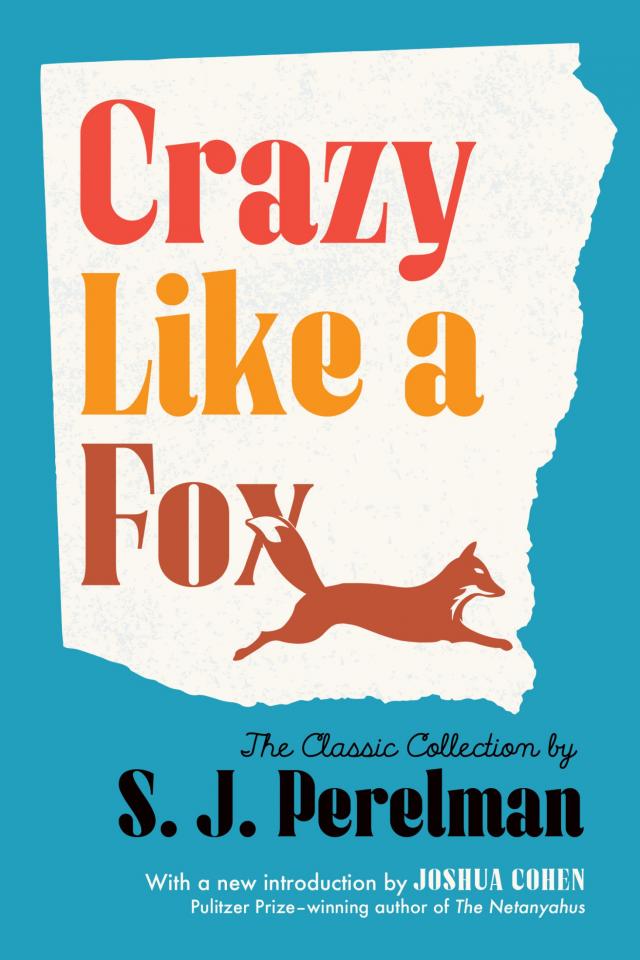
CRAZY LIKE A FOX
Introduction and volume compilation copyright © 2024 by
Literary Classics of the United States, Inc., New York, N.Y.
All rights reserved.
No part of this book may be reproduced in any manner whatsoever
without the permission of the publisher, except in the case of brief
quotations embodied in critical articles and reviews.
Published in the United States by Library of America.
Visit our website at www.loa.org.
Crazy Like A Fox copyright © 1929 by S. J. Perelman, renewed 1971 by S. J. Perelman. Reprinted by arrangement with Harold Ober Associates.
All rights reserved.
Illustration of fox on dedication page by Omar Mouhib.
Distributed to the trade in the United States by Penguin Random House Inc.
and in Canada by Penguin Random House Canada Ltd.
ISBN 978–1–59853–780-2
eISBN 978–1–59853–779–6
Contents
Introduction by Joshua Cohen
Kitchen Bouquet
Somewhere a Roscoe . . .
Waiting for Santy
The Idol’s Eye
Beauty and the Bee
Is There an Osteosynchrondroitrician in the House?
Abby, This Is Your Father
Buffalos of the World, Unite!
Sauce for the Gander
Frou-Frou, or Vertigo Revisited
Scenario
A Farewell to Omsk
Nothing but the Tooth
Woodman, Don’t Spare that Tree!
Strictly from Hunger
P-s-s-t, Partner, Your Peristalsis Is Showing
A Pox on You, Mine Goodly Host
Slow—Dangerous Foibles Ahead!
Footnote on the Yellow Peril
Midwinter Facial Trends
Counter-Revolution
The Love Decoy
To Sleep, Perchance to Steam
Down with the Restoration!
The Body Beautiful
Poisonous Mushrooms
Button, Button, Who’s Got the Blend?
Boy Meets Girl Meets Foot
What Am I Doing Away from Home?
Hold that Christmas Tiger!
Smugglers in the Dust
Beat Me, Post-Impressionist Daddy
Tomorrow—Fairly Cloudy
Sweet and Hot
Seedlings of Desire
Kitchenware, Notions, Lights, Action, Camera!
Captain Future, Block that Kick!
Adorable, Taxable You
A Couple of Quick Ones
1. Arthur Kober
2. Vincente Minnelli
Avocado, or the Future of Eating
You Should Live So, Walden Pond
Swing Out, Sweet Chariot
Second-Class Matter
Wholly Cleaning and Dyeing
Well, Roll Me in a Turkish Towel!
Physician, Steel Thyself
Pale Hands I Loathe
Insert Flap “A” and Throw Away
Farewell, My Lovely Appetizer
About the Author
Introduction
by Joshua Cohen
My toilet clogged the other day, so I called in my super, who came surly and got down to work, plunging, plungering, plumbing the porcelain depths with a literal snake, and lecturing me about comedy: the uses and abuses of, the power imbalances intrinsic to; the danger of parody and satire and the like becoming mere handmaidens of the regime . . . and I’m like, yo, hold up, did you seriously just say “mere handmaidens”?
But he was insistent, my super. Facing away from me, his hairy crack thrust up high with his efforts, he explained in a bowl-echoed voice that more often than not, to poke fun at something winds up backfiring; taking the piss out of something, or shitting on a thing comedically, just acknowledges the control that thing has over us and sometimes even reinforces and increases that control; he said that to subject something to ridicule or lampoon is frequently just a flattering form of cozying up to it and that most attempts to be funny about what are essentially not-so-funny things like political malfeasance and violence ultimately trivialize their harms and, in a way, make the joke-maker complicit in their damage.
“You do drugs?” he asked, switching from his Slav accent to a vaguely urban thug delivery that during the course of his discourse became stereotypically Black and stereotypically Hispanic and multiple unidentifiable diversities between. “Because, check me, brah, it’s like drugs, it’s like narc-ot-ics, it’s like any type of addiction: comedy’s a coping mechanism, a self-preserving defense; when you can’t deal with the world-as-the-world, mi güerito, you reach for a smoke or a vape or the powders sucked up the nose or a needle shot into the soft insides of the elbows . . . you pop pills beyond prescription, you spring for the supersize fries and the deep-fried shake, and in the same way you bingestream your ha-ha comedies on HuloFlix Prime Plus. It’s just another way of accepting your powerlessness and remaining a victim. Entrenching your victimhood episode by episode and training yourself to enjoy it unto the credits. Comedy changes nothing. It’s evil as hell. Now give me the wrench.”
I gave him the wrench—“Spasibo”—and he went about tightening, banging, clanging, as I reassumed my stance behind him and cradled my crotch.
“The idea isn’t original, of course,” he went on. “It’s ancient. Older than classical antiquity, older than the pharaohs. But you find it making quite a resurgence in the twentieth century with psychoanalysis that tells us that ‘there are no jokes,’ which I’m not sure Freud himself ever actually said, and then you have Marx or at least Marxism that tells us that farce is really only the neutralization or normalization of tragedy . . .”
He turned around and, wielding his wrench like a scepter, used its pincher to flush. The toilet flushed. He winked and gathered his tools and dripped his way through the living room. “Anyway,” he said, one wet stinking boot already out the door, “this theory about how comedy is the true opiate of the people and that it serves to numb them to the conditions in which they’re oppressed? To be honest, it’s a pretty hard argument to refute, so most of the time when I bring it up to the tenants they just, you know, make fun of it.”
The moment the door shut behind him, I half-ran half-slipped my way back to the bathroom—I’d been holding it in—and when I got myself settled inside the tile enclosure, I found he’d left a copy of this book atop the tank.
S.J. Perelman—the S is for Sidney, the J is for Joseph, and the style above is a bad Perelman-cast-before-swine rendition of his own that I already regret having tried. Born in 1904, a Brooklyn boy, the unobservant son of Polonized German Jews, Perelman bolted out of the gate as a cartoonist before switching decisively to verbal caricature and producing piece after piece (after piece) for The New Yorker, Esquire, Playboy, and scores of other once-general-interest-and-popular magazines that are now defunct. Not a few of his masterpieces first appeared columnized alongside ads for cars and suits and watches and hats and shoes. The magazines ran these masterpieces because they had to run the ads and not the other way around. Comedy perpetuates capital perpetuates comedy and that’s what’s called, ladies and gents, a round of applause. That’s also maybe why these pieces are filled with references to brands and celebrities that have long ceased to be household names: Vat 69, Chesterfields, Flexible Flyers, Schrafft’s. Lindy’s, Kaufman and Hart, the G.E. Electric Comforter, and, to quote one of Perelman’s lovely lists in toto, Toto, this only partially fictionalized stretch of stretchy ladies’ undergarments: “Flashes and Filmys, Speedies and Flexees, Sensations and Thrills, Snugfits and Even-Puls, Rite-Flex and Free-Flex, Smoothies and Silk-Skins, Imps and Teens, La Triques and Waikikis, Sis and Modern Miss, Sta-Downs and Props, OverTures and Reflections, Lilys and Irenes, Willo-th-wisps and Willoways, Miss Smartie and MisSimplicity, Princess Youth and Princess Chic, Miss Today and Soiree, Kordettes and Francettes, Paristyles and Rengo Belts, Vassarettes and Foundettes, Fans and Fade Aways, Beau Sveltes and Beau Formas, Madame Adrienne and Miss Typist, Stouteze and Laceze, Symphony and Rhapsody, Naturade and Her Secret, Roll-ees and Twin Tops, Charma and V-Ette, La Camille and La Tec.”
OK, OK, you skipped. But I’d advise you to go slower with the pages that follow this introduction. Maybe you might even read them aloud? And, whenever it’s appropriate, and especially whenever it’s inappropriate, do the voices? These pieces might seem disposable—they were written, at least they should’ve been written, to be disposable—and yet they appear to have endured and not only as academic fish-wrap or fudgy slices of nostalgia.
Perelman’s work is important (he would’ve hated that “important”) because it documents the exact mid-twentieth-century American moment that the experimental became fully and finally commercial; rather, it documents the exact mid-twentieth-century American moment that the commercial completely absorbed and neutered (or spayed, if you prefer) the mostly foreign if not exclusively European experimental through making fun of it—gloriously, uproariously, and without giving any effs besides effrontery of a startling egalitarianism.
Perelman satirizes Hollywood in a parody of James Joyce, with the result that both ballooned reputations ar e popped to sputter; he travesties radio-serials-and-commercials in the bleeding vein of Dostoyevsky, with the result that both are made absurd and absurdly equal. He performs similar stunts with noir tropes and Baudelaire, Broadway revues and Cocteau, product assembly instructions and existentialism. There’s a democratic glee in these antics, to be sure, but there’s also a sense, for me at least, of sadness—the sad realization attending the laughter that back during the Second World War, The New Yorker’s two hundred thousand or so regular subscribers could be expected to “get” these jokes and recognize the references.
Every few years, when his contract called for it, Perelman would slap together a collection of his magazine pieces (feuilletons he called them, “little leaves”) and Crazy Like a Fox, a retrospective from 1944, might be the best of his best-ofs. It was chosen by the U.S. military to be published in an Armed Forces Edition and distributed to the troops and as I read it, I couldn’t help but imagine some private first-class rereading the screenplay-pitch-meeting montage of “Scenario” or the hard-boiled “Somewhere a Roscoe” after digging some latrines in the Philippines or liberating Buchenwald.
CRAZY LIKE A FOX
FOR
LAURA
AND
ABBY LAURA
Kitchen Bouquet
Yesterday morning I awoke from a deep dream of peace compounded of equal parts of allonal and Vat 69 to find that autumn was indeed here. The last leaf had fluttered off the sycamore and the last domestic of the summer solstice had packed her bindle and caught the milk train out of Trenton. Peace to her ashes, which I shall carry up henceforward from the cellar. Stay as sweet as you are, honey, and don’t drive through any open drawbridges is my Christmas wish for Leota Claflin. And lest the National Labor Relations Board (just plain “Nat” to its friends, of whom I am one of the staunchest) summon me to the hustings for unfair employer tactics, I rise to offer in evidence as pretty a nosegay of houseworkers as ever fried a tenderloin steak. Needless to say, the characters and events depicted herein are purely imaginary, and I am a man who looks like Ronald Colman and dances like Fred Astaire.
The first reckless crocus of March was nosing up through the lawn as I sprang from the driver’s seat, spread my cloak across a muddy spot, and obsequiously handed down Philomène Labruyère—colored, no laundry. Philomène was a dainty thing, built somewhat on the order of Lois De Fee, the lady bouncer. She had the rippling muscles of a panther, the stolidity of a water buffalo, and the lazy insolence of a shoe salesman. She stood seventy-five inches in her stocking feet, which I will take my Bible oath were prehensile. As she bent down to lift her suitcase, she picked up the car by mistake and had it halfway down the slope before I pointed out her mistake. She acknowledged the reproof with a glance of such sheer hatred that I knew at once I should have kept my lip buttoned. After all, perhaps the woman wanted my automobile in her bedroom for some purpose of her own.
“You—you can take it up with you if you want,” I stammered, thinking to retrieve her esteem. “I’ve got plenty of others—I mean I’ve got plenty of nothing—I mean—” With my ears glowing, I attempted to conceal my gaffe by humming a few bars of “Summertime,” but her cold, appraising glance told me that Philomène had me pegged.
“Whuh kine place is this?” she rumbled suspiciously. “You mus’ be crazy.”
“But aren’t we all?” I reminded her with a charming smile. “C’est la maladie du temps—the sickness of the times—don’t you think? Fin-de-siècle and lost generation, in a way. ‘I should have been a pair of ragged claws scuttling across the floors of silent seas.’ How well Eliot puts it! D’ye ever see any of the old transition crowd?” I skipped along doing my best to lighten her mood, carried her several hatboxes, and even proffered a reefer, but there was no doubt in either of our minds who had the upper hand.
That Philomène was a manic-depressive in the downhill phase was, of course, instantly apparent to a boy of five. Several boys of five, who happened to be standing around and were by way of being students of psychopathology, stated their belief to me in just those words: “Manic-depressive, downhill phase.” At the close of business every evening, Philomène retired to her room armed with a sixteen-inch steak knife, doubtless to ward off an attack by her Poltergeist. She then spent the best part of an hour barricading her door with dressers, armoires, and other heavy furniture, preparatory to sleeping with the lights on. I say “sleeping” utterly without conviction; she undoubtedly molded lead statues of her employer and crooned to them over a slow fire.
But if her behavior was erratic, there was no lack of consistency in Philomène’s cuisine. Meat loaf and cold fried chicken succeeded each other with the deadly precision of tracer bullets. At last, when blood and sinew could stand no more and I was about to dissolve the union, I suddenly discovered that this female Paul Bunyan had grown to womanhood under the bright skies of Martinique, and I knew a moment of elation. I let it be bruited through the servants’ hall that I would look tolerantly on fried plantain, yams, and succulent rice dishes. That afternoon the kitchen was a hive of activity. The air was heavy with saffron, pimento, and allspice. I heard snatches of West Indian Calypsos, caught a glimpse of Philomène’s head swathed in a gay bandanna. With the care befitting a special occasion, I dressed negligently but with unimpeachable taste in whites and cummerbund, mixed myself several excellent stengahs, and sauntered in to dinner for all the world like an up-country tea planter. A few moments later, Philomène entered with what might be called a smoking salver except for the circumstance that it was stone cold. On it lay the wing and undercarriage of an even colder chicken, flanked by two segments of meat loaf.
After five minutes of reflection, during which, I am told, my features closely resembled a Japanese print, I arose and, throwing out my tiny chest, marched into the kitchen. The maledictions withered on my lips. Seated at the table, my black hibiscus blossom was tucking in a meal consisting of potage Parmentier avec croûtons, a crisp gigot, salade fatiguée, and pot de crème au chocolat.
“You—thing,” I said at length, and five minutes later Philomène was on her way back to St. Pierre.
Her successor was a chapfallen Australian cadaver who had reached his zenith as steward of a country club in Pompton Lakes and treated me and mine with the tired fatalism of a social worker. For some reason I never could fathom, unless it was that I occasionally wore a Tattersall vest, William persisted in regarding me as a racing man. He could recall every entry in the Cesarewitch Sweepstakes since 1899 and did, but faced with a pot roast, he assumed a wooden incomprehension that would have done credit to a Digger Indian. It was William’s opinion, freely given, that cooked food was dead food and that I would triple my energy by living on fronds. He knew a hundred different ways of preparing bran, each more ghastly than the last. For an avowed vegetarian (or “raw-fooder,” as he described himself), he spent his leisure in a puzzling enough fashion, polishing and whetting the superb collection of Swedish steel carving knives which was the one relic of his former magnificence.
William hadn’t been with us long before I began to feel uneasy, but I attributed my disquiet to Edmund Pearson’s admirable study of the Lizzie Borden case, which I was reading at the time. And then, on the sultry morning of August 4th—by an uncanny coincidence the forty-seventh anniversary of the Fall River holocaust—I came down to find awaiting me an exact duplicate of the breakfast which had been served on Second Street that fateful morning: warmed-over mutton soup, cold mutton, and bananas. I am not unduly superstitious, but there is no sense flying in the face of history. I left the check and the usual reference on William’s bureau and hid in the woods until traintime.
The time had now come, I felt, for plain speaking. I inserted two and a half inches in the metropolitan press setting forth my special needs. I wanted something stout and motherly, with floury hands and a hot apple pie cooling on the window sill. What I got was an ancient Latvian beldam named Ilyeana, who welcomed the idea of living in the country with such alacrity I was convinced she must be a fugitive from justice. Her cooking did nothing to contradict the impression; three nights hand running she served mulligan and coffee made in a tin and seemed strangely familiar with the argot of hobo jungles. How near I was to the bull’s-eye was revealed a week later with the arrival of a letter sent to Ilyeana by relatives in Canada. She ripped open the envelope and a newspaper clipping fell to the floor. I picked it up and was about to hand it to her when I saw the sinister heading, “Missing Man Believed Found.” The Mounties, idly dragging a lake near Moose Jaw, Saskatchewan, had recovered some parcels which, laid end to end, turned out to be the body of a man. “The victim’s sister, whom the authorities would like to question,” the account added, “is at present thought to be in Latvia.” Far from being in Latvia, the victim’s sister was standing at that exact moment peering over my shoulder in good old Tinicum Township, Pennsylvania. I cleared my throat and edged a little closer to the fire tongs.


