Paper son, p.27
Paper Son, page 27


I didn’t deny it. He stretched and reorganized himself in his chair. “But I’m feeling bighearted tonight. My report’ll go something like this. Convict name of Trevor McAdoo down on Parchman got in touch with Mr. Roberson, asked him to come down. What they talked about, I couldn’t say, there being some kind of confidentiality thing involved so Mr. Roberson, he don’t have to tell me. But probably, it had to do with Trevor knowing his brother Tremaine was planning to get into some bad business with Leland Tam, because after that, Mr. Roberson went to see Tremaine. Tremaine told him this story about wanting to deal drugs from out Leland’s store. Seems Leland tried to run him off with a knife, and Tremaine grabbed it up and sliced Leland in the leg. Then, for some reason, Mr. Roberson and Tremaine got in a tussle. Tremaine, he was that type, to tell a man a story and then kill him for hearing it. But it was Tremaine got killed.”
Lucknell stopped and gave me a long look. I didn’t say anything, waiting for the other shoe to drop.
“So we’re looking at the knife now, see if we can find Tremaine’s prints somewhere on it. To my way of thinking, even if we can’t, the D.A.’ll drop the charges against Jefferson. Mr. Roberson, he’s a pretty reliable witness.”
Meaning, I thought, he’s white, middle class, and works for a congressman.
“What Tremaine told him, you could call it hearsay, but there’s also such a thing called a ‘dying declaration.’ Since it ain’t a hundred percent clear when Tremaine said all this in relation to when he died, it might be one of those, so it would be admissible in a court of law. As to Jefferson, there’s still the jailbreak, but he claims he wasn’t in on it, didn’t even know what was going on until they got him to Burcell, and I’m inclined to think that’s true. D.A.’s got to sort all that out, but meanwhile, judge set bail and Captain Pete already went it.
“Now, then, there’s Captain Pete himself. He was harboring Jefferson. And you and Smith knew about it and didn’t say a thing.” Lucknell leered, giving me a moment to wonder about the Coahoma County Jail’s women’s wing. Then he grinned broadly and went on. “But I ain’t disposed to bother with that. Sheriff’s feeling real warm toward y’all for saving his nephew, and as to Pete, I don’t know’s it would do anybody any good for him to spend time as a guest of the county. Now, Mr. Roberson, he should’ve reported Tremaine’s death, of course. He could be charged with leaving the scene, even with manslaughter, but I do understand the delicate position the boy was in and I doubt if the D.A. will bother to make anything of it. It ain’t like Tremaine McAdoo was a prize citizen of Coahoma County.”
Lucknell gave me another long look, then stood and put his hat back on. “That right there is pretty much it. Anything else you got to talk about with kin, anything to do with old photographs and family records, the Great Flood and suchlike, none of that’s my business, and it’s just a story, anyway, so it won’t be in my report. You’re free to go.” Lucknell walked out, leaving the door open.
My mouth was open, too. I closed it and scuttled out before Lucknell changed his mind.
As I expected, I found Bill waiting on an orange chair by the entrance. Frank sat on one side of him and Pete and Jefferson on the other. They all stood, and nobody said a word as we turned and left.
52
The silence thing ended when we got to Pete’s. The hospitality of the Sheriff’s Department had included two patrol cars to take us home. I couldn’t swear Pete’s neighbors were watching from behind their curtains, but it seemed to me porch lights went on and people stepped out even before HB’s greeting barks cracked open the night.
“Everything’s fine,” Pete hollered, ushering the rest of us through the front door. “No casualties. Tell you about it in the morning. Thanks for your concern.” He shut the door, threw the bolt, and turned the porch light off. “Now,” he said, hands on hips, eyeing us all. He opened a cabinet and took out a bottle and four shot glasses. “Cousin Lydia, you want some tea?”
“Is that moonshine?”
“The best there ever was.”
“Then I believe I’ll join you. I mean,” I said, looking around at these three men who were related to me, and the one who wasn’t but whom I knew so well, “all y’all.”
Pete grinned, took out another glass, and poured. Moonshine was handed around. Then the questions and answers started.
Jefferson had gotten caught up on some things—like who Frank was—while they were waiting for me at the jail, but he was still behind on some others, like what had happened in Pete’s living room while Jefferson was hiding in the secret room behind the basement water heater.
“For the times when I win big,” Pete explained.
Jefferson replied, “Room’s empty, Uncle Pete.”
Pete took off his cap and whacked Jefferson on the arm with it.
After Jefferson was up to speed, all three of my relatives started talking at once. I pretty much just sat back and let them, as Bill was doing. I sipped at my moonshine, trying not to cough, deciding the warm glow I was beginning to feel was worth the struggle.
The guys finally ran out of steam. The pace of conversation slowed and the room quieted. As Pete poured more moonshine, I said, “All right, I have a question. Lucknell made it clear he knows the whole story—about the photo, about Reynold’s grandmother. But he’s not going to say anything.”
Frank nodded. “We are, though. Is that the question? I spoke to Reynold while we waited for you.” Frank rolled his shot glass between his palms. “For one thing, there’s still Trevor McAdoo. My promise to him—” Frank grinned. “It only worked as long as Reynold didn’t know about it. He just about blew his top.”
“He won’t pardon Trevor?”
“I never thought he would. I had to say it, to keep Trevor quiet until after the primary. I figured once Reynold was governor, Trevor could say what he wanted and we’d deal with it.”
“A politician whose staff tells lies?” Bill shook his head. “What’s the world coming to?”
Frank lifted his glass in acknowledgment. “But Reynold’s pretty shaken, about who his grandmother was. He wants to see the photo and hear all the details.”
“Then what?” I asked.
“Then we’ll have a press conference. He’s already decided. He’s going to tell the voters the truth—that he just found this out and he doesn’t want to hide it. In fact, he’ll say, he’s proud because it makes him the perfect candidate—now he knows he represents all of Mississippi.”
“Will that work?”
“Unlikely. I think we’re finished. Mallory’ll sink his teeth into this. But Reynold’s weakness as a candidate has always been a certain . . . sense of honor. It’s a hard sell, these days.” He rose. “I’d better go.”
“It’s late to drive all the way to Jackson,” Pete said. “Why not stay here?”
“Thanks, but my family’s used to my hours. I do like to get home to them, if I can.” He shook his head. “It’s just a shame we’ve discovered a whole new branch of the family tree, and there’s no one left to ask about it but a guy like Trevor McAdoo.”
“Oh,” I said, “but there is.” I pointed to the manila envelope, left behind when we all were carted off. I told Frank where we got it, and finished, “I’m sure Lunetta Briggs would be thrilled to meet Reynold. And all the rest of you, especially your kids. When you go, bring some fudge.”
53
Everyone slept late the next morning, and everyone seemed to ease slowly into the new day, sipping coffee and tea, speaking little, waiting for the grits and eggs Bill had been working on in the kitchen. When finally the table was loaded, the toast buttered and fresh coffee poured, Pete said to me, “Your mama must be happy, how things worked out.”
“She will be. But I didn’t call her yet. I was a little . . . tired last night.”
Bill tried to hide a grin behind his coffee cup.
“Don’t pick on my mother!”
“I’m just being supportive. Your mother could make a tweaker tired.”
“I’d back off, was I you,” Pete warned Bill.
“Thank you,” I replied with great dignity. “Besides,” I said to Pete, “I want to be able to tell my mother the rest of the story. You know, what happens now.”
Pete looked at Jefferson. “Well,” he said. “What does happen now? Once the legal mess gets taken care of, I mean?”
Jefferson shrugged. “I’m not sure, Uncle Pete. Right now, like, after breakfast, I’d kind of like to go to the store. Just because . . . I mean, the last time I was there . . .”
“Yeah,” Pete said. “We get it.”
“But then . . . I know Daddy would’ve wanted me to stay here and take it over—heck, he wanted that for a long time—but it’s just not right. I can’t do that. Shopkeeping, it’s not for me.”
“Yeah,” Pete said again. “Was never for me, either.”
“I feel bad. Because the store’s so old, has so much history.”
“Still useful, too.”
“I guess.”
“As it happens,” Pete said, “I’ve been studying on this problem.”
“What problem? Me and the store?”
“Finish up. We got someplace to go.”
That place, of course, was H. Tam and Sons, and sitting in the sun out front, of course, were Henry Watson, Sam Shoemaker, and Bobby Lee Smith.
“Welcome back, Jefferson,” said Henry, as we got out of the car. “Word is, you’re in the clear. That so?”
“Close enough,” Pete said. “Sheriff would’ve taken up Tremaine McAdoo for killing Leland, but the devil saved him the trouble.”
“That’s good every which way, then.”
The other two men echoed the sentiment, and Sam, rubbing his bald head, added, to Jefferson, “So. You gonna open?”
“Sam wants his malt,” Pete explained, unlocking the front door. He stood aside for Jefferson, who stepped in, stopped, and whistled.
“Well, I’ll— Uncle Pete, what happened here? The place hasn’t looked this good in—in ever!”
“Your staff took care of things.”
“My what?”
“See,” Pete said, “right now, these worthless layabouts, they do nothing but sit out front and scare business away. They got their talents, though. Henry, when he gets up offa his butt, he’s pretty good at organizing and such.”
Henry turned around and stuck his butt out at Pete.
“Bobby Lee, he’s got a mind for carpentry, electric, like that.”
Bobby Lee waved a modest hand.
“And Sam—okay, Sam’s kind of useless, but he can stock shelves long as you don’t let him be the one puts the malts in the cooler. Point is, Jefferson, you got here a store you don’t want to run, and you also got here three vagrants with nothing to do. Maybe there’s a deal could be made?”
Jefferson looked from Pete to the three men, who looked at each other. Henry shrugged and nodded. “I don’t believe I got any objection.”
“Me neither,” said Bobby Lee.
“Me neither,” Sam agreed. “And now that I’m a employee, I gotta go check on the stock. Starting with the malts.”
54
Bill and I left the Tams and their new hires to work things out. “We’ll come back for you later, Cousin Pete,” I said.
“Nah, Henry’ll run me home in the truck. You kids run along. Now you got no murders to solve, maybe you could find other things to do.”
“Kids, huh?” Bill said as we got in the car.
“It’s all relative. And I have nice relatives.”
“You do.”
“Even my mother?”
“Especially your mother. Where to?”
“Well,” I said, “everyone keeps telling me this is Mississippi. So I’d kind of like to see the Mississippi. Are we allowed to go up on the levee?”
“Who’s going to stop us?”
We drove out of Clarksdale, past the occupied storefronts, the empty ones, the lamppost flowerpots and the draped tinsel. Brown frosted fields waiting for next year’s cotton slid by the windows, until Bill turned the car onto a muddy track under a tunnel of waving branches. We’d never been down this road before, so I might have asked how we knew where we were going, but this was Bill, so I didn’t.
After a while, we emerged onto a flat under the bright gray sky. In front of us, the sloping levee rose.
“Should we park and climb? Or look for a road?”
“Let’s climb,” I said. We left the car and cut a diagonal across the grassy, treeless slope. Bill, his long legs taking him ahead, waited for me at the top. He offered me a hand up and I took it. His palm was warm in the chill of the Mississippi morning. Holding hands, we crossed the levee’s flat top and looked out over the slow-flowing river. Cypresses with their tangled roots shadowed the shoreline. Beyond them, the water glittered silver.
“What’s on the other side?”
“Here, Arkansas. Farther down, Louisiana.”
“I’ve never been to those places, either. I know so little about the South.”
“You know a lot more than most Yankees, now.”
“Maybe so. But still. Listen.” I watched the water flow. “I want to stay around until Leland’s funeral. I think Pete would like that. Then maybe we can see some more of Mississippi? Some of those big mansions. Natchez, maybe, and go to Jackson and meet Frank’s kids? Get to know the family a little.”
“Sounds good, but you sure you want me around? I’m not family.”
“Well, you sort of are.”
“Tell that to your mother.”
“I will. I’ve been thinking. About relations, and people not knowing each other, and people giving things up. Giving each other up. And poor Leland, dying on a day that wasn’t supposed to be different from any other day. I think I just figured out we don’t have all the time in the world. I know, it’s a giant cliché, go ahead and laugh at me.”
“I would never.”
“You would.”
“Well, okay. But not now.”
“So what I’m thinking is, when we go to Natchez, maybe we can find a warm, Christmasy bed-and-breakfast? With one cozy room and a big soft bed?” I turned to look at him, and added, so he wouldn’t have to ask, “Yes, I’m sure.”
I could read surprise and wonder in his eyes; then he leaned down. I stood on tiptoe to meet him halfway, and we kissed under the gray sky beside the silver river, in this Mississippi that wasn’t at all what I’d expected.
ACKNOWLEDGMENTS
Josh Getzler, my agent
Gilroy and Sally Chow
Gene Joe
Jonathan Santlofer
Barbara Shoup
Steve Blier
Hillary Brown
Susan Chin
Belmont Freeman
Charles McKinney
James Russell
Ace Atkins
Reed Farrel Coleman
Margaret Maron
Craig and Karina Buck
Patricia Chao
Parnell Hall
The NYPL Chinatown Branch
And a special lift of the moonshine to
Eric Stone,
who started me off
ALSO BY S.J. ROZAN
China Trade
Concourse
Mandarin Plaid
No Colder Place
A Bitter Feast
Stone Quarry
Reflecting the Sky
Winter and Night
The Shanghai Moon
On the Line
Ghost Hero
Absent Friends
In This Rain
AS SAM CABOT
Blood of the Lamb
Skin of the Wolf
SHORT STORY COLLECTION
A Tale About a Tiger
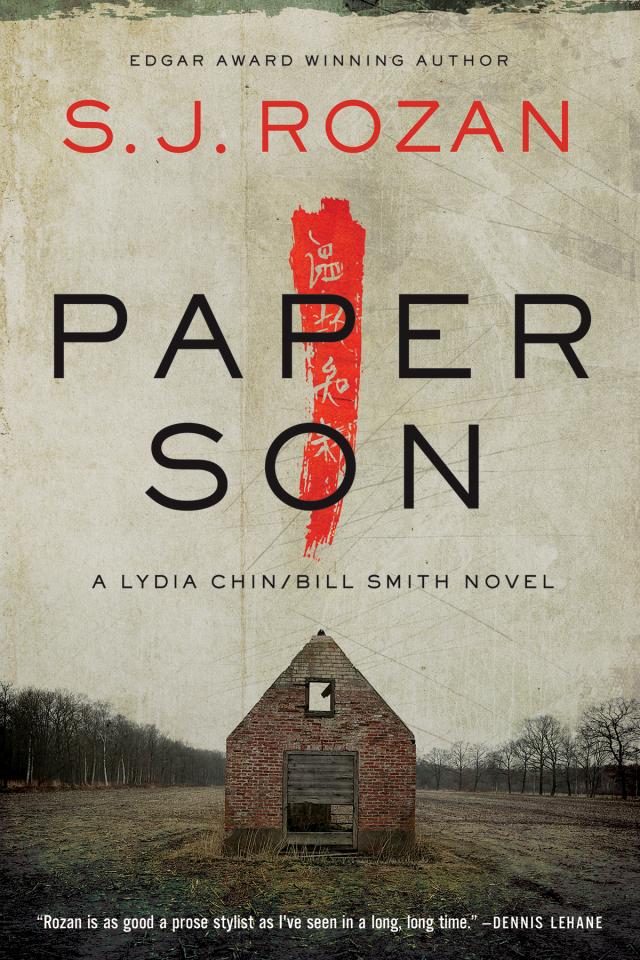
PAPER SON
Pegasus Crime is an imprint of
Pegasus Books, Ltd.
148 West 37th Street, 13th FL
New York, NY 10018
Copyright © 2019 by S. J. Rozan
First Pegasus Books hardcover edition July 2019
Interior design by Sabrina Plomitallo-González, Pegasus Books
All rights reserved. No part of this book may be reproduced in whole or in part without written permission from the publisher, except by reviewers who may quote brief excerpts in connection with a review in a newspaper, magazine, or electronic publication; nor may any part of this book be reproduced, stored in a retrieval system, or transmitted in any form or by any means electronic, mechanical, photocopying, recording, or other, without written permission from the publisher.
Library of Congress Cataloging-in-Publication Data is available
ISBN: 978-1-64313-129-0
ISBN: 978-1-64313-190-0 (ebk.)
Distributed by W. W. Norton & Company, Inc.
S. J. Rozan, Paper Son