The lords of creation, p.1
The Lords of Creation, page 1


The Lords of Creation copyright © 2025 by S. M. Stirling. All rights reserved. This book may not be copied or reproduced, in whole or in part, by any means, electronic, mechanical, or otherwise without written permission except short excerpts in a review, critical analysis, or academic work.
This is a work of fiction.
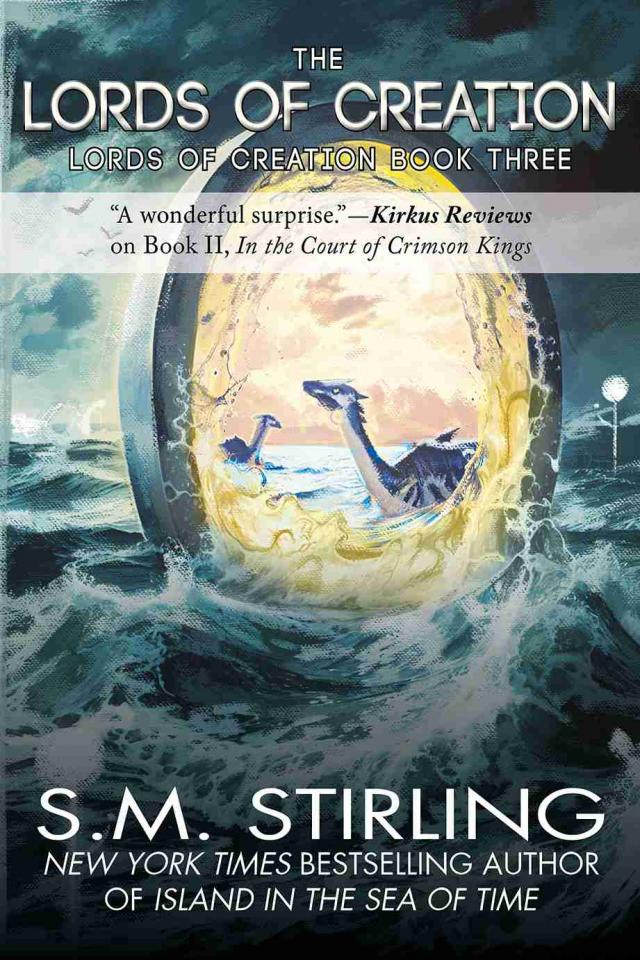
Cover art by Dany V.
ISBN EBOOK: 978-1-64710-100-8
First Edition (Digital). June 2025.
An imprint of Arc Manor Inc.
www.CaezikSF.com
To Janet Cathryn Stirling,
1950-2021, dearest of all.
ACKNOWLEDGMENTS
Thanks—
To Kier Salmon, longtime close friend and valued advisor, to whom I have always listened very carefully. And for things like managing the beta reader stuff. I owe her greatly for everything I’ve written since 1998.
To my first readers: Pete Sartucci, Markus Baur, Steve Brady, Ara Sedaka, Mike Ralls, Diane Porter, Margaret Carter, Kier Salmon, Romaine Spence, Jade Cheung, Sandy Michaud, and Emily Sedaka.
And to Joe’s Diner (http://joesdining.com/) and its splendid proprietor, Roland Richter, for his help with German stuff.
And to Tribe’s Coffee House (https://www.tribescoffeehouse.net/) here in Santa Fe.
To both institutions and their staff for putting up with my interminable presence and my habit of making faces and muttering dialogue as I write.
Also, they don’t have attention-demanding cats walking on the keyboard. A cat sleeps more than fourteen hours a day yet somehow manages to interrupt you continuously—feline magic. I write these words one-handed, with a cat curled up in the crook of my left arm.
PROLOGUE
Bahamas Gate
February 8th, 2001
“GODDAMN, but that … that thing is weird,” the Aerospace Force general said, looking up at the immaterial—but very solid—structure of the Gate.
And up, and up, as the aircraft carrier John Paul Jones kept station with its nose into the wind … the warm salt-smelling wind that came out of the … thing … about a mile south.
Gate, Janice DiFalco—newly minted Ph.D. in applied physics from Stanford University, and BA in anthropology and extraplanetary linguistics from Berkeley—thought. We can’t just go on calling it That Thing.
The top of the tall silvery arch was ten thousand feet above the ocean; the opening at the base was half a mile wide at the surface. She knew it was roughly egg-shaped, since the bottom looped around to close itself less than a thousand feet below the waves. As far as even the most sensitive measurements could tell, it didn’t move at all. There was water on the other side too, and air above that … not exactly like terrestrial air, but very close. Very slightly denser. Hence the constant wind, a bit more oxygen, a bit less CO2 …
Since it had … appeared … the frame around the … gate effect … had given off exactly the same amount of light whether it was midnight or noon. It looked shiny, but that was an illusion, because it looked exactly the same on a moonless overcast night. All attempts at getting a sample for analysis had failed. Failed to do anything but blunt a good many diamond drills, at least. The opposite side was blankly impenetrable over its entire surface.
“Strange, certainly,” the young scientist replied.
They exchanged a look of mutual incomprehension. She thought it was partly generational. Janice wasn’t quite thirty yet. The military officer was twice her age, born in the late 40s.
He’d grown up in a world where people still thought it was exciting but perfectly natural that Mars and Venus had life that looked like long-extinct Earthly species and human or nearly-human inhabitants. Back then, genetics hadn’t been advanced enough to prove they were descended from Earthly life-forms transplanted to the sister planets.
They’d just assumed that it was parallel evolution or panspermia or both.
The first probes in the early 60s had shown what people expected from generations of fevered speculation, when the general had been three or four years short of his entry as a plebe at Colorado Springs Academy, and eager to be an officer in what was then just the US Air Force, instead of “Aerospace.”
She had known from her teens that something … somebody … someone … was responsible for that life and a great deal else. Mars and Venus had been changed, long before the human race, or even australopithecines, had existed. Back when the very first dinosaurs were just beginning on their career of eliminating nearly everything else bigger than a mouse and then some evolving into herbivores because the niche was empty. Geological research on the two sister planets had shown it conclusively, though it had taken time to sink in outside academic circles. DNA had conclusively shown that whoever … or whatever … did it had raided Earth to stock the new fields of life.
By the time she was in her early twenties, space-based telescopes had shown obvious structures in the deepness of interstellar space, vast enough to be visible over many light-years. And other things utterly enigmatic but equally, inescapably, the result of conscious action, as they peered further and further into the galaxy every year.
Well, this is … enigmatic, all right, she thought, looking up again. And vast, like those extra-Solar structures. Well, vast on an Earth-surface scale. This thing …
Gate, she told herself firmly. It certainly is that, among other things. Things that blatantly contradict the laws of physics, as humans understand them. And we can’t be completely wrong about physics, because nuclear reactors work and atoms exist. But we certainly don’t know as much as we thought we knew when the General was my age.
Most people were calling it that, The Gate, with capitalization.
Certainly the newspapers and the networks do!
They were looking out from what was normally the equivalent of air-traffic control on a carrier, one deck below the bridge. Right now it was crammed with the equipment that would control the drone when it went through, and record its findings from one end of the spectrum to the other.
The other side … wherever the Gate led to … showed comparative darkness, like a night somehow starless and with a bright moon at the same time. The air on the carrier was full of the odor of burnt aircraft fuel, the harsh detergents used to scrub the decks, and the faint ozone of electronics. The wind from the Gate just smelled of sea.
“The light interval is 22.98 hours,” she said thoughtfully.
“So a different length of day,” Lee Daiyu replied. “Though I understand the … the light source over there is about the same visible diameter as the sun from the Earth’s surface.”
She was the EastBloc representative, a little younger than the American scientist, and claimed to be an astrophysicist with a sideline in archaeology and historical linguistics. That was a typical curriculum vitae for someone trained for interplanetary work. The competition for that was fierce in both the Blocs, and you had to be a scholar-athlete and very very good at both to get onto the finalist list.
This was technically international waters, so her Bloc couldn’t be excluded without serious retaliation, and the US and its allies were anxious to preserve the legal sanctity of those spaces after the confrontations in the South China Sea a decade or so ago. That had been about as close to actual war as anyone had gotten in the last fifty years, since the Blocs joined to impose peace on the Middle East.
She knew that there were worries at the top that the EastBloc might get more confrontational, now that China was clearly the dominant partner after the ever-accelerating decline of the shambolic mess that still called itself the USSR. In the brief intervals when the constituent parts weren’t cutting each other’s throats.
“Why put the drone through at night, though? Or what looks like night … over there?” Lee asked.
What Lee was, in terms of scholarship, in fact was an open question, though she definitely knew what she was talking about when she chimed in on scientific issues. An American in her position would too … but would probably also be working for the Agency or the Aerospace Force’s Intelligence division or some other part of the arcane scene.
I am myself, after all. Kinda. Sort of … indirectly. I was planning on going to Mars with Doug once we got married, after all. We both passed all the tests. Planning on that until this came to us.
“Well, there’s more than enough light for the pickups to compensate,” Janice said. “We can hope that it will make the drone less conspicuous.”
She thought for a moment.
“But 22.98 hours is around the same length of day that Earth had two hundred million years ago,” she added slowly.
Then cursed silently as General Saunders’ dark face scowled.
Her own glance said: You think they wouldn’t have noticed that?
Two hundred million years, give or take, was what geological investigations showed to be the date of the terraforming of Mars and Venus. A cold, dry deadness, a hot acid-bath Hell respectively … and then suddenly, life and breathable atmospheres, the change happening in an eyeblink so brief they couldn’t form an estimate from what the rocks told. It could have been overnight; it could have taken at most a few million years.
But it’s highly significant that the length of day of whatever-it-is beyond the Gate is precisely what it was on Earth, back then. Though what it signifies, we don’t know. Yet.
Lee spoke in her native Mandarin, as if talking to herself , then dropped back into accentless General American English. Spoken the way someone who’d graduated from … for instance … Stanford might have sounded.
“A precise measurement might give us an accurate date of the … the restructuring of our sister planets. More accurate than about two-hundred million years.”
“Under way,” Janice said. “You’ll be kept precisely informed.”
Lee’s lips tightened in her delicate-boned face. She was taller than a Chinese person would have been at the same age a generation ago, the fruit of better feeding. Clues from the way she stood and moved showed she was a trained athlete as well. She hid her anger well, but Janice was fairly good at picking things like that up … unlike many of her colleagues.
Who tend to dorkitude. Very capable dorks, but dorks.
Though of course if the EastBloc had been in charge of this in an area they controlled, they wouldn’t have revealed a thing. Or done so with grudging parsimony, if it was in a sea theoretically international but in fact controlled by their navies.
They might believe to get rich is glorious these days and have a new class of Red Princes and Princesses flaunting their bling in hot nightclubs, but a lot of their other habits bore an unpleasant air of Stalin and Mao.
“Well, we know that this appeared at precisely the same time the one on Mars did,” Janice went on.
The EastBlocer’s lips tightened even more. Jeremey Wainman had been an American archaeologist working for the Aerospace Force there … and ended up as consort to the new holder of the Ruby Throne on Mars. Which was being politically re-united under the Tollamune dynasty after many thousands of years of gradually accelerating decay, as the ecology … the artificially created ecology … decayed.
And he was an American of her own service, the scientific arm the Aerospace Force acted as patron to—an archaeologist, or the extraplanetary equivalent. The equally-new Martian gate led to somewhere a bit like Mars, but with more air and water … which was steadily flowing in, much to the Martians’ delight.
Expressed with exquisite politeness, of course, but containing an element of nose-thumbing nyah-nyah-nyah to the uncouth and obstreperous Wet Worlders. Who most Martians thought of as upstart barbarian savages, squat, stinky, ugly, and oozing. Though evidently Tollamune Empress Teyud—the new holder of the Throne and according to Wainman’s reports genuinely entitled to it by the bizarre Martian genetic regulations, enforced by an Ancient device known as the Invisible Crown—was more inclusively inclined.
Though the word for emperor in Martian Demotic wasn’t gendered, something she approved of.
Presumably having an American as the planetary ruler’s consort would be good … for America and its allies, at least. But having a united planet on the Martian side would mean more opportunities for playing Terrestrial nations off against each other. Mars had had a single civilization for fifty thousand years, and they were very good at political intrigue. Their average IQ was also about a third higher than the Terrestrial branch of humanity too, though they also had a lot less variation from the average. That gap could cause problems too … though fortunately, there wasn’t any detectable difference between the brightest Martians and the brightest Terrans.
“Exactly the same time for the appearance of the Gate here?” Lee asked.
“Precisely … as far as we can tell. Which is within a couple of minutes.”
They exchanged a look, politics put aside for an instant as scientific curiosity gained the upper hand. Coordinating something like that over light-minutes … twelve light minutes and forty-two light seconds at the time the Gates appeared … would require something … bizarre. Especially since it had evidently been triggered by events on Mars.
Nobody had any idea where the similar Gate that had appeared on Venus went yet, of course. Both the Blocs had bases there, but there was exactly one civilization on the next planet in, and it was early Bronze Age. It was called Kartahown and was near the American-British settlement called Jamestown Base, and roughly equivalent to Sumeria in the time of Sargon of Akkad. Or had been before what they called the Sky People arrived and told them about things like iron and paper.
That severely limited the amount of information the Earthlings could gather.
Space travel was still slow and relatively expensive, though cheaper every year now that reusable launch vehicles were routine, but electronics did make relaying what the bases knew fairly quick. The problem was that the rest of Venus outside Kartahown was a howling wilderness of hunter-gatherer savages … when it wasn’t homo erectus, Homo Heidelbergensis and Neanderthal savages, or Hobbit-sized midgets with poison-dart blowguns or whatever.
There was a lot of whatever on the next planet in.
And it was physically composed of densely beclouded jungles and savannahs (even the poles there were warm and the equator at sea level was a serious threat), which cut down the effectiveness of satellites. The surface swarmed with mammals from all periods, coexisting with thriving dinosaurs and locally evolved post-dinosauroids. All combined with weather rather more active than Earth’s had ever been, which together with the hominid and non-hominid wildlife made surface travel … problematic. The seas were worse. It all made air travel risky too, particularly in the improvised blimps that were the best available.
Life there was an adventure … and the best definition of adventure she’d ever seen was—
Someone else in deep shit far away.
So far the WestBloc had used the location of the Gate in their Atlantic Ocean stronghold to be more cautious with the Earth’s Gate than the Martians had been with theirs. Nobody really knew what was on the other side, except that it was human-habitable. If it wasn’t crawling with deadly diseases, of course, but there wasn’t much they could do about that except be careful and use the Martian biotech they’d bought in the last generation.
Martians used swords and half-living poison-dart firearms fueled by methane to settle their frequent but dispassionate disputes, but even after ages of decay and regression they still did biologicals better than Earth.
She felt a surge of excitement. The drone circling overhead would pass through the Gate in a few minutes. After that, they’d know something …. Which might restrain the fervid world-wide speculation, or at least redirect it a little.
“Now,” the general said, his furrowed dark-brown face set in a scowl. “Do it.”
The technicians at the banks of controls started punching buttons and flipping switches and the pilot at the control yoke moved his hands with careful precision. A dot became visible through the big slanted windows, silhouetted against the silvery moonlike-light through the Gate, its running light tiny against that expanse … though she knew the drone was the size of a business magnate’s private jet. As big as an entire nuclear-powered carrier’s deck could handle.
The picture on the big flat-screen monitor showed the darkness looming, gradually growing until it crowded out a night sky that had been bright with stars and the full moon. Then it was through …
There was a moment of transition, a hash on the screens and the beginnings of a frantic scramble, then …
“Normal function restored,” one of the techs … one with a lieutenant-commander’s three stripes and star on her shoulder-boards … said. “Gravity is exactly one Earth standard, to at least seventeen decimal points—the limit of our instrumentation.”
That ruled out chance, and Lee made a hmmmm sound. Janice supposed that somewhere in the universe there might well be a planet with exactly the same gravity as Earth … to within seventeen decimal points … but the chance of a Gate linking to that one without intentionality on the part of the builders … the Ancients … the Lords of Creation … was almost the definition of vanishingly small. Modern telescopes outside earth’s atmosphere had long since shown that many, many stars had planets, and a fair number were similar to Earth in mass and atmospheric composition. But nobody had found one that close.
The lieutenant-commander was looking down at her control panel incredulously. Janice and everyone else were looking at the screen and gasped as it cleared.
It was split, the upper of the two halves showing the view above the drone, the other the one below it. The upper showed a dark sky … except for something about the same apparent diameter as the sun. And in exactly the place the sun would be at noon on the equator, but with only about the brightness of a good full moon right now.