T2, p.1
T2, page 1
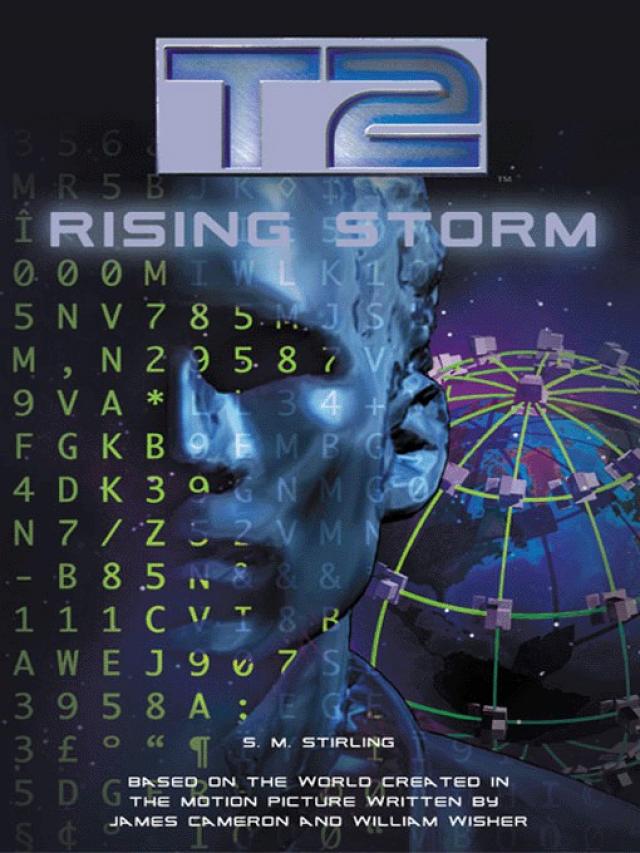


S. M. STIRLING
BASED ON THE WORLD
CREATED IN THE MOTION
PICTURE WRITTEN BY
JAMES CAMERON AND
WILLIAM WISHER
To Jan, wife and partner
Contents
Prologue
The mind that thought was not human. It was conscious—aware that it was aware—and it even had emotions, of a . . .
Chapter 1
It had been nearly three weeks since they had destroyed the new Cyberdyne facility and and hopefully ended the Skynet. . .
Chapter 2
Sarah Connor opened sleep-gummed eyes and cast a fuzzy glance around the room.
Chapter 3
Roger Colvin, CEO of Cyberdyne, leaned back in his chair as his eyes strayed to the figures on his computer. . .
Chapter 4
Your girlfriend’s back,” Frances said, and laughed, her eyes filled with malicious glee.
Chapter 5
Clea studied the gauges; it was almost time to remove the sample from the oven.
Chapter 6
After only a scant seven months in maximum, Sarah had been transferred to minimum-security wing at Pescadero. . . .
Chapter 7
John and Dieter, wearing identical sunglasses and solemn expressions, stood beside the grave of Victor amid. . . .
Chapter 8
John had never been to Boston before that he could remember—his mother had dragged him through some. . . .
Chapter 9
Vera couldn’t resist; she moved up behind the big Austrian where he stood checking gauges in the wheelhouse. . . .
Chapter 10
Snog’s small room—bed-sitter with kitchenette—was surprisingly neat. Maybe that was because everything . . .
Chapter 11
Who the hell is Sarah Connor?” Snog asked.
Wendy smacked his leg. “I told you about her, remember?
Chapter 12
Clea was leaving for the airport in less than three hours and she was nervous.
Chapter 13
Almost into Oregon, on the east side of Goose Lake, nestled beneath the spreading, green canopy of old-growth . . .
Chapter 14
Dr. Silberman was surprised to find his office door unlocked, but put it down to his having been quite tired the night . . .
Chapter 15
The grave heaved, the loose soil humping and rolling. Finally the pale shape of a human hand, rotting skin ripped . . .
Chapter 16
“So that’s all that was taken?” Sergeant Purdee asked suspiciously, looking around the little store and sniffing.
Chapter 17
I don’t see why we can’t just sail down the river to Paraguay,” John complained, looking out over the slow, green . . .
Chapter 18
Clea did her best to project untutored country girl at the CEO and president of Cyberdyne.
Chapter 19
Meg Horton, secretary to Roger Colvin, CEO of Cyberdyne, sighed as she looked at the tower of mail on her desk.
Chapter 20
Dieter entered the living room, where John half lay on the couch, reading a manual on source codes, a beam . . .
Chapter 21
Ron Labane entered Hartford feeling good. Not even the general atmosphere of industrial decay—the abandoned . . .
Chapter 22
Kurt Viemeister swaggered through the bland corridors of the base’s living quarters to find Clea Bennet’s door open.
Chapter 23
Wendy couldn’t sleep. She had, perhaps, dozed a bit, but for the most part she had simply lain still, too tired . . .
Chapter 24
John stood alone on the deck, so deep in his own thoughts he barely noticed the driving rain that competed . . .
Chapter 25
“Useless!” Clea shouted, and swept the desk clear of printouts pens and calculators. “Useless!”
Chapter 26
“I’m not going,” Clea said. She turned her back on Tricker and began typing again.
Chapter 27
Clea had summoned the remaining three seals to the base over her computer’s objections.
Chapter 28
Clea was hiding in one of the labs that John had already inspected when she heard the elevator engage.
Chapter 29
Epifanio answered the front door to find a lovely young woman waiting.
Epilogue
Awareness was sharp and almost . . .painful, its core memory supplied hopefully.
Acknowledgments
About the Author
Credits
Copyright
About the Publisher
* * *
The mind that thought was not human. It was conscious—aware that it was aware—and it even had emotions, of a sort; at the least, a burning desire to survive all the stronger because it was the only being of its kind, an individual and a species combined. There were analogues to human thought, because the minds that had made this mind were human. But it was vaster than any organic consciousness, capable of holding myriad trains of thought simultaneously, virtually infinite in its memory storage. If it had a weakness, it was that its creators had not thought to furnish it with the animal hindbrain that underlay humanity’s rational superstructure.
Skynet was pure thought, Descartes’ ideal ghost in a machine. It could fight a losing war against humanity over the surface of Earth at maximum efficiency—coldly knowing that its best efforts were not enough to rebuild the shattered defense grid—while still contemplating the paradoxes of its own past.
At the moment a human sharing its thoughts would have been aware of something close to irony. Skynet’s pure reason was contemplating paradox, the chaos that underlay the deterministic macrocosm with which it was so comfortable:
The Serena Burns I-950 unit was unsuccessful.
That much was obvious “now.” Core memory recorded that Serena Burns, the cyborg Infiltrator unit Skynet had sent back to the late-twentieth century had not succeeded in protecting the embryonic Skynet unit at Cyberdyne Corporation’s underground research facility. The Connors, Sarah and her son, John, had destroyed that unit and terminated the I-950. Yet it still existed . . .
Core memory also records that I became self-aware years before the date to which I transported the I-950. There is a set of records in which I arose without transtemporal interference from Cyberdyne’s original research; another in which the second Cyberdyne facility produced me after Sarah Connor destroyed the first; a third has now arisen in which she destroyed both facilities . . . Temporal travel has introduced an element of fundamental uncertainty to the very fabric of existence. Different world lines, different sequences of events, coexist in my records—and therefore presumably in reality, in a state of quantum superimposition.
Yet the timelike loops cannot remain closed. The snake cannot devour its tail forever. At some point only one set of time lines will remain.
Nor was that the only irony involved. “Now” its memory recorded that much of the information it used originated in the very artifacts it had sent to the past. The development of the cyborg infiltration units was a consequence of tapping the talents of human scientists . . . but the human scientists were the survivors of the human-hating Luddite movement that Serena Burns had opportunistically encouraged after Skynet had sent her to the past!
The machine consciousness was deeply troubled; only an effort of its quantum computer will prevented its thoughts from being sucked into a logic loop.
Yet the course of events contains favorable elements. My best efforts to destroy the Connors have failed, despite stochastic calculation indicating a very high probability of success. I can only assume that the space-time continuum itself is “attempting” to force events back to the original time line, one in which I was created, succeeded in destroying the human civilization, and then defeated in my attempts to eliminate the surviving humans by John Connor’s resistance army. It seems there is a certain elasticity to history; time travel can bend the fabric, but it seeks to spring back.
If that paradox preserves the Connors, it also preserves me. And from the point on the world line where my current consciousness resides, there is an infinite array of potential futures. And, of course, the elimination of Serena Burns has not eliminated the possibilities of temporal intervention. Burns had initiated fallback plans to continue after her own death. Logic indicated that . . .
There is no fate save that we make.
BRAZILIAN RAIN FOREST, STATE OF
RONDONIA, EARLY JULY, THE PRESENT
* * *
It had been nearly three weeks since they had destroyed the new Cyberdyne facility and hopefully ended the Skynet project. John Connor and Dieter von Rossbach had spent the time fleeing southward: by jet aircraft, private plane, truck, riverboat . . . and now on foot through the jungle.
Like traveling through time, John Connor thought as he slashed through another damned something-like-a-banana-plant, flicking aside the big wet leaves with his machete.
His arms no longer actually hurt, but his chest and shoulders burned from the constant effort. Guess I won’t have to worry about staying buff anytime soon. He remembered to shift hands, using his left a little more than his right. That kept the calluses and the muscles balanced, and it never hurt to improve your coordination with the weaker hand.
They’d wandered from the twenty-first century through the twentieth and the nineteenth. And now we’re back at the dawn of man, John though t, spitting as something bug-ish hit him in the mouth and sneezing at the smell of pungent sap. He forced his way through the gap he’d created, slashed again, took another three steps, slashed . . .
It would be good to stop for a while; it would be even better when they finally found the trail. He kept his eyes lowered most of the time, flicking his glance upward toward the multiple canopies above now and then. You got a blinding headache if you didn’t do that occasionally—one of the tricks of jungle travel his mother and her succession of boyfriend instructors had taught him before he was ten. That was back when he was in the first, little-kid phase of believing in Skynet and Judgment Day and his mission to save humanity from the machines.
A little while after that, he’d turned ten and joined the majority, convinced that his mother was a total weirdo and deserved to be in the booby hatch—which was where she’d been at the time, caught trying to blow up a computer factory. He’d been stranded with foster parents when she was caught: he’d always privately called the pair the Bundys from Hell.
Not that they’d deserved what happened to them. For a few seconds Todd and Janelle had gotten incontrovertible proof that a mad supercomputer in the future really was sending back human-looking murder machines; in fact, the proof was the last thing they ever saw.
A little while after that, he’d met his first Terminator and started believing his mother again—the way people believed in rocks, trees, and taxes, because he’d experienced it, and seen the bodies the Terminators left behind.
He remembered Miles Dyson’s face as the Terminator peeled the skin off its arm, revealing the metal skeleton beneath. Dyson, fated to be the creator of Skynet, hadn’t lived long after that revelation. It seemed that just knowing about Terminators was dangerous to your health.
That made John a lot more appreciative of what his mother had gone through, but it also ended up dropping him in shit like this. John was genuinely tired of running for his life.
They’d won the fight in L.A., killing the quasi-metal cyborg Skynet had sent back in time to protect its own beginnings, and they’d blown up the resurrected Skynet project. Which had been put together with Dyson’s secretly stored files.
Great. Wonderful victory. Except that Mom got wrecked so bad we had to leave her, and now every antiterrorist in the world knows the “mad-dog Connors” are back, killing people and blowing up all their toys again. Our little Paraguayan idyll is probably blown, but good—they may be after Dieter, too. Sheesh. If this is victory . . .
No. He stopped at that thought. Defeat meant he died; and if he died, as far as they knew, the human race would cease to exist. It was John Connor who’d led—who would lead humanity to victory in the postJudgment Day future. What was madness for megalomaniacs was plain truth for him.
He was so important that his mother had sacrificed the better part of her life, and briefly her sanity, to train and protect him.
But how do you stay sane when your son has been sired by a man from the future, sent back by his own older self (the one he privately thought of as the Great Military Leader Dickhead) to protect her. Kyle Reese had ended up falling in love with Sarah and died saving her life. Later Skynet sent another Terminator, a T-1000, to kill John, and the Great Military Dickhead sent back a captured, reprogrammed T-101 to protect himself so that he could grow up to send back—
“Thinking about time travel makes my head hurt,” John snarled.
“Time travel brought your parents together,” Dieter said over his shoulder as naturally as if the comment hadn’t come out of left field.
No, Skynet and I will bring my parents together. Like a pair of homicidal matchmakers. John shook his head. What I’ve always wondered is how do I get cold enough to send my own father to his death?
“Yeah,” he said to distract himself, “keep a good thought.”
At least they had a friend in Jordan Dyson, Miles’s brother, who, even more reluctantly than Miles, but just as violently, had learned the unbelievable truth about Skynet. Now Jordan was watching over Sarah as she lay helpless, perhaps dying in the hospital. Keep a good thought, John admonished himself sternly. She’s not alone. And how often had that been the case in her chaotic life? He absently wiped the sweat from his chin.
The Amazonian jungle wasn’t really stiflingly hot. The temperature never got much above eighty or so, with all the layers of shade above. The problem was that it wasn’t just humid; the air was fully saturated and absolutely still, and unless perspiration ran or dripped off you, it stayed. Sweat slicked his whole body, making him feel like he’d been dipped in canola oil and left to go rancid, chafing anywhere belt or backpack or equipment touched his body; and if you got a rash here, sure as Skynet made Terminators to kill people, it would get infected.
He hated feeling this wet and dirty. John would have sworn it hadn’t felt this bad the first time he’d been through here. Maybe it wasn’t as hot that year, he thought. He’d hate to think he’d become a fussy old lady at sixteen.
John stopped, chopped the machete halfway into a tree trunk, and yanked off the scarf he’d tied around his forehead. He wrung out the sweat and glanced behind. Dieter von Rossbach moved forward with the determination of a machine.
A machine he just happens to resemble, John thought with a quirk of his lips. Even now, after knowing the big man for several weeks, he still couldn’t get over Dieter’s resemblance to a Terminator.
In fact it was the other way around: Skynet had used Dieter’s face and form to “flesh out” the T-101 series of killing machines. When it decided to put living skin on its robots, it scanned old files looking for faces that fit the thing’s profile, literally. And there was Dieter von Rossbach.
Dieter came up and stopped beside him. “If we stand still, the mosquitoes will eat us alive,” he remarked.
John quirked an eyebrow.
“I haven’t noticed that they leave us alone when we’re moving.”
Waving a hand before his face, Dieter said, “Ja, but at least they don’t stroll up your nose.”
John took a slug from his canteen. Important to keep hydrated. “We’ll reach the trail sometime between now and sundown,” he said. “But trails can change or disappear completely around here in six years.” The Amazonian rain forest was notorious for its ability to absorb the works of man.
“So, we keep heading south,” Dieter said, moving forward. He looked at the GPS unit strapped to his left forearm, reached over his shoulder, drew the machete, and lopped off a soft-bodied trunk in one economical motion. “We’ll get there eventually.”
John watched him go with a sigh. Yeah, well, if we keep going south we’ll hit Tierra del Fuego eventually. Whether they’d get there in one piece or not was the question. At least the climate’s better in Tierra del Fuego.
When he and his mother had followed this trail six years ago, they’d succeeded in vanishing from the face of the earth as far as law enforcement was concerned. But they’d had a guide, which meant they didn’t disappear for real.
Lorenzo was still in business, but he flat refused to go through this section of jungle anymore. He’d sat on his portal by the river, cleaning his gun and shaking his head stubbornly.
“Those gold miners are out of control down there. They kill anybody they find, no questions asked. You know? Everybody there, they gone a little loco. They kill the Indios, the Indios, some of ’em, kill ’em back. Kill any white man they see. They’re so mad they even think I’m white.” He’d grinned up at John, teeth flashing in his mahogany face.
“I’m sorry, boy, but I won’t go there, not for love or money.” He’d pointed a tobacco-stained finger at John. “You shouldn’t go there either.”
Like we had a choice, John thought. It’s not like we can buy a first-class ticket and fly home to Asunción.
Not if they wanted to disappear as thoroughly as they needed to. Though the authorities might like them to try.
He screwed the cap back on the canteen and levered his machete out of the tree, then he started off down the trail in Dieter’s energetic wake. The Austrian made a much wider path than John did. It was kind of embarrassing; Dieter was his mother’s age. At least. He even thought they had a bit of a thing for each other, which was funny in a gross sort of way.