The human zoo, p.1
The Human Zoo, page 1


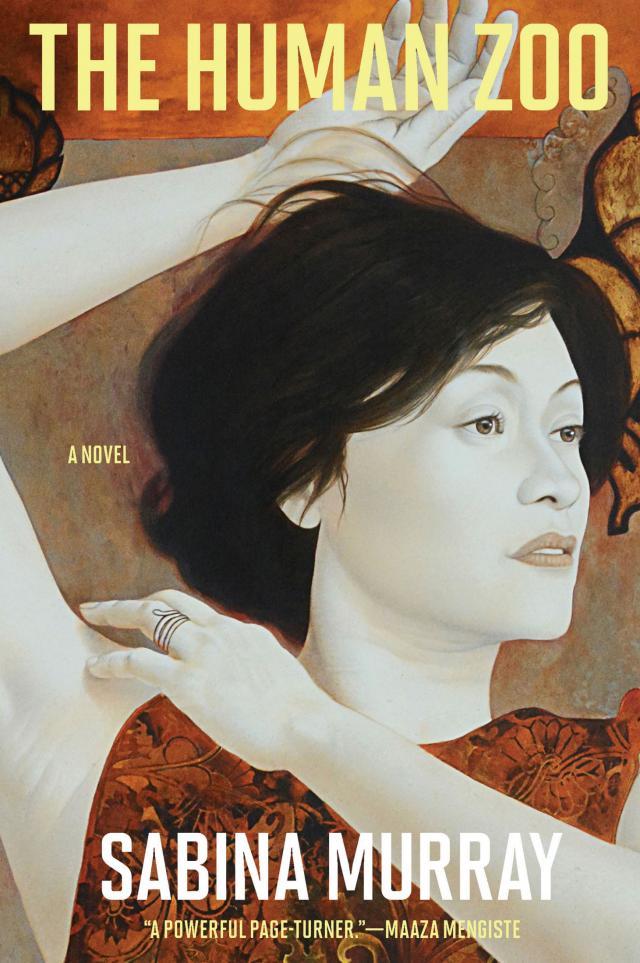
THE HUMAN ZOO
Also by Sabina Murray
Valiant Gentlemen
Tales of the New World
Forgery
A Carnivore’s Inquiry
The Caprices
Slow Burn
THE HUMAN ZOO
A NOVEL
SABINA MURRAY
Grove Press
New York
Copyright © 2021 by Sabina Murray
Jacket design by Anamaria Morris
Jacket painting, La Guapa, by Ronald Ventura
Photograph courtesy of Leon Gallery
All rights reserved. No part of this book may be reproduced in any form or by any electronic or mechanical means, including information storage and retrieval systems, without permission in writing from the publisher, except by a reviewer, who may quote brief passages in a review. Scanning, uploading, and electronic distribution of this book or the facilitation of such without the permission of the publisher is prohibited. Please purchase only authorized electronic editions, and do not participate in or encourage electronic piracy of copyrighted materials. Your support of the author’s rights is appreciated. Any member of educational institutions wishing to photocopy part or all of the work for classroom use, or anthology, should send inquiries to Grove Atlantic, 154 West 14th Street, New York, NY 10011 or permissions@groveatlantic.com.
Published simultaneously in Canada
Printed in the United States of America
First Grove Atlantic hardcover edition: August 2021
This book was set in 12-point Goudy by Alpha Design & Composition in Pittsfield, NH.
Library of Congress Cataloging-in-Publication data is available for this title.
ISBN 978-0-8021-5750-8
eISBN 978-0-8021-5752-2
Grove Press
an imprint of Grove Atlantic
154 West 14th Street
New York, NY 10011
Distributed by Publishers Group West
groveatlantic.com
For R. Zamora Linmark
I fain would be an Igorrote,
Without a stitch of clothes,
And dwell up the sandy beach
Where the cooling sea-breeze blows.
Iron-jointed, supple-sinewed,
I would walk—would almost fly,
Catch the stray dog by the hair,
And work him into pie.
There I’d live the life idyllic,
Caring naught for Summer suns,
Caring naught for scorching cities,
Where the perspiration runs.
Dressed alone in my complexion,
With a palm-leaf fan, perchance,
I would rather be a savage
Than a magnate wearing “pants.”
New York Morning Telegraph,
July 19, 1905
I
I
The plane had been delayed departing Seoul and, on reaching Manila, was at first unable to land. For over an hour we circled in the heavy, gray air. Suspended like this, I wondered why I had been so determined to return to the Philippines and was not altogether sure, beyond knowing that my aunts would be happy to see me. In the darkness below, I could sense Manila’s ever-expanding hive, its choked highways, teeming tenements, and raucous babble. When the plane finally touched down, it was with an alarming shuddering of the overhead compartments, vibrations I could almost feel in the roots of my teeth. I found the possibility that one might crash on landing comforting, in a darkly humorous way, because my life had become chaotic. I did not want to crash, but it was a prospect that offered resolution. The outer edge of an early-season typhoon was dropping impressive amounts of rain and glazed the windows with thick, sheeting water. Contorted in the aisles, we waited to disembark. Lines through immigration were long. There was a band playing somewhere in the terminal’s bowels, and traditional Filipino songs—cheerful guitar, love-soaked lyrics—echoed from the source.
The crowd at the baggage carousel was composed largely of overseas workers in bright sneakers and flashy clothing, but the girl blocking my access to the carousel, who had walked to stand directly in front of me, was a well-fed, solitary blonde. She was wearing a sleeveless plaid shirt that exposed a tattoo on her right bicep, an outline of a circle in black. Doubtless she was waiting for a backpack. A stream of boxes thudded down the chute, the girl’s backpack, which she quickly shouldered, and, finally, my yellow suitcase.
There was no one to meet me because my family didn’t know that I had returned. I hesitated by the sim card booths before exiting the terminal, put off by the thundering rain. A pair of children—boys, brothers—were shoving a wheeled suitcase at each other, back and forth, laughing like maniacs, until their frazzled mother yelled at them. When the sliding doors released me, it was through a wall of heavy heat and the dim flicker of fluorescent bulbs into a black night shot through with headlights. Horns sounded all around as if a force of nature.
At the taxi stand, the girl with the circle tattoo was looking into a battered Hyundai, speaking to the driver. “Cocoon Boutique Hotel?” she asked. “Do you know where it is?” The taxi driver did not seem to understand. “Kyoozon City?” she said, consulting a piece of paper. Leaving the girl to flounder had its appeal, but I did not feel up to being so callous.
“Excuse me,” I said, interrupting. “It’s Quezon City.” I pronounced it in the acceptable Spanish way. “You’re going to the Cocoon Hotel? Let’s share a cab. It’s not far from where I’m headed.”
Together, we slid into the taxi’s rear seat. “Cocoon Hotel,” I said. “Alam mo ba yon? Dumaan ka sa Timog.”
“You speak the language,” the girl said.
“Enough.” I smiled. “I’m from here.”
“You don’t look like it.”
I was too tall and too light skinned to be recognized as a Filipino by this girl, but my mother had been Filipino, and this is how I thought of myself. “Some Filipinos look like me,” I said. I caught the cab driver checking me out in the rearview mirror. “And what brings you here? Are you traveling alone?”
“I’m meeting my boyfriend in Cebu, but I have two days in Manila,” the girl replied. “We were on the same flight, but you were in Traveler Plus.”
“Yes, that’s right,” I said.
“Do you travel a lot?”
“I do.” The taxi had made it off the curb and was slowly easing its way into the traffic. The driver wiped at the windshield with a sodden tissue, clearing a porthole through the condensation. “And you, do you travel much?”
“I was in Machu Picchu in January.” The girl was proud of this.
“Really?” I said. “I was in Peru last November.”
“Isn’t Machu Picchu amazing?”
“I wouldn’t know.” I smiled. “I spent all my time in Iquitos, except for a brief foray up the Amazon.”
“Why didn’t you go?”
“There wasn’t time. I was doing a piece for a travel magazine and my assignment was to cover the Amazon River International Raft Race.” November was dry season in Iquitos, and the city, built on stilts but currently without benefit of flooding, had seemed to float above the packed dirt. Vultures dropped heavily into the shadows without warning. The town hall had reminded me of an old Manila building: the broad staircase, the heavy wood, the unchecked decay. The race itself did not intrigue me; it presented a predictable challenge, a victory—as with all races—given to whoever was fastest, assuming that speed was a universally valued thing. “Competitors come from all over the world,” I added.
“Who won?”
“Who won? Oh, some Peruvians, of course. Although one year, the Americans had it.”
The girl was looking out the window, her mouth agape, the bright lights slowly dragging across her face. Pedestrians rushed along the underpasses of Edsa. A jeepney stopped abruptly, releasing a number of people. The women had taken off their shoes, which were tucked under their arms, and they stepped cautiously into the ankle-deep water like socialites closing the final yards to the beach after a day spent yachting.
“Is it always this bad?” the girl asked.
“The flooding? Often worse, actually. Although if this continues, much of the city will be shut down tomorrow.”
The girl nodded as if registering something, but she remained openmouthed.
“Timog will be clear. Where your hotel is located is actually at a higher elevation.”
“I hope the weather’s better on Cebu,” the girl said. “I want to go to the beach.”
“Yes. Cebu’s known for its beaches. And for its mangos and beef.”
“Weird,” the girl said. “What else do I need to know?”
Perhaps I should have told her about pakikasama, social empathy, and amor proprio, personal dignity, which were the two tenets that Filipinos lived by, but I was discouraged by her large, wet eyes that seemed hopeful for things to be simplified rather than complicated. “The balut, the fertilized duck eggs? They’re not for everyone. Many Filipinos don’t eat them, including me. Try the bagnet, which is fried pork belly. And make sure the water you’re drinking is filtered.”
I lifted my chin to the driver in the rearview mirror. “Nasa corner ng Scout Tobias at Timog ang Cocoon. Okay?”
The driver nodded.
“You must excuse me,” I said to the girl. “I
The girl nodded in response and I, duty fulfilled, pretended to nap.
Nearly a year had passed since I had last visited Manila. I had been on assignment from Vice, covering newly sworn-in president Procopio “Copo” Gumboc, who had swept the elections in an upset and was now governing the nation in state-run terror. Under his rule, police had carte blanche to execute anyone suspected of dealing or using drugs, mostly shabu, a form of crack cocaine. The policy had been embraced by a corrupt police force, whose officers were gunning down anyone they felt like. I wondered if this girl knew, if she was aware that close to ten thousand people had lost their lives.
Vice had sent me to explain why, despite the killings, the president’s popularity rating had held at an astounding eighty percent. I had set up interviews with people that I found interesting—college-age socialists, a radical nun who had been active when the former dictator, Batac, was ousted in the eighties, a community leader whose neighborhood of Mandaluyong had lost many lives. Vice ran it as a centerpiece to an issue on populism. Since then, Gumboc had managed to insult an assortment of people that included the president of the United States and an Australian nun, who had, improbably, inspired his sexual fantasies. As I wrote the article, I felt as if I were inventing things, but it was all verifiable and, when it appeared, fact-checked, as if reality were something that earned its name through verification rather than by just being real. Barreling along the night streets, the taxi wrapped in an aqueous blanket, the driver constantly clearing the tiny porthole through the fogged windscreen amid the thump and screech of the faulty wipers, it was hard to feel that I was in anything but a dream.
It must have been close to 1:00 a.m. when we reached the hotel. As we pulled in beneath the concrete overhang, the sudden relief from the water created a degree of silence. The girl asked, “How much do I owe you?”
“This trip is on me,” I said. “Consider it local hospitality.”
The girl thanked me and got out of the cab. The driver handed her the backpack from the trunk of the taxi and the girl returned to tap on the window. “I didn’t get your name. That seems weird.”
“Christina,” I said. “And you?”
“Martha.”
“Martha, it was a pleasure to meet you. I hope you have a wonderful time in the Philippines.”
From the hotel, it was just over a mile to my aunt’s house on Twelfth Street in New Manila, a ten-minute drive along familiar streets. When my aunt’s house was first built, right after the war, it had stood alone on a hill, a symbol that the Filipinos had survived, that wealth still existed. Over the years, the gate stayed the same deep green it had always been, resisting change—although across the street, where once had been a series of smaller houses, a towering apartment building now stood, the whole area having been aggressively developed in the last twenty years.
“Busino ho kayo,” I said, indicating that the driver should use his horn. A few short blasts sent a sleepy security guard beneath a deteriorating pink umbrella into the street. He peered suspiciously into the taxi and I presented my face as explanation. The guard unbolted the gates and swung them open, holding the umbrella in the crook of his neck, and we continued in and up the circular drive. By the way the taxi bumped along, I knew that some repaving was in order, and I could see the plants were overgrown. The headlights picked up a thin dog, who lifted a paw questioningly and then ran around the back of the house. I paid the driver, thanking him and tipping him well, although the look he gave the money seemed disappointed. As I stood with my yellow suitcase at the bottom of the tall steps that led to the front door, I wondered if anyone was awake, if it would be difficult to rouse the maid. Just then, the door swung open. Leaning against its frame, silhouetted by the dim light glowing behind her, was my tita Rosa, an old woman made stout by her age. My aunt looked out suspiciously at first, then swooned back dramatically, her hand on her breast.
“Ay, Ting,” she said. “Thank God it’s you.”
I laughed. “Tita, why ‘thank God’?” I picked up my suitcase and started up the steep set of steps that led to the front door.
“For a second I thought you were your mother.”
I reached the top of the landing and hugged my aunt, who peered closely into my face, as if I might be hiding something, and then released me.
“You don’t seem surprised to see me,” I said.
“I’m not.” Tita Rosa waved for me to follow her into the library, which was through a doorway by the front entrance. “Why shouldn’t you be here?”
“Because I live in New York.”
“Well, you know how things are.” Tita Rosa lowered herself carefully into a rocker. “Sometimes people are in one place, and then they’re in another. Is it true you’re divorcing your husband?”
“Yes, that is true.” I sat on the low couch, which my aunt had chosen over a bed for the last three years.
“He is a charming man,” the old woman said. “And you know, I don’t like charming men. But he is your husband. I feel I have to say that. Still, if God didn’t make annulments, who did?”
“Lucifer?” I ventured.
“We are Lucifer.” My aunt laughed. The maid, Beng, placed a tray with a bowl of ice, a bottle of Coke, and some glasses on the small table. “Aren’t you thirsty?”
I nodded, and my aunt nodded to Beng, who dropped some cubes in the glass and poured the Coke. Tita Rosa instructed Beng to make up the guest bed and to make sure there was a towel and some filtered water and a glass in the room.
My aunt’s long white hair was down around her shoulders, a rare sight, as in the day she always had it pinned into a bun. She was wearing a floral shift and beaded, black velvet slippers.
“Why are you still awake?” I asked.
“Me? I don’t really sleep. An hour here, an hour there.” My aunt reached over and began rubbing my arm. “It is so good to see you. I was worried about you. I love you so much. You know that. I pray for you every day, after my great-grandchildren and before your cousin Gina.”
“You pray for me before Gina?” I gave a wary laugh. “I really must be in trouble.”
“Yes,” my aunt said calmly. “Yes, you are.”
My aunt’s house was sliding into indolent decay, but its elegant symmetry and high ceilings and staircase made of wood felled from giant trees cast a spell that was deeply tied to its history.
Its rooms had no air-conditioning and no screens, a testimony to its age, and the plumbing, which had been a wonder in the late forties, was challenged by the years, though there was still water running in the pipes. A full bucket was in the shower stall, and a tabo with which to bathe. If I had waited until morning, I could have asked Beng to heat water, which usually she did in a large kettle that she added to the bucket, but the idea of dousing myself with cold water was actually appealing.
Tita Rosa was the eldest survivor of my mother’s siblings. Her role in the family was that of matriarch, a self-created title that she’d claimed as young woman and held for over sixty years. She was now ninety. Shortly after the end of the Second World War, my aunt had married a man who had been a friend of her father’s, one of the old Konyos, or Spaniards, whose money had survived. At the time of their wedding, Tita Rosa was seventeen and Tito Iñigo thirty years her senior. Tito Iñigo had died in the eighties, but I remembered him well. He had a narrow face and a long, hooked Spanish nose. His expression had always been composed in a sort of regal withdrawal, but he had loved low Filipino culture: bad TV, junky food. Tito Iñigo had often traveled to the province for cockfighting, boxing matches, local fiestas with native dancing—things that people in Manila disdained. He had been loved by the peasants who worked his lands, where rice and peanuts were grown, and at his funeral, bus after bus had pulled up outside the church, disgorging what seemed to be the entire village of San Isidro. That day it had felt to me that we were burying not only my uncle but also an era of Philippine life that had been lost with land reform and the rise of the city.