

Blind owl, p.1
Blind Owl, page 1


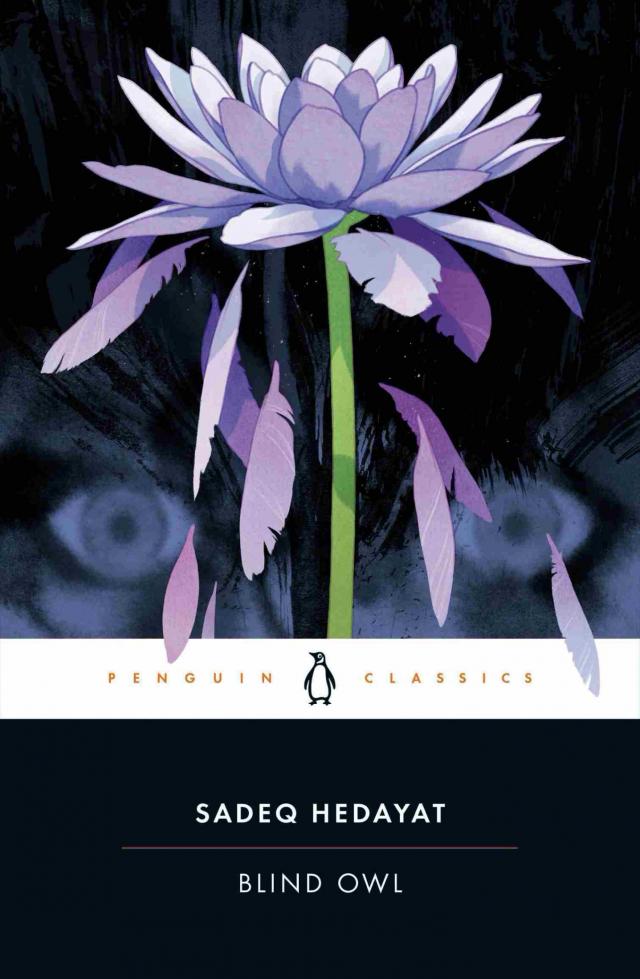
penguin classics
BLIND OWL
sadeq hedayat was born in Tehran in 1903 and is considered one of the most important Iranian prose writers of the twentieth century. He is celebrated as the father of modernist Persian literature and is credited with bringing modern Persian literature onto the international scene. Although born into a prominent aristocratic family, Hedayat’s writings display an obsession with characters who populate the fringes of society—the base and the marginalized. In 1936, while living in Bombay, he published his most famous work, Blind Owl, as a handwritten volume with original illustrations. Hedayat took his own life in Paris in 1951. Despite his short literary life, Hedayat was a prolific writer and leaves behind a copious body of work.
sassan tabatabai was born in Tehran in 1967 and has been living in the United States since 1980. He is a poet, a translator, and a scholar of medieval Persian literature. He is Master Lecturer in World Languages and Literatures and the Core Curriculum, and Coordinator of the Persian Language Program, at Boston University. Tabatabai is the author of Father of Persian Verse: Rudaki and His Poetry (Leiden University Press, 2010), Uzunburun: Poems (Pen and Anvil Press, 2011), and Sufi Haiku (Nemi Books, 2021).
PENGUIN BOOKS
An imprint of Penguin Random House LLC
penguinrandomhouse.com
Translation and introduction copyright © 2022 by Sassan Tabatabai
Penguin supports copyright. Copyright fuels creativity, encourages diverse voices, promotes free speech, and creates a vibrant culture. Thank you for buying an authorized edition of this book and for complying with copyright laws by not reproducing, scanning, or distributing any part of it in any form without permission. You are supporting writers and allowing Penguin to continue to publish books for every reader.
Originally self-published in Persian as Boo-e-koor in Mumbai, formerly Bombay, 1936.
library of congress cataloging-in-publication data
Names: Hidāyat, Ṣādiq, 1903-1951, author. | Tabatabai, Sassan, 1967–
translator author of introduction.
Title: Blind owl / Sadeq Hedayat ; translated with an introduction by Sassan Tabatabai.
Other titles: Būf-i kūr. English
Description: New York : Penguin Classics, 2022. | Includes bibliographical references.
Identifiers: LCCN 2021031212 (print) | LCCN 2021031213 (ebook) | ISBN 9780143136583 (paperback) | ISBN 9780525508083 (ebook)
Subjects: LCGFT: Novels.
Classification: LCC PK6561.H4 B813 2022 (print) | LCC PK6561.H4 (ebook) | DDC 891/.5533—dc23
LC record available at https://lccn.loc.gov/2021031212
LC ebook record available at https://lccn.loc.gov/2021031213
Cover illustration by Leonardo Santamaria
Adapted for ebook by Shayan Saalabi
pid_prh_6.0_139683235_c0_r0
Contents
Cover
Title Page
Copyright
Introduction
Suggestions for Further Reading
The Blind Owl
Notes
Introduction
On April 9, 1951, Parisian police were called to a small flat on 37 Rue de Championnet. There they found the dead body of a forty-eight-year-old Iranian writer identified as Sadeq Hedayat, who had apparently committed suicide by gas inhalation. He was found lying on a blanket on the floor of the small kitchen in his apartment. He had sealed the flat to keep the gas from escaping the room as best he could. There was no suicide note. Thus ended the life of one of the most consequential Iranian prose writers of the twentieth century.
Sadeq Hedayat is generally lauded as the father of modernist Persian literature. He is seen as the inheritor of the mantle of Mohammad-Ali Jamalzadeh, the great Persian prose writer of the turn of the century, and is credited with bringing modern Persian literature onto the international scene. Although born into a prominent aristocratic family, his writings display an obsession with characters who populate the fringes of society—the base and the marginalized. Hedayat came of age in the period following Iran’s Constitutional Revolution of 1906, but his most prolific years as a writer coincided with the reign of Reza Shah, who ruled Iran as the founder of the Pahlavi dynasty from 1925 until his forced abdication by the Allies in 1941. This was a period of autocracy in Iran when freedom of speech was severely restricted. In this environment, some intellectuals embraced the new regime and were rewarded accordingly with government positions and comfortable lives, whereas others took an active stance against the curtailed freedoms and the restrictive atmosphere and revolted against the establishment. Hedayat, as a man with little respect for sycophancy and the privileges enjoyed by the upper class, shunned the former group, and as a recluse who kept society at arm’s length, did not join the latter. Instead, he took refuge in the solitary enterprise of the writer. His writings reflect a disdain for both the monarchy and the clerical establishment in Iran. The theme of a people abused by these two powers is a prevalent feature of his works.
* * *
• • •
Sadeq Hedayat was born on February 17, 1903, in Tehran, Iran, and was educated in Tehran’s College Saint-Louis (a French Catholic school). In 1925, he received a scholarship to be part of a group of Iranian students to continue their higher education in France. After a number of false starts in different fields, in 1927, a disillusioned Hedayat attempted suicide by throwing himself into the river Marne. In 1930, he returned to Iran without having acquired a degree. Around this time, he started writing Blind Owl, which would become his most famous work. In 1936, Hedayat moved to Bombay to live with the Parsi community and study Zoroastrianism and Pahlavi (Middle Persian). In the same year, he published Blind Owl as a handwritten volume with original illustrations. Only fifty mimeographed copies were made of this edition. He returned to Paris in 1950, where he took his own life on April 9 of the following year.
During his short literary life, Hedayat dedicated himself to the study of Western literature, in particular the works of Kafka, Sartre, Chekhov, and Gogol, and showed great interest in Iranian folklore, Zoroastrianism, and the Pahlavi language (he published a work titled, “Pahlavi Script and Phonetic Alphabet”). Hedayat eventually became one of the central figures in Iranian intellectual circles and joined the literary group known as Rab’eh (“Group of Four”), which also included Mas’ud Farzad, Mojtaba Minovi and Bozorg Alavi. Despite his short literary life, Hedayat was a prolific writer and published a wide range of material, including short stories, plays, travelogues, satires, literary criticism, studies in Persian folklore, and translations from both French and Pahlavi. He is buried in Père Lachaise cemetery in Paris. Hedayat is justifiably considered one of the greatest Iranian writers of the twentieth century.
* * *
• • •
Note: The following pages contain details of the story that can spoil the plot. The first-time reader of Blind Owl is urged to skip over this part of the Introduction and return to it after having read the novel.
* * *
• • •
Blind Owl tells the story of an isolated narrator with a fragile relationship with time and reality, who relates his own story in the first person, in a string of hazy, dreamlike recollections. The book is divided into two main parts, each of which is followed by a transitional passage that shifts the time and space of the narrative.
In the first part, we are introduced to the unnamed protagonist, a painter of pen-case covers who lives alone in a remote and uninhabited area on the outskirts of an unnamed city. In the opening pages, he tells us that he is trying to relate the story of one incident from his life that has left an enduring, “poisoned” mark on him. He is writing what he remembers, not for the sake of posterity but in order to get to know himself better. The reason he is writing his recollections, he tells us, “is to introduce myself to my shadow—which is hunched over on the wall and swallows everything I write with a voracious appetite.”
The narrator always paints the exact same scene on the pen cases: a hunched old man wearing a cape and turban sitting under a cypress tree, separated by a small stream from a beautiful young woman in black who is bending down to offer him a water lily. One day, a man comes to his door and identifies himself as the uncle who he has never seen. He is a hunched old man wearing a cape and turban. Our protagonist realizes the only thing he has in his house to offer his uncle is a flask of aged wine that was his birthright. When he goes to fetch it, he sees the same scene he has been painting on the pen cases through an opening in the pantry.
He is struck by the young woman’s “intoxicating” eyes, that seemed to have “witnessed horrifying, supernatural scenes others can’t see,” and terrified by the old man’s “dry, disturbing laugh that made the hair of your body stand on end.” The scene (along with the opening in the pantry) subsequently disappears, which sends him down the path of delirium. Every night he prowls around his house trying to find the cypress tree by the stream, but to no avail.
One night the narrator returns to find the same woman outside the door of his house. She enters and lies down on his bed. He wants to offer her something but realizes he only has the flask of aged wine. He pours a cup of wine through her clenched teeth as she appears to be sleeping. Soon he realizes that she is not sleeping but is dead. He repeatedly tries to sketch her face on paper but is unable to do so because he cannot see her eyes. Suddenly, she seems to come back to
Unsure of what to do with a decomposing corpse, the narrator decides to chop up her body and put her in a suitcase and bury her. At this moment a mysterious gravedigger appears with a hearse-wagon and offers his help. The gravedigger is a hunched old man wearing a cape and turban and has a dry and disturbing laugh that makes the hair of your body stand on end. In the process of digging the grave, the old man unearths a glazed earthen jug, which he identifies as a vase from Rhages, and gives it to the narrator. This is the first indication of the setting for the story. Rhages is the classical name for the city of Rey, which dates back to the time of the Medes in the seventh and eighth centuries BCE. Once back in his house, our narrator unwraps the vase from a filthy piece of cloth and sees the image of a woman painted on it. He is shocked to discover that the image of the woman on the vase is identical to his own sketch on paper. The first part of the story ends with the narrator sitting in front of his opium brazier. He smokes all his remaining opium and seems to drift off in a fevered, semiconscious dream.
The first part of the story is followed by a brief transitional link in which the narrator claims to have been reborn into a different world, “an ancient world but one closer and more natural.” His clothes are torn and he is covered in blood, and feeling paranoid that the police will burst in at any moment to arrest him. But instead of trying to get rid of the bloodstains, he is overwhelmed by the urge to write down his recollections in order to “expel the demon” that has been torturing him.
The second part of the story opens with quotation marks that don’t close until the very end of the section, reminding the reader that this is a testament written down by the narrator himself. It is not clear whether this part of the story constitutes an actual movement back in time and offers a window into a previous incarnation, or if it signifies confessional recollections of a hallucinatory world fueled by opium. Nevertheless, the narrative that unfolds provides the disturbing perspective, supported by clues, that eventually unlocks the mysteries to the enigmatic accounts of the first part.
We realize that the narrator does not live alone on the outskirts of the city, but lives with his old wet nurse and unfaithful wife (who is also his first cousin) in the city of Rey. He suffers from an ailment that, for the most part, has him confined to his coffin-like room where he languishes like a living corpse. From the window in his room that faces the street, he can see a butcher shop and an old peddler who sells all kinds of oddments. In the solitude of his room, the narrator becomes increasingly obsessed with the butcher and the peddler, who infiltrate his psyche like termites and slowly eat away at him from the inside.
The narrator lives an isolated life from his wife, who has refused to consummate their marriage and who does not even let him kiss her. Always lurking in the backdrop of his thoughts is his own sense of inadequacy and the paranoia that a group of drunken patrolmen will burst in at any moment and arrest him. Soon he discovers, what he thinks, is the cause of his wife’s refusal of him. She has numerous lovers, who he calls her “fornicators,” and is showing signs of pregnancy. He develops a love-hate relationship with her and is tormented by the thought of losing her.
Eventually, he is horrified to find out that one of his wife’s fornicators is the old peddler. But as has been the case throughout the story, it’s not exactly clear what is real and what is a product of his paranoia. Finally, he disguises himself as the peddler by wrapping a dirty scarf around his face and visits his wife in her room with a bone-handled knife that he is hiding under his cloak. There is a violent sex scene during which the narrator “inadvertently” stabs and kills her. The story ends with the narrator looking into the mirror only to be confronted by the old peddler of oddments with the disturbing laugh.
In the final transitional passage after the second part, the narrator once again finds himself in the same familiar room he had occupied in the first part. The opium brazier in front of him is cold and full of spent charcoal. He sees his own reflection in the mirror covered in coagulated blood with maggots wriggling on him.
Throughout the work, emanations of the two archetypal characters on the pen-case covers from the first part of the story—the hunched old man with the disturbing laugh, and the beautiful woman in black with the intoxicating eyes—reappear through repetitive turns of phrase that draw the reader into the unstable psyche of a tortured soul whose life unfolds in the dark recesses of his mind. The gravedigger, the butcher, the peddler of oddments, the narrator’s uncle, his father-in-law, and ultimately the narrator himself are different manifestations of the hunched old man. The mysterious ethereal woman who comes to his house in the first part of the story, and the narrator’s mother—a temple dancer in India named Bugam Dasi (the only named character in the book)—are idealized images of the young woman in black, whereas the narrator’s wife, who he calls “the slut,” is a demonized reflection of the same character.
The misogyny with which the narrator engages his wife in the second part of the story stands in stark contrast to his attitude toward the ethereal woman of the first part and his mother, from the second part. The narrator is consumed by the ethereal woman who embodies a vision of purity that must “not be sullied by the eyes of a stranger” or touched by earthly hands lest she wither and die. The only physical contact he has with her is in his bed with her dead body, initially, in a scene that suggests necrophilia and subsequently, when he dismembers her dead body in order put her in his suitcase. Finally, he ends up burying her in a remote location and covers up the grave so well that even he himself cannot tell where she is buried. His wife, on the other hand, who has a number of sexual partners, is the epitome of a sullied woman as she is seen and touched by multiple strangers, something that fuels his sense of solitude and inadequacy.
When the narrator recounts the story of his mother, Bugam Dasi, in the second part, she is a virgin in the service of the temple of Lingam Puja. Eventually, she is corrupted by the narrator’s father/uncle and is dismissed from the temple when she becomes pregnant with the narrator. In contrast, the narrator’s wife is depicted as the corrupting agent who is not a virgin when they get married and eventually becomes pregnant by someone other the narrator. She is presented as calculating and opportunistic and the root of all his woes. In turn, he directs all his lust and rage at her. He suspects that she manipulated him in order to force him to marry her, so that she could take possession of the house where they live together after his death, something that seems increasingly impending as the story unfolds and his health deteriorates. Her plan is ultimately foiled when she has a miscarriage.
Other than the different emanations of the two main characters, several items create a bridge between the two parts of the story. The glazed vase from Rhages, which the gravedigger unearths and subsequently gives to the narrator in the first part, reappears in the second part in the spread in front of the old peddler of oddments and is one of the indicators of a possible shift in time frames between the two sections. In the first part, the narrator offers the gravedigger two qiran and one abasi, Iranian coins that were in circulation until the early 1930s. In the second part, we are told that the peddler was a potter in his youth and had only kept that one vase for himself. The narrator buys the vase from him for two dirhem and four pashiz coins, which were in circulation during the Sassanian Empire in the third century CE.
In the second part of the story, we learn the history behind the flask of aged wine from the first part. The wine, which is the narrator’s birthright, contains the same snake venom that was responsible for the death of the narrator’s father or uncle. In the first part, the narrator dismembers the dead body of the young woman with a bone-handled knife. In the second part, he murders his wife with a bone-handled knife.
The details the reader encounters in the second part of the story provide clues that help unlock some of the mysteries in the first part: the appearance of the uncle, the narrator’s relationship with the woman who randomly shows up at his door, her death, and ultimately, the disturbing reality about her momentarily opening her eyes after she is already dead. The fascinating architecture of the book lends the story to more than one reading. For a full appreciation of the interwoven narrative between the two parts, the reader is encouraged to revisit the first part of the story after reading the entire book.


