The bastard son and the.., p.1
The Bastard Son and the Devil Himself, page 1


Contents
PART ONE: THE TRICK the trick
the cage
press-ups
ironing
the trick doesn’t work
PART TWO: HOW I ENDED UP IN A CAGE my mother
jessica and the first notification
my father
my mother’s suicide
the second notification
jessica’s giving
a long way off seventeen
thomas dawes high school
more fighting, some smoking
the fifth notification
my first kiss
BF
post-trauma
the story of the death of saba
mary
two weapons
the sixth notification
PART THREE: THE SECOND WEAPON the choker
the new trick
the routine
lessons about my father
fantasies about my father
thoughts about my mother
assessments
punk
a hunter
gran
visitors
codified
PART FOUR: FREEDOM three teabags in the life of nathan marcusovich
nikita
cobalt alley
money
jim and trev (part one)
jim and trev (part two)
hunters
arran
PART FIVE: GABRIEL geneva
gabriel
the roof
PART SIX: TURNING SEVENTEEN the favours
the eagle and rose
trusting gabriel
annalise
the detheridge
back to mercury
three gifts
running
About the Author
SALLY GREEN lives in Cheshire, England. She has had various jobs, from her first paper round to a career as an accountant, but in 2010 she started writing a novel and that changed her life. She still runs most days despite several attempts to give it up.
Books by Sally Green
HALF BAD
HALF WILD
HALF LOST
THE SMOKE THIEVES
THE DEMON WORLD
THE BURNING KINGDOMS
Short stories (ebook only)
HALF LIES
HALF TRUTHS
Follow her on Twitter
@SalleGreen
For my mother
Foreword
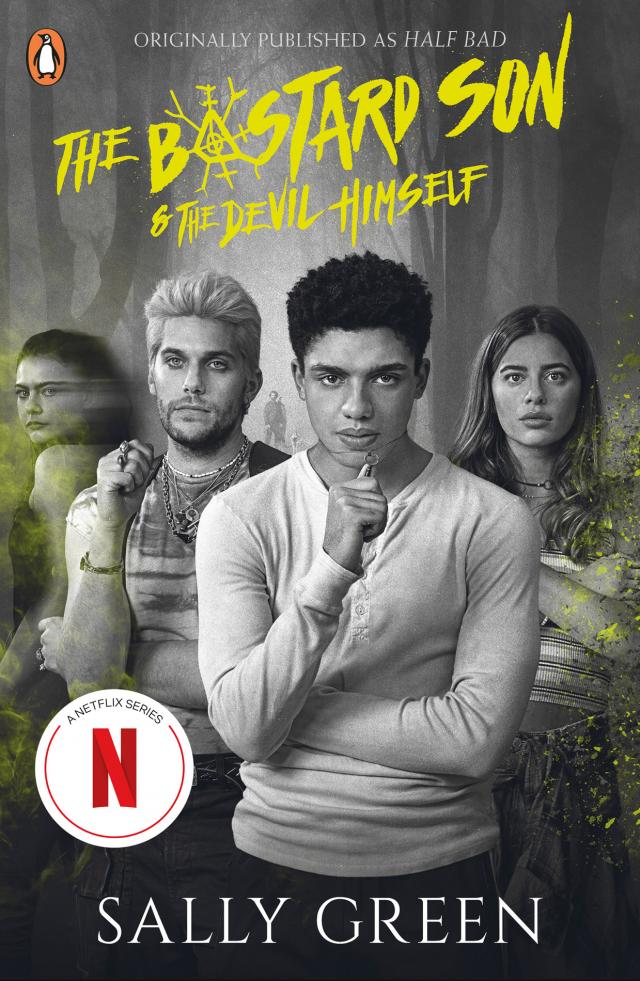
The Half Bad trilogy is a story about Nathan, a boy who is a witch. I created Nathan’s world of witches, war and mysterious powers a decade ago, and the making of the Half Bad Netflix series (under the title The Bastard Son and the Devil Himself) has given me the opportunity to revisit it. It has been a little nerve-wracking to see my stories adapted for the small screen, but, though many details have changed (not least that title!), the characters and the world remain true to my original concept. The complex logistical and creative process of making a TV series has been fascinating to witness. I’ve loved meeting the actors who play the key roles, and I hope the series brings Nathan’s story to an even wider audience.
I have also been fortunate enough to be in a position to consider what, if any, changes to the books might need to be made. After much thought and discussion with my editors, as well as thoughtful reviews from sensitivity readers with a variety of backgrounds and lived experiences, I decided to change the names of the two factions of witches in the novels to reflect the names used in the TV series: Blood Witch and Fairborn Witch. Originally, I had used the traditional terms Black Witch and White Witch, which for me reflected a medieval Christian construct of black and white magic. In retrospect, however, I realize that it’s impossible to fully separate these words from their significance in our real-world race relations. And while the oppression of people of colour at the hands of white people could be recognized as an allegory within this story, it is not the only one. I would not feel that a story that centres race was one for me to tell. So my original terminology wound up feeling inappropriate. In the world of Half Bad, the witches of each side are of a range of races and skin colours, and in this new edition that has not been changed.
Making these updates meant a handful of other minor changes – for example, the name of a certain knife had to be altered – but essentially I have left the books just as they were when first published. Of course, as a writer re-reading my work for the first time in many years, I saw countless things I might do differently today, but to make any substantial changes to these characters or their journeys felt like it would be disingenuous, both to the books and to the many readers they have touched over the years.
Half Bad is a coming-of-age story and a love story, but most of all it’s a war story. Nathan is caught in the middle of a long-running and increasingly violent war between two types of witches, and, to depict that, I drew on my own study and indirect observations of conflict.
I’ve never been in a war, but I believe they affect even those like myself, who have only experienced them remotely, through family anecdotes, history books or television news. I was a child during the Cold War and, like Nathan, as a teenager I read One Day in the Life of Ivan Denisovich and The Gulag Archipelago by Aleksandr Solzhenitsyn. One Day, the story of a prisoner at a Soviet labour camp, influenced Half Bad through its depiction of the brutal physical hardship the prisoners suffered, but Gulag had a more profound effect through its depiction of what happens when a community lives in fear of betrayal for a wrong word or idea. This is not a modern phenomenon. The Tudor era in England – when Catholics and Protestants, members of different branches of the same religion, persecuted each other – was another time when the consequences of being on the ‘wrong’ side could be fatal. That period of history was a major inspiration for these books.
During and after the Cold War there were, of course, other conflicts: the Troubles in Northern Ireland; the Falklands War; the genocide in Rwanda; Bosnia, Afghanistan – there are too many to list. I began to write Half Bad in its earliest form in 2010 and developed it over the next three years while living in the north of England, watching news footage of war in Iraq and then Syria. Like many in the West, I had the absurd privilege of being able to switch off the TV and carry on with my normal day, but the words I heard and images I saw affected my storytelling. I did not want to shy away from the horror of war, and certainly not to glorify or make light of it but to reflect that young people are drawn in to fight, often against their will. Even now, as I write this, we are witnessing genocide and other atrocities in Ukraine, as well as heroic stories of bravery, love and fortitude.
I am a fan of Hemingway’s writing style, particularly one of his semi-autobiographical short stories, ‘Big Two-Hearted River.’ In this story the main character, Nick, mentally scarred by war, goes fishing alone and begins to recover. The healing capacity of being in nature, and the feeling of freedom that brings, was something I wanted to reflect in Half Bad. While writing the trilogy, I went regularly to Snowdonia to scramble around the ruggedly beautiful ancient mountains – a place I knew Nathan would love and where he’d feel at home. My walks in Wales inspired me to think about how witches might access their strange individual powers, their Gifts, and it seemed right that the magic should somehow be drawn from the Earth, an old symbol of motherhood.
Like the witches, I have long believed that if we take time to connect with nature and value its power, diversity and beauty, and our place within it, we can all benefit. Recently, in this new world of a global pandemic, many of us have realized how something as simple as a walk in the woods can improve our mental health. We ignore nature, or use it for selfish ends, at our peril, and in Half Bad even the most beautiful, natural magic can be perverted by humans bent on power. Like many, I’m afraid for the Earth, afraid of the destruction that humanity brings, which is causing the loss forever of plants, animals, and even whole ecosystems.
While the war goes on around Nathan, he does find friendship and love – and not always from those whom you might expect. Nathan is a witch with unusually strong magical gifts. He is angry, violent, defiant, determined, and has a cynical sense of humour – he is the hero I would have loved when I was a teenager.
I’m frequently asked which of the characters from all my books is my favourite. Of course, this is impossible to answer as they are all my children, but Nathan was a huge part of my life for nearly five years as I was writing the trilogy, and I felt I knew him better than I knew anyone, but he was more than that: he was part of me. As I’m a fan of Wuthering Heights, there’s probably something of Cathy and Heathcliff in Half Bad too, and I feel I’m in danger of sounding like Cathy here – ‘Nelly, I am Heathcliff’! – but as a writer I have to care about and understand all my characters, the good and the bad, if I’m going to stand a chance of telling their story truthfully.
Since the Half Bad series was first published, war, discrimination and disinformation have continued, possibly even grown. Like many people, I have a greater understanding now of the prejudices faced by marginalized groups, highlighted particularly to me by the Black Lives Matter movement and the campaigners for rights for LGBTQ+ people. In the world of Half Bad, Blood and Fairborn are two types of witches, but the differences between them are fewer than the similarities. And while some witches use fear of differences to sow hate and mistrust, others live their lives noticing the similarities and building bridges when they can. I hope that, like me, reader
There is one final thing to say. In the books, Nathan comes from Warrington, an average town in north-west England, the place where I live and where I was inspired to start writing in my fifth decade. When I began the process of trying to get Half Bad published, I feared this setting would somehow be unacceptable as most books seemed to be located in Oxford, London or some sunnier, more affluent, southern region. It seems strange to me now that I went through this thought process, and it highlights how even the smallest difference can seem like a huge barrier, but many writers from marginalized groups face much bigger hurdles and feel even more of an outsider than I did. Now as I reread Half Bad I recognize my northern voice and roots as a source of strength of my writing. I would encourage all would-be authors, of all ages, to be proud of their uniqueness – the world will be richer for your stories.
Sally Green, Warrington, March 2022
Part One
* * *
THE TRICK
The Trick
There’s these two kids, boys, sitting close together, squished in by the big arms of an old chair. You’re the one on the left.
The other boy’s warm to lean close to and he moves his gaze from the telly to you, sort of in slow motion.
‘You enjoying it?’ he asks.
You nod. He puts his arm round you and turns back to the screen.
Afterwards you both want to try the thing in the film. You sneak the big box of matches from the kitchen drawer and run with them to the woods.
You go first. You light the match and hold it between your thumb and forefinger, letting it burn right down until it goes out. Your fingers are burnt but they hold the blackened match.
The trick works.
The other boy tries it too. Only he doesn’t do it. He drops the match.
Then you wake up and remember where you are.
The Cage
The trick is to not mind. Not mind about it hurting, not mind about anything.
The trick of not minding is key; it’s the only trick in town. Only this is not a town; it’s a cage beside a cottage, surrounded by a load of hills and trees and sky.
It’s a one-trick cage.
Press-ups
The routine is OK.
Waking up to sky and air is OK. Waking up to the cage and the shackles is what it is. You can’t let the cage get to you. The shackles rub but healing is quick and easy, so what’s to mind?
The cage is loads better now that the sheepskins are in. Even when they’re damp they’re warm. The tarpaulin over the north end was a big improvement too. There’s shelter from the worst of the wind and rain. And a bit of shade if it’s hot and sunny. Joke! You’ve got to keep your sense of humour.
So the routine is to wake up as the sky lightens before dawn. You don’t have to move a muscle, don’t even have to open your eyes to know it’s getting light; you can just lie there and take it all in.
The best bit of the day.
There aren’t many birds around, a few, not many. It would be good to know all their names but you know their different calls. There are no seagulls, which is something to think about, and there are no vapour trails either. The wind is usually quiet in the pre-dawn calm, and somehow the air feels warmer already as it begins to get light.
You can open your eyes now and there are a few minutes to savour the sunrise, which today is a thin pink line stretching along the top of a narrow ribbon of cloud draped over the smudged green hills. And you’ve still got a minute, maybe even two, to get your head together before she appears.
You’ve got to have a plan, though, and the best idea is to have it all worked out the night before so you can slip straight into it without a thought. Mostly the plan is to do what you’re told, but not every day, and not today.
You wait until she appears and throws you the keys. You catch the keys, unlock your ankles, rub them to emphasize the pain she is inflicting, unlock your left manacle, unlock your right, stand, unlock the cage door, toss the keys back to her, open the cage door, step out – keeping your head down, never look her in the eyes (unless that’s part of some other plan) – rub your back and maybe groan a bit, walk to the vegetable bed, piss.
Sometimes she tries to mess with your head, of course, by changing the routine. Sometimes she wants chores before exercises but most days it’s press-ups first. You’ll know which while still zipping up.
‘Fifty.’
She says it quietly. She knows you’re listening.
You take your time as usual. That’s always part of the plan.
Make her wait.
Rub your right arm. The metal wristband cuts into it when the shackle is on. You heal it and get a faint buzz. You roll your head, your shoulders, your head again and then stand there, just stand there for another second or two, pushing her to her limit, before you drop to the ground.
one Not minding
two is the trick.
three The only
four trick.
five But there are
six loads of
seven tactics.
eight Loads.
nine On the look-out
ten all the time.
eleven All the time.
twelve And it’s
thirteen easy.
fourteen Cos there ain’t
fifteen nothing else
sixteen to do.
seventeen Look out for what?
eighteen Something.
nineteen Anything.
twenty N
twenty-one E
twenty-two thing.
twenty-three A mistake.
twenty-four A chance.
twenty-five An oversight.
twenty-six The
twenty-seven tiniest
twenty-eight error
twenty-nine by the
thirty Fairborn
thirty-one Witch
thirty-two from
thirty-three Hell.
thirty-four Cos she makes
thirty-five mistakes.
thirty-six Oh yes.
thirty-seven And if that mistake
thirty-eight comes to
thirty-nine nothing
forty you wait
forty-one for the next one
forty-two and the next one
forty-three and the next one.
forty-four Until
forty-five you
forty-six succeed.
forty-seven Until
forty-eight you’re
forty-nine free.
You get up. She will have been counting but never letting up is another tactic.
She doesn’t say anything but steps towards you and backhands you across the face.
fifty ‘Fifty.’
After press-ups it’s just standing and waiting. Best look at the ground. You’re by the cage on the path. The path’s muddy, but you won’t be sweeping it, not today, not with this plan. It’s rained a lot in the last few days. Autumn’s coming on fast. Still, today it’s not raining; already it’s going well.
‘Do the outer circuit.’ Again she’s quiet. No need to raise her voice.
And off you jog … but not yet. You’ve got to keep her thinking you’re being your usual difficult-yet-basically-compliant self and so you knock mud off your boots, left boot-heel on right toe followed by right boot-heel on left toe. You raise a hand and look up and around as if you’re assessing the wind direction, spit on the potato plants, look left and right like you’re waiting for a gap in the traffic and … let the bus go past … and then you’re off.
You take the drystone wall with a leap to the top and over, then across the moorland, heading to the trees.
Freedom.
As if!
But you’ve got the plan and you’ve learnt a lot in four months. The fastest that you’ve done the outer circuit for her is forty-five minutes. You can do it in less than that, forty maybe, cos you stop by the stream at the far end and rest and drink and listen and look and one time you managed to get to the ridge and see over to more hills, more trees and a loch (it might be a lake but something about the heather and the length of summer days says loch).