The lost tarot, p.1
The Lost Tarot, page 1


Copyright © 2024 Sarah Henstra
All rights reserved. The use of any part of this publication, reproduced, transmitted in any form or by any means electronic, mechanical, photocopying, recording or otherwise, or stored in a retrieval system without the prior written consent of the publisher—or in the case of photocopying or other reprographic copying, license from the Canadian Copyright Licensing Agency—is an infringement of the copyright law.
Doubleday Canada and colophon are registered trademarks of Penguin Random House Canada Limited
Library and Archives Canada Cataloguing in Publication
Title: The lost tarot : a novel / Sarah Henstra.
Names: Henstra, Sarah, author.
Identifiers: Canadiana (print) 20240305752 | Canadiana (ebook) 20240305817 | ISBN 9780385688116 (softcover) | ISBN 9780385688123 (EPUB)
Subjects: LCGFT: Novels.
Classification: LCC PS8615.E597 L67 2024 | DDC C813/.6—dc23
Ebook ISBN 9780385688123
This book is a work of fiction. Names, characters, places and incidents are products of the author’s imagination or are used fictitiously. Any resemblance to actual events or locales or persons, living or dead, is entirely coincidental.
Cover and text design: Kate Sinclair
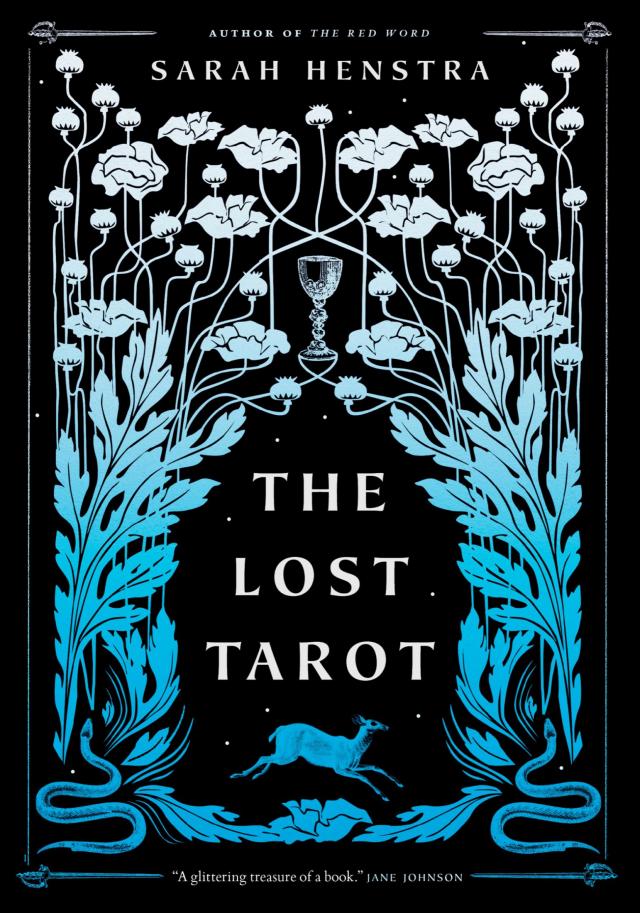
Cover images: (flowers) trigga, (fawn) THEPALMER, (snakes) mikroman6, (chalice and swords) ilbusca, all Getty Images
Typesetting: Terra Page, adapted for ebook
Published in Canada by Doubleday Canada,
a division of Penguin Random House Canada Limited
www.penguinrandomhouse.ca
a_prh_7.0_147409718_c0_r0
Contents
Copyright
0: The Fool
1: The Magician
2: The High Priestess
3: The Empress
4: The Emperor
5: The Hierophant
6: The Lovers
7: The Chariot
8: Strength
9: The Hermit
10: Wheel of Fortune
11: Justice
12: The Hanged Man
13: Death
14: Temperance
15: The Devil
16: The Tower
17: The Star
18: The Moon
19: The Sun
20: Judgment
21: The World
0: The Fool
Acknowledgments
— 0 —
THE FOOL
On the last day of her uncle Corvo’s life, Nell Larkin paid her final visit to the moss throne. September 18, 1938. In the steely predawn air she looked down over the meadow and almost laughed in her relief at being alive. It was the flimsiest time of day, when night was still peeling back from the world. This was near Kilndown, in Kent, the idyllic home of the community Corvo Ringold had named the Shown. Well, formerly idyllic. Descending the hill toward its ruins, Nell saw that the fire had eaten holes everywhere, so that the buildings’ solid edges were frayed into fine threads wavering and blurring into the dull sky. She snuck a look at the lodge to be certain her uncle wasn’t watching out the window. Corvo lay in hospital in London siphoning a last dribble of oxygen into his charred lungs. He could not be staring out at her and tracking her movements past the walled garden and down the lane. Yet she could almost see him twitch the curtain in the window. Almost see the flash of his silver rings as the curtain sylphed into ash, and then Corvo’s face a black crust with glaring, lidless eyes. Nell was twenty-two years old and pretty well the only one left.
She turned her gaze to the golden gleam at the horizon where, in the burned hayfield, a mayhem of starlings dodged among the furrows, too impatient for full dawn. All the insects that had burrowed down into the soil for safety from the flames were now creeping up again, only to be met with fresh slaughter. The smoke odor slithered into Nell’s throat, and she started running—away from the night’s horrors behind her and the morning’s horrors now awakening. She crossed through the orchard, vaulted the stiles on either side of the road, entered the wood and climbed a steep hill where deadwood littered her path and burrs clustered on her socks. Then down the other face of the ridge; Nell dug her heels into the earth and planted her hands behind her to slow her slide.
Halfway into the ravine was the broad chalk shelf where, in March and April, Simon Shawcross had collected roots from the Tunbridge filmy fern. In the spring the whole gill—Simon called it a “gill;” was that an official geological term or had he made it up?—went slick with mud and its rock shelves seeped moisture, but now, mid-September, the ferns were dense and spongy as if they’d soaked up and were hoarding all the water. The chalk was smooth and cold under Nell’s palm.
It was Simon who showed her the treasure at the bottom of the gill: A massive vertical stone slab, a broad stone seat, tall stone arms, and every surface furred with vivid green. The moss throne. Simon showed her what to do here. He showed Nell everything in those last months, as if he knew they were running out of time. The air down here was strange, with the color and density and scent of an alien planet, and the two of them always felt like encroachers, always a pair of vagabonds on some furtive, foreign business. The way Simon explained it: mosses don’t remember faces.
And now Nell was all alone, a solitary fool on a fool’s errand. Silence stuffed her ears. Her shoes and socks came off, then the rest of her clothes. She had never felt such a stranger in her skin, moon-white. The throne was tall as a forest queen, three times taller than Nell. Nothing welcoming about it. Nothing useful down here for any human enterprise save the survival of her soul.
Naked, Nell climbed onto the moss seat and knelt, gasping as the chill seeped into her kneecaps. She flattened her thighs and belly against the throne’s back, raised her hands and dug in with her fingertips. Ice-cold water ran into her armpits and across her ribs. The moss throne’s back was a saturated sponge filled by an underground source whose water never warmed. A shiver quaked her spine, and she laughed at the way her muscles clenched and flinched, body versus brain. She stood up, turned around and leaned back into the moss so that the water sluiced down her spine and buttocks. She rolled her head and soaked her hair until her skull ached. Rotating again she opened her mouth and went in nose first, swallowing mouthful after mouthful of spring water.
When she couldn’t feel her feet, when even her molars were numb, Nell dismounted the throne and lay flat amid the dry, rubbery ferns. Her pulse thrummed over every inch of her skin from neck to ankles. She might have been levitating. Nell did what Simon had shown her, what he’d done for her when they’d lain in the ferns together, their laughter splintered with shivering. She put her hands between her legs and pulled all the sensation into a single, burning point. The moss spirit traveled from the roof of her mouth to the root of her sex and then out, back into the moist world where it belonged.
Afterward she rolled onto her belly and went to sleep. Her dreams down here were less suffocating and funereal. What woke her again, minutes or hours later, was a warm nudge to the hip. She lifted her head from the ferns and saw a half-grown deer with its spots mostly faded but its eyes still liquid with innocence. At her sudden movement it sprang into the air, all four hooves off the ground. It wheeled, leapt for the bushes and in an instant had vanished.
The Fool is the first card of the tarot’s major arcana. The first and the last, numbered zero, which is no number at all. This Fool has a peculiar relationship with survival. He is all alone, fresh fledged from the nest and terrifyingly inexperienced. With his head bared to the sun he takes to a cliffside road without a compass or a forwarding address. Yet we know for certain he’ll be the last one standing, the only one left to tell the tale. For all his lollygagging and woolgathering, he’s the one we will have to rely on to set the record straight.
* * *
March 8, 2000
Dear Dr. Bateman,
I am writing with a request on behalf of my grandmother. As you may already know, some of the original paintings for the Ringold Tarot which were lost during the Second War have recently been rediscovered.
Three students were waiting for Theresa’s office hour at the University of Toronto. Martin Podolski from Advanced Critical Theory, first in line as usual, had ignored the neat row of chairs and was slouched on the filthy carpet. Hunting for her keys, Theresa waited for him to reel in his long legs. “Allow me,” he said, and reached up and took the Styrofoam cup of coffee from where it teetered in the crook of her elbow.
She wished she hadn’t stopped at the coffee kiosk and the mailroom, let alone started reading her mail on the way to the office. It wrong-footed her a bit whenever her students beat her back from class and then watched her approach. As if Theresa were the petitioner come to consult their expertise, to throw herself upon their mercy, instead of the other way around. But her eye had been drawn to a thick, hand-addressed airmail envelope in her cubby—no return address, British stamp—and then the penmanship of the one-page letter inside was so untidy that she’d had to read slowly and guess every fifth or sixth word.
My grandmother is hoping that as an art historian you might be willing to examine these paintings and to offer an academic opinion on their provenance.
Martin always arrived first, but he preferred to wave everyone in ahead of him so he could take up whatever time Theresa had left. Today
As Martin shrugged out of his vintage overcoat, she took another look at the odd missive.
Some haste is called for in the circumstances, since the paintings will likely be put to auction before long.
“I don’t know how you can work in here,” Martin said, grimacing at the wall beside him, “with all this visual noise.”
Theresa glanced up at the collage of art prints: Caravaggio, Alma-Tadema, Monet, all yellowed and curled at the corners. “I don’t even notice it.”
“It still compromises your visual field, though. And it, like, dishonors the artists to cram their work together like that.”
Compromise. Dishonor. Theresa was only half a dozen years older than Martin—only two years out from getting her PhD—yet to her ears he sounded as quaint and anachronistic as a medieval knight. She set the leaf of stationery on her lap. The lid of her coffee cup was smudged with charcoal from Martin’s fingers, but she sipped from the opening anyway, appreciating the scald in her throat after three hours of lecturing.
He’d pulled his sketchbook from his bag. “Can I show you what I drew last night?”
“No, thanks.” This was the problem with Martin. He never came to her office for actual help.
“If I could give you a clearer sense of my aesthetic, how it responds to some of the stuff we’re talking about in class—”
“You don’t come to class, though.” She smoothed the letter against her thigh, sifting through its author’s claims in her mind. Original paintings recently rediscovered? News traveled fast in the art world, especially with the help of online networks, but Theresa hadn’t encountered anything along these lines.
Now Martin was saying, “I’ve been reading Ringold’s book, On Seeing, and it’s totally unlocking the work for me. I feel like I’ve been living inside his head.” He turned the sketchbook around to face her. “Here, look at this one.”
“You do know Lark Ringold didn’t write that book, right?” she said. The coincidence spooked Theresa only momentarily. No, Martin hadn’t somehow traveled to the UK to prank her by posting this letter; no, he hadn’t managed to peek at it across her desk. Many art students, especially the male ones, fell in love with Lark Ringold at some point during their schooling. And they tended to get the facts all wrong. “The author of On Seeing was Lark’s uncle Corvo, the cult leader.”
Martin made an impatient noise. “I’m just saying that as an artist I should get some credit for engaging with the theory through my actual art.”
Picking up the envelope to tuck the letter away, Theresa remembered that it contained something more. It turned out to be money, a whole stack. Another quick peek confirmed that it was British currency: a bunch of twenty- and fifty-pound notes.
This definitely called for more attention than she was capable of mustering at the moment. She shoved the envelope under her daybook, out of sight, and dragged her focus back to the student in front of her. “First,” she told him, “On Seeing isn’t on our reading list. And second, it’s not a critique class. I can’t give you a grade unless you turn in the essays.”
Martin picked at the cuticle beside a paint-ringed fingernail. “I wrote an essay on Ringold for Russell’s seminar,” he said, as if that should satisfy Theresa’s requirements as well. “He gave me an F, though. He said I was ‘seduced by the mystique,’ whatever that’s supposed to mean.”
“Russell would know—Dr. Horber,” she corrected herself. “He’s probably the world’s leading Ringold expert.”
“I told him my work needs to speak for itself anyway.” Martin leaned forward to turn more pages. “Look at this one. Look how it takes Ringold’s motif of the spyglass and turns it around so it’s you, the viewer, who’s being surveyed.”
Theresa reached over and flipped the sketchbook shut on Martin’s fingers, making him fall back with a gasp and then gape at her as if she’d slapped him. “You’ve shown me your drawings before,” she said, “lots of times. And they’re great, Martin; you know I think your work is great. But we’ve talked about this: on their own they’re not enough. Without a proper theoretical framework, you’re just floating around in a black hole.”
“Yes.” Martin sat up straighter. “Yes, a black hole. That’s where it all happens for me.”
Theresa shook her head. “That’s not really what I—”
Excited, he cut her off. “I, like, go into the black hole on purpose. The real problem is when you can’t access the black hole anymore because there’s so much crap in the way. Like Ringold’s book says, the veils over reality stop us from seeing reality.” He lifted his hands to his face and spread them wide, miming the parting of a pair of curtains. “We Surrealists will do anything to try to get back to it, to that place where the veil gets torn away.”
Theresa didn’t reply. She hadn’t finished marking the European Traditions essays until after three that morning. Fatigue fritzed in her brain, shorting out the lines of reasoning she would normally follow back to the subject of Martin’s academic problems. Voices came from outside her open door: more students were arriving to see her. She scooped up her daybook with the envelope underneath it, added both to her stack of mail and then put the whole pile into her backpack. She neatened the papers on her desk, trying to indicate to Martin that his time was up. When he made no move to leave she picked up his sketchbook and held it out to him.
He clutched it to his chest. “Isn’t that basically all of art history right there?” he said. “Artists breaking down the walls society puts up around the black hole? Look at Ringold! He runs away and joins a cult. He does all these drugs and séances and orgies or whatever. And he paints, like, dozens of paintings. Paintings like nobody has ever made before. Images nobody’s even dreamed of before.”
“Yes, and then he flames out. Literally. Ringold was only twenty-two when he died in that fire.”
“So what? I’d happily die three years from now if I could paint like he did.”
She knew Martin was only trying to provoke her now, to resist her attempts to end the conversation. “I don’t see it that way,” she said. “I always imagine what Ringold could have painted if he’d lived.”
“He probably would’ve got boring.” Martin glared again at the prints on the office wall. Then he sighed and bent to pick up his satchel. “I really hate the way you people suck the mystery out of everything.”
“It’s true that mystery is what draws us to art. But it doesn’t help us make sense of it. We need to develop a critical distance.”
“I didn’t come to university to get critical distance.”
“Well, then, you came to the wrong place.” She gulped her coffee, already tepid and sour. “We’re not in the mystery business. We’re in the mastery business.”
* * *
—
It seemed to Theresa that her postgraduate life could be boiled down to a single, demoralizing paradox: whenever she finally had a chance to sleep was precisely when she was most awake. The hollow breath of the furnace, the ducts’ ticking contractions, voices rising from the street corner. Ten minutes to two. A car came by, too fast over the speed bump; its lights pierced the curtain and strafed the room with yellow, then white, then red. For a moment her legs were long and doll-like under the sheets. Through her wall came a muffled, uneven percussion: her roommate, Polina, fellow insomniac, practicing the electric piano with her headphones on.
The remainder of Theresa’s day had been crowded tight—meetings, groceries, dinner, a last-minute reference letter to write for a student—and only now, in the barren borderlands of sleep, did she recall the airmail envelope in her bag. She slid out of bed to sit in the sallow glow of the streetlight and counted out 450 British pounds. That was, what, a thousand dollars? In addition to the accompanying letter was an illustrated card, like a playing card but larger, patterned on the back with blue marbling. On the front was an image reproduced from a painting, and across the bottom its title, not printed separately on the card but hand-lettered within the painting itself: The Fool.