

Crystal blue murder, p.1
Crystal Blue Murder, page 1


PRAISE FOR Crystal Blue Murder
“Crystal Blue Murder is an expertly crafted mystery that kept me guessing until the end. In addition, Oliver Parrott is the most charming detective to come along in quite some time. He and his family -- consisting of a hero wife struggling with PTSD and a cockatiel who steals every scene he’s in -- elevate this into one of the best procedural series going. Satisfying in every way, Crystal Blue Murder is another wonderful installment in author Saralyn Richard’s Detective Parrott series.”— Rick Treon, award-winning author of Deep Background and Let the Guilty Pay
“Detective Parrott and his chatty cockatiel, Horace, are back in this delightfully entertaining and expertly crafted mystery. Crystal Blue Murder keeps you glued to the page from its explosive beginning to its suspenseful end. Saralyn Richard is a masterful storyteller!” —Margaret Mizushima, author of the award-winning Timber Creek K-9 Mysteries, including Striking Range
“We could talk about the intrigue and solving the mystery, but for me, relationships make the story. The tender, loving relationship between Detective Parrott and his wife, Tonya, was perhaps what I most enjoyed about Crystal Blue Murder.” —Sheila Lowe, author of the Forensic Handwriting suspense series
“What’s not to love about the tenacious Detective Parrott who sifts through the evidence of arson and murder, uncowed by self-entitled gentry. While dealing with his own issues, Parrott digs out long-hidden secrets, and, at great risk to his person, proves his worth to the people of Brandywine Valley.” —Susan P. Baker, author of the Mavis Davis Mystery Series.
“In Crystal Blue Murder, readers will find Saralyn Richard’s hallmark clear writing, vivid descriptions, and an assortment of complicated characters with deep secrets, stirring a plot so delicious one must keep reading. The tension, surprises, and sparks of humor as Detective Oliver Parrott unravels another Brandywine Valley mystery make this book another page-turner in the series.”–Ginny Fite, award-winning author of the Detective Sam Lagarde mystery series
“When Claire Whitman, the owner of Sweetgrass, blasts into one of Detective Parrott’s Brandywine Valley cases, he has to remind himself that nothing is as perfect as it seems.” —Phyllis H. Moore, author of the Meg Miller Mystery Series
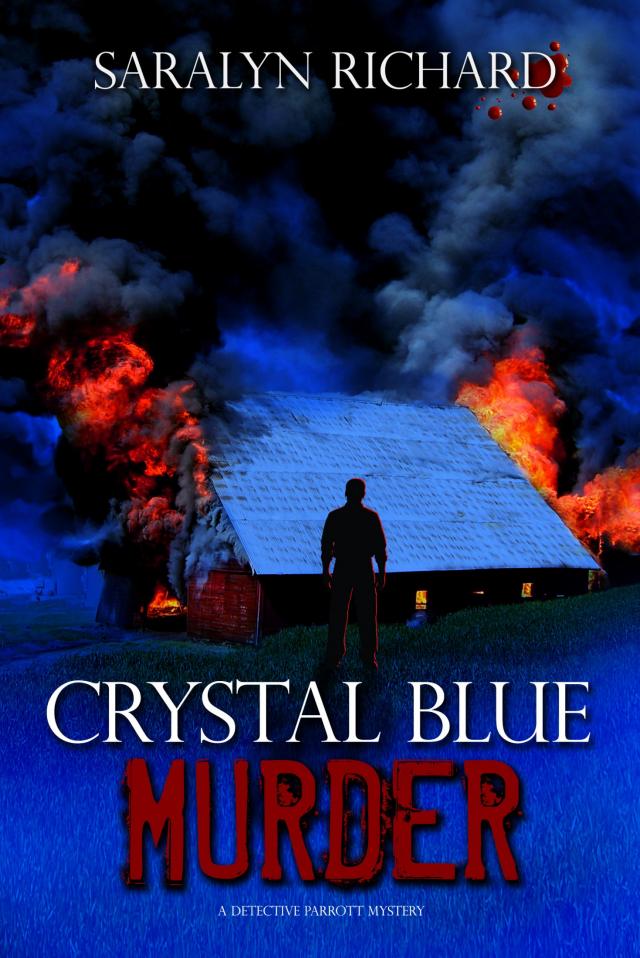
Crystal Blue
Murder
Saralyn Richard
GENRE: Police Procedural
Crystal Blue Murder is a work of fiction. Names, places, characters, and incidents are either the product of the author’s imagination or are used fictitiously, and any resemblance to any actual persons, living or dead, businesses, organizations, events, or locales is entirely coincidental. All trademarks, service marks, registered trademarks, and registered service marks are the property of their respective owners and are used herein for identification purposes only. The publisher does not have any control over or assume any responsibility for author or third-party websites or their contents.
Crystal Blue Murder Copyright © 2022 by Saralyn Richard
Cover Design by Rebecca Evans
Cover photos used with permission All cover art copyright ©2022
All Rights Reserved
Print ISBN: 978-0-9896255-5-5 paperback
978-0-9896255-6-2 hardcover
Library of Congress TX9-051-304
Published in the United States by Palm Circle Press, LLC
All rights reserved under the International and Pan-American Copyright Conventions. No part of this book may be reproduced or transmitted in any form or by any means, electronic or mechanical, including photocopying, recording, or by any information storage and retrieval system, without permission in writing from the publisher.
WARNING: The unauthorized reproduction or distribution of this copyrighted work is illegal. Criminal copyright infringement, including infringement without monetary gain, is investigated by the FBI and is punishable by up to 5 years in federal prison and a fine of $250,000. Anyone pirating our eBooks will be prosecuted to the fullest extent of the law and may be liable for each individual download resulting therefrom.
Published by Palm Circle Press, LLC. www.palmcirclepress.com
Also by Saralyn Richard
Bad Blood Sisters
A Murder of Principal
A Palette for Love and Murder: A Detective Parrott Mystery
Murder in the One Percent: A Detective Parrott Mystery
Naughty Nana
To Mamie and Scott
Third time the charm
Chapter One
Being awakened at two a.m. was bad enough, but the word explosion yanked Detective Oliver Parrott out of bed in nothing flat. The barn on eighty-two-year-old celebrity hostess, Claire Whitman’s fifty-acre farm was burning.
Grumbling, Chief Schrik elaborated. “Suspected meth lab. Whitman and her helper evacuated. Air quality testers from Philly’re on the way. Fire chief asked for you by name.”
The touch of flattery did little to diminish the adrenaline surge. Parrott threw on the shirt and pants left on the chair the night before, tiptoeing so as not to wake Tonya. He brushed the grit from his eyes and downed a glass of cold water. He needed to be alert. The only meth lab explosion he’d ever investigated was a simulation. His role would be secondary to the fire department’s, but no less dangerous. If it was meth, laws had been broken, and people who cooked drugs could be unpredictable, desperate, or violent. Parrott sped to the scene, hoping to arrive before all evidence was reduced to ashes.
Driving on the winding country roads, windows down and with the summer breeze sweeping his face and neck, he had mixed feelings—dread of what might lie ahead, but also, he had to admit, excitement. Solving crimes was its own elixir, and that never got old. He barreled toward the dark, quiet countryside, the woodsy smells giving way to something more sinister.
When he turned off the road and onto the long driveway of the Whitman estate, the lack of streetlights didn’t matter. The fire illuminated the area like a beacon. A third-of-a-mile away, and the noxious chemical odors and thick, warm air already wrapped him in toxic filth. Meth fires were no joke.
Parrott rolled up the car windows and turned on his flashers. A firefighter in a white hazmat suit waved him to the side of the roadway, a good five hundred yards before the gravel path to what might once have been a stately barn, set into a hillock. Jagged blackened edges of burning timber stood tentatively above a stone wall base, the spray from hoses jousting with the still-raging flames.
“Over here,” the firefighter yelled, pointing toward a sprawling willow near the side of the road.
When Parrott stepped out of his car, the stocky fireman extended a gloved hand and a hearty welcome, despite the occasion. “Detective Parrott? Name’s Skip. Heard a lot about ya, kid.”
Parrott shook the offered hand, thinking this was no time for compliments. Parrott focused on the suit that hung over Skip’s left forearm and boots on the ground next to him.
“Put this stuff on. The air’s poison.”
Grateful for the protective garb, Parrott stepped into a fire-resistant jumpsuit that covered his body, clothes, and all. He pulled the hood up over the top of his head, securing the drawstring. He traded his Nikes for thick, steel-reinforced boots.
Skip handed him a black gas mask, identical to the one he now pulled over his own face. Parrott donned the mask, glad he’d never been claustrophobic. Heavy rubber gloves completed the uniform. Eager to begin his search, Parrott headed toward the blaze, but Skip shook his head, blocking him. Talking through the gas masks was difficult, but Parrott understood. Everything about this scene was dangerous—the fire, the debris, the toxicity. There was even the possibility of another explosion if flames reached a new accelerant.
Parrott nodded, but he wasn’t going to stand there watching while he waited for the firefighters to get the blaze under control. He moved his gloved index finger in a large circle. “Get a look around,” he shouted.
Throwing his Nikes into the front seat of his car, he grabbed his tactical flashlight, cell phone, and an evidence kit, all of which he pocketed in the suit. He took off at a slow jog, the heavy boots dragging on him. He kept adequate distance between himself and the intense heat from the barn. The light from the flames illuminated the gravel path and the split-rail fence that separated this part of the property from the rest.
As he circled the perimeter of the barn, he looked for any signs of traffic, other than those of emergency vehicles--tracks of wheels, footprints, objects dropped on the gravel or grass. He didn’t expect to find much from this distance, but he’d rather be moving than standing still.
On his second lap, he gazed in the opposite direction. The generations-old Whitman country mansion stood, tall and broad and neatly etched against the horizon to the east, quiet in contrast to the drama surrounding the barn. Where had the inhabitants gone in the middle of the night—to a nearby farm? Or somewhere closer to Philadelphia? A car or truck was parked on the circular drive, in front of the house. Parrott couldn’t tell for sure with the smoke and distance. He saw no spectators anywhere on the property, not even wildlife—only firefighters, going at the fire like a flock of furious birds on attack.
Parrott stopped jogging. The flames were dying now, and with them, the illumination of his path. Spots of light shone from the headlamps and other high-intensity flashlights attached to fire equipment, but these were focused on the smoldering remains of the barn. Parrott was
glad to have his own flashlight, even if he would have to decontaminate it later. As he paused to assess the disaster zone in front of him, the pungent acid-smell invaded his gas mask, and the air hung about him like a thick sooty curtain.
This scene was going to be a bear—a grizzly. As Skip or another white-suited firefighter waved him onto the main stage, Parrott sucked in a deep breath. He strode into the path of destruction with only one hope, a slim one—no dead bodies.
Chapter Two
Barn conversions were fairly common in Brandywine Valley, and Claire Whitman’s bank barn, built into a hill, so it had ground-level entrances on two floors, had probably been one of the simpler remodels. Based on the stone wall perimeter, the barn was about eight thousand square feet, four thousand on the ground floor and another four thousand in the converted loft. The exterior of the first floor was composed of large stones, still largely intact.
Skip materialized at Parrott’s side again, apparently to welcome him into the still-smoldering debris. “Be careful. You can burn yourself on some of these surfaces, so test everything before touching.” Skip tapped the top of a pile of timbers to illustrate.
“This stone stable?” Parrott shouted at Skip as they approached the structure.
“Can’t count on it. Fire melts grout. One minute it looks solid, and the next minute it starts to crumble.” The fireman shoved a gloved fist against the timbers at the top of the nearest boulder. A sheet of wall, covered in sparks and cinders, crashed to the ground, but the stone held. Can’t take anything for granted in explosions like this.”
Parrott recalled having read about a famous local explosion and fire in the early 1800s. “Wasn’t the Dupont gunpowder factory a stone building?”
“Sure was. Over in Hagley Yards. And even so, it blew up in the direction of the river, and people were killed.”
As they entered the stone perimeter, Parrott and Skip stopped shouting at each other through their masks. Other firefighters were moving about, some with hoses, some with hatchets and other equipment. There was no clear path to take. Debris littered the entire area, most objects barely recognizable after collapsing or burning to cinders.
Preserving the crime scene would be near to impossible under these circumstances. All the objects were either scattered in pieces or burned, some still too hot to touch. The roof had caved in, and timber fragments lay across objects that might have been toilets and cabinets and furniture. Parrott had investigated fire damage before, but nothing like this. At any moment, a wall could cave in, or another fire could break out. Everything in sight was coated with ash and chemical residue. The masks helped, but Parrott wondered whether they screened out all the poisons.
Parrott’s initial excitement over the new case was tempered now by thoughts of what his wife would say if she knew he was here. Tonya suffered from PTSD. Anything could trigger an attack, and lately Tonya had been harping on the dangers of Parrott’s job.
He couldn’t dwell on Tonya’s fears, though. Inside the hot protective suit, his heart pounded, and his breath came in staccato gulps. Parrott let the adrenaline do its job. He knew what to do--observe, note, question, hypothesize, and repeat. Whatever bad things had happened in this place, he would discover them. He might not be able to make them right, but he could make them better.
Skip had left Parrott’s side to help another fireman clear a path into the interior of the barn. Parrott began a methodical trailblazing of his own, as he crouched, stretched, twisted, and leaped through the debris, the beam from his tactical flashlight leading the way. He would make this first pass as quick as possible, without sacrificing thoroughness of observation. He’d search more meticulously once he had daylight on his side.
In the dark wet muck, he could make out a few objects—a brass headboard, a broken sink, a fragment of countertop. It was hard to tell which items had fallen from the second floor, although, if he had to guess, the living quarters had been there. He swiped his gloved hand over his visor to clear it of ash and soot, and he shone his light on the ground in big arcs around him, looking for whatever interesting bits of information he could glean. Bits became pieces, and pieces became stories. He wouldn’t leave until he had a picture of what had happened.
As he eased himself further into the center of the barn, Parrott hit paydirt. His flashlight caught the gleam of something shiny under what might’ve been a table. Parrott dropped to the ground and shone the light under the crushed furniture. The light illuminated a pile of hypodermic needles, maybe a gross of them, lying in a puddle of blackish-amber muck. Needles had been on the list of items most often found in meth labs in the manual Parrott had studied. So were colanders and metal strainers, both of which Parrott found next. Plastic soda bottles would have burned in the fire, but Parrott found a few bottle caps scattered among shards of glass. There was enough evidence that this barn had been a working meth lab. But who was running the operation, here in the yard of a proper dowager, and how and why had it blown up?
He wished he could take photos, but he couldn’t use his cell phone without contaminating it. Instead, he dug red sticky flags from his evidence kit. His clumsy gloves slowed him down as he marked areas of potential evidence. Parrott continued his methodical examination of the barn’s mystery, swinging his flashlight before him. In the next moment his light landed on something blue—a piece of fabric, part of a short-sleeved shirt. And inside the fabric was a man’s arm, covered in soot and blood.
Chapter Three
At eighty-two years of age, Claire Whitman had experienced a lot of highs and lows, and she’d learned anything could happen at any time. Life’s events hadn’t surprised her in at least two decades. She simply did not permit herself to engage in drama.
So, when her assistant Tammie woke her from a satisfactory sleep to say there had been an explosion in the barn, and they needed to evacuate, Claire didn’t cry out in shock. She didn’t panic. She insisted on brushing her teeth, combing her silver hair, and putting on a mauve pant suit.
“We need to hurry, Mrs. Whitman. The fumes, and the danger of the fire’s spreading.” Tammie’s melodious voice was raised to its highest volume. Claire didn’t bother to reply that her hearing was perfect. Just a little way of facilitating her eavesdropping when the caregivers thought she couldn’t hear.
“Relax, Tammie. This time of night we only have the two of us to worry about. I’m practically ready.” Claire smeared her lips with her favorite mauve lipstick and grabbed her collapsible cane. “Just in case I need it,” she said, holding the implement aloft and dropping it into her handbag. She led the way down the hall to the elevator and down into the kitchen, where a door connected to the laundry room and garage. Claire’s stride was purposeful, though slow, and her posture was as perfect as her hearing.
Once seated in the passenger seat of her Mercedes, Claire tapped Tammie on the arm. “By the way, where are we going?”
“We’re evacuating. There’s a fire in the barn.”
“I know that. But what is our destination?” She consulted her wristwatch. “We can’t just show up on the doorstep anywhere at two a.m. What’s the plan?”
Tammie hesitated. “I thought we’d go to the Fairfield in Kennett Square. They’ll probably have a vacant room where we can get a few more hours’ sleep. We can eat breakfast there, too. The firefighter I spoke to said we’d be able to come back home by mid-morning if all goes well.”
“That’s fine, but perhaps we should go back and get a change of clothes and my makeup. I wouldn’t want to be embarrassed having breakfast in yesterday’s clothes.”
“No need, Mrs. Whitman. I took the liberty of packing a few of your necessities in an overnight bag. It’s in the trunk.”
“That’s wonderful.” Claire patted her young assistant on the shoulder. “You thought of everything.” Now that the most immediate concerns were apparently met, Claire turned her thoughts to the explosion in the converted barn. Many months had passed since she’d set foot inside. Maybe a year.


