

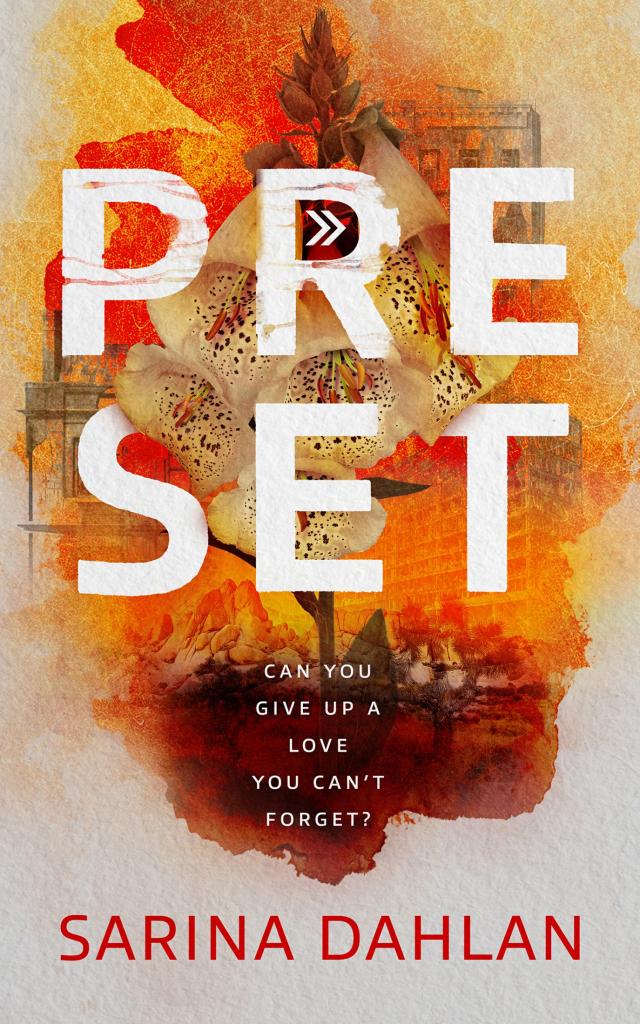
Preset, p.1
Preset, page 1


Subscribe to our newsletter for title recommendations, giveaways and discounts reserved only for subscribers.
Join here.
Praise for the Series
“A collision of our era’s catastrophes fuses a new world, becoming something rich and strange.”
—Kim Stanley Robinson, Hugo Award–winning novelist
“Through her sage storytelling, Sarina Dahlan richly weaves philosophy, science, and dystopia . . . Preset offers a trenchant meditation on what we both lose and gain when we choose to remember.”
—Jennifer Givhan, author of River Woman, River Demon
“Intricate, imaginative, and often surprising, Preset propels you through a future of warning, danger, and possibilities.”
—David Brin, New York Times bestselling author
“Reset captured me on so many levels . . . It was an absolute pleasure to read.”
—NAOMI GIBSON, author of Every Line of You, on Reset
“Reset haunts the reader through an ethereal, existential exploration of memory and meaning that lingers long after the last page.”
—D. ERIC MAIKRANZ, author of The Reincarnationist Papers, on Reset
“A vivid, evocative journey…This compelling debut is a story for our current world.”
—KIMIKO GUTHRIE,
author of Block Seventeen, on Reset
“Evocative and literary, I highly recommend it.”
—DAVID R. SLAYTON, author of White Trash Warlock, on Reset
BOOKS BY
SARINA DAHLAN
THE FOUR CITIES
Preset
Reset
SHORT STORY COLLECTIONS
Shadow Play
Copyright © 2023 by Sarina Dahlan
E-book published in 2023 by Blackstone Publishing
Cover design by Luis Alejandro Cruz Castillo
All rights reserved. This book or any portion
thereof may not be reproduced or used in any manner
whatsoever without the express written permission
of the publisher except for the use of brief quotations
in a book review.
The characters and events in this book are fictitious.
Any similarity to real persons, living or dead, is coincidental
and not intended by the author.
Trade e-book ISBN 979-8-200-97850-2
Library e-book ISBN 979-8-200-97849-6
Fiction / Science Fiction / General
Blackstone Publishing
31 Mistletoe Rd.
Ashland, OR 97520
www.BlackstonePublishing.com
To Ben & Jane
We are what we think. All that we are arises with our thoughts. With our thoughts, we make the world.
—Gautama Buddha
You are the drop and you are the sea
You are mercy and you are wrath
You are nectar and you are poison
—Rumi
Chapter One
Eli
Callisto, the Four Cities
Inside his right ear was a constant ache. Sometimes it jabbed. Sometimes it throbbed. At all times, it persisted. It ran a straight line from deep inside his cochlea to the bullet scar on his right shoulder, as if it were a string attaching two ends of a tin-can telephone. Accompanying it was a beating sound—the rhythm of a heart. It had been the soundtrack to his life since the day he stood on the precipice of death. The assassin had aimed to kill and missed, but they did not fail. A part of him had died—and in its place was the unending, consuming pain.
Above his tabletop, a schematic diagram floated like a golden spiderweb. He rearranged the threads of lights connecting the various points with a finger. At first glance, it was a web of chaos. But there was order and meaning to everything. The process of organizing his predictive model soothed him, like how one got peace from raking a Japanese sand garden. It was the only way to calm his ever-racing mind.
How did we get here? Eleanor’s voice rose through the veil of memory. It was a question she had asked the last time they spoke. He couldn’t answer her then, and he did not know how to answer her now. He had been trying to pinpoint a defining moment in their life together that could shed light on this riddle. But there wasn’t one.
He hated not having answers. He was supposed to be the one everyone looked to for solutions—the one who brought order to chaos. Perhaps he hadn’t looked closely enough. Thirty-one years together. A lifetime together. To him, though, it was multiple lifetimes—each layer needing to be peeled away to reveal the one beneath. But memories were subjective, each one wrought with the dark spots of imperfection.
“Eli, everyone is waiting for you,” a voice said, disrupting his reverie.
He looked up and saw the slim flat shape of a silhouette against the backlit door. His heart jumped. Elle?
“Lights,” he said.
The room slowly brightened. The silhouette took a defined form. Tall, a woman, hair up in a loose bun. It was not his wife, but his assistant, Kennedy.
Of course not, the thought bitter on his tongue. His wife was missing, or rather hiding with John and the other enemies of the state. An enemy of the state. What a strange title to associate with the love of his life.
Did Eleanor know that her one action had tipped the scale in the Resistance’s favor and put the survival of the Four Cities in jeopardy? She must. That’s why she left. Now he had no choice but to push everything forward faster than he intended.
“Do you want me to cancel today’s address?” Kennedy asked.
“No.”
He looked down at the speech his publicist had written—bullet points with keywords in bold. The people of the Four Cities needed reassurance. They wanted to feel safe again.
Smoke and mirrors.
There was no peace, and there could never be peace. The problem was choice. The problem would always be choice. Why couldn’t anyone else see it?
He rose from the chair. A sharp pang stabbed at a spot on his neck below his earlobe, as though someone had driven a nail through the soft tissue behind his jawbone. The pain pulled him back down and he landed on his seat with a heavy thud.
“Damn it!” he spat.
Kennedy rushed to him. “Let me help you.”
He raised a hand. “I’m fine.”
She stopped in her tracks, concern written on her face. She was becoming more empathetic and responsive to his commands—a feat, considering what she was just a year and a half ago. He could take pride in that.
“Can I get you anything? A glass of water? A Tab?”
He shook his head. “Just give me a minute.”
Tab was Eleanor’s creation—a PTSD drug used to calm anxiety and lessen depression. She had made it to help those suffering from their painful memories of the war, the one that killed the rest of humankind. He would not give her the credit of curing the wound the Resistance had inflicted. He, himself, would be its cure.
Eli stood again and leaned against the desk. His head felt heavy. He succumbed to its weight and let it droop like the branch of a willow tree. The pain was good, he told himself. It served to remind. Of human nature. Of the fine membrane separating life and death. It would make what he had to do easier.
His gaze landed on the white-gold wedding band on his left ring finger. He began sliding it up—the ring resisted, and his stomach hollowed. He stopped and quickly pushed it back down. A lifelong habit could not be shrugged off. Not in a day. Not in a month. Maybe not ever.
Suffering. He could never be free of it. He should not expect to be. It’s the first Noble Truth, which explained everything. Life was suffering, and he was fated to suffer his love for Eleanor.
He lifted his eyes. Through the doorframe was a long corridor. How many times had he walked this path? A hundred? A thousand? Never before had he felt this same seizing anxiety. But this time was different from all the others. After this, nothing would ever be the same.
He drew in a breath, slowly and deeply, until it touched the bottom of his lungs. One long breath out. He took one step after another until he reached the door to the future.
Kennedy was standing in front of it with a lapel microphone in her hand. She stepped forward and clipped it to the collar of his shirt. “Ready?”
He nodded, and she opened the door. Bright lights stung his eyes, making him squint. A series of images flashed through his mind like blazing comets: cities in flames, land crumbling into the ocean, death. He shook his head and steeled himself before entering the room.
The long, carpeted walkway led to a podium in the middle of a drum-shaped space. From here, he could see that every seat was filled. At the crescent table in front of him sat the head of each council, and in rows of stadium seats behind them were the council members.
The room felt enormous, though at the same time the walls seemed to be closing in. Fear prickled his spine. He reminded himself he had taken steps to ensure his safety. Everyone here was fully vetted. They had all passed the detectors. He was not the kind of man who made the same mistake twice. With a deep breath, he swallowed his fear, stepped onto the stage, and faced the councils.
There were several closed-circuit cameras around the room—each pointing at him, waiting to capture his message to all the citizens of the Four Cities. One of those would get him to her. He needed her to see him—to look into his eyes and know there was no hiding. Not for her. Not from him.
He squared his shoulders. The audience inched forward in their seats. All eyes were on him.
“Today begins the excising of our tumor,” he addressed the crowd. “The Resistance.”
Chapter Two
Eleanor
Tunnel to Elara, the Four Cities
Something hard kicks her feet—once, twice—followed by a startlingly bright orange light shining through her closed lids. She opens her eyes and stares straight into the barrel of a shotgun. Blood drains from her, and the freezing train tunnel feels even colder.
“What are you doing here? Are you from Callisto?” a man’s voice yells.
Will a “yes” translate to a spray of pellets through her face? Should she lie? What should she say?
“Wait, that’s Eleanor Hope,” another voice, a woman’s, speaks. The one grasping the gun. She lowers it slightly, eyes still fixed on her.
Eleanor was afraid her face would be too recognizable even with the scarf on her head to cover her blond hair. There’s no hiding. She gives up and pulls off her scarf.
She tilts up her chin. “I am Eleanor Hope.”
“Why are you here?” There’s panic in the woman’s voice. Panic and a gun do not make a good pairing.
“I need to see John Chang.”
Her friend since college, once the head of the Research & Intelligence Council of the Four Cities. After his fallout with Eli a year ago, he had joined the Resistance. Since that time, she’s had no contact with him.
The man and woman look at each other, both obviously unsure of what the correct move is. Eleanor takes their silence like an intermission during a play and gets up. The gun lifts and points directly at her. Her heart jumps. She raises both hands, showing her empty palms.
“I’m unarmed,” she says. “And I don’t think shooting me will solve anything, except maybe start something you can’t win with Callisto.”
“Why shouldn’t we? We’re already at war,” the man spits.
She does not have the heart to tell the young man that a war implies both parties have a chance of winning. Callisto, the capital of the Four Cities, holds most of the power and resources. Elara is but a moldy tomato in a large bushel—granted, one that will rot the entire bunch if ignored.
“It’s important that I talk to John Chang. Trust me, he’ll want to hear from me. Call it in,” she says.
“We can’t.”
She knows. In a tunnel this deep underground, there is no phone or Wi-Fi signal. No radio frequencies that could penetrate through the thick rock. The digital through-the-earth communications system the Four Cities uses to transmit messages between belowground locations was cut off from Elara long ago. They have only one option.
“We have to bring her in,” the woman says to her partner.
“What if she’s a spy?” the man asks.
Eleanor scoffs. “Come on, do you think they would send me as a spy? I can tell you I’m not the best choice.”
The woman lowers the gun. “She’s too valuable. We’ll bring her. But tie her up.”
The man walks toward her. He is about six feet tall and thin as a rail. The woman is much shorter but just as slight. Eleanor wonders what they are living on with no farms of their own.
“Put your hands together,” he orders.
Eleanor picks up her backpack from the ground.
“Hey!” he yells.
“I need to put this on first. It’s just my clothes.”
“Check it,” the woman says.
The man takes the backpack and roots through it—pulling things out and putting them back in. “Clothes, some lady stuff—lotion and shit.”
He throws it to Eleanor, and she eases the straps around her shoulders. The bag contains what’s left of her worldly possessions. The weight and bulk make her feel like a turtle, carrying her entire home on her back.
“Put your hands together,” he says again. She does, and he tightens a zip tie around her wrists.
The man leads them. The woman is behind her. The tunnel is dark but for the pale white glow emanating from both their jackets. They do not talk. The sound of gravel crunching beneath their feet is the only sign of time moving—like the ticking of a clock.
Though the trains no longer run, this tunnel leads directly to Elara. Eleanor knows she is close, just not how close. She first saw Elara years ago—when it was just raw desert, before it became a part of Eli’s Four Cities—and hasn’t seen it since. It was still in the middle of construction when the war destroyed the world.
During the expansion period afterward, the Dwelling Council extended the pipes here, intending it to be a new settlement for those who were rescued from the surrounding areas. But there were not enough building materials left, and this place ended up with no more than the basic infrastructure.
Population continues to concentrate in the other cities: Callisto, Lysithea, and Europa. Neglected, Elara has become a glorified spring in an unforgiving wasteland. A refuge for those who prefer living on the fringe, and a hotbed of the Resistance.
Her original plan was to sneak into Elara and find John. She does not know what will happen after she meets him. Does he still care about her? What if his year with the Resistance has changed him significantly?
After what seems like forever, the man stops and addresses the woman. “You wait here with her while I go tell them about this.”
She nods. The man turns and runs until his jacket is but a tiny glow in the distance. The woman gestures with her gun at Eleanor to sit. Even though her legs could use some rest, with both hands tied and the heavy backpack affecting her center of gravity, Eleanor knows she would never be able to get up without help. She decides to lean against a wall instead.
“What’s your name?” she asks.
The woman does not answer. Though the light is dim, Eleanor can guess from the way she carries herself that the woman is probably half her age. Early to midtwenties. She must have been a teenager when the bombs lit up the sky. How old was she when her parents told her that the atomic bombs had leveled metropolises, that chemical and biological weapons had made life outside the Four Cities impossible to sustain, that they could never leave? How old was she when she learned she would never be able to have children?
The gun in the woman’s hands makes Eleanor nervous. Eli’s publicist once sent her an article listing what to do in case she was ever kidnapped. She’s not sure if this situation is exactly that, but it cannot hurt.
One: remind the kidnapper you are human.
“Have you always lived in Elara?” she begins. “I’ve only ever lived in Callisto since I moved to the Four Cities. Before that I was in Silicon Valley, and before that New York City.”
The woman does not reply, so Eleanor continues.
“I lived near Central Park. Have you ever been to the real one? It is—was—spectacular.” A lump forms in her throat from the longing. She clears it. “The one in Callisto is just a replica and much smaller. My mother was still living in the city when it was destroyed.”
“Why are you telling me this?” the woman says.
“Just making conversation. Do you remember anything about the world before the war?”
“I don’t want to talk about it.”
Two: obey instructions.
Eleanor stops talking and stares into the darkness. Elara is about a hundred and seventy miles from Callisto—the same distance from San Diego to Yuma or Seattle to Portland. It’s an hour by the speed train connecting the two cities, or two days of continuous walking. She has no idea how long she’s been in the tunnel with no sun or a watch to tell her, but she has eaten and drank everything she packed. The person who dropped her off somewhere midway had risked everything to take her to that spot, though she didn’t even know them. A someone arranged by someone arranged by someone, as they usually are. She can’t even remember their name now. Did they even give it?
After a long while, the male captor returns. But he is alone. Eleanor’s heart sinks. Where’s John?
“They want us to bring her to Command,” he says.
He unfurls a long piece of black cloth and approaches her. “Turn around.”





