

We and me, p.1
We and Me, page 1


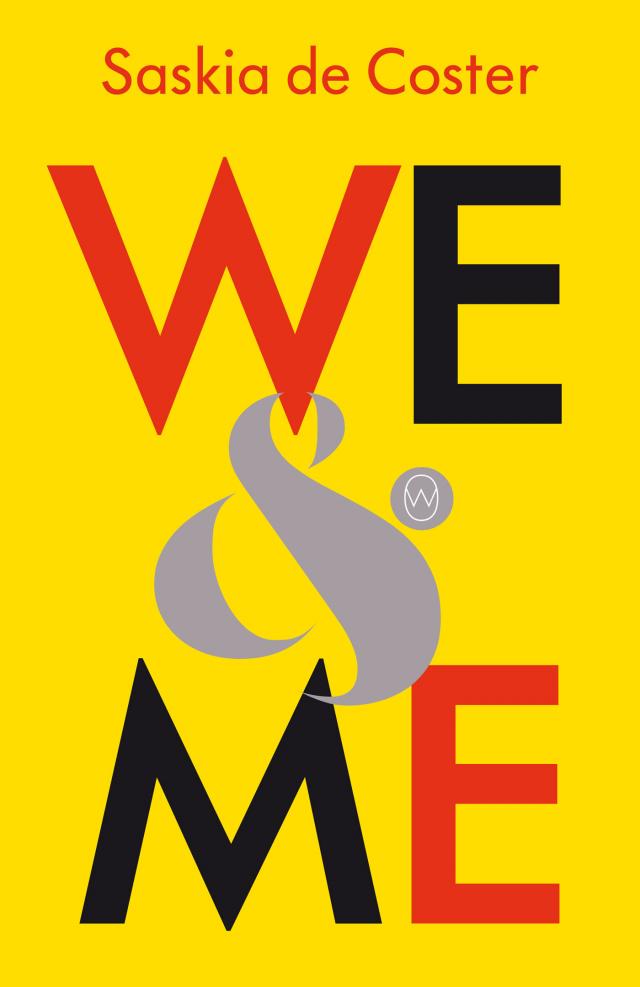
-
A DEVASTATING PICTURE OF A DYSFUNCTIONAL BOURGEOIS FAMILY
From atop their opulent private mountain estate, We and Me follows the aristocratic Vandersandens from 1980 to 2013, for whom neuroses, claustrophobia, scandal and rebellion run rife. At the heart of the family is Sarah, whose coming of age is both daringly and sensitively explored in de Coster’s skillful prose. In this spellbinding novel, which has been compared to the work of Franzen, Eggers and Eugenides, Saskia de Coster provides a uniquely European take on the Great American Novel. With the family unit and some of life’s most pressing questions at its center, the award-winning We and Me paints a poignant picture of modern-day family life.
-
Praise for We & Me
‘The Great Flemish Novel is not dead. It has just been written by Saskia de Coster. We and Me is a novel that will haunt me for a long time. Excellent and unforgettable’
HERMAN KOCH, author of The Dinner
‘For years the most stubborn, capricious and attractive pen of Belgium’
TOM LANOYE
‘As sharp as a knife and with great psychological insight the author investigates the ‘we’ feeling versus the longing for freedom and individuality. Sarah is a contemporary Emma Bovary or Anna Karenina. We and Me is like a breath of fresh air, because of its content as well as its virtuous form and fluent, ironic style’
OPZIJ LITERATURE PRIZE
‘Tender and cruel, Saskia De Coster unravels the illusions of social climbers in a novel that shows that every unhappy family is still unhappy in its own way’
TOMMY WIERINGA, author of Joe Speedboat
‘The book provides a wonderfully witty narrative about family relationships that everyone will be able to relate to in some way: an incredibly accessible novel that is hugely entertaining’
Buzz Magazine
‘A literary Desperate Housewives’
Jera’s Jamboree
‘De Coster paints a devastating picture of the modern-day nuclear family, revealing how loneliness can be threaded through the most intimate relationships of all. A bold and daring book’
ANN MORGAN, A Year of Reading the World
‘De Coster is highly original in her use of language: her choice of words and repetition of sounds make every sentence a story in its own right’
De Volkskrant
‘De Coster is a writer capable of reaching extremes lying just outside the experience and perhaps even beyond the imagination of most readers’
Vrij Nederland
‘With We and Me, De Coster positions herself at the highest level of Dutch literature. Pure class’
Liberales
-
SASKIA DE COSTER (Belgium) is a visual artist, playwright and regular participant in television debates, as well as an author. She is also manager of Andermansland, a company that brings words into action in public space. She has seven novels to her credit, five of which are currently translated. Her work is described as haunting, appealing, and unforgettable. Her bestseller We and Me won the Cutting Edge Award (an award de Coster has won three times), and the Opzij Literature Prize, and was nominated for several other prestigious prizes; it sold over 40,000 copies in the Netherlands and Belgium alone. Her work has been translated into ten languages.
NANCY FOREST-FLIER is a New Jersey-born translator who moved to Europe in 1982 and has worked in the Netherlands since 1988. Her literary translations include The King by Kader Abdolah, Dissident for Life by Koenraad de Wolf, Gliding Flight by Anne-Gine Goemans, Mr. Miller by Charles den Tex, Departure Time by Truus Matti, Hex by Thomas Olde Heuvelt, and most recently The Story of Shit by Midas Dekkers. Nancy also translates children’s literature and has translated for numerous Dutch museums and institutes, including The Anne Frank House and the Kröller-Müller Museum (home to the world’s second largest Van Gogh collection).
-
AUTHOR
‘The spark for this novel came when I started to repeat some of my mother’s favorite sayings. For a long time I thought I was a very independent individual, until I heard myself say something and it was as if my mother was speaking through my mouth. Although we are very different people, this moment made me realize that there is not only a ‘me’ but also a ‘we’ that we are all inevitably a part of.’
TRANSLATOR
‘We and Me is essentially a detective story—a story of family secrets and the kinds of unspoken past events that are familiar to all of us. Who am I, and how did I get this way? It’s written in the present tense, which gives it a level of suspense that continues from beginning to end. That is the translator’s challenge: maintaining that suspense.’
PUBLISHER
‘De Coster is an amazing author. Her writing is fluent, bold and intelligent and she touches upon one of the most essential questions possible: what exactly is it that we inherit from our parents, and what defines our very own identity?’
-
Saskia de Coster
WE&ME
Translated from the Dutch
by Nancy Forest-Flier
WORLD EDITIONS
New York, London, Amsterdam
-
Published in the USA in 2018 by World Editions LLC, New York
Published in the UK in 2016 by World Editions Ltd., London
World Editions
New York/London/Amsterdam
Copyright © Saskia de Coster, 2013
English translation copyright © Nancy Forest-Flier, 2016
Author’s portrait © Johan Jacobs
This book is a work of fiction. Any resemblance to actual persons, living or dead, or actual events is purely coincidental.
Library of Congress Cataloging in Publication Data is available.
ISBN Trade paperback 978-1-64286-004-7
ISBN E-book 978-1-64286-024-5
First published as Wij en Ik in the Netherlands in 2011 by Prometheus
This project has been funded with support from the European Commission. This publication reflects the views only of the author, and the Commission cannot be held responsible for any use which may be made of the information contained herein.
The translation of this book is funded by the Flemish Literature Fund (Vlaams Fonds voor de Letteren – www.flemishliterature.be)
All rights reserved. No part of this publication may be reproduced, stored in or introduced into a retrieval system, or transmitted, in any form, or by any means (electronic, mechanical, photocopying, recording or otherwise) without the prior written permission of the publisher.
Twitter: @WorldEdBooks
Facebook: WorldEditionsInternationalPublishing
www.worldeditions.org
-
‘To look life in the face, always, to look life in the face.’
– Virginia Woolf
-
WE 1980
No one comes to the mountain unannounced. Friends always arrange their visits well beforehand. Always, without exception. It’s one of the many unwritten rules of the housing estate on the mountain. Unexpected visitors may very well find themselves staring at a locked door, as we say, forcing them to turn away, their goal unaccomplished. Too bad. The residents of the housing estate all lead busy lives. It is in their spacious villas amidst lakes of green grass, protected by trees and six-foot fences, that they are able to unwind. Normal visits are made by appointment. The appointments are written down weeks in advance in a large ledger with sewn signatures issued by a bank—the deluxe edition for good investors—made in the year 1980. Clandestine meetings are moved to highway motels, distant vacation resorts, or private clubs with passwords.
The very idea of casually dropping in at one of the villas in the richly wooded housing estate, just for fun, is out of the question. Friends would never do such a thing, because friends respect each other. There’s no reason for that kind of impertinence, say the housing estate residents. No such thing as a neighbourhood committee here, or a charter with guidelines. The men are busy senior executives who already spend too much time at meetings during the day to fill their free hours with more of the same. These are not common labourers who chair their local bridge club, or petty officials whose idea of a good time is to stand in front of a mirror and practise their monthly treasurer’s report for the local marching band. Nor do the women of the housing estate see the point of such committees. They have quite enough to discuss with their own families, and they prefer to spend their free time on themselves. Although there’s no formal consultation of any kind among the residents, they’re in complete agreement on most matters, remarkably enough. Tacit agreement.
The working people who come to the mountain know exactly when they are expected. Gardeners, cleaning women, and manicurists all have fixed hours. Even the procession of Sunday mendicants—black men from Zaire alternating with Jehovah’s Witnesses—abide by the resting community’s unshakeable schedules and only come on Sundays between the hours of eleven and twelve. The blacks begin their pitch with a broad smile and milk-white teeth, immediately followed by the friendly warning not to be frightened, and in one breath they sing the praises of their little hand-stencilled books containing ancient stories about the genesis of their African tribes, which they are peddling to finance their university education in theology at some unknown or non-existent university in the south of France. Whether it’s due to the people’s feelings of coloni
So it comes as a total surprise to the residents when we make our way along the sunken road to the housing estate on a Tuesday afternoon in April 1980 without anyone on the mountain expecting visitors. We climb the mountain slowly. The road is so narrow here that two oncoming cars cannot pass each other. But there are no cars. Not at this hour of the day. At half past two on a Tuesday afternoon there’s no traffic from the housing estate to the real world, or vice versa.
There are only two roads leading to the estate. One of them sets out from the neighbouring backwater as a bumpy patchwork quilt of cobblestones and asphalt, patched countless times. At the end of this road the neighbourhood reveals itself, like the sea to a herd of water buffalo trotting across the Serengeti Plain: home, a final destination, a haven for quenching your thirst. The other way to get there is along the sunken road in the woods. The sunken road is an earthen trench that runs straight through the woods, a former riverbed in which an erratic asphalt road was laid. The road starts in the village and ends up in the paradise among the trees.
Potential buyers of the properties are enticed by the vastness of the lots and the fragrance of pine needles. Building permits are rather lavishly granted here. There’s room for large villas with swimming pools and tennis courts at the far end of each back garden. Even horse stables can count on a friendly wink from the mayor.
The families in the lower village still vividly remember how the count sold off the woods and grounds piecemeal to the occupiers up on the mountain. Their clans have been living in the village since time immemorial. Even before the village had an official name their ancestors were here. They were an industrious folk. They set up butcher shops, cafes, and liquor stores that they passed on to their children who in turn passed them on to their children, so the only things that had to be changed on the signs out front were the first names. The villagers speak a colourful local vernacular among themselves, with lush tones and heavy vowels that the people on the mountain can’t begin to fathom. There’s no direct communication between the two groups. Their only form of contact is gossip and backbiting.
If a professor from the housing estate should come down to buy something he accidentally overlooked on his shopping list for the big supermarket, the villagers close ranks. When he’s just within earshot they tell each other what for him is unintelligible slander, distilled from stories from the cleaning women and gardeners who work on the mountain off the books, fertilizing lawns and hanging bird houses on tree trunks at precarious heights. The mountain resident quickly purchases a loaf of salt-free, four-grain bread or a grilled chicken, jumps into his car, and returns to his family on the mountain as fast as he can.
Proceeding down the tongue of asphalt that rolls out of the sunken road, we turn onto the first street of the housing estate. All we see is one living soul, standing at the only bus stop in the entire housing estate, a pole with a minuscule timetable screwed onto it. A golden retriever lying in an impeccable front garden glances up for a moment. The smell of pine needles and horse manure hangs in the air. Somewhere in the belly of one of the villas a radio emits a news report on the death of the great master of film, Alfred Hitchcock.
On this calm Tuesday afternoon the housewives creep even more deeply into their cocoons of calm, drowsy boredom. At number 6 Nightingale Lane, Evi Vanende-Boelens, in an advanced state of pregnancy, leafs through an interior design magazine. Ulrike Vanoverpelt-Schmidt, who lives a couple of houses farther on, takes the ironing board from the storeroom and tackles the enormous pile of laundry generated each week by her husband and three children. The men still have hours of work ahead of them. The children have a little more than one hour at their school desks before the bell rings. Most of the residents started producing children a couple of years ago. The oldest children from the housing estate are now in their first year of school. Their mothers are waiting at home for a report of their day. Evi hopes to give birth soon so she can go back to filling her afternoons with visits to the boutiques.
All the residents of the housing estate are at about the same stage in their lives. They’re bringing a new generation into the world, in this paradise that they themselves discovered and developed. They live a respectable distance from each other because they respect each other’s privacy. No one can see into their neighbour’s bathroom, living room, or conservatory. Only the plentiful magpies see everything.
The dog follows us with his eyes but doesn’t bother to jump to his feet. He just lies there in front of his kennel, chained up, his head resting on his front paws. The fresh spring air is dry and every sound carries. It hasn’t rained in weeks. A pair of woodland birds break off their song. This is where we come to a halt.
We see the villa on the other side of the road, number 7 Nightingale Lane. There’s no avoiding it. The villa is a gigantic, rustic edifice in dark red brick with glazed, blue-black tiles on the weathertight roof and an enormous chimney. It must have taken a great deal of time and an impressive building plan to raise this construction successfully. The house attempts to exude an air of timelessness, there in the middle of a bright green lawn full of tree stumps, oak trees, and daffodils in full bloom. This picture is exactly what Stefaan had led us to expect.
We cross the lane and approach the villa. The hallways in the house must be streets in their own right, the rooms all ballrooms. We plant our finger on the round doorbell. Somewhere deep in the house, metal strikes a gong and we hear the loud reverberation.
It takes a long time. A very long time. This, too, we expected. We know this milieu; we’re aware of the time of day. In a neighbourhood like this one it’s not unusual for postmen or firemen making the rounds for their annual collection to think they’ve encountered an empty house. But they’re being watched from behind closed curtains and from indoor landings by kneeling cleaning women who are dusting the tubular limbs of the radiators, or by the lady of the house, clad in bathrobe and slippers, as she shuffles her way from the bathroom to the dressing room and looks down through the little window on the landing. The callers know it will be a long time before the locks of the fortified citadels are opened, one by one, and they stand face to face with a human being.
But now it’s been a very long time. We ring the doorbell once again. The sound is loud indeed. We’ve come all this way to congratulate Stefaan. The Vandersandens propagating themselves: that is a happy event that we, too, want to celebrate. Apparently we’re too late, or too early. After a third ring and a long wait, when there’s still no sign of life, we take a step back and search the front of the house for any movement behind one of the many windows. Nothing.
As unannounced visitors we now commit a double violation. We step away from the path to the front door and walk across the grass, past the windows. You see, there is someone home, isn’t there? Sitting in a dark red chesterfield armchair is a squat figure in a flowered robe. It’s unusual for someone in the housing estate to sit at the window in an armchair. The street is so far away that you can hardly see anything from the window. And gazing out at the street is the sort of thing old working-class women do. Those kinds of women don’t live on the mountain.
You would expect her to be startled by the loud tap on the glass, but the woman in the chair doesn’t stir. It’s difficult to tell whether her eyes are closed or just sunken into her fleshy, wrinkle-ridden face. Her short legs don’t reach the floor but hang in the air, motionless. Is the old woman unconscious, sitting there in the chair? Or is she dead? No, she cannot be dead. To get the old woman’s attention in some other way (she may be deaf), we wave at her.


