Black daylight jack wido.., p.1
Black Daylight (Jack Widow Book 11), page 1


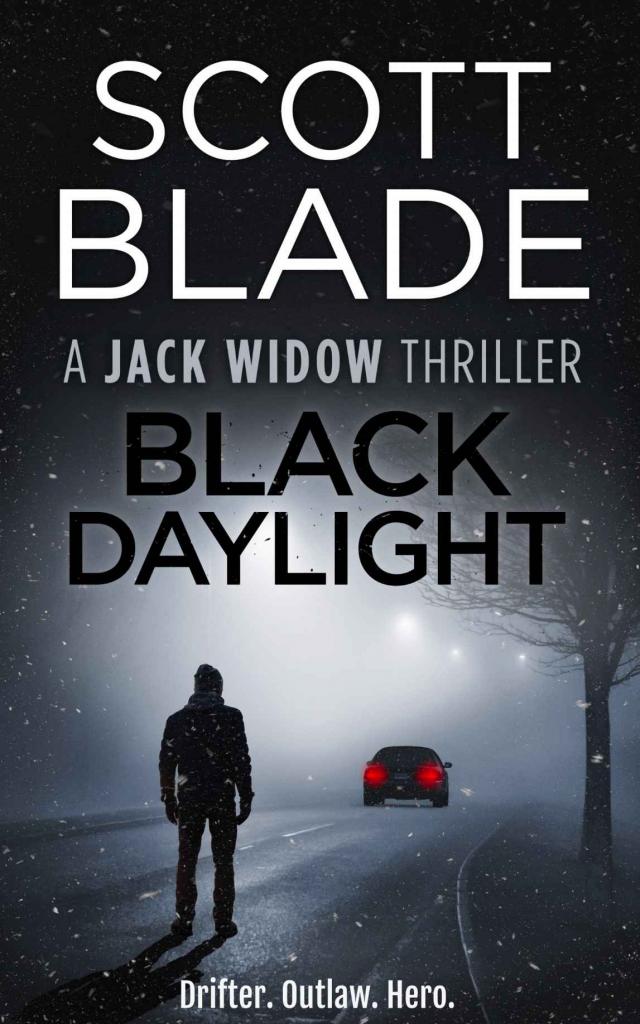
BLACK DAYLIGHT
A JACK WIDOW THRILLER
SCOTT BLADE
Copyright © 2018.
Scott Blade.
A Black Lion Media Publication.
All Rights Reserved.
Available in eBook, paperback, and hardback.
Kindle ASIN: B07G9R3XPD
Paperback ISBN-13: 978-1-955924-31-3
Hardback ISBN-13: 978-1-955924-30-6
(Original KDP ISBN-13: 978-1790843169)
Visit the author's website: ScottBlade.com.
This book is copyrighted and registered with the US Copyright Office under the original ISBN. All new and alternate editions are protected under this copyright.
The Jack Widow book series and Black Daylight are works of fiction produced from the author’s imagination. Names, characters, places, and incidents either are the product of the author’s imagination and/or are taken with permission from the source and/or are used fictitiously, and any resemblance to actual persons, living or dead, or fictitious characters, business establishments, events, or locales is entirely coincidental.
This series is not associated with/or represents any part of any other book or series.
For more information on copyright and permissions, visit ScottBlade.com.
This book is licensed for your personal enjoyment only. This book may not be resold or given away to other people. If you would like to share this book with another person, please purchase an additional copy for each person you share it with. If you’re reading this book and did not purchase it, or it was not purchased for your use only, then please return it and purchase your own copy. Thank you for respecting the hard work of this author.
The publisher and/or author do not control and do not assume any responsibility for author or third-party websites or their content.
No part of this book may be reproduced, scanned, or distributed in any printed or electronic form without express written permission from the publisher. The scanning, uploading, and distribution of this book via the internet or any other means without the permission of the publisher is illegal and punishable by law. Please do not take part in or encourage piracy of copyrighted materials in violation of the author’s rights. Purchase only authorized editions.
Published by Black Lion Media.
CONTENTS
Also by Scott Blade
Chapter 1
Chapter 2
Chapter 3
Chapter 4
Chapter 5
Chapter 6
Chapter 7
Chapter 8
Chapter 9
Chapter 10
Chapter 11
Chapter 12
Chapter 13
Chapter 14
Chapter 15
Chapter 16
Chapter 17
Chapter 18
Chapter 19
Chapter 20
Chapter 21
Chapter 22
Chapter 23
Chapter 24
Chapter 25
Chapter 26
Chapter 27
Chapter 28
Chapter 29
Chapter 30
Chapter 31
Chapter 32
Chapter 33
Chapter 34
Chapter 35
Chapter 36
Chapter 37
Chapter 38
Chapter 39
Chapter 40
Chapter 41
Chapter 42
Chapter 43
Chapter 44
Chapter 45
Chapter 46
Chapter 47
Chapter 48
Chapter 49
Chapter 50
The Standoff: A Preview
The Standoff: A Blurb
Chapter 1
The Scott Blade Book Club
The Nomadvelist
ALSO BY SCOTT BLADE
The Jack Widow Series
Gone Forever
Winter Territory
A Reason to Kill
Without Measure
Once Quiet
Name Not Given
The Midnight Caller
Fire Watch
The Last Rainmaker
The Devil’s Stop
Black Daylight
The Standoff
Foreign and Domestic
Patriot Lies
The Double Man
Nothing Left
The Protector
Kill Promise
1
Killing a loved one in cold blood was harder than they thought. It wasn't like shooting a pedestrian in the street or killing a stranger, or a nobody, stealing his wallet and driving off, unnoticed, unidentified, anonymous, unscathed.
It isn't like murder, even though it is murder. Killing a loved one squeezes a little more out of the words cold-blooded than other kinds of murder.
They knew that because they had felt it.
Killing her shouldn't have been like killing a dog either. But that's how they went about it.
They put her down in the same way that a vet kills an animal, carelessly, compassionless, sterile. They murdered her with no regard for her relation to them, without empathy, without remorse.
It was still hard, though.
At first, it had been different. At first, they had two problems with killing the girl.
One, the act itself, the "killing" part, not the concept, but the "how to do it" part of the whole thing. And second, the "getting away with it" part, which was the most important part.
What was the point of premeditated murder if they couldn't get away with it?
Premeditated murder without the "getting away with it" part was like calling their drug dealer and not knowing what they wanted to order, a problem that they never had.
Their problem had always been paying for the drugs, not deciding what to get.
In the end, they strangled the girl and dumped out the body in what they considered being the middle of nowhere, which was also everything around them. They lived in the middle of nowhere. Compared to other states, theirs was mostly ignored, except for one busy attraction, Mount Rushmore, but not this time of year—too cold.
Strangled and dumped like a dog. That's how it would be seen on a police report if it ever got seen on a police report. That's how it would be reported in a newspaper if it ever saw a newspaper. But that's not exactly how it went down.
What a police report or the newspapers wouldn't say is how hard it was to do, how much strength it took.
Loved one or not. Killing someone is hard enough for most people, especially their first time, and this had been their first time.
Strangling a loved one to death happens in only two ways.
The first is a crime of passion. It's done in the heat of the moment, like an explosion of emotion and rage and indignation and hate and love, all at once, all straight from the gut, like a volcano erupting or an earthquake rattling the ground below. There's little warning if any, but the results are the same—deadly and messy and unstoppable.
Killing a loved one comes from a place of love. They knew that. One of them did, anyway. That was a big part of their rationalization for the whole thing, but it wasn't rationalization. It was twisted backward logic.
They loved her.
They were doing this for her, in a way. That was the twisted logic, they told themselves. And they believed it.
They brainwashed themselves into rationalizing it this way, like a man on death row, confessing his sins to the chaplain, thinking it would make a difference, hoping it would make a difference, but knowing in his gut that the end was the same.
Convincing themselves to follow through with it was as much an act of desperation as the killing itself.
There was another thing, another question they asked themselves over and over. It was the question that started the whole thing.
What was the girl going to do with all that money, anyway?
She had a large sum of money coming to her. But why? Why should she get it and not them? What had she ever done to deserve it?
That amount of money was enough to set them up for a lifetime. At least, that's what they thought.
The money was better off with them, and she was better off dead. She had nothing to live for, after all. No husband. No kids. No prospects for a husband.
All she had in her life was them and a little dog, and some plans to get out of there, to move on to some place, maybe college, she had mentioned.
That was a joke.
What college would take her? She was a reformed meth-head from South Dakota. And she was barely reformed. She was more like one foot out of the grave.
No, that money was better off with them.
The money was the ultimate reason, the motive for killing her. Without it, they would've never come up with the whole scheme.
Still, they told themselves it wasn't just about the money. They told themselves it was out of love.
How could they kill a loved one without love?
That was what they asked themselves.
The whole business was like how people talk themselves into committing suicide. It calls for backward and sideways logic.
Initially, a person jokes about suicide, maybe months before, maybe years before he or she actually goes through with it. Maybe it comes up on impulse, at first. Maybe they're stoned or drunk during the inception of suicidal thoughts.
Unlike most thoughts, this one doesn't leave them.
After mulling it over, eventually, the weed grows and grows until they've brainwashed themselves into thinking that suicide is a good idea until they convince themselves it's the only choice they have left.
It's the only way out.
With someone contemplating suicide, there comes a line that once crossed; there's no turning back.
Suicide is premeditated murder. It gets planned and thought of and rationalized, until that plan, that thought, that rationalization, becomes reality, and then someone dies.
The loved ones also twisted that old saying: There's a thin line between love and hate, to help rationalize it.
A thin line between love and hate.
That's where her murder took place. Somewhere between love and hate. Somewhere on that thin line.
The loved ones didn't go about killing her in that first crime-of-passion way.
They didn't get the urge to kill in a fit of rage. It was no accident. No one lost control and did the deed that way.
They planned it.
They fed themselves the delusion that it was out of love for weeks leading up to the act, but they killed her for money—plain and simple.
What other reason did they need?
They planned the whole thing out, as best as two people like them could plan it out.
When it was finally time, it made total sense to them. The way the plan was laid out, they could get away with it.
Why not?
Who was going to catch them?
People got away with murder all the time. Every day. They saw the news. They saw the true crime shows on TV. They had social media, saw the retweeted and reposted news stories.
Plus, they had grown up here, a big state with lots of rural, rugged, mountainous areas and pockets of thick forest. They heard the stories. People died all the time where they lived.
Part of the beauty of their plan was that no one else knew about the money.
It wasn't insurance money. She had no life insurance—no pending lawsuit that would award a large payout upon a final court decision.
There was no inheritance coming her way.
If she had ever been found, there was nothing to tie the murder to them. They had no visible motive. There was nothing to gain by killing her. Nothing that anyone could see. No cops. Certainly not the county sheriff's department. They had that part locked down.
There was nothing on paper.
The money was untraceable because it wasn't coming from a legal source. Therefore, no one could track it. No one could find it. No one even knew about it, except the three of them, and one of them was about to die.
That was the beauty of it all. It was all secret: untraceable, secret money, a payment that only she was expecting for her efforts, a payment that they planned to kill her for.
Kill her and take the money. Easy-peasy.
Even though they planned it out, they had to be smart about it—no question. They had watched cop shows. They had watched the forensic shows. They knew that to get away with murder, you must get rid of the body. That part was crucial. It was imperative. The whole plan depended on it.
No body. No evidence. No crime.
That was the second mistake they made.
The first mistake they made was they thought they could kill her sober, without drugs. They thought that staying sober was key in order to make sure every little detail was accounted for, and all loose ends were tied off—the right way.
Once they did one hit, or one bump, or shot up, or popped a pill, eventually they'd lose their sobriety, lose their senses, and they couldn't let that happen. That's how mistakes get made. Everything would be reduced, and for murder, they figured it best to keep all brain functions working optimally.
But that was mistake number one.
They stayed sober all day long, waiting for when the completion of the money transaction came, waiting for the funds to be in hand, waiting for the moment to strike.
It started that morning for her, but for them, it had started the day before because they couldn't sleep the whole night long. They had too much anxiety; too much rode on getting everything just right.
The whole procedure was delicate after all, not the murder, but the part before, the part that the buyers needed before they would even hand over the money.
The buyers were an X-factor that they didn’t expect, and they worried about it. Only the girl had spoken with them. They knew from the conversations with the girl that the buyers were serious, dangerous people. They were not the kind of people to be trifled with. When they first met the buyers, that assumption was proven correct.
The buyers turned out to be two guys. They claimed to represent the actual buyer, who they knew nothing about, and neither did the girl.
The buyers never revealed their names, at least not their real names. That's how it came off because the names they gave were generic—John Smith and Joe Smith.
The fake names might've been more believable if the men had been white or American, but they were neither. That was clear.
Neither of the men was American, not in the born and raised sense of things.
The two men were both dark-skinned and appeared Arabic, and they had accents, but not the Middle Eastern Arabic kind that they had seen in movies or on TV. These guys had accents closer to British than anything else, but they weren't from India. That was obvious.
They were from somewhere in the Middle East, maybe Saudi Arabia, one of the loved ones figured, with no real evidence or reasoning behind it. It just sounded right to them.
The buyers wore clean, pressed suits and ties. The suits were expensive, tailored pieces. They were customized to give enormous leeway so they could provide the wearer with room to move and fight.
The suits were tactical, like something James Bond might wear.
One suit was brown and the other straight black. Both ties were black. Both were clip-ons because the United States Secret Service agents only wore clip-ons. In close-quarters combat, the clip-on tie keeps the wearer from being choked with his own tie.
The buyers came off like soldiers because their behavior seemed bellicose and militaristic.
The buyers were armed. They had shoulder rigs under their coats, presumably with special-forces-grade firearms holstered in them.
After they met, the buyers, the loved ones, and the girl all waited in a ventilated, abandoned tire garage on the side of a road that was nothing more than a lonely turnoff from another lonely road that spider-webbed somewhere between the town of Deadwood and a sleepy town called Reznor.
They were closer to Deadwood than Reznor.
The buyers and the girl had scheduled the whole procedure to take place at this location. It was an agreed spot. It was abandoned, concealed from the main roads, and well ventilated. Plus, it had ample space for all the medical equipment that would be needed for a successful transaction.
The buyers were good at their jobs. Their entire organization was good at what they did. So, they did more of the suggesting of the location than the girl did, but they let her think she had input.
Unbeknownst to the girl and her killers, the buyers had scouted the location out beforehand.
Of course they had. They were professionals. They oversaw this kind of transaction all the time. At least once a week, they were on the road, somewhere in America, or Canada, and sometimes even Mexico, doing what they do.
Sometimes they oversaw transactions, and sometimes they dealt with problems—all part of the job description.
The buyers had mapped it, scouted it, and even timed the ambulance response. They'd arrived a day earlier and called nine-one-one to a similar distance from Deadwood and waited. When the paramedics arrived, they clocked the arrival time as seventeen minutes, give or take ten seconds. It was a good arrival time, considering that they were so far out from Deadwood.