

All down darkness wide, p.1
All Down Darkness Wide, page 1


Advance Praise for
ALL DOWN DARKNESS WIDE
“Stunning . . . A profoundly moving meditation on queer identity, mental illness, and the fragility of life.”
—Kirkus Reviews (starred)
“A raw and hypnotic retelling reminiscent of Garth Greenwell’s Cleanness . . . an exquisite vision of queer heartbreak and liberation.”
—Publishers Weekly
“Gorgeous and moving prose that excavates the deep complexities of grief, shame and love with a tenderness and lightness of touch that make the words sing.”
—Andrew McMillan, author of Physical
“It’s impossible not to be intensely moved by this book, written with a poet’s eye for detail: line after line that grip head and heart. You are truly there with Seán Hewitt in the darkness and the light.”
—Niven Govinden, author of Diary of a Film
“Hewitt’s gorgeous prose gleams like a dayspring in the dimness, his story lingering long after the book is closed.”
—Melissa Harrison, author of All Among the Barley
“I loved the complexity of it, the way he subtly reveals how our fragile identities are formed (and de-formed) by the forces that surround us.”
—Charlie Gilmour, author of Featherhood
“Luminous and utterly original, a book with its own darkly beautiful gravity.”
—Niamh Campbell, author of This Happy
ALSO BY SEÁN HEWITT
Tongues of Fire
J. M. Synge: Nature, Politics, Modernism
PENGUIN PRESS
An imprint of Penguin Random House LLC
penguinrandomhouse.com
Copyright © 2022 by Seán Hewitt
Penguin Random House supports copyright. Copyright fuels creativity, encourages diverse voices, promotes free speech, and creates a vibrant culture. Thank you for buying an authorized edition of this book and for complying with copyright laws by not reproducing, scanning, or distributing any part of it in any form without permission. You are supporting writers and allowing Penguin Random House to continue to publish books for every reader.
“Min ångest är en risig skog,” poem by Pär Lagerkvist – licensed through © Pär Lagerkvist Estate, SWEDEN.
ISBN 9780593300084 (hardcover)
ISBN 9780593300091 (ebook)
Cover design: Stephanie Ross
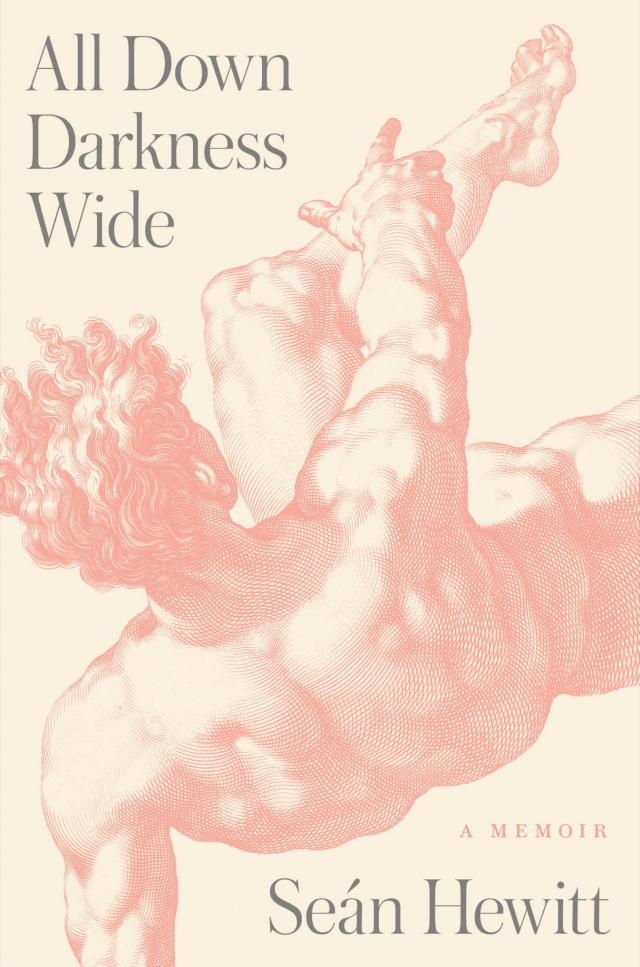
Cover art: Rijksmuseum, Amsterdam, The Netherlands / Bridgeman Images
Adapted for ebook by Cora Wigen
pid_prh_6.0_140374773_c0_r0
Contents
Cover
Advance Praise for All Down Darkness Wide
Also by Seán Hewitt
Title Page
Copyright
Part I
Part II
Part III
Part IV
Part V
Part VI
Part VII
Bibliography
Acknowledgements
About the Author
I
The Oratory of St James’s Cemetery in Liverpool has no windows along the whole length of its outer walls. Only a long rectangular skylight, its leaded panes half-mossed over, lets the winter sun reach down and touch the white marble statues staring blankly inside. A mortuary chapel, but long closed up, its coffered ceiling and tall, carved columns are mostly in shadow. Years ago, as the great homes of the city were pulled down stone by stone, the monuments of proud families (monuments of terracotta and marble and bronze) were hoisted here and locked away, and so the wealth of the city – wrenched from far-off lands and furnished from blood – was hidden, and so forgotten.
And as the years went by, other things were hidden, too. Some (like the terraced slums of the poor and their washhouses) were razed, others (the orphanages and workhouses, the asylums and homes for the destitute) were emptied one by one, turned by sharp-suited businessmen into flats or bars or restaurants, where the names of the dead, engraved in plaques on newly pointed walls, were the climbing holds of a city once again dragging itself up out of its own grave. And so the churches and crypts were closed, and the docks shut down, and the shackles shipped and left on other shores, and the subterranean tunnels and the catacombs were filled in with stones, and the quarry was planted with oaks and with sycamores and with the bodies of the dead. And it was in this way that the ghosts of the city were parcelled off, ushered from the streets into derelict buildings, made to stand in exhibition cases, hurried into the pages of books and diaries, and folded away. For, after all, ghosts can only live in the darkness; and once the dark places are closed up, their cast-iron locks bolted fast, it is easy for those who do not live with them to pretend that ghosts do not exist at all.
Past midnight, one mid-January, standing in the church gardens, I felt the wind blow up from the River Mersey, weighted with Atlantic salt. It blustered up to the city, battering the red bricks of the warehouses on the dock, rattling the barred doors of the pump-house and the locks of the customs house. I heard it rush south-east between the empty units along St James’s Street, clapping the tattered flags of the old sailors’ church, and spinning frantically in the bell-turret of St Vincent’s. It rushed up the steep junction of Parliament Street, past the new-builds, over the waiting cars at the traffic lights, and there scurried down the tree-tunnelled sandstone path into the cathedral cemetery, resting, finally, in a swirl of leaves and a ripple of the spring water by the catacombs, unseen by anyone except a carved angel weeping over a nineteenth-century grave, and the lone figure of a man – me – kneeling and drinking from the water flowing in runnels down the old cemetery wall.
I had come here to meet someone – a man I didn’t know, but who was somehow like myself. Above the cemetery gardens the terrifying neo-gothic cathedral loomed across the sky, its stained glass half-aglow even at night. I could almost feel the weight of its shadow, like a body bearing down on mine. To venture into the graveyard, you have first to walk through a tunnel of hollowed rock, its walls lined with old grave-slabs and dripping with dank water filtered through the paving stones and tree roots overhead. And at the end of this, where hardly any light can be found after sundown, a little path winds fearlessly onwards between the holly and the yews and the leaning granite obelisks.
Nearly a century has passed since the last body was interred here, and the lichen has spread over the tombs and into the once-neat etchings of names and dates and Latin mottos and platitudes both sentimental and heartfelt. Lichen over the staunch Victorian formalities of lives lived in stoicism and resignation, and into the carefully chosen testaments to numberless tragedies and joys given from mother to child, from husband to wife, from friend to friend and from lover to dearly missed lover. Years ago, a hearse tunnel, now capped with brick, brought carriages, one by one, down from the Georgian grandeur of Rodney Street into the cemetery, and now perhaps no one is old enough to remember these dead.
At the centre of the cemetery, flowing down into a square pool between the laid-out gravestones, a little spring uncovered in the eighteenth century runs on, unperturbed, trickling over the luminous green growths of liverwort and algae on the bricked-up far wall of the plot. And on this January night, when the only living inhabitant of the graveyard is a single man drinking from the spring, anyone might come down and walk under the silvered boughs, hearing that gentle babbling stream, and imagine all the souls here, cooped up in the soil, passing from root to root, moving slowly in the underworld of the earth. At the heart of it all is water – its slow leak along the walls, its passage through all the plants and mosses and trees, its movement through the apertures of the shale embankments, its sheening under the moon on the marble of a family vault. Laden with iron, the water is sharp and metallic and tastes faintly of blood. Some in the city believe in its healing powers, and follow the words of the inscription carved above the spring, which speaks, in the voice of water, of the endless cycle of giving:
Christian reader view in me
An emblem of true charity,
Who freely what I have bestow
Though neither heard nor seen to flow.
I, like others, held closer to a different truth: that the water contains the souls of the dead, trapped in the graveyard, and that it turns black, like blood, when boiled.
Ghosts in the water, ghosts in the blood. Everything, once you start to look, is haunted. And so perhaps it was fitting that I came here that evening, unsure of where else to go, feeling lonely and shut out from the daylight world, the downward paths from Princes Park leading me on into this navel of the city. An unsettling place to be after dark, not so much for any fear of the dead, but of the living: the men I had seen huddling around a lighter, their square of tinfoil glinting; the occasional hunched figure wandering; a group of drunks walking the pavement of Hope Street, faces hot with wine. It would be tempting to say that it was a sense of communion that drew me into the gardens, a sense that down here, with the dead, was where I belonged – hollowed out, tired, looking for something in this wooded grove squat amongst the townhouses and the busy roads – but other urges drove me, too, on to the little spring, like a pilgrim to the underworld, my phone’s light held up to the darkness, my golden bough.
I met the man by the Huskisson monument. Unsure at first (who can tell if the lone man in the cemetery is the man you’re looking for, or the man you don’t want to find?), I leant a
The man was tall, his body taut beneath his winter coat and jeans. A kickboxing teacher, it turned out. Later, he would text me, asking if my name was Ryan. He had mistaken (whether accidentally or wilfully, I can’t tell) my face in the dark for that of one of his students. I suppose we are all, at some point, taking the face of some ideal lover into our mind and placing it like a mask on to the person in front of us. Maybe I was mistaking him, too, for another boy I once knew. Maybe this was my way of continuing his life, seeing him age into manhood, seeing him inhabit years he never would. If I closed my eyes, perhaps it was Jack I was with, or Elias, or another boy, or all of them merged into a new form.
After some quiet introductions, he nodded towards a thicket of trees and started walking, keeping his distance. I heard the clicking of his lighter as he lit a cigarette, watched him take a deep, slow drag and then exhale the blue smoke into the night-blue air. Then, as I reached him, fumbling: the belt unbuckled, the vertical sound of the zipper. All the time that I was on my knees, I could hear the trembling chain of the spring water clinking and splashing over the far stones. When he finished, I took him all the way into my mouth and held him there as I felt him weaken, then pull back.
Afterwards, I walked to the spring and cupped the ice-cold water into my palm, watched its bright dancing for a second and then lifted it to rinse my mouth. I could still taste him there and couldn’t face the long walk home without this little ablution, cleansing myself back into sanctity. As I walked away, up to the Parliament Street gate, I cast my head down, determined to muster some deep reserve of what I thought of as masculine courage. I wanted so much to be the man who could walk in these places at night, to be the man who would not turn his head to check if, in the black spaces of the cemetery, there wasn’t a lone figure following, hiding behind the headstones, who might (out of his own fear) stop me from leaving.
A week later I sat up in bed and felt my neck sore and swollen, my glands puffed up and beating. The sun touched each bead of water on my single-paned window, glittering them. I could almost feel the virus pricking and spreading in my body. I panicked. I sweated cold and then hot. My mind whirred and whirred madly over statistics and history, ancestry, all those men lining the corridors of wards, all those bleeping machines and frail, stick-thin corpses. Though I did not know them, their ghosts haunt me. I am, somehow, their descendant: I arrived into a world full of ghosts, and owed a part of myself to each of them. At the clinic, as the nurse took a vial of blood from my arm and commented on the raised width of my vein, she noted down my history, and I heard their voices, and felt a dull weight come over me that wouldn’t lift for a week.
In the end it was a false alarm. All clear. Of course it was. I was anxious, full of shame, always expecting the worst, always expecting to be put in line by some sort of cosmic justice. I still saw my body as a thing that might register every misdemeanour and then punish me for them. But it was strange how, in that strip-lit hospital room, my history was not mine at all. Like a river, spreading through its bends and tributaries, it moved through even the most secret parts of my body. It included every encounter, every man, and from there all of their men, all of their encounters, spreading outwards and outwards over the city, then the country, then continents, linking thousands of us together by what we had given to each other, and what we had taken. That night in the cemetery was just one node in a huge, sprawling network. History seeping from one man into the warm body of another, then being carried off into the daily life of the world, barely noticed.
* * *
*
It was at school, aged seventeen, that I first became aware of my blood as somehow historical, extending back before I was born. Though I had known it in different ways as a child, I was carrying the weight of the past in my veins. Every day, without thought, my heart pumped it around my body – it seemed natural, unconscious, free from morality. It was only later that I found out that my blood could be a clamp, could be tightened to hold me in place. My high school sat on the edge of a wealthy village by a post-industrial town in the north-west of England. Partly because of its proximity to the town, it was the sort of place where purity (of class, of race, of family) was prized, but left largely unspoken. The village – with its quaint sandstone buildings and bridges, its pubs, its odd festivals, its pretty canal dotted lazily with painted narrowboats – was exclusive even to those who schooled there. Catching the bus into school each morning was enough to mark you as an outsider, hailing from some close but far-off place where the house prices were lower, the vowels slightly more lengthened. Wearing the wrong shoes, the cheap blazer, the hand-me-down sports gear – anything was enough to elicit a look or a comment.
Being who I was, I had learnt from a young age the stealth tactics of conformity: how to hide a lisp, how to correct a too-expressive walk, how to pitch my voice lower, which I practised in my bedroom for many weeks during puberty. But it wasn’t until I was seventeen that I was faced, consciously, with a non-conformity I couldn’t finesse my way out of. I saw then, more clearly than before, the ways in which the world had placed me – even before I knew it – into innate opposition. One afternoon, the blood-donation vans rolled up into the school car park, and suddenly the lunchtime common room was full of nurses and camp beds and middle-class moral fervour. A vague rumour went around the school – a sense of excitement and obligation, a sixth-form rite of passage into adulthood taking place in the oddly transfigured hall. Known as the ‘hexagon’ for its six-sided structure, the common room was brightly lit, blue, and full of fold-down furniture and tables stacked against the walls. In one corner, there was a small hatch where canteen staff would sell cakes and pastries to teenagers who seemed hardly ever to gain weight. But now, booths had been set up using felt-board dividers, and in each sat a nurse, with a clipboard on her lap and an empty chair in front of her. One by one, we moved from the queue and took our seat in front of whichever nurse was free, and on doing so we were welcomed kindly, and handed a form to fill out. It was a good thing we were doing, it was selfless and right, and they reminded us of that often.
On the form there was a row of tiny boxes, and next to each box was a question. As usual, I went down the list, cavalierly ticking ‘no’. No, I do not have HIV. No, I have never been given money for sex. No, I have never injected drugs. And then a pause, a sudden flush of the cheeks. I felt my ears burn red and looked up, wondering if the nurse had noticed my hesitation. ‘In the last twelve months,’ the form asked, ‘have you had oral or anal sex with a man, with or without a condom?’ I didn’t know what to do. Tell the truth, tick ‘yes’ and have to leave, have to explain to her and to everyone why I couldn’t donate (sixteen, fumbling of zips in the back row of the cinema, something secret and forbidden); or lie, preserve myself as respectable, virginal; a queer, yes, but not the sort of queer who would dream of doing what half the other students did every weekend on the faded couches at the back of the Rugby Club discos. I had changed my accent, studied hard, cultivated myself into inviolability. And so, for everything I had worked for, for the safety of my one-man kingdom, I scratched a quick pencil line through the box that said ‘no’, and handed the clipboard back to the nurse.


