Sparrow kobresia, p.1
Sparrow, Kobresia, page 1


SPARROW, KOBRESIA
SEAN MONAGHAN
Copyright © 2023 Sean Monaghan
All rights reserved.
Published by Triple V Publishing
* * *
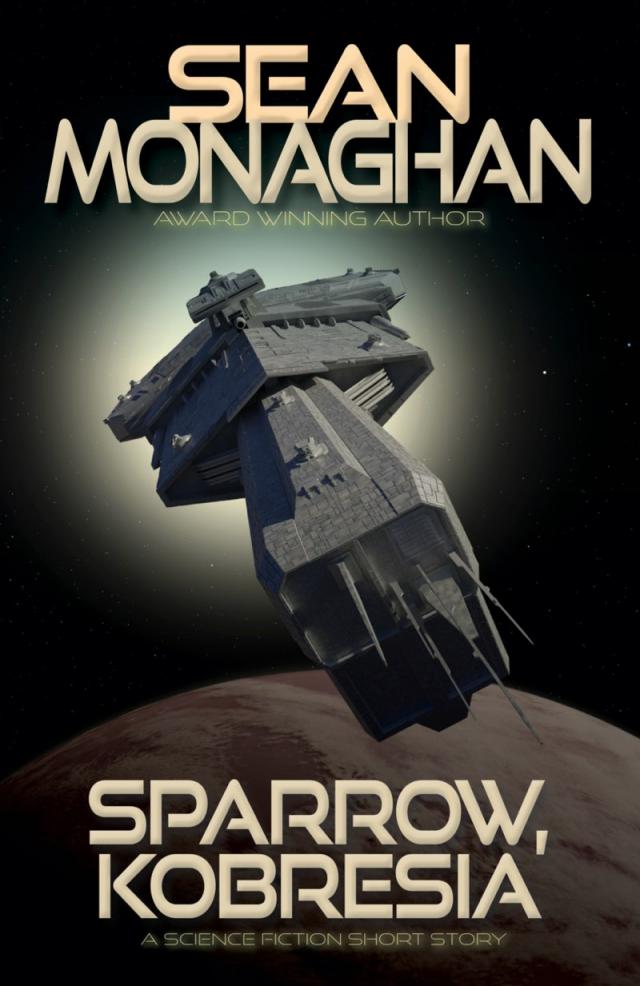
Cover illustration
© Algol | Dreamstime.com
* * *
Paperback isbn: 9798865100263
* * *
Discover other titles by this author at:
www.seanmonaghan.com
* * *
This is a work of fiction. All characters, places and incidents described in this publication are used fictitiously, or are entirely fictional.
* * *
No part of this publication may be reproduced or transmitted, in any form, or by any means, except for fair use by reviewers or with written permission from the publisher. www.triplevpublishing.com
CONTENTS
Introduction
Chapter 1
Chapter 2
Chapter 3
Chapter 4
Chapter 5
Chapter 6
Chapter 7
Chapter 8
Chapter 9
Chapter 10
Chapter 11
Chapter 12
Chapter 13
Chapter 14
Chapter 15
Chapter 16
Chapter 17
Chapter 18
Chapter 19
Chapter 20
Chapter 21
Chapter 22
Chapter 23
Chapter 24
Chapter 25
Chapter 26
Chapter 27
Chapter 28
Chapter 29
Chapter 30
Chapter 31
Chapter 32
Chapter 33
Chapter 34
Chapter 35
Chapter 36
Chapter 37
Chapter 38
About the Author
Also by Sean Monaghan
INTRODUCTION
A short story with thirty-eight chapters?
I have been known to break my short stories up into chapters. Where other writers might simply leave a line break to indicate a new scene, I tend to chapter it up.
To me it lends the book the feel of a novel, and I’d like to think that Sparrow’s story here is novelistic in scope, if not in length. In writing the story there were things that felt as if they should stand alone. Perhaps this was me looking at a chapter that was just a few sentences and getting the sense that that part didn’t blend with the pieces around it.
There are time gaps, of course. A simple scene break doesn’t quite do it.
But, it does make for a fatter book, at least if you’re reading the paperback.
I hope you enjoy the story. I know that I had fun writing it.
Thanks for reading.
Sean
October 2023
SPARROW, KOBRESIA
CHAPTER ONE
Sparrow looked out over the star system and ran her database checks again, in case there was an error.
But there was no error.
This was Sol. That was Earth.
And Mercury, Venus, Mars, Jupiter, Saturn, Uranus and Neptune.
They were beautiful.
She was home.
CHAPTER TWO
The warmth of the sun was glorious. Even this far out it tingled across her hull.
Sparrow let herself turn, slowly absorbing every warming ray.
CHAPTER THREE
Sparrow dialed in her systems and ran a meditation. Reminded herself that she was a ship. Reminded herself to focus on the now and the here.
Her central core was her essence. A darkly whirling scatter of light pretzels in a complex nutrient bath. A neural network. Axonic. Synaptic.
She was beautiful too.
She had to remember that.
Much too long.
CHAPTER FOUR
Sparrow calibrated.
She was closing on sixty AU–astronomical units–from Sol. The Kuiper belt. Comets and little rocks. She was still moving fast, her stern pointed backward, her wings unfurled to catch a little of that weak solar wind. A gentle burn on her main nacelle. After all this time she still had fuel.
Sixty times the distance from Earth to the sun.
She was years away. Decades.
Earth was her target.
Every moment brought more warmth. That physical warmth, slight though it was, but also a warmth to her heart.
CHAPTER FIVE
Sparrow’s wings charged her. The wind brought energy and the energy went into her banks.
After the swing around Kobresia, there had been troubles. Damaged systems and angry people. Sleeps from which would never wake.
Sparrow’s banks had depleted. She’d collaborated on her own rebuild, even as the glow of Kobresia faded into the darkness and Sparrow picked up speed.
“You’re doing great,” Raoul had told her, patting his console in her tiny, spherical bridge. “You’ve saved so many lives.”
“But so many died.”
It had taken Raoul a long moment to reply.
“We didn’t... expect all that,” he said.
“All what?”
He’d shifted upright in his seat. “The main point is that we can go home. You can guide us. We’ll see what they make of us on old Earth after twenty-thousand years away.”
Expect all what though?
Through her lenses Sparrow parsed the nuances of his response.
He’d avoided. Deflected.
Changed the subject.
CHAPTER SIX
Sparrow was over sixteen hundred meters long. More than a mile.
A tiny speck in the cosmos.
And only a tiny fraction of her was habitable.
Her external skin, dotted with sensors, was a fabulous weave of carbon and silicon. On the few occasions she’d seen herself from outside–the camera feeds from construction crews and maintenance workers before she left–and she liked to think she looked simply amazing. The way the light reflected and refracted from and through the fiber mats was startling.
She was a princess, with a quartz-diamond gown.
CHAPTER SEVEN
Her nutrient bath had been renewed twenty-three thousand, two hundred and eighty-four times. Once a year, whether she needed it or not.
Apparently that was a joke.
CHAPTER EIGHT
Three hundred and six souls.
Each in their own nutrient pod. Metabolisms slowed beyond reckoning.
Waking, once every hundred thousand hours for two days to test and check. To stretch their muscles. To play Go and Twister. To carouse and drink. To whisper secrets.
To calibrate the course.
To see how the ship was doing.
Sparrow enjoyed their conversations. Enjoyed the banter and noise.
Then, they returned to their pods. Sealed in for another eleven years, one hundred and fifty days.
She watched them age staccato fashion. In their voyage, they would have over ten years of waking life, but they still aged in the pods.
Much more slowly, but faster than had been expected.
Some of the scientists had said zero ageing, some had said one percent, others zero point zero zero one percent.
If it was one percent, the sleepers would never survive.
The hardest thing, until Kobresia, had been that the rates had been different.
Aleisha Dresson had been the worse affected. Close to that one percent. By the five hundredth waking, it was clear to everyone. She was no long the healthy mid-thirties woman, but was slipping away into her fifties.
Obvious.
Menopause. Thinning skin.
She would be dead before they reached Kobresia.
CHAPTER NINE
In those long runs of quiet, racing through the endless dark gap between stars, while her squadron of robots cleaned and checked and maintained, Sparrow ran simulations of braking into Kobresia.
Decelerating with wings and gathered fuel. Angling in toward the sun, turning at closest approach with her skin glistening against the fierce heat. Sliding out and letting the star’s gravity tug even more velocity from her.
It might take fifteen passes.
Her occupants would sleep on.
CHAPTER TEN
Sparrow remembered the time when Aleisha set her own pod to shut off and had come to visit in the bridge while all the others slept.
The smells of them were already fading. The sounds, if Sparrow listened carefully, still seemed to echo along the companionways and off the centrifuge walls.
The lighting was low and Aleisha brought a coffee in a bulb. She strapped herself gently into the captain’s chair and cast her eye around the room’s curved walls, filled with shut down readouts and displays.
No need for displays and telltales if there was no one around to see them.
“I’ll miss you the most, Sparrow,” Aleisha had said.
Her biological systems now matched most a woman in her seventies. It seemed so unfair, that she’d had but a fraction of her adult years awake and aware. Most of her ageing had proceeded while she slept.
“That’s kind,” Sparrow said. “If you return to your pod, you’ll be able to make it through to explore Kobresia with the others.”
A smile had flickered across Aleisha’s face. Her eyes became unfocused.
“If I go back,” she said, “I may not survive the next hundred thousand hours of sleep. I would rather live out my time here.
“I would enjoy your company.”
The ship had an abundance of stores. With two hundred ninety-eight sleeping, there was plenty of space for a lone, older woman to kick around in.
They played go and checkers. Twister was off the table, what with Sparrow being a distributed system in a vast ship, rather than corporeal.
When Aleisha passed, some of the robots bundled her up and stored her body.
Sparrow had a morgue of course. Any responsible vessel would. Any vessel planning to be out in the void for millennia would.
Aleisha, thankfully, was the only occupant.
Then.
CHAPTER ELEVEN
One day, Aleisha hung weightless in the bridge. The others were asleep. Apparently she found it restful.
“Did you know, Sparrow,” she said, “that Kobresia is a plant? Not a star.”
“It’s both,” Sparrow said. “I knew that.”
“You have databanks. You know everything.”
“Not quite. But I do know that kobresia, the plant, is very pretty. A lovely little sedge.”
“Grass family.”
“Exactly.”
Aleisha had drawn a deep, nasal breath.
She said, “I wish that I could run my hands through grass. Just once more. To feel the life. To feel the earth beneath.”
Sparrow had no reply.
CHAPTER TWELVE
Sparrow played back recordings of her conversations with Aleisha. On Earth, during Sparrow’s training and alignment, she’d had plenty of conversations.
People found her fascinating.
But they had homes and families. They clocked off at five PM and raced away to a local bar for pool and karaoke and pitchers of house beer.
Aleisha wasn’t going anywhere.
They talked about Kobresia and the radio signals that had prompted the trip. They talked about how some people truly thought that by the time they arrived humans would already be there, since faster than light drives would have been invented.
“Physically impossible, of course,” Aleisha had said. “Any 101 course makes that clear.”
“Einstein,” Sparrow had said.
“Exactly.”
Sparrow had listed a dozen of the hypotheses people were working on. Things like folding space and wormholes and vapor bubbles.
Aleisha had laughed. She had a wonderful, deep belly laugh. Genuine and warm.
“Those things are fabulous for doctoral students,” she’d said. “Theoretical. But then there’s engineering.”
“Like me.”
“Exactly. How does a species that can’t even make a car that lasts thirty years, or a phone that lasts more than two, actually get itself together to make a starship that’s supposed to last for twenty-five thousand years?”
Twenty-three thousand, two hundred and eighty-four. Plus or minus one hundred.”
“To be precise.”
“That’s why they gave me the job.”
Aleisha laughed again. “Ten times the age of the pyramids.”
“The pyramids were built by slaves, from stacked rock.”
“And you’re built from carbon fiber, by employees?”
“Yes.”
“They’re simply the modern equivalents. They had stone to work with, we have carbon and silicon chains. Employees get two weeks vacation, medical and dental plans, if they’re lucky, and a staff ball team they have to participate in every Thursday. Slavery without the actual whips.”
“Metaphorical whips.”
“You get it.”
CHAPTER THIRTEEN
Without Aleisha, Sparrow’s interior seemed very lonely and empty. Barren.
CHAPTER FOURTEEN
Sparrow brushed Neptune.
It was quite intentional. From out in the Kuiper belt, scooping up what hydrogen she could, she’d angled her trajectory a fraction.
The timing was good.
Ice Giant. Blue and cold. Atmosphere swirling with hydrogen and methane, oxygen and xenon.
“Hello,” she said into the dark. “You have a visitor. I’m back.”
Neptune made no reply.
CHAPTER FIFTEEN
In the whole mission briefing, they’d been told that it was quite possible that there would be no responses to their transmissions when they returned.
“Imagine trying to send a telegram today,” Major Kenneth Grampian had said. He was a communications expert in the army, co-opted by the Agency to train the crew.
“But worse,” he’d gone on, “Imagine trying to speak with someone from Shakespeare’s time. Even English was very different then.”
It was Aleisha who’d raised her hand and pointed out that Shakespeare had been writing poetry.
“People didn’t speak like that.”
“Fair point,” the major had said. “And any example I give will only hazily give you an impression. Has the language not changed since your grandparents’ time?”
Aleisha had conceded.
“And then,” he’d said, “and I know this comes up a lot, imagine the time when the pyramids were being constructed. English didn’t exist. Go back ten times longer and in essence none of those languages exist.”
The languages that had been in use when they’d left would be long gone.
Likewise, the communications technologies would be long gone.
“Will there even be people?” Ira Sildursdottir had asked. “Maybe they will have reconstituted dinosaurs from amber DNA and everyone will have been eaten.”
The major had rolled his eyes.
“That old trope. Let me tell you what you might find when you come back.”
CHAPTER SIXTEEN
They would all be at least ten years older.
Ten years at two days every two hundred and fifty days.
Cyan Endermeyer had helped Sparrow understand how that was possible without going insane.
They’d had long conversations while she’d read in her tiny, sparse cabin on shift breaks on those waking periods. Cyan liked classics. King and Lewis and Austen. She had printed, bound editions and was troubled by how they were ageing poorly.
Cyan had been one of the techs who worked on Sparrow’s nutrient renewal. Checking that the automated systems were working. She was twenty-eight with a shock of red hair and front teeth that were slightly crossed.
“It’s just like going to sleep,” she’d said. “In my own bed, I lie down and fall unconscious. Dream a little, and wake the next morning. Here, I slip into the pod, which is kind of goopy and weird, but warm, at least.”
“And you wake up. Later.”
“Exactly.”
“But it’s not eight hours,” Sparrow had said. “It’s one hundred thousand hours.”
“Amazing, huh? And you keep us all alive through it.”
“I do?”
“Well, Sparrow, one of your jobs is ensuring that the pumps are all working. If something goes wrong, you send in the robots and get it going.”