

Per aspera ad astra, p.1
Per Aspera Ad Astra, page 1


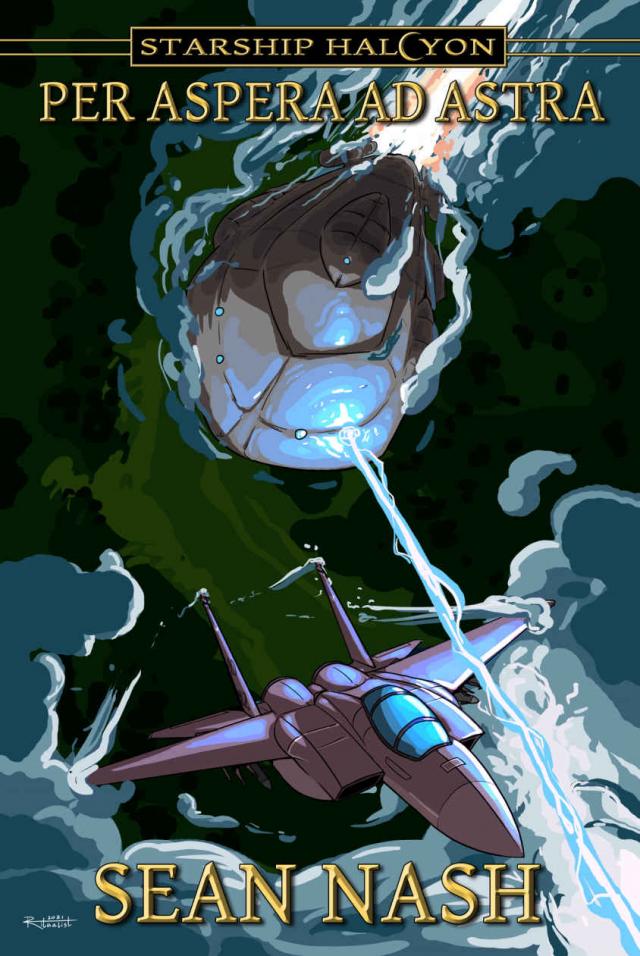
Per
Aspera Ad Astra
Copyright © 2021 Sean Nash
All rights reserved. No part of this book may be reproduced in any form or by any electronic or mechanical means, including information storage and retrieval systems, without written permission from the author, except in the case of a reviewer, who may quote brief passages embodied in critical articles or in a review.
This is a work of fiction. Names, characters, places, and incidents either are the product of the author’s imagination or are used fictitiously, and any resemblance to actual persons, living or dead, events, or locales is entirely coincidental.
Published by Sean "Goodwood" Nash
Cover Art by @Ritualist_dA
ISBN: 979-8-5980-8392-5
For Mr. Burke R. Baldwin
A wise, generous old gentleman who saw in me such great potential as a writer, a decade before I ever had any such inkling. I always loved to read, but he knew I was destined for greater things.
I still remember that book of clichés he gave me when I was a kid, hoping I might remember him later on, once I’d become a success.
I sure do, Mr. Baldwin. I sure do.
Other novels by
Sean Nash
The Crop-Duster’s Son
Starship Halcyon
Book I
______________
Per Aspera Ad Astra
______________
Sean Nash
ACKNOWLEDGMENTS
As with my first novel, this was not a single-person effort; many folks played their parts in its creation, continuation, and completion. Fellow author Clyde Andrews deserves a special mention here, as he took a mostly completed draft and gave it perhaps the most honest, neutral read-through it could’ve possibly received, and despite a few notes, he genuinely regarded it as a first-class effort. Sally Trivone also warrants high praise, for her willingness to step beyond her comfort zone to help a friend, continuing to plug away despite a busy schedule of her own. Not only did she provide a crucial final-pass edit, but key feedback for both covers; she and a YouTube essayist called Marushia Dark each gave good advice regarding the back blurb. The artist known as Ritualist, who crafted the cover art, merits tremendous thanks, not only for the work itself but for putting up with this first-time commissioner. I was far from the easiest customer to deal with, considering I didn’t really know what to ask for at first, and struggled with how to articulate my requests and desires for the piece.
Many others were of welcome assistance in some way, shape or form, even if most of them I know only by Internet pseudonyms or callsigns; whoever you are, you have my thanks. “Rookie” in particular happily provided many hours of productive discussion, regarding the setting, as well as various possibilities therein, as did others, including Ryan Keller. A very special mention in this regard goes to a United States Air Force major and onetime C-17 pilot I only ever knew as “Titup,” who played a crucial role as a sounding board for military culture, and that of Air Force pilots in particular. It was his feedback that enabled me to give a lot of the narrative an extra ring of authenticity, and whose one wish for this book I’m quite happy to have been able to grant. “Little White Mouse,” meanwhile, reined in my French foibles, drawing attention to one amusing error in particular thanks to her fluency. My aunt Merry was also a significant source of inspiration and encouragement; I thank her and Laurence Kelly both for believing in me, even if we occasionally disagree on certain topics. Lervetris Clora also routinely offered encouragement, even if she was always too busy to really give my work a read (that’s hardly her fault, of course). Thanks also goes to Jes who, as a marketing guy, helped me develop a proper cover header for the Starship Halcyon series.
A final thanks goes out to those who’ve taken the trouble to read and follow my writing blog, whimsically called The Forest of Goodwood (www.goodwoodwrites.wordpress.com), as well as anyone else who may have contributed but went unmentioned. The failing is mine, not yours.
From: James Markett
To: Ben Markett
Sent: Sunday, 9 July, 2017 4:23 PM
Subject: Emotions etc.
Dad,
Upon browsing your latest draft, something curious occurs to me.
You write a lot of what you did and how you felt afterward, but what of your feelings during the battles themselves? I can’t believe you never felt the rush of adrenaline as you pressed the firing stud to send a burst into an enemy plane, to say nothing of your many strafing runs. We never did discuss that, and though I no doubt feel as you do, perhaps your readers might also benefit from such exposure?
There were times when I secretly hoped the Argies would have another go, and not only because I was bored stiff out there. If they had done, I would have fired on them with no remorse; it would have felt good to do so. They trained us for such an eventuality, after all.
Your son, Jim
From: Ben Markett
To: James Markett
Sent: Sunday, 9 July, 2017 6:49 PM
Subject: RE: Emotions etc.
Jimmy,
I felt it, yes. The thundering of my ears, reflecting the ferocious, quickening pounding of my heart within my chest as the scope of my concentration focused ever tighter on that one pinprick of space, wherein the bullets I unleashed and the unfortunate souls I fought against intersected. It was a thrill, yes, but not a happy one in retrospect for the very reasons we discussed. I cannot for the life of me understand why you would want me to describe it for people who have never been in such a position, and who would go to great lengths to avoid being thrust into similar kill-or-be-killed situations.
I take that back. I think I know what you’re getting at, but having thought about it some more, it does make a certain kind of sense. For completeness sake if nothing else, but again, it comes down to what the average reader can be expected to know, and what they could ever have experienced. Such an explanation would be lost on them; they would have no frame of reference. Even those who have served in the past, or currently wear the uniform—we don’t fight wars that way anymore, and you long ago realized that air combat too has changed drastically—wouldn’t be able to truly appreciate it. There’s a world of difference between pushing a button and sending a missile or bomb flying against a target tens of miles away, and shredding one with bullets or cannon shells at distances of only a couple hundred yards.
You see the results of such strikes almost immediately. They flash before you, frame by frame every time you think about what you have done, seared into your consciousness forevermore. There’s no escaping it, no matter what one does. They're with you until you die, and if what your mother believes is true, even death isn’t the end. Dropping such a burden upon people who are not prepared for it can be soul-crushing; it can easily break even the strongest of men. We bore it then because we had no choice, and even so, many were left emotionally scarred, even mentally wounded by the sheer mass of howling fury descending upon them like an invisible guillotine.
Sometimes, I catch myself thinking that if it hadn’t been for your mother’s embrace, I wouldn't have lived out the year, irrespective of what she’d already done for me. That was her special gift to our family, reflected in your sister’s talents and abilities. I’ve never talked to her about this of course, but it’s become an increasingly frequent line of thought.
However, you aren’t wrong, not at all. That giddy feeling of survival, the rush of victory and the pride of a mission well done were all as much my companions as the sorrow I felt for those we lost. I gave the first three no purchase for the same reasons I was always having to banish the latter; we had jobs to do, and no amount of woolgathering on my or anyone else’s part was going to win the war any faster. That said, don’t think that your words have fallen upon deaf ears. I will think about what you wrote, and attempt to incorporate what may result into my narrative at some point. I cannot guarantee that any such thoughts on the matter will make the cut, however.
How is Maggie doing?
Love, Dad
----------------------------------------------------------
From: James Markett
To: Ben Markett
Sent: Monday, 10 July, 2017 10:06 AM
Subject: RE: RE: Emotions etc.
Dad,
You’re right, and I’d like to think I would have felt the same about such a hypothetical engagement as you do about your war service. We all know Bill wishes he’d been there during the fight, but I reckon he also doesn’t mind the fact he doesn’t have to share that burden. I had no idea you felt that way about Mum, however, and quite understand why you’ve never mentioned it. How could you, without dredging up all sorts of unpleasant memories?
But perhaps you underestimate the ability of the average human to absorb, and to empathize, with such experiences? War by its very nature demands of us actions that no sane human would ever willingly commit, actions that in any other context would well merit long prison sentences, if not outright execution in countries that practice the death penalty. You noted yourself that in its midst, it’s so very hard to separate the sane men from those who’ve gone round the twist, so perhaps that might be a vector? People can relate to those sorts of things, even if they’ve never gone into the service; many read war stories for that specific purpose.
If not, I understand, it was only a suggestion on my part. This is, after all, your story to tell,
Your son, Jim
P.S.: Maggie is doing well. She received her BS in applied science this past May, in fact, and will be starting graduate school in Fife this autumn.
----------------------------------------------------------
From: Ben Markett
To: James Markett
Sent: Monday, 10 July, 2017 11:16 PM
Subject: RE: RE: RE: Emotions etc.
Jimmy,
I think you may be on to something, and it humbles me to think about it from that perspective.
I’ve spent so much time in the past, it’s easy to forget that my experiences aren’t so unique, to say nothing of the reasons why I’ve spent the past twenty odd years slowly accumulating—and rediscovering—the facts and putting them to paper in the first place. Your grandparents both regarded it as a noble endeavor, and their good opinion served as ample motivation to continue.
Remember that trap I mentioned in the epilogue? Not to be melodramatic, but I think you may have saved me from falling for it. You’ve once again proven it was a good idea to bring you in on the editing process.
Love and thanks,
Dad
Chapter 1
City of Edinburgh
24 April, 1948
Goddamn telephone, Benjamin Markett muttered to himself. Its incessant ringing in the downstairs parlor jerked him out of a pleasant dream with the grace of a thousand-pound bomb smacking a battleship. Grumbling over the rain noisily lashing the windows, he glared at the illuminated clock atop the dresser; it was a quarter to two in the morning. Knowing the only reason a call would reach him this late, he eased out of the bed he shared with his wife, trying not to wake her. Her form gently heaving, Emma slept like a log, having spent the day seeing the occasional patient and working on a new technique while her husband went into the city. The two had shared a quiet dinner, more focused on their plans for the coming weekend than anything else, since the third member of their household was absent. Representing the U.S. Army Air Service at a meeting of First World War veterans in Chichester, he wasn't expected to return until Monday. The food was excellent, as ever, but when he considered asking about her progress, thoughts of the burbling situation in Berlin and the ongoing airlift of military supplies into the Allied occupation zones intruded, sending the topic fluttering to the back of his mind.
Padding downstairs into the front room, Ben gingerly lifted the receiver at the tenth ring. “Colonel Markett speaking.”
“Sorry to bother you, sir,” said a cool female voice with a light Scottish accent. “There's been a spot of bother at RAF Banff, and—”
“What's this got to do with USAFE?” Ben interrupted, suppressing a yawn. “We don't have anything that far north.”
“Apologies, Colonel,” the woman said. “I was told you’d know. Something called Lead Balloon.”
Ben's hazel eyes flashed in the night. Those two words, so ironic in their pairing and representing something as secret and potentially world-changing as the atom bomb, put him on high alert. “Thank you,” he said, his tone gentler; this wasn’t her fault. “Tell them I'll be along shortly.”
“Understood, Colonel.”
The connection died. Replacing the handle, Ben was already darting into the writing desk drawer. Extracting pen and paper, he prepared to write a note when Emma appeared. Her dark auburn hair was rumpled, her sapphire eyes bright with worry.
“Another incident?” she said without preamble. An unhappy, knowing look shone upon her beautiful visage, so reminiscent of Ben’s long-lost mother.
“Yeah, on the north coast of Aberdeenshire,” he replied stoically. “I didn't want to wake you.”
Their eyes met; with a nod of understanding, Emma drew a thin wooden object from behind her back and stepped closer. “Hold still,” she cautioned, touching the tip of a wand to Ben's left temple. After a beat, she returned it to the pocket of her pale nightdress and pursed her lips. “This is the third one this year. I don't like what's going on.”
“Neither do the brass,” Ben agreed, enfolding her in his arms. “You just about gave me a heart attack when you told me about the sensory link.”
“Mother, Father and I all felt it, that first time you were called, as did others. It’s only natural we’d want to learn more.”
Ben chuckled nervously. “Sure, but I damn sure don't want to think about the blowback, if the Air Force ever found out you were doing this. The CIA would be even less impressed.”
Emma frowned, keenly aware of her husband's gross understatement as they ascended the stairs. “I know it's risky,” she said, sitting on the bed as he pulled on his uniform trousers. “And I hate having to ask it of you, but it’s important. Perhaps even vital.”
“It's okay, sweetheart,” Ben replied, more cheerfully than he actually felt.
As far as he was concerned, it really was fine. He trusted his wife to the hilt, knowing she shared the sentiment in full. As the war waned and he’d finally learned the breadth and scope of the secret world his then fiancée had ensnared him in, Ben accepted what he was told with good grace. It was easy, since aside from their unconditional love, every explanation came with proofs and practical demonstrations he could comprehend. His father, despite living in the same house and sharing meals with his son and daughter-in-law, remained somewhat mystified by it all. James Markett had been extremely skeptical upon first being told—the day after the wedding—but he’d agreed to keep mum. Not that anyone would’ve believed him, were he to tell people there were sorcerers living in semi-isolation all over the world. The truth was a bit more complicated, but thus far he’d refused to look into the notion any further. Ben couldn't blame his father in the least for wanting to keep things as simple as possible. Simplicity had kept them afloat and working, clear through the Depression’s worst years, and old habits died hard.
James was typical of what Emma and her parents referred to as minders—people content to either downplay or outright ignore the extraordinary in favor of the more easily believable. People who were, to use the common phrase, happy to mind their own business. There was no stigma associated with such attitudes, not usually; it was merely the acknowledgment of a different point of view.
Some took it further than that, however, particularly with regards to marriage outside the circle. For a time, Emma’s mother was one example, but pragmatism—and the clear evidence of her daughter’s affection—won out in the end. Ben and Llewellyn had since established a cordial, if occasionally distant, relationship.
“At least bring something to eat,” Emma said as Ben adjusted his tie. With a flick, she conjured a clutch of fried chicken drumsticks, Ben’s favorite snack, wrapped in a thick napkin to keep them warm.
“Thanks, dear,” Ben said, slipping it into his briefcase.
“Don't forget your overcoat, it’s quite dreadful out there,” she continued, peering through the curtained window. Despite the gloom, the occasional branch could be seen slashing about, caught in the spring storm whipping by.
Ben chuckled to himself; he’d long since grown used to his wife's fussing. Not only did he understand from whence it came, it made him feel appreciated. The fact he’d married a witch, who could take care of herself in almost any situation, didn't cause him to so much as bat an eyelash anymore. It was a fact of life, one he’d come to appreciate for many different reasons. Her being a doctor as well was even better. All things considered, he felt like the luckiest man in the world, and not only because she’d used her powers to save his life when they’d first met. That explanation proved quite the eye-opener, for it was how she and her mother introduced him to the people and concepts they represented.
Donning a tartan housecoat, Emma escorted her husband to the front door, sharing tender kisses before Ben opened it. “Remember to tap the spot thrice,” she reminded him, raising her voice as waves of fat drops peppered the veranda roof. “That will activate the connection. Another three taps will close it and so forth, until I lift the spell once you've returned.”
“Thanks, and don't worry,” Ben said, giving her a quick, firm hug. “I'll try to wrap this up quickly.”


