


A Sister Fidelma Mystery Series by Peter Tremayne
A Sister Fidelma Mystery #1
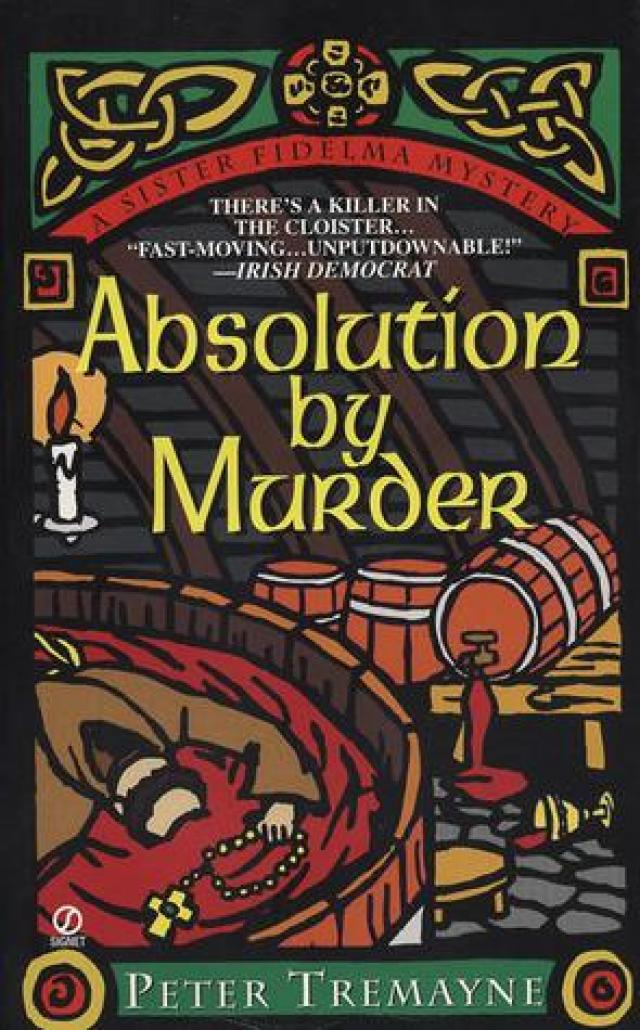
Absolution by Murder
Peter Tremayne
In A.D. 664, King Oswy of Northumbria has convened a synod at Whitby to hear debate between the Roman and Celtic Christian churches and decide which shall be granted primacy in his kingdom. At stake is much more than a few disputed points of ritual; Oswy's decision could affect the survival of either church in the Saxon kingdoms. When the Abbess Etain, a leading speaker for the Celtic church, is found murdered, suspicion falls upon the Roman faction. In order to diffuse the tensions that threaten to erupt into civil war, Oswy turns to Sister Fidelma of the Celtic Church (Irish and an advocate for the Brehon Court) and Brother Eadulf of the Roman church (from east Anglia and of a family of hereditary magistrates) to find the killer. But as further murders occur and a treasonous plot against Oswy matures, Fidelma and Eadulf soon find themselves running out of time.From Publishers WeeklyThis immensely appealing launch of a new series is set in seventh-century Ireland, which in Tremayne's rendering is a golden age of enlightenment and of total equality for women. Such narrative stumbling blocks as an abundance of stereotypical characters and much more dynastic trivia, ecclesiastical and secular history than can be absorbed are offset by the vigorous, intriguing puzzle posed by a series of murders and by Sister Fidelma, the tale's brilliant and beguiling heroine. An ecclesiastical conclave to settle major divisions between the Roman and Celtic branch of Christianity is held at Whitby in 664. When a major proponent of the Celtic way, the Abbess of Kildare, is murdered, Sister Fidelma, a fellow Celtic follower and legally trained scholar, is asked to investigate. She is paired with her ideological opposite, Brother Eadulf, on the Roman side, who is shrewd, highly educated and immediately smitten with the outspoken sister. The intellectual and physical sparks that are ignited between these two clerics (in an age before celibacy) light up the pages, and when two monks are killed and the malevolence thickens, the book becomes difficult to put down. It is reassuring to read that Sister Fidelma and Brother Eadulf will reappear... next time in Rome. Copyright 1995 Reed Business Information, Inc. About the AuthorPeter Tremayne is the pseudonym for Peter Berresford Ellis, a well-respected authority on the ancient Celts. He is the author of over twenty books, including The Dictionary of Celtic Mythology, The Celtic Dawn: A History of Pan Celticism, and The Druids. Valley of the Shadow is the sixth Sister Fidelma mystery. Tremayne lives in London, England.
Read online
A Sister Fidelma Mystery #3
Suffer Little Children
Peter Tremayne
In A.D. 644, a respected scholar of the Celtic Church is murdered during a visit to the Irish Kingdom of Muman. The kingdom's ruler summons Sister Fidelma to solve the brutal murder, but her time is limited. The victim, as it turns out, was a comrade of the arrogant King of Fearna, who threatens war over the suspicious death of his friend. But during her inquiries, Sister Fidelma comes to realize that there is more at hand than what appears, and finds her own life caught in the balance.From Kirkus ReviewsA third appearance for Sister Fidelia (Shroud for the Archbishop, 1996, etc.), an advocate of the courts in seventh- century Ireland. Fidelia is the sister of Colg£, who has just become king of Muman, the largest of the five Irish kingdoms, after the death of his cousin King Cathal. Colg£ has asked his sister, skilled in detection, to solve the mystery of the killing of elderly, highly respected Venerable Dac n, from the Kingdom of Laigin, who was stabbed to death while doing research in the Abbey of Ros Ailither, in Colg£'s domain. Now Laigin's King Fianamail is demanding heavy penalties for the death, and Colg£ hopes that Fidelia's expertise will remove his culpability. She sets out for the abbey with her brother's trusted aide Cass. On the way they encounter the sad remains of a village ravaged by order of Salbach, chief of the fighting unit Corco Loigde. They gather up survivor Sister Eisten and the few remaining children, putting them in the abbey's care while Fidelia begins her investigation. Many more will die as she begins to unearth an underlying cause of the ongoing mayhem--a search for the missing son and heir of Illan, ruler of the long-coveted petty kingdom of Osraige. This is revealed and, in a twisty finale, so is the identity of Dac n's killer, as Fidelia makes her case before the Dal--the assembly of the High Court. Endless subplots, characters by the dozen, and the author's determination to educate the reader in the politics, laws, customs and topography of the country make for heavy going. Scholars may love it; for the average reader, though, more penance than pleasure. -- Copyright ©1997, Kirkus Associates, LP. All rights reserved.Review"The uncommon time period makes this a distinctive mystery."—Mystery Reader.com
Read online
A Sister Fidelma Mystery #4
The Subtle Serpent
Peter Tremayne
In the fourth book in this acclaimed Irish medieval mystery series, Sister Fidelma investigates a murder at a remote abbey, only to encounter the strange disappearance of a ship and its entire crew... "The literary successor to Ellis Peters' Brother Cadfael." --Southern Star (Ireland)"One of the most intriguing new characters in detective fiction."--Book & Magazine Collector"A heroine whom many readers will willingly follow."--Kirkus ReviewsSister Fidelma is "brilliant and beguiling." --Publishers WeeklyThis is the fourth book in the acclaimed Irish medieval mystery seriesThe popular Sister Fidelma has been featured in stories in Ellery Queen's Mystery Magazine, The Mammoth Book of Historical Mysteries, and Great Irish Detective StoriesAmazon.com ReviewSeventh century Ireland provides the background in Peter Tremayne's newest murder mystery which begins gruesomely as two nuns pull a decapitated corpse from their drinking well. Sister Fidelma is called upon to determine who the body is and how she met her untimely end. Fidelma, as an advocate of the courts, is the appropriate person to collect evidence and determine if there is a case to be answered. Although Tremayne makes clear in his introduction that women under Irish law in the period aspired to and performed most professions on a similar footing with men, he does not neglect the opportunity to place Fidelma in situations where both her youth and gender raise the question of her suitability for her official capacity. Still, her enjoyment in convincing her doubters of her abilities and her ultimate success indicate, as Tremayne evidently intends, that this particular period, at least as Ireland as concerned, should not be characterized as a dark one. En route to the scene of the crime that opens the story, Sister Fidelma encounters a second curiosity, a ship foundering in the waves without a person on board. What Fidelma does discover are hints that an old and trusted friend was aboard and seems to have met the same mysterious fate as the rest of the crew and cargo, whatever that might have been. The novel proceeds as Fidelma sets out to determine the cause of each of her mysteries, and what if any is the connection between them. Tremayne is a careful and engaging storyteller; his characters are thoughtfully drawn, and he uses the central mystery for them to discuss and reflect upon the differences between the native Irish church and that of Rome (which is becoming the more powerful--and whose ultimate success will keep women like Fidelma out of the halls of power which she has confidently and capably strode.) The ecclesiastical period setting may remind readers of the work of Ellis Peters, but the 7th century is distinct from the 12th and Ireland distinct from England. Tremayne relishes those differences, creating a tale that has much to enlighten and intrigue his readers and make them anxious for the next time Sister Fidelma is called to perform her duties. From BooklistSeventh-century sleuth Sister Fidelma employs her considerable powers of reasoning and deduction to solve another perplexing homicide steeped in avarice and intrigue. When the decapitated body of a young woman is found in the well of the Abbey of the Salmon of the Three Wells, Sister Fidelma travels to western Ireland in her capacity as an advocate of the Brehon law courts. En route to the Irish kingdom of Muman, she encounters a drifting merchant ship whose crew and cargo have evidently disappeared. Tying these seemingly unrelated incidents together, Sister Fidelma unravels a tangled mystery rooted in the legend and lore of ancient Ireland. A treat for history buffs who devoured Thomas Cahill's How the Irish Saved Civilization and historical mystery fans who appreciate strong and highly intelligent female protagonists, such as Sharan Newman's Catherine LeVendeur and Kathy Lynn Emerson's Lady Susanna Appleton. Margaret Flanagan
Read online
A Sister Fidelma Mystery #5
The Spider's Web
Peter Tremayne
The fifth book in the Irish medieval mystery series finds Sister Fidelma investigating a murder in a seemingly tranquil town, only to uncover a web of secrets that everyone wants to keep hidden. And now she must race to discover the truth before she becomes the next victim...."[Sister Fidelma is] a brilliant and beguiling heroine."-Publishers Weekly "The literary successor to Ellis Peters' Brother Cadfael."-Southern Star (Ireland)"A treat for history buffs who devoured Thomas Cahill's How the Irish Saved Civilization."-BooklistFrom Publishers WeeklyRich with Irish lore, Tremayne's fifth entry in his Sister Fidelma series (following The Subtle Serpent) introduces readers to further Celtic law, religion and mores in a multilayered search for a cold-blooded killer. In A.D. 668, Fidelma, an advocate in the law courts of Ireland, is sent by her brother, the king of Muman, to investigate the murder of a Celtic chieftain. Though a blind, deaf mute named M?en was found holding a bloody knife near the chieftain's corpse, Fidelma and her Saxon friend Eadulf are not convinced that the man is guilty. For one thing, M?en is also supposed to have killed the chieftain's sister, who raised M?en since he was a babe, and Fidelma finds it hard to believe that in one night the blind deaf-mute would slay the two people in his compound who had befriended him. As Fidelma and Eadulf scrutinize the evidence, they cast about for other suspects among the chieftain's family and subjects. They find a daughter who hated her father and quickly took power after his death, a wife who scorned her husband, a cleric whose religion leans toward Roman practices and a wealthy cousin who assumed that he was the chieftain's heir. Despite several threats to their lives, the sleuthing sister and her sidekick persist and finally ferret out the culprit. In painstaking detail, Tremayne follows Fidelma's careful analysis of the facts while spicing the narrative with asides on the battle between Roman Catholic and Celtic views of theology and law. Though the secondary characters lack complexity, Fidelma's own is strong enough to carry the story, albeit slowly, to its finale. Copyright 1999 Reed Business Information, Inc. From BooklistWhile most of seventh-century Europe was shrouded in intellectual darkness, Ireland enjoyed a period of unprecedented enlightenment. During this era, Irish universities flourished and women were accorded the same rights, protections, and professional responsibilities as men. As an advocate of the seventh-century Brehon courts, Tremayne's Sister Fedelma, a legal scholar and expert in both criminal and civil codes, is once again charged with the task of gathering and assessing the evidence in a perplexing murder case. When Eber, chieftain of the rural outpost of Araglin, is brutally stabbed to death, Fedelma's brother, the king of Muman, requests that she undertake an investigation and see that justice is dispensed. Though most of Eber's clansmen are eager to implicate a defenseless deaf-mute in the homicide, Fedelma exposes an array of suspects and motives. As she delves deeper into the past, she uncovers a shocking family secret and a tangled web of hatred, deceit, and greed. Margaret Flanagan
Read online
A Sister Fidelma Mystery #6
Valley of the Shadow
Peter Tremayne
From Publishers WeeklySister Fidelma and Brother Eadulf, her Saxon monk sidekick, are on their way to Gleann Geis, a remote pagan community in southwest Ireland, when they run across a horrible massacre: 33 young men have been ritually killed, their bodies laid out in a pattern peculiar to the ancient Druid faith. (As her fans know from the five novels in this well-researched series, most recently The Spider's Web, religious and political tensions simmer in seventh-century Ireland, though with its sophisticated legal system and fair treatment of women, it is one of Dark Age Europe's more civilized societies.) At Gleann Geis, the pair stumble on another murder, for which Sister Fidelma is arrested. The meek Eadulf has an easier time mounting a clever defense of his mentor than he does fending off the advances of the local chieftain's precocious 14-year-old niece. Released from confinement, Sister Fidelma is free to make full use of her sharp analytical powers to figure out who is behind the massacre and the seemingly unrelated murder of which she was unjustly accused. She does not disappoint. At the climax, the religieuse explains all, untangling a complex web of intrigue that moves from one surprising revelation to the next. While adept at plotting, Tremayne has an annoying habit of overusing adverbs. A door opens "boisterously," a mouth droops "pessimistically," while characters smile "thinly," "wanly," "warmly," "gravely," "grimly," "apologetically" and "maliciously." In the future one hopes that the author--or his editor--will put as much faith in plain verbs as Sister Fidelma does in her God. (Mar.) Copyright 2000 Reed Business Information, Inc. From Library JournalSeventh-centruy Irish princess Fidelma (The Spider's Web), late of the sisterhood at Kldare, negotiates witha pagan worrror-chieftain on the behalf of her king/brother. Hidden Valley, however, she and companion Brother Eadulf discover 33 ritually slaughtered young men laid out in a circle. Since her object is to establish a Christian church and school in the area, Fidelma vows to investigate the crime. Firmly set in a wild, dangerous time but featuring well bred and educated protagonists, this historical teaches as it entertains. Recommended.Copyright 2000 Reed Business Information, Inc.
Read online
A Sister Fidelma Mystery #7
The Monk Who Vanished
Peter Tremayne
In September of 666 A.D., an aged monk and a set of relics disappear during the night from the Abbey of Imleach. The missing monk is a matter of great concern for the abbey. But the relics are a disaster of a much higher order. They are the priceless holy relics of St. Ailbe, the man who, in the fifth century, brought Christianity to the Irish kingdom of Muman, converted and baptized it's king, and founded the abbey. The relics themselves are the political symbol of the entire kingdom and their disappearance threatens to disrupt its continued peace and stability.On a visit to the Abbey of Imleach, Sister Fidelma, sister to Colgu, the current King of Muman, and an advocate of the Brehon Courts, is asked to investigate. With the help of her friend and traveling companion, the Saxon monk Brother Eadulf, Fidelma begins to slowly unravel the mystery behind the twin disappearances. But there are dark forces at work, which will stop at nothing - even murder - to achieve their aims.
Read online
A Sister Fidelma Mystery #10
Our Lady of Darkness
Peter Tremayne
In mid-seventh-century Ireland, Sister Fidelma of Cashel-sister to the King of Muman, an advocate of Brehon Courts, and religieuse of the Celtic Church-returns hastily from a pilgrimage to the Shrine of St. James. The news that brings her back is that her companion and friend, the Saxon monk Brother Eadulf, is under arrest for a serious crime in the neighboring kingdom of Laigin. Riding furiously through hostile territory, she arrives only to find out she is too late. Eadulf has already been tried and found guilty of the murder of a young girl. Even worse, Laigin's king has abandoned the traditional judicial code of Ireland in favor of the ecclesiastical Penitential from Rome-and under this code he is to be executed the following morning.Convinced that her friend is innocent, Fidelma has only twenty-four hours before his execution to come up with evidence persuasive enough to sway the king into allowing an appeal of Eadulf's conviction. Facing a king determined to make an example of Eadulf and an old adversary of her own, Fidelma soon realizes that nothing is as it was portrayed, and behind the heinous crime is an even more shocking conspiracy. Now, Fidelma must unravel her most perplexing puzzle before time runs out for her closest companion.From Publishers WeeklyIn Our Lady of Darkness: A Celtic Mystery, by British author Peter Tremayne (the pseudonym of Celtic historian Peter Berresford Ellis), Roman Penitential law and traditional Irish law come into conflict as Sister Fidelma finds herself defending her good friend, Saxon monk Brother Eadulf, from a rape and murder charge. This is another solid installment in this well-established medieval series.Copyright 2002 Cahners Business Information, Inc. From Library JournalSeries protagonist Sister Fidelma of Cashel (Act of Mercy) attempts to save her Saxon monk friend, Brother Eadulf, from wrongful execution. A faithful rendering of life and justice in seventh-century Ireland. Copyright 2002 Reed Business Information, Inc.
Read online
A Sister Fidelma Mystery #12

The Haunted Abbot
Peter Tremayne
Fidelma of Cashel and her beloved companion Brother Eadulf have one final journey to make before returning to Ireland. Invited to Aldred's Abbey, where Eadulf's childhood friend Brother Botulf is steward, they arrive at midnight on the old pagan festival of Yule to find Botulf dead-his head caved in by a blunt instrument. As Fidelma and Eadulf soon learn, murder isn't the only danger facing those in the abbey. The ghost of a young woman haunts the cloister shadows, a ghost closely resembling the Abbot's dead wife. It will require all of Fidelma's skill as an advocate of the Brehon Courts to uncover the truth-before the abbey's secrets take yet another life.From BooklistSister Fidelma, seventh-century religieuse of the Celtic Church and advocate of the Irish Brehon Courts, continues her travels in search of spiritual and personal fulfillments. Together with her beloved companion, Brother Eadulf, she journeys to East Anglia to visit Aldred's Abbey. Arriving in the middle of a snowstorm on the eve of the winter solstice, Fidelma and Eadulf are shocked to find Brother Botulf, the steward of the abbey and Eadulf's childhood friend, with his skull brutally smashed in. Although the abbey itself appears to be haunted and Christians and pagans are engaging in armed conflict, Fidelma probes beneath the surface to uncover a decidedly unexpected motive for murder. Interwoven into the suspenseful plot is the intimate story of Fidelma and Eadulf as they decide whether to permanently bind themselves to one another--a commitment sanctioned by the ancient church before celibacy became a requirement. Tremayne displays his usual meticulous attention to historical detail in this intelligent and artfully crafted whodunit. Margaret FlanaganCopyright © American Library Association. All rights reservedReview"A solid historical series."--Library Journal"...reliably entertaining."--Publishers Weekly
Read online
A Sister Fidelma Mystery #14

The Leper's Bell
Peter Tremayne
In November of 667 A.D., Fidelma of Cashel has returned home to her brother's castle to discover that a servant, her son's nurse, has been found brutally murdered in the woods near town, and her son is missing, presumed kidnapped or worse. Sister Fidelma, sister to king of Muman in Ireland, an advocate of the Brehon courts, and a religieuse of the Celtic Church, and her husband Brother Eadulf now must face their most personal and baffling case ever. Is there a traitor at her brother's court? Are the Ui Fidgente, the old blood enemies of Fidelma's family, involved? And what is the role of the mysterious dwarf seen leaving the kingdom carrying a leper's bell? With few clues and precious little time, Fidelma must unravel this complicated puzzle in time to rescue her missing child.From Publishers WeeklyIn the pseudonymous Tremayne's intriguing 15th Irish historical (after 2005's Badger's Moon), Fidelma of Cashel suffers a terrible personal loss. On returning in the fall of A.D. 667 to the castle of her brother, Colgú, who's the king of Muman, Fidelma discovers that her baby son's nurse has been murdered and her son has disappeared. She and Brother Eadulf, her partner in a trial marriage, become involved in a complex plot involving palace politics and hostile tribes, frightening captures and hair-raising escapes. The diverse supporting cast includes warriors and woodsmen, bishops and apothecaries, dwarfs and lepers. Despite some clunky prose, the author, an authority on ancient Celtic culture under his real name of Peter Berresford Ellis, once again brings the people and customs of seventh-century Ireland to vivid life. (Jan.) Copyright © Reed Business Information, a division of Reed Elsevier Inc. All rights reserved. From BooklistIn the fifteenth entry in the series, Sister Fidelma, seventh-century religieuse of the Celtic Church and advocate of the Irish Brehon Courts, faces her most personal and difficult case to date when her infant's nurse is found dead in the woods and her child is nowhere to be found. Together with her husband, Brother Eadulf, she launches a meticulous investigation into the circumstances surrounding her son's presumed kidnapping, but the meager clues point in multiple directions. Meanwhile, her marriage to Eadulf is strained not only by worry but also by the fact that her countrymen think she has married beneath her station. In addition, she is wracked by guilt over her previous irritation at the restrictions that being a wife and a mother impose on her personal freedom. Struggling to contain her emotions, she brings her formidable logic to bear on the case. Tremayne brings his customary attention to historical detail to a narrative that incorporates surprisingly modern concerns. Joanne WilkinsonCopyright © American Library Association. All rights reserved
Read online
A Sister Fidelma Mystery #15
Whispers of the Dead
Peter Tremayne
Fidelma of Cashel - sister to the King of Muman, a religieuse of the Celtic Church and an advocate of the Brehon courts - returns in this new collection of fifteen tales. These stories of murder, mayhem, and mystery are not merely spellbinders but also provide insight into the ways and mores of the complex, fascinating society of seventh century Ireland as well as heretofore unrevealed background details of Fidelma herself.Review"Sister Fidelma fans-and they have their own international society ...-will welcome Peter Tremayne's Whispers of the Dead."--Publishers WeeklyAbout the AuthorPeter Tremayne is the fiction pseudonym for Peter Berresford Ellis, a prominent authority on the ancient Celts and author of numerous works of history and scholarship. As Tremayne, he is the author of eleven books featuring Sister Fidelma, including Our Lady of Darkness. He lives in London.
Read online
A Sister Fidelma Mystery #17

A Prayer for the Damned
Peter Tremayne
In February of 668 A.D., Fidelma of Cashel and her companion Eadulf are about to get married. Again. Their initial trial marriage of a year and a day has ended and they are about to embark on a permanent partnership. As the sister to the King of Muman, Fidelma's marriage ceremony is a major event in the kingdom of Ireland and the High King, as well as kings of the other Irish kingdoms and other major figures are going to be in attendance. One not so welcome guest is the fanatical Abbot Ultan, who advocates the radical position of celebacy for all religieuse and feels that Sister Fidelma's upcoming nuptials are an abomination. On the eve of the ceremony, Abbot Ultan is found murdered in his chamber. Worse still, one of the most distinguished guests, the King of Connacht, has been seen fleeing from the scene and is charged with the murder. Quickly Fidelma, who is appointed in the King's defense, discovers that Abbot Ultan is not the pious man he was thought to be, and has numerous enemies amongst those assembled for the wedding. Her wedding delayed, the high born guests restless and querulous, and the murder and it's aftermath threatening to cause chaos throughout the Kingdom, it's up to Fidelma to uncover the murderer--and the truth behind the murder itself--if the often tenuouos peace of 7th century Ireland is to be maintained.From Publishers WeeklyTremayne's engrossing 17th Ancient Ireland mystery (after 2006's Master of Souls) finds series heroine Fidelma on the eve of her marriage. Political and ecclesiastical bigwigs have gathered for the ceremony. The tremendously unpopular Abbot Ultán also arrives to protest that Fidelma must uphold her long-ago religious vows by remaining celibate. Ultán soon turns up dead, and there's no shortage of suspects. Muirchertach Nár, the king of Connacht, who believed his sister-in-law had been wronged by Ultán, was spotted near the crime scene. The sons of a woman Ultán beat for worshipping a pagan deity also come under suspicion. When Muirchertach Nár is killed, Fidelma must determine whether the deaths were related. The solution to that riddle is so unexpected that it slightly strains credulity. Rich in historical detail, this series also reflects on many contemporary issues, including celibacy, gender and church leadership. Tremayne (pseudonym for scholar Peter Berresford Ellis) has produced another winner. (Nov.) Copyright © Reed Business Information, a division of Reed Elsevier Inc. All rights reserved. From BooklistAfter being joined together for a year in accordance with ancient Irish custom, Sister Fidelma of Cashel and Brother Eadulf are about to be officially married. Of course, it will come as no surprise to fans of this series that their much-anticipated ceremony is postponed when one of their guests is murdered. Not only was Abbot Ultan universally despised, he was also vehemently opposed to Fidelma and Eadulf's marriage. Although not uncommon for members of religious orders to marry in the seventh-century Celtic Church, Ultan was among the growing number of clergy lobbying against these unions. When the king of Connacht is accused of the crime, he enlists the scholarly Fidelma as his advocate. As the list of suspects grows longer, so do the frustration levels of the would-be bride and groom. Another stellar installment in the most authentically detailed medieval mystery series currently being published. Flanagan, Margaret
Read online
A Sister Fidelma Mystery #19
Dancing With Demons
Peter Tremayne
In the late 7th Century, the High King of Ireland is killed at night in the middle of his compound. Who killed him is not in question - there are unimpeachable witnesses that point directly to the clan chieftain responsible. Dubh Duin is, after all, found by the High King's guards in the High King's bed chamber holding the murder weapon. But with impending civil war in the balance, the motive for the murder becomes of paramount importance. The Chief Brehon of Ireland asks Fidelma of Cashel - sister to the King of Muman and a dailagh - to investigate. What her investigations reveal is an intricate web of conspiracy and deception that threatens to unbalance the five kingdoms and send them spiralling into a violent and bloody civil war and religious conflict. And it's up to Fidelma to not only see to justice but to private the violent fracturing of an increasingly fragile peace.
Read online
A Sister Fidelma Mystery #20
The Dove of Death
Peter Tremayne
In A.D. 670, an Irish merchant ship is attacked by a pirate vessel off the southern coast of the Breton peninsula. Merchad, the ship’s captain, and Bressal, a prince from the Irish kingdom of Muman, are killed in cold blood after they have surrendered. Among the other passengers who manage to escape the slaughter are Fidelma of Cashel and her faithful companion, Brother Eadulf. Once safely ashore, Fidelma—sister to the King of Muman and an advocate of the Brehon law courts—is determined to bring the killers to justice, not only because her training demands it but also because one of the victims was her cousin. The only clue to the killer’s identity is the symbol of the dove on the attacking ship’s sails, a clue that leads her on a dangerous quest to confront the man known as The Dove of Death.From Publishers WeeklyAn intriguing lead and a tricky puzzle propel Tremayne's 18th whodunit featuring seventh-century Irish legal advocate Sister Fidelma (after 2009's The Council of the Cursed). When pirates board the Barnacle Goose, the ship on which Fidelma and her husband, Eadulf, are sailing home after the previous book's events, the pirates' white-clothed, masked leader fatally stabs both the Goose's captain and a royal envoy who's Fidelma's cousin. Fidelma and Eadulf jump overboard to save their lives. A man in a small boat rescues the couple and takes them to the island of Hoedig, where Fidelma vows to devote her energies to identifying the murderer, a promise complicated by evidence that the brigands may be connected with a local nobleman. More murders and plenty of action follow on Hoedig. The ease with which Tremayne brings 670 C.E. Ireland to life more than makes up for a solution that's less clever than usual. (Nov.) (c) Copyright © PWxyz, LLC. All rights reserved. From BooklistSister Fidelma and her companion-husband Brother Eadulf reappear in an all-new medieval adventure distinguished by the attention paid to both suspense and historical detail. Returning home aboard an Irish merchant ship after the divisive Council of Autun (Council of the Cursed), Fidelma, Eadulf, and their shipmates are beset by marauding pirates, who ruthlessly murder both the captain and Fidelma’s cousin, special envoy to her brother, Colgú, king of Muman. Barely escaping with their lives after jumping overboard, the two are determined to exact justice for the crime. As more atrocities are committed, Fidelma, an advocate of the law courts of seventh-century Ireland, employs her keen intellect and heightened powers of observation in pursuit of some uncomfortable truths. Tremayne, a master of the medieval mystery, continues to shine as he sheds light on the twists and turns of both church history and the remarkably enlightened political and legal position accorded to women in seventh-century Ireland. --Margaret Flanagan
Read online
A Sister Fidelma Mystery #21
Chalice of Blood
Peter Tremayne
Ireland AD 670: When an eminent scholar is found murdered in his cell in the Abbey of Lios Mor, fear spreads among his brethren. His door was secured from the inside, with no other means of exit. How did the murderer escape? And what was the content of the manuscripts apparently stolen from the scholar's room?Abbot Iarnla insists on sending for Sister Fidelma and her companion Brother Eadulf to investigate the killing. But even before they reach the abbey walls, there is an attempt on their lives. As the mystery deepens, Fidelma and Eadulf must also wrestle with problems of their own, problems which threaten to separate them forever...
Read online