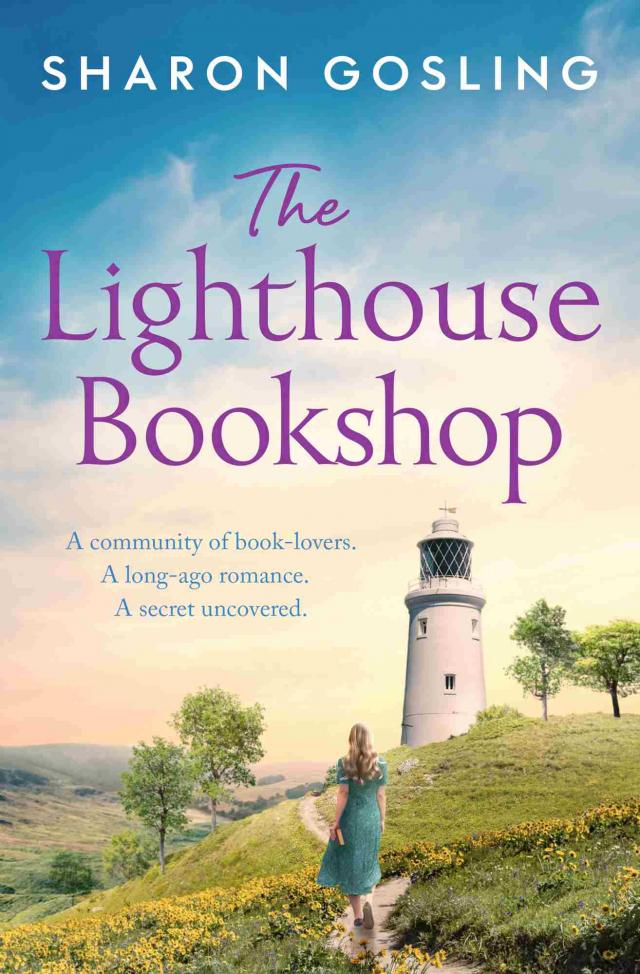
The lighthouse bookshop, p.1
The Lighthouse Bookshop, page 1


Thank you for downloading this Simon & Schuster ebook.
Join our mailing list to get updates on new releases, deals, recommended reads, and more from Simon & Schuster.
CLICK HERE TO SIGN UP
Already a subscriber? Provide your email again so we can register this ebook and send you more of what you like to read. You will continue to receive exclusive offers in your inbox.
For Adam, because books.
Prologue
The letter came on a Thursday, hidden away inside another envelope that seemed entirely innocuous and that Rachel therefore didn’t hesitate to open. It was a little battered, as if it had taken the scenic route to reach her, travelling around for a while before arriving at her door.
The envelope landed on the counter face up. Rachel stared at the name and address printed in the clear window in its front with the curious sensation of falling very fast, as if from a very great height. It took just a split second to rip away all the years that stood between those five short lines and her, between what she had been and what she had become, until all that was left was the sound of her heart beating to a sick, uneven rhythm in her ears as her fingers touched a name that had the power to undo every good thing in her life.
With the envelope there was a note, written in an open, curling hand. At length she picked this up and unfolded it. For a few minutes Rachel stared blindly at the words written there, until the world began to rush back towards her and she could breathe enough to read again.
First of all, don’t worry, it said,
He has no way of knowing I took this. He’s gone. I talked to old Mrs Meadows, who says he told her he was going abroad for work and wouldn’t be back. I don’t know if that’s true, but I also don’t know why he would bother lying to her. Before he went he dumped a load of black bags for the council to collect. The seagulls got to them and there was rubbish blowing all over the road, so I went to clear up the mess and found this. I don’t know what it is. I didn’t open it. But I thought you should have it, just in case. I’m not sure why, really, except that if a man like that throws something away, then it probably deserves to be kept.
I hope you are well. I think about you often. I wish that we’d had more of a chance to get to know each other. I wish that we could get to know each other now, in fact, but I understand that it would probably be difficult for you to know me without thinking about him. Thank you for letting me know that you are settled, at least. I am glad that you have somewhere to call home. I hope you have friends, too, and perhaps even someone to love. I hope you found a way to start again.
Don’t feel that you have to answer this.
All my love,
A
Rachel stared at the note for several minutes. He’s gone abroad. Really? She looked up at the bookshop door. For a moment she imagined him walking through it, and his face and figure were so clear in her mind that she staggered with it, felt the fear like a hand clamped tightly around her throat. She pushed that tremor away, annoyed by the reaction. It had been years now, years, and he hadn’t found her yet. And if he ever did—
‘Are you all right?’ said Cullen’s familiar voice, from the armchair.
‘Yes,’ she said. ‘Just forgot something, that’s all. Can you hold the fort? I’ll be back down in a minute.’
Rachel went upstairs, carrying the letter with her with no real idea of what to do with it. She stood in her kitchen and turned in a circle, the envelope with that name on burning her palm like the flame of a candle. This place was so small. There was nowhere to hide anything, nowhere at all.
Eventually she opened one of the drawers, stuffed the envelope inside and then forced it out of her mind.
Everything was fine. It was only a name, after all, and a forgotten one at that. What damage could it do?
One
Toby had dreamed again of ruin. He awoke, sweating, into darkness. It took a few minutes for him to realize that the screams in his head had been parsed from the searing agony in his leg. He had vaguely thought, in that incongruously naive manner of his that used to drive Sylvie to distraction when they were married, that in leaving behind his old life he had also left the spectre of death behind, too. That morning, lying on his side at the edge of an unfamiliar bed, trying to catch his breath as he waited for the now-familiar pain to subside, he understood that this was something else about which he had been decidedly wrong.
It was that awful woman’s fault. What was her name? Dora McCreedy. She’d been coming out of the house beside his rental cottage when he’d pulled up. It had a ‘For Sale’ sign in its front garden and she’d clearly been viewing it. Isn’t it a lovely area, he’d said, caught up in the cheerfulness of arrival, and Are you thinking of moving in? She’d laughed in a gratingly indulgent way that immediately made Toby wish he’d kept quiet. The woman had gone on to explain that her family was one of the oldest in the area and that she had building developments all over Aberdeenshire.
‘I’ve always had a soft spot for Newton Dunbar, though,’ she’d added. ‘It’s where I’m from and I like to keep my hand in here. It could be such a beautiful, vibrant place, with a little more thought and investment.’
‘Oh – but I think it’s beautiful already,’ Toby had said. ‘Especially the lighthouse.’
She’d glanced back up the village, to where the curious tower was just visible on the hill behind the furthest houses, with an elaborate sigh. ‘That old monstrosity! I do hope you didn’t come here for that.’
‘Well, I’ve got some work to do too,’ Toby had told her, struck by a strange need to justify himself. ‘I needed somewhere quiet. Newton Dunbar seemed like a good place.’
She’d laughed at that. ‘Well, yes. It’s definitely quiet. What line of work are you in, Mr…?’
By that point, Toby had regretted the urge that had made him say hello in the first place, but there was no way he could rebuff her now without seeming horribly rude.
‘My name’s Toby. Hollingwood.’ He’d added his surname after a split second of hesitation. ‘I’m a writer.’
To his relief, McCreedy’s face hadn’t registered recognition.
‘Well,’ she’d said, ‘if you’re writing about the lighthouse, you’ll find the tower in a bad state. It’s becoming an eyesore, really. Full of dreadful clutter.’
‘Isn’t it a second-hand bookshop?’
McCreedy dismissed his question as if she hadn’t heard it. ‘You know the story, don’t you? The builder died in a fire. James MacDonald was his name.’
‘In the lighthouse?’ Toby, startled, had looked instinctively towards the tower.
‘No, no. In the big house. This was back in the early 1800s, not long after the folly was built. There’s barely anything left to see of it now. It was his mad wife, you know. Set fire to the place and burned him to death inside.’
‘How very gothic.’
‘Oh yes,’ McCreedy had said, with the specific kind of gloating tone habitually present in the regular gossip. ‘I own the ruins of the house and the land around them now. The walls are mostly overgrown, but what’s left is still as black as tar. The flames could be seen for miles, so they say, and the wife danced on the lawn as the place burned. Perfect material for a novel,’ she’d smiled.
Toby had wondered if Dora McCreedy had ever seen a life burn and if she’d smile so if she had. He suspected she might, and thus his impression of her soured further.
‘Not my kind of writing,’ was all he’d said.
And so this past night his dreams had been flushed through with raging fire, as well as the usual miasma of gunfire, explosions and exodus. He’d woken suddenly into darkness and now here he was, staring at an unfamiliar ceiling. Experience told Toby there would be no more sleep for him that night, no matter that it was barely 5 a.m. He got up, pulled on sweats and a jumper, and went downstairs in a house so quiet that the silence rang in his ears. The kitchen was modern, as white and minimalist as the rest of the house, with a wide glass door sliding open onto a deck that flowed into the garden. He stood staring at the darkness outside, his reflection set against it like a ghost floating in light.
Inactivity had always been his downfall. He didn’t know what to do. Or rather, he knew what he had to do, but could not find a way to begin. Sylvie had told him she could get him a book deal if he wrote his memoirs, but that meant deciding where to start, and then actually starting. Toby was more used to reacting to an event and then describing it to an audience, putting it into context. He had no idea how to put his own life in context, to explain himself to others, to make himself understood. Lately he could not even do that to himself. What, When, Where, How, Why – the five questions every piece of journalism had to answer or it had failed in its basic function. Toby could not even answer the first of them, not right now, not when there were so many other stories still ringing in his head, so many lives and events that 300 words, 500 words, 1,000 words had failed to encapsulate with any degree of completion. Or, he’d frequently feared even at the time of writing them, compassion.
Tired of his own reflection, he went out instead, taking his satchel with him as if he were on any other assignment.
Outside, dawn was coming on, despite the heaviness of the sky. The air smelled wet. It was not raining, although it had been recently. He brushed against bushes overhanging the path and felt the spray from their leaves on his cheeks.
The cottage Toby had rented was at the western end of Newton Dunbar’s main street. In fact, the place was small eno
Newton Dunbar was a tiny place, hidden away, unknown and largely without note. Except of course for the fact that it had a lighthouse that was not a lighthouse at all. The tower was at the east end of the village, behind a short row of cottages and a small, square gatehouse that edged the base of the hill on which it stood. In the typical ostentation of the Victorian period, Toby had read that it had been built as the library for Braecoille, the grand mansion house that had once stood master of this valley but that had long since crumbled into ruins now hidden by the forest that spread beyond the hill. He could imagine why the master of a once-grand estate would choose to build a lookout in that spot – from the top of the tower it must be possible to see the whole of the village and the valley in one direction and, on a clear day, the distant conglomeration of Great Dunbar in the other.
Toby walked with slow determination, aiming not for the tower built by the unfortunate James MacDonald but for the forest on the other side of the hill on which it stood. By the time his stuttering gait had reached the first tangled bank of trees there was just enough natural light to see gradients in the blue-black shadows beneath them. A waist-high wooden fence blocked the way and Toby recalled McCreedy’s declaration that she owned the woods. Well, she wasn’t here now. Toby swung his satchel from his shoulder and dropped it on the other side of the fence before following, cursing his leg as it refused to act how he wanted, cursing again at the inevitable pain.
* * *
For Rachel, the day started the same way as every other, with Eustace miaowing loudly in her ear. She opened her eyes and rolled onto her back. Above her the white papered ceiling of her small, circular bedroom looked the same as it had for the past five years. The tower’s windows were small in its thick stone walls and even at this early juncture of the morning the irony was not lost on her: that a lighthouse should be so very lacking in illumination seemed deliberately perverse.
Rachel dodged the cat on the short set of curving steps down to her tiny half-moon of a kitchen. The cat had come with the lighthouse, but Rachel had no illusions that he was hers. Eustace belonged to Cullen MacDonald, just as the tower did and always would, no matter that he no longer actually lived within its walls. Rachel put down Eustace’s food and stroked his old head for a moment, wondering how long it would be until he, like his owner, would find the many stairs too much to manage.
Later, ready for the day, Rachel walked the spiral staircase down to the bookshop, Eustace with her all the way. At the bottom of the curving flight of steps that led down from the two tiny floors of living quarters was a heavy wooden door that let her out onto the upper mezzanine floor. From this level, the staircase down to the bookshop’s ground floor was built of wrought iron and set against the wall. She and Cullen had debated this at length throughout Rachel’s tenure as manager. This place had been built as a library in the first place, so why hadn’t the architect put the stairs in the centre, like a spindle, instead? That would have given more space on the impractically curved walls, and the bookshop could certainly use the extra room now.
Cullen would not hear of changing any aspect of the tower’s internal workings beyond what he’d already altered when he’d originally moved into it sixty years before, and even then he’d modified as little as possible about the cavernous space that housed his beloved books. It was obviously inherited, this adoration of the printed page, a genetic predisposition passed down intact in a way that the money responsible for housing it in such an eccentric place was not.
There were only two additions that Cullen had allowed: the tiny ground-floor bathroom facilities and the semi-circular counter set in the centre of the lower room. The latter housed a plethora of drawers and shelves, full of things both important and forgotten. This included but was not limited to: the till; a lurking explosion of invoices and bills; a laptop as old in computer years as the lighthouse itself; a kettle; the makings for tea and coffee; a toaster, a bread bin and a domed glass cake stand.
Directly behind the counter was the stove, the lighting of which had no seasonal break inside a stone building with walls thick enough to withstand the North Sea. No matter that there was only a river within a mile of this particular lighthouse, and the sea itself was distant to the point of being irrelevant. The proximity of the wood burner to the counter would have been ideal if not for the fact that Bukowski had a habit of lying as close to it as he could get, and was thus responsible for Rachel frequently almost going arse over tit in the middle of the working day. This was, she had often thought, something that the writer for whom the collie was named would have enjoyed.
As she relit the stove there came the sound of a large key being turned. Rachel looked up to see the arched door of the lighthouse beginning to open. She put down the matches, took a larger step than necessary over a non-existent dog, dodged around the duet of armchairs and small table with chessboard that stood beside the counter, and hurried towards it. She glanced at the time as she went. It was barely 8.30.
The stooped, white-haired figure of Cullen MacDonald appeared in the opening doorway, the dark misery of the day picked out as if in wet indigo ink behind him. The wind was up, the branches of the trees peeking from the far side of the hill whipping unhappily against the sky.
‘What are you doing here so early?’ Rachel asked, reaching out to take the wicker basket he had over one arm. ‘I thought you were going to have a lie-in?’
‘I did,’ her employer and landlord told her cheerfully, as he shook rain from the fine drift of his hair. ‘I got up at six thirty instead of six.’
Rachel led the way back towards the counter. The basket was covered with a pristine white tea towel and emitted the aroma of baked sugar and butter, as if it had been conjured from the pages of a fairy tale involving hoods and conniving wolves.
Cullen flopped down in his armchair, the one upholstered in olive green velvet, with the squashed yellow cushion and threadbare arms. Eustace appeared as if from thin air, hopped onto the old man’s lap and turned around once before curling up, purring with contentment that routine had once again been correctly observed.
‘It’s just shortbread,’ Cullen said, as Rachel uncovered the basket. ‘Thought I’d keep it simple today.’
Rachel smiled as she lifted the cake dome from beneath the counter and began to transfer the biscuits into it. ‘You’re finally getting used to the oven, then?’
‘Getting there,’ Cullen agreed. ‘Though I still don’t know why anyone would need so many bells and whistles on a device solely devoted to the preparation of food. To look at it you’d think it could make the trip to Mars and back completely of its own volition.’
Rachel finished with the shortbread and started on the coffee and toast for their breakfast, another part of her regular morning routine. When she had first come to Newton Dunbar, Cullen had still been living in the tower. But he’d reached his seventh decade and it had become apparent that the lighthouse was a folly in more ways than one. He’d finally conceded that he could no longer manage the stairs safely, or indeed at all. He took possession of the little gatehouse at the bottom of the hill instead, which was part of the remains of his family estate and had been empty for some years. There hadn’t been funds for full renovation, and Cullen was once more loath to change the essential nature of the building, but he had at least conceded the need for a new kitchen and bathroom.