

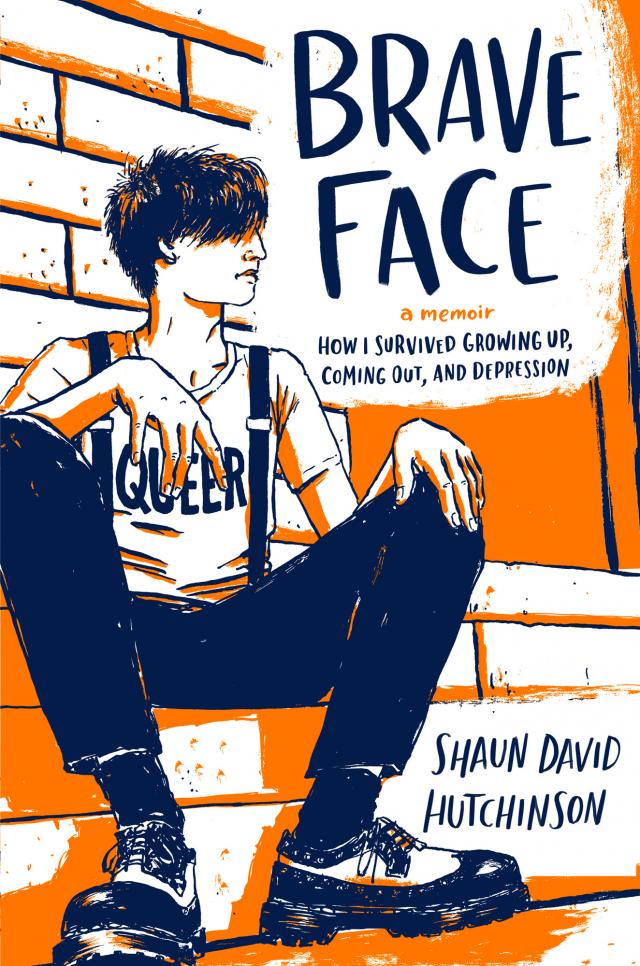
Brave face, p.1
Brave Face, page 1


PRAISE FOR BRAVE FACE
“As much a book about coming out as it is a book about simply coming to be, Brave Face is the bravest memoir I’ve read in years. Illuminating, brutally honest, poignant, and sometimes laugh-out-loud funny, this isn’t a book just for queer kids; it’s a book for any teen (or adult) who feels left out, rejected, confused, and scared about their place in the world.”
—KATHLEEN GLASGOW, New York Times bestselling author of Girl in Pieces
“Shaun David Hutchinson has long been one of our brightest lights and best storytellers. In Brave Face, he shares all the sh*t he had to survive to get there—and how we can too. Brutal and essential.”
—SAM J. MILLER, award-winning author of The Art of Starving
“Shaun David Hutchinson’s account of his teenage years is as honest and compelling as his young adult fiction. People of all ages will find comfort and hope in this powerful, beautifully written memoir.”
—BRANDY COLBERT, Stonewall Book Award–winning author of Little & Lion
“Shaun David Hutchinson has been hammering out one brilliant book after another, and Brave Face is his most honest and courageous one yet. This profound memoir is a triumph–a full-throated howl to the moon to remind us why we choose to survive and thrive.”
—BRENDAN KIELY, New York Times bestselling author of Tradition
“Fearless and resonant, Hutchinson’s memoir explores personal darkness with profound candor and earned wisdom. Courageous, devastating, and beautiful.”
—CALEB ROEHRIG, author of Death Prefers Blondes
“Shaun David Hutchinson’s Brave Face is an unforgettably profound memoir. A gut punch with moments covered in raw emotion. Its exploration of depression, family relationships, acceptance, sexuality, old wounds, and pain remind all of us that it’s okay to not be okay. That we are not alone, even in our darkest hours.”
—JULIAN WINTERS, author of Running with Lions
Thank you for downloading this Simon & Schuster ebook.
* * *
Get a FREE ebook when you join our mailing list. Plus, get updates on new releases, deals, recommended reads, and more from Simon & Schuster. Click below to sign up and see terms and conditions.
CLICK HERE TO SIGN UP
Already a subscriber? Provide your email again so we can register this ebook and send you more of what you like to read. You will continue to receive exclusive offers in your inbox.
For anyone who’s ever felt a little queer.
You’re not alone.
Please be aware that Brave Face includes the following content:
Suicidal Ideation
Attempted Suicide
Self-Harm
Sexual Assault
The Trevor Project
www.thetrevorproject.org
or call TrevorLifeline at 1-866-488-7386
National Suicide Prevention Lifeline
www.suicidepreventionlifeline.org
or call 1-800-273-8255
The It Gets Better Project
www.itgetsbetter.org
To Write Love On Her Arms
www.twloha.com
Trans Lifeline
www.translifeline.org
or call 877-565-8860 (US) 877-330-6366 (Canada)
The Jed Foundation
www.jedfoundation.org
CONTENT WARNING,
PART 1
I’LL KEEP THIS SHORT. A lot happens in this memoir. There’s drug use, sex in the backseat of a Mustang, discussion of homosexuality, alcohol use, a smidge of profanity, and a little petty theft. Those, of course, aren’t worthy of a content warning. Those are just the hundred million pieces that make up a life, and I’m not ashamed of them. But I’m also going to talk about depression, about cutting and burning myself, and about my attempted suicide. I’m not ashamed of those things either, but they might be tough for some of you to read, and I want to make sure you’re aware of what’s coming.
I’m also going to use words that will probably make you uncomfortable. Words like “faggot” and “fag” and “homo.” I know these words hurt to read. They’re not pleasant to write, either, but they’re part of my story. There were a lot of misconceptions about what being gay meant in the 1990s, and I absorbed them all. Many of my attitudes and beliefs were a result of internalized homophobia and are not beliefs I hold today.
I should also warn you that I was selfish, arrogant, and kind of screwed up when I was younger. I made a lot of mistakes. And while I had my reasons for many of the things I did, they’re not excuses. There are no excuses for the ridiculous crap I did when I was younger, and if I could apologize to every single person I hurt, I would. It’s fine to hate teenage me a little, but trust me, no one will ever hate that arrogant little prick more than he hated himself.
As you’re reading, it’s okay to put the book down if it becomes too much or if you need a break. I took lots of breaks while writing. Just remember that no matter how dark it gets along the way, I’m working on this from the light at the other end of the tunnel, and I’ll be waiting for you there.
THE TRUTH
THANKFULLY, I WAS ABLE TO piece together time lines and events from old e-mails and journals that I managed to hold on to. I’ve changed the names of all schoolmates and friends as well as many identifying details. Some of the people portrayed are composites. When it came to re-creating conversations, I’ve done my best to recall the flavor of the conversation, because it’s not always possible to recall something from twenty years ago word-for-word.
One thing I do want to point out is that memory isn’t always accurate. I gave a speech for the 2016 School Library Journal Leadership Summit, where I discussed some of my personal history with suicide and depression. In it, I mentioned how my mom had been tested in the hospital as a potential match for liver donation. Later, after my mom watched the speech, she told me that I’d gotten it wrong. She’d never been tested; she’d only talked to the doctor about being tested.
That’s not how I remembered it, though. So as I started writing this memoir, I wondered what was more important: what actually happened or what I remembered happening.
I think the answer depends on who’s doing the telling. How I remember events is more important to this memoir than how someone else remembers them, and someone else’s recollection isn’t necessarily the objective truth either. For example, I don’t remember my mom crying when she came to the emergency room after my suicide attempt. Her strength and stoicism set an example for me later in my life. If I found out that she had actually cried in the ER, it wouldn’t change the effect my original belief ultimately had on me.
Therefore, while I’ve done my best to verify dates and other objective truths, the majority of this memoir is how I remember events. Anything I’ve gotten wrong is on me.
Finally, this memoir contains e-mails, journal entries, and some of my early writing. Even though it’s incredibly embarrassing, I’ve left all my awful grammar and spelling errors intact except where doing so rendered the passage too confusing to read. Please don’t judge me.
PART 1
THE WRONG WORDS
JOURNAL ENTRY
1997
Every day, at least once, I silently wish I wasn’t gay. See, basically, being gay involves choices and fears. The choice is how to go about finding love. The fear is that I never will.
I feel so alone because I’m surrounded by people who can never understand exactly how I feel.
I know that I’m gay and I can’t do anything about the life I have to lead, but neither can I do anything with the life I have.
No matter what angle I try to look at things, the truth is that I’m a coward. I talk and strut, but what do I ever accomplish? I don’t know, it just seems like I’m running in an endless circle. I don’t want to look back on my life and regret the path I took. I look at my life presently though, and I hate and I hate and I hate . . .
VOCABULARY LESSON,
PART 1
Eighth Grade, 1991 to 1992
I KNEW WHAT IT MEANT to be a faggot, but not what it meant to be gay.
I was thirteen, in eighth grade at St. Mark’s Catholic School. Thankfully, this wasn’t a building filled with nuns who beat our knuckles with rulers. Our science teacher and vice principal was a woman with short hair who’d served in the military, rode a Harley to school, and taught us about both puberty and evolution. We attended daily religion class, which is where I did my homework for my other classes, and had mass once or twice a month, but I didn’t mind.
Despite not being Catholic, I liked St. Mark’s. It was nothing like my previous school, where I’d been frequently sent to the administrator’s office for counseling with the vice principal, who would beat my ass with a sandal and then pray for my eternal soul, which she made sure I knew she believed was hell bound. I hated that school so much that I faked fevers by going to the bathroom and running hot water against my forehead. I also scraped a pencil eraser across the crook of my arm until it bled and frequently jumped from the top of a metal geodesic dome on the playground in an attempt to break my ankle. My only friend was a boy who once ate a spider during a fire drill.
My experience at St. Mark’s was different. I learned how to cultivate friendships, how to fit in without being miserable, how to make people laugh. And I learned some new vocabulary words.
In the mornings before school, I sat in front of the library, which was situated at the far end of a parking lot between the main school building and the church. Younger kids chased one another around or threw foo
One morning near the beginning of the school year, I was lounging on the steps, my back to a column, reading The Eye of the World by Robert Jordan. I didn’t hear Kurt approach, didn’t know he was there until his shadow fell across me, and I didn’t think anything of it until he slapped the book out of my hand so hard the cover tore off.
“Faggot.” He stood over me with his hands on his hips, staring down.
I’d never been bothered while reading before. In fact, I was known for sneaking books behind my textbooks when I was bored. I wasn’t popular, but I wasn’t unpopular, either, and I certainly wasn’t a faggot.
Albert was a faggot. Albert was a tall, thin boy with delicate features and long eyelashes whose hair was always perfect and whose uniform was always impeccably neat. Albert was best friends with girls and hung out with them instead of with us.
Tito was a faggot. Tito was my mother’s hairdresser, and she sometimes took me to him to get my hair cut too. He was a flamboyant Mexican man who fluttered around his shop, spoke with a lisp, and carried his hands with a characteristic limp wrist.
Hollywood was a faggot. Hollywood was a character in the 1987 movie Mannequin, which tells the story of an uninspired young man on the verge of losing his job designing window displays for department stores, and the mannequin who comes to life and does the work for him. She saves his job, they fall in love, barf, the end. Hollywood is a fellow window dresser who is played for laughs by Meshach Taylor. From his campy demeanor and dramatic gasps to his flamboyant collection of glam sunglasses, he’s nothing but a joke. Hollywood has no backstory, no life, and serves no purpose in the movie other than to be laughed at and to help the hero get the girl. Hollywood was every gay stereotype rolled up into one poorly written character.
Hollywood was a faggot, Tito was a faggot, Albert was a faggot, and “faggot” was the worst insult to fling at an eighth-grade boy.
“Fuck you,” I said. Slowly, I rose to my feet. Kurt was bigger than me, but I was taller. All I wanted to do was pick up my book and go back to reading about a world of magic, where a person’s deeds defined them, but I couldn’t let Kurt’s challenge pass. There was no one else from our class around, but that didn’t matter.
“Faggot,” Kurt said again, and then he walked away.
I retrieved my book, and the cover, which I later decided not to tape back on. It was the cover, I believed, that had set Kurt off, and I made the decision to stop reading where anyone might see me so that no one else thought I was a fag. I also decided Kurt had to learn a lesson. So I casually whispered to the right people that I’d seen Kurt being friendly with Albert. I never called Kurt a fag, but soon other kids did. Soon Kurt was the butt of jokes. Soon boys he’d been friends with conspired to throw him in the Dumpster at the edge of the PE field. And Kurt never called me a faggot again.
No one did.
I knew nothing of sexuality, nothing of sex except that it sounded kind of gross. I knew nothing of love. Nothing of being gay. To me, being gay and being a faggot were the same. They were the worst thing a person could be. They were what I never wanted to become, and I’d do anything to ensure I never did.
FUTURE SELF,
PART 1
August 1992
“I WANT TO BE A lawyer.”
My mom was scared. She was driving slowly, stuck in traffic alongside everyone else who’d waited until the last minute to flee the monster hurricane that had targeted South Florida. Hurricane Andrew might have been the first hurricane of the season, and he might have come late, but he was not playing games. My mom had been born and raised in Florida, as had I, so she didn’t scare easily when it came to hurricanes, but Andrew was projected to tear right through our neighborhood, and she’d finally made the call to take me and my two stepbrothers to my aunt’s house north of us.
“Why?” my mom asked.
I shrugged. “To help people.”
“Then you’d want to be a defense attorney?”
“Yeah,” I said. “A public defender.”
“You won’t make much money that way.”
“I guess not, but I love to argue, and you don’t need a lot of math to be a lawyer.”
My mom laughed. It was good to see her laugh despite the fact that a force of nature, a thing over which she had no control, was threatening to tear apart the life she’d built. My mom had worked for a law firm until she’d fallen down a flight of steps and hurt her back so badly that she’d been declared legally disabled. She’d escaped a small town, escaped a bad marriage to my biological father, and had built a life she was proud of. She was raising me and my brother, Ryan, had remarried, and was helping to raise my stepdad’s two sons. No matter what the universe threw at her, she fought to protect the life she had and the life she wanted.
But no one can fight a hurricane.
I was fourteen when Hurricane Andrew hit, wobbling slightly to the south and sparing my hometown, but devastating Homestead. While most of my friends from St. Mark’s graduated eighth grade and went to a nearby Catholic high school, I decided to jump ship and attend my local public school. I honestly don’t know why. Maybe I was ready for a new adventure, maybe I wanted to reinvent myself. Leaving the kids I’d spent four years with and starting over at a new school was a terrifying decision, but it also felt like the right one. I said good-bye to my friends and never saw any of them again.
I was excited to start high school. I’d signed up for classes and had gone shopping for supplies, but Hurricane Andrew screwed everything up. I was maybe the only person who was actually disappointed that the first week of school had been canceled, because I’d spent all summer dreaming of how my first week would unfold. It’d be like a John Hughes movie, more Sixteen Candles than The Breakfast Club. I wished I was Jake or Bender, but I was probably going to wind up more like the characters played by Anthony Michael Hall—nerdy, eager, and badly dressed. I was okay with that because the cool kids still accepted him in their own way.
I saw my future self make friends and go to homecoming games and get drunk at parties and go to prom. I saw my future self graduate high school and head off to college. Fall in love and get married. Attend law school and build a career defending the vulnerable. Have children and grow old and die happy, surrounded by people I loved.
“You can do it,” my mom said. “I believe you can do anything you set your mind to.”
“Really?”
“Of course.”
My mom always told me the truth, even when I might have preferred she didn’t. So I believed her when she said I could do anything and become anyone. I believed there were no doors closed to me, no challenges I could not defeat, no obstacles I could not overcome if I worked hard, fought bravely, and moved through life with integrity. I wasn’t a good student. Teachers were constantly saying that I was smart but that I wasn’t living up to my potential. I’d come to believe that my failures were a result of me just being lazy.
We studied the thirteen original US colonies in Mrs. Baker’s eighth-grade social studies class. Mrs. Baker had never liked me, and I’d definitely never liked her. She was a bully, and I hated bullies, so I took advantage of every opportunity to undermine her. I asked uncomfortable questions that I knew she wouldn’t want to answer—questions about the colonists’ complicity in the mass murder of native tribes and about how American exceptionalism was an idea founded on the backs of slaves—and played the class clown whenever possible. When Mrs. Baker announced we’d be taking our comprehensive exam on the thirteen colonies, she made sure to fire a shot at me.
“The exam will be on Monday, giving you all weekend to study, though I’m sure that won’t bother Mr. Hutchinson, since no amount of studying can help him.” She sneered at me, and a couple of people snickered. Oh damn. I’d been called out by Mrs. Baker.





