

A particular madness, p.1
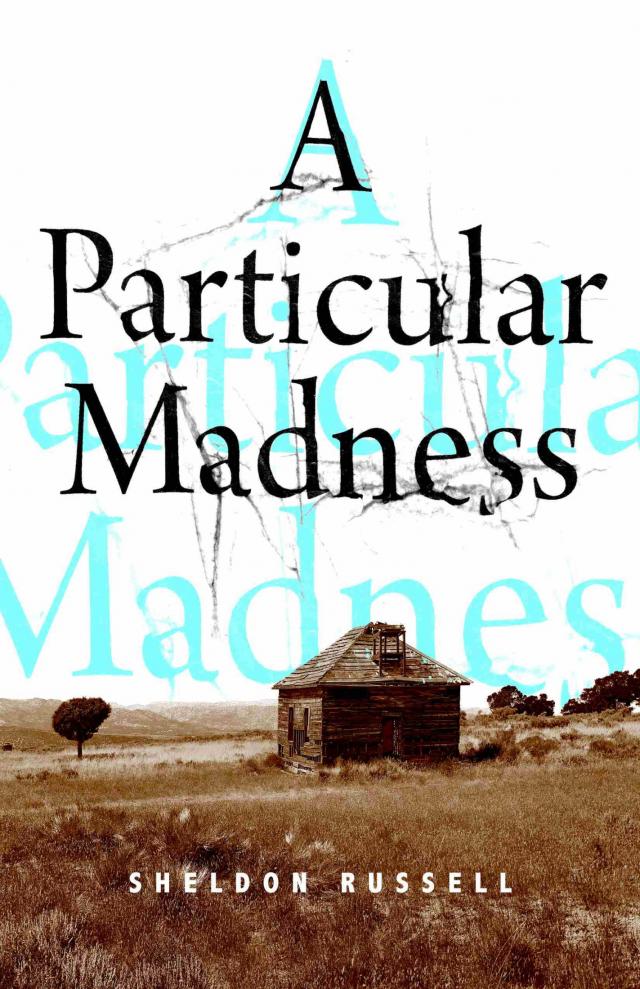
A Particular Madness, page 1


PUBLISHED BY Cennan Books of Cynren Press
101 Lindenwood Drive, Suite 225
Malvern, PA 19355 USA
http://www.cynren.com/
Copyright 2021 by Sheldon Russell
All rights reserved. No part of this publication may be reproduced, stored in a retrieval system, or transmitted, in any form or by any means, electronic, mechanical, photocopying, recording, or otherwise, without the prior written permission of the publisher.
ISBN-13: 978-1-947976-26-9 (hbk)
ISBN-13: 978-1-947976-27-6 (ebk)
Library of Congress Control Number: 2021930543
Cover design by Kevin Kane
For Keith and Judy
Whom the gods would destroy, they first make mad.
—Sophocles
Contents
Chapter 1
Chapter 2
Chapter 3
Chapter 4
Chapter 5
Chapter 6
Chapter 7
Chapter 8
Chapter 9
Chapter 10
Chapter 11
Chapter 12
Chapter 13
Chapter 14
Chapter 15
Chapter 16
Chapter 17
Chapter 18
Chapter 19
Chapter 20
Chapter 21
Chapter 22
Chapter 23
Chapter 24
Chapter 25
Chapter 26
Chapter 27
Chapter 28
Chapter 29
Chapter 30
Chapter 31
Chapter 32
Chapter 33
Chapter 34
Chapter 35
Chapter 36
Chapter 37
Chapter 38
Chapter 39
Chapter 40
Chapter 41
Chapter 42
Chapter 43
Chapter 44
Chapter 45
Chapter 46
Chapter 47
Epilogue
Acknowledgments
About the Author
Chapter 1
On my fifth birthday, I asked my mother where I came from. She said that a buzzard threw me up on a rock. From that day on, I knew that my family had somehow failed to tighten all the screws.
That same night, I stood at the window of the old farmhouse and watched a storm brewing on the horizon. It wasn’t a house, really, not in the normal sense, but an old railroad shack that had been moved onto the land and set on a foundation of red sandstone that my father hauled in from the field. When the wind blew, which was nearly all the time on the Oklahoma prairie, the house moaned like someone in pain, or lost, or in mourning.
“Mom?” I said.
“What?”
“You making fudge?”
“No,” she said.
“It’s lightning out,” I said.
“We could use the rain.”
“I gathered black walnuts out of the shelterbelt this morning?”
“I saw.”
“For making fudge, I mean.”
I could hear her walking across the kitchen. The floorboards made a bong, bong sound that was peculiar to her.
“You could have shelled them,” she said.
“Gea should shell them,” I said. “She never does.”
“Gea isn’t here.”
Gea is my sister, older sister. Her name means “earth,” or “dirt,” or something like that, and she is the one who said that if I gathered the walnuts, Mom would have to make fudge. But Gea never picked them or shelled them. She’s a girl, and older than me, so she never has to do anything like that. Mom and Dad favor her.
And she’s pretty, too, that much I know. Not to me, because she’s my sister, but to the boys at West Liberty, the one-room school three miles away. Both Gea and me went there. I started at five, though I should have started at seven. My dad said, why not, he don’t do nothing around here anyway.
When Gea was at school, the boys giggled and turned red and gave me rides on their shoulders. But when she was not around, they tied my shoelaces together and threw my Lone Ranger gloves down the outhouse hole.
I’d fallen under Gea’s sway myself from time to time. I did her chores, opened the door at night so she could get in without waking the folks, said I liked her new dress, even when I didn’t, or the way she’d changed her hair. I carried wadded notes to her from the boys, listened to her play the piano and sing what Dad said was perfect alto. I’d seen how my folks gathered about and centered on her smile. I knew why. It was her right.
“Jacob, there isn’t any water in the water bucket,” Mom said. “Didn’t I tell you to draw water?”
Lightning cracked open the sky beyond the window and zigzagged through the blackness. My hair tingled, and I closed my eyes, the zigzag still burning on my eyelids.
“If you’re not cooking fudge, what are you cooking?” I asked.
“Chicken gizzards,” she said.
“Pencil erasers,” I said.
“Don’t talk about food that way, Jacob Roland, or you won’t get anything.”
My mother always says that about food, that it’s not to be wasted and not to be talked about in a “dirigible” manner, whatever that means.
“Go draw the water,” she said.
“It’s dark, and it’s storming.”
“You should have thought of that earlier.”
“Dad will do it when he gets home.”
“Your dad’s tired when he gets home, and it’s your job to do.”
My dad, Abbott Roland, works the seven to eleven shift at the Santa Fe roundhouse in town. We need the cash to make place payments. The cream check buys the flour, and sugar, and kerosene for the lantern, but little more. When Dad gets home, he goes straight to bed, rising again at daybreak to do the chores, fix fences, or chase cows all over the damn country. Sometimes he takes a short nap before leaving once again for the roundhouse.
“What if I get hit by lightning?” I said.
“I’ll see that you’re buried up on Casket Hill,” Mom said.
Casket Hill is the cemetery that sits atop the mesa that rises between the Rolands’ and the Franklins’ places. Both families bury their dead there, the Rolands to the east, the Franklins to the west. The Cimarron runs at its base and marks the boundary between the Rolands’ and Franklins’ farms, but with each flood, the course of the river changes. Some years the mesa belongs to the Rolands. Some years it belongs to the Franklins. It’s a constant source of irritation between the families, who don’t much get along anyway. But when my dad, a Roland, married my mother, a Franklin, it brought the whole matter to a head.
On a July morning, my relatives from both sides gathered at the base of the mesa and decided that neither family would own it in the future, that it would be a cemetery to be used by both families instead. The deal was struck with a handshake, the first and only ever to pass between them. It became known as Casket Hill, and so it’s been ever since.
What the mesa lacks in fertility, it gains in scenery. The gypsum cap rock is white as chalk, with red cliffs dropping away to the river. Even in the heat of summer, a blue haze shrouds the mesa, and sometimes ghosts sit in the shade of the cap rock. I’ve seen them.
Over eternity, the river has carved the mesa from earth red as blood, leaving behind a sheen of salt that kills all living things, save for the kangaroo rats and the green lizards that scuttle about in the rocks, and the diamondback rattlers that writhe in tangled balls deep in the gypsum caves. In the spring, the rattlers bask on the rocks in the sun’s warmth but stay put on the mesa so long as the Cimarron runs water. They swallow whole the rats and lizards that wander in too close. They flick their tongues and level their beady eyes at each other.
But then there are years like this, when the rains stop, the river dries, and the salt gathers in white ripples across its bed. On years like this, the rattlers slither down the mesa on their bellies and into the valley like an invading army.
“You don’t even have a casket,” I said.
“I have a tow sack,” Mom said. “Now, go draw the water.”
Chapter 2
I lowered the bucket into the cistern and flipped the rope to upend it, thinking the while about that tow sack and those snakes. Drawing it up hand over hand, I could hear the water spilling and could smell its murkiness. Rainwater is slick as grease, and when Mom washes my hair in it, she says I look like Fuzzface, my dad’s coon dog. He’s half Black and Tan and half Airedale, and his whiskers sprout out his face like a wore-out toothbrush.
I worked at the screen door lock, which only opens if you hit it with the heel of your hand. The wind caught the door and whipped it against the house with a bang. Water sloshed into my shoe.
“Dammit,” I said.
“Jacob, I’ll not have cussing in this house,” Mom said.
“I said ‘darn it,’ ” I said, lifting the bucket onto the table next to the icebox.
I hooked the dipper handle over the side of the water bucket. Everyone in the family drank out of the dipper, which I didn’t mind so much, except when my uncle, the one who always had tobacco stains on his chin , stayed overnight.
Mom lit the lantern and turned up the wick. A black curl floated out the chimney and rose to the ceiling. The lightning no longer zigzagged outside but pulsed instead, like on the newsreels about those German bombs that fell on London. The thunder growled, a low and constant rumble. Mom walked to the window and looked out.
“I wish your dad would get home,” she said.
She always said that, because making decisions by herself was hard.
“I’ll shell the walnuts, if you’ll make the fudge,” I said.
“Jacob, quit picking about that fudge. We might have to go to the cellar, and I don’t want nothing on the stove.”
The cellar was my dad’s pride and joy. He’d built it by digging a trench in the shape of a rectangle with his posthole diggers and piling the dirt in the center. After that, he filled the trench with concrete and let it cure. Then he covered the pile of dirt in the center with concrete, and my sister and me put our handprints in it, “May 1948.” When everything was cured again, he dug out all the dirt inside of it, and his storm cellar was made. The neighbor drove his John Deere tractor over the top of it to prove its worthiness.
It was a good cellar, except Dad had built it too far from the house. It didn’t have steps or a floor, and the crickets in it were the size of prairie dogs.
A gust of wind rattled the windows, and a hailstone pinged off the side of the house.
“Maybe we should go now,” Mom said.
“It’s passing around,” I said.
I said that because that’s what Dad always said. He’d stand on the front porch and study the clouds and the lightning and say, “It’s passing around, Vega.” That was my mom’s name, Vega.
But everyone knew that he didn’t like to go to the cellar because of the big elm tree that grew just outside the door. When the wind blew hard, the limbs creaked through the vent pipe. Dad said there was no telling when that tree would fall over onto the door and trap everyone inside. I think he figured the best bet was not to go to the cellar at all, given that most storms pass around.
Another gust of wind blew in, harder this time, and the house shuddered. Sheets of rain swept the windows, and thunder rumbled under our feet. Mom sat next to the lamp with her elbows on the table. The flame flickered in her glasses, like the devil’s eyes, but they weren’t really the devil’s eyes. Mom said I had an overactive imagination because I came from both the Rolands and the Franklins. She said it was putting cold water in hot grease and I’d be lucky if my head didn’t explode someday.
“Mom?” I said.
“What, Jacob?”
“Do your eyes shoot out of your skull when your head explodes?”
She started to answer, but the rain stopped. The wind fell away, and the world took a deep breath, sucking up all the sound and air. My heart beat in my ears, and my skin tingled.
“Get your coat,” Mom said.
I started to protest. “Mom—”
And the world exhaled. My ears popped, and the kitchen linoleum lifted a foot off the floor. The screen door broke loose from the lock and slammed against the side of the house.
She grabbed me by the arm. “Go, Jacob!” she said.
She hauled me out the door with my coat halfway on. The wind cut at my face and snuffed away my breath. Hail, no larger than match heads, screamed out of the sky like blasting sand and pelted my face and ears. Puddles of water gathered in the low spots, and balls of lightning danced along the old barbed wire fence. Mom covered her face with her arm and pushed through the storm, and by the time we reached the cellar, her hair hung in wet strands.
She struggled to lift the door, but it was heavy, too heavy against the wind, and the limbs of the elm were touching the ground. Dad had made the door from boxcar siding and said it would last forever. It didn’t matter that no one but him could lift it.
“Help me,” Mom said.
So I grabbed hold, and we lifted it six inches, no more, before another gust of wind slammed it closed again. Wind twisted through the yard, picking up dirt and grass and water.
Mom turned, rain dripping off the end of her nose. “What’s that sound?” she said.
“What sound?”
And then I heard it, like the sound a mad bull makes when he’s throwing dirt over his back, or the sound of a steam engine pulling grade up Curtis Hill.
“I don’t know,” I said.
“That’s a tornado,” she said. “Get in the cellar, now.”
So we put our backs to it, along with a dose of fear, and it opened. The dank smell of old potatoes rose up from the blackness.
“Get down there,” Mom said.
“It’s dark,” I said in my best whine.
“Get, Jacob, before we blow away.”
I’d forgotten about the lack of steps, or, if I had not forgotten altogether, it didn’t seem all that important under the circumstances. But what awaited me was a mud slide caused by rain water mixing with the red clay left behind from all the digging. My feet went out from under me, and I shot down the muddy chute and into the blackness of the cellar. Before I could say a word, Mom plunged down behind me, nearly knocking me over. I couldn’t see her, but I could hear her groaning and breathing hard.
“Are you OK?” I asked, my voice reverberating inside the concrete walls.
“There’re matches on the nail keg. Light the lantern,” she said.
We kept a nail keg in the cellar for the kerosene lantern to sit on, and an old daybed for resting and storing potatoes on in the fall. It was black as night, so I swept my hand through the darkness slowly, so as not to knock anything over. I worked my way up to the base of the lantern and then the box of matches next to it. The elm tree creaked through the air vent overhead as it bent under the force of the storm.
“I found them,” I said.
“Well, light it,” she said.
I pushed my back against the coldness of the concrete wall and fished out a match from the box, striking it across the striking strip. Dampened from the humidity, it smoldered and went out, the cellar filling with the smell of phosphorous. I dug out another match and tried again. This time the match struggled to life. I lit the wick, put the chimney back on, and turned it up.
That’s when it started—first a small scurrying sound in the rocks somewhere in the shadows, then a full-blown rattle that built to a crescendo and filled the cellar and my heart with dread.
Chapter 3
“It’s a rattler,” Mom said. “Get on the bed.”
We both climbed up on the bed, balancing ourselves on the springs. The lamp light pushed our shadows up the wall and across the ceiling. My heart beat in my neck, and my ears rang. Rain streaked through the vent pipe overhead and onto our backs. We clung to each other as the rattling mounted, bouncing and echoing from every direction in the confines of the cellar.
“Where is it?” I asked, my voice pitched and thin.
“I’m not sure,” Mom said.
“What are we going to do?”
“I think maybe it’s by the door,” she said. “I think we came right past it in the dark.”
I peered through the dim lantern light but could see only darkness next to the door. Lightning shimmered through the vent pipe. The wind howled, and my ears popped against the pressure.
“I can’t see anything,” I said.
“I’m pretty certain that’s where it is,” she said.
The rattling stopped, only for a moment, but long enough for me to locate the sound when it commenced again.
“It’s by the door,” I said. “We can’t get out.”
Mom’s arm trembled against mine, from the wet and cold, I think.
“Maybe we could hold the mattress between us and the snake and make it past the door,” she said.
I had visions of our earlier plunge down the mud slide and what it would now take to climb out carrying a mattress, and with a rattlesnake waiting in the darkness.
“No,” I said.
So we stood there, thinking, and listening to the storm rage above the relentless rattle of the snake.
Finally, Mom said, “I have an idea.”
“What idea?” I said, hopeful that it was better than the mattress thing.
“There’re rocks on the floor. We’ll throw one at the snake to get it to move away from the door.”


