

Six feet over it, p.1
Six Feet Over It, page 1


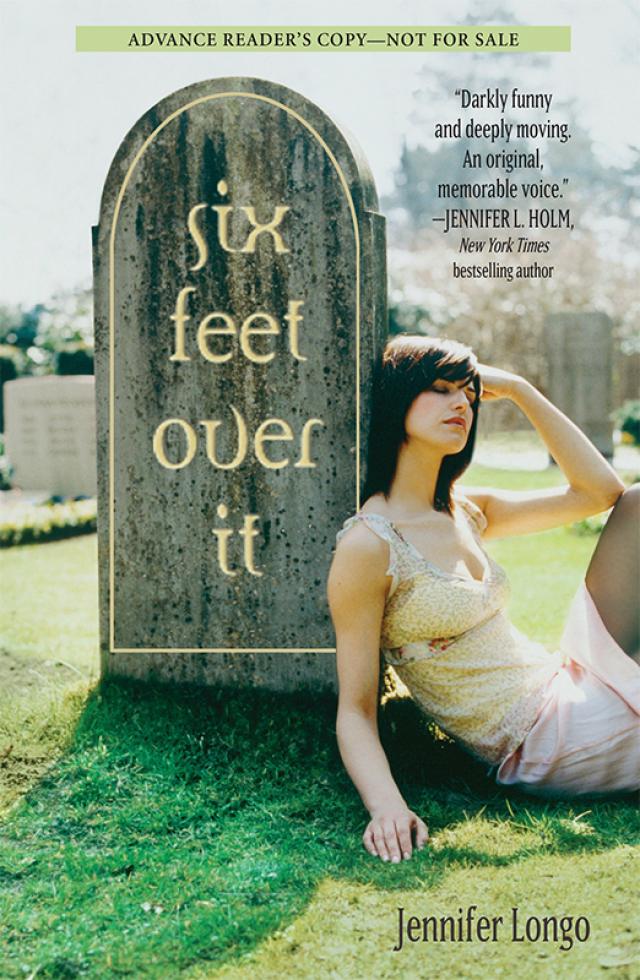
This is an uncorrected eBook file. Please do not quote for publication until you check your copy against the finished book.
This is a work of fiction. Names, characters, places, and incidents either are the product of the author’s imagination or are used fictitiously. Any resemblance to actual persons, living or dead, events, or locales is entirely coincidental.
Text copyright © 2014 by Jennifer Longo
Jacket photograph by Cusp/SuperStock
All rights reserved. Published in the United States by Random House Children’s Books, a division of Random House LLC, a Penguin Random House Company, New York.
Random House and the colophon are registered trademarks of Random House LLC.
Visit us on the Web! randomhouse.com/teens
Educators and librarians, for a variety of teaching tools, visit us at RHTeachersLibrarians.com
Library of Congress Cataloging-in-Publication Data
Longo, Jennifer.
Six feet over it / Jennifer Longo.—First edition.
p. cm.
Summary: When fifteen-year-old Leigh’s father buys a graveyard and insists she work there after school, she learns much about life, death, and the power of friendship.
ISBN 978-0-449-81871-8 (trade)—ISBN 978-0-449-81872-5 (lib bdg.)—ISBN 978-0-449-81873-2 (e-book)
[1. Cemeteries—Fiction. 2. Family life—California—Fiction. 3. Friendship—Fiction. 4. Death—Fiction. 5. California—Fiction.] I. Title.
PZ7.L8634Six 2014 [Fic]—dc23 2013026249
Printed in the United States of America
First Edition
Random House Children’s Books supports the First Amendment and celebrates the right to read.
For Cordelia,
all in the world
There is a land of the living and a land of the dead and the bridge is love, the only survival, the only meaning.
—Thornton Wilder, The Bridge of San Luis Rey
Contents
Cover
eBook Information
Title page
Copyright page
Dedication
Epigraph
Prologue
Part One: Pre-Need
ONE
TWO
THREE
FOUR
FIVE
SIX
Part Two: Non-Endowment
SEVEN
EIGHT
NINE
TEN
ELEVEN
TWELVE
THIRTEEN
FOURTEEN
FIFTEEN
Part Three: At Need
SIXTEEN
SEVENTEEN
EIGHTEEN
NINETEEN
TWENTY
TWENTY-ONE
TWENTY-TWO
TWENTY-THREE
TWENTY-FOUR
Epilogue
Author's Note
Acknowledgments
About the Author
prologue
FOR THE BODY you go to the mortuary. A lot of people don’t know this. Kids at school don’t know this. They think bodies come to us. They also think we’re out here at dusk with a pickax and a kerosene lantern, digging graves with a shovel, rotting, moonlit hands reaching from the upturned earth to pull us down with them. So dumb. Digging a grave really needs a backhoe, not just a shovel, and also we never see bodies dead or undead. By the time we get them they’re drained and dressed or burned, in a box and ready to be buried. It’s just a cemetery. We’re not living in the “Thriller” video.
What’s worse is when actual customers don’t get that bodies aren’t our thing. It’s so bad. Awful. Why doesn’t anyone tell them how to do it? The logistics? All we do is graves. That’s it. Well, and headstones. But they’re pretty much part and parcel so same diff.
Now the Pre-Needs, they know what’s up. They bought their graves a long time ago, before they needed them. But everyone else—I can’t blame them for not knowing because four months ago I had no idea either. I have to remember to be patient, because for crying out loud they’re here on sometimes the worst day of their lives. But then what do I know? I’m just a fourteen-year-old girl wearing jeans and a T-shirt trying to sell some graves, which—it’s just stupid. It looks stupid. I know this, Wade knows this, everyone knows this. It’s a really classy way to run a business, making your teenaged daughter sell graves because you’re too lazy to look farther than across the dinner table when searching for employees, but that’s Wade. No corner is too sacred to cut.
We all pretend it’s okay I’m shoving my algebra homework aside to make room for the headstone brochures, the maps of where to find the best grave sites … away from the road, something with a view, maybe near a tree? People and their trees.
Four months and it feels like forever. Four months since we left the ocean, and sitting here with all these dead people has made me a world-weary curmudgeon, everything bugs the crap out of me. I’m turning into Wade. Tall, dark, and probably twice as ridiculous.
“Ever think you’d get to live in a park?” Wade sighs dreamily every ten minutes or so.
A park. Drop that qualifying memorial and it’s more than just a creepy euphemism. It is Wade’s loving tribute to his greatest real estate conquest ever, his golden ticket away from the drudgery of years in a cramped Re/Max office cubicle. Here he has his very own sovereignty, a million tiny little plots of land to sell. Buying this thing has given him an enviable joie de vivre that in virtually any other situation (i.e., one not involving hundreds of dead bodies) might have been infectious. He is King of the Hill. Sierrawood Hill(s).
I only have to hold down the office fort three days a week, a blessing owing more to Wade’s lack of scheduling prowess than to any actual parental concern, even with my begging him to take it down closer to zero. When enlisting my heretofore-untapped grave-selling skills, he got me for a bargain: five dollars an hour, cash under the table of course, me being underage and super underenthused. Before I had a chance to turn him down, Wade let me know it wasn’t so much an offer as it was a requirement that I wasn’t allowed to turn down.
“An after-school job builds character!” he declared. “Any kid would be lucky to have this chance! Couple hours after school in your very own office”—says the guy who hated being in an office so much he’s making his family live in a graveyard—“and you’re getting paid? It’s icing on the cake!”
“I don’t want cake,” I whispered.
“Leigh. Leigh. We need you. I need your help.”
A Sasquatch sighting of his actual sincerity and desperation.
Unfair.
“Please?” I begged. “Please.”
He gave me maybe half a second.
“No one’s asking you to wrestle a bobcat in a phone booth; just sell a few graves and call it a day, jeez! Don’t be so dramatic. You love it!” No one loves real-time revisionist history more than Wade.
I love it.
Done.
My job training four months ago was twenty minutes of Wade giving me the lowdown on his way to lunch one afternoon. The whole operation basically involves binders. Two three-ring binders: one holds the maps of each section’s graves, decades of names written in corresponding representative rectangles, and the other features general section maps of the entire park: Harmony Haven, Memory Meadow, Vaunted Valley. Seven sections in all, each one titled like a Lifetime original movie. Standard burials can be single-spaced, double-spaced (side by side, popular with spouses and siblings), single or double depth (just what it sounds like). Cremains go in small drawers or in containers in the ground.
The mausoleum is a hulking white building made of drawers of caskets, each featuring a bronze plaque and a bud vase. People come to visit these drawers and tape notes to them, photographs, haiku about loneliness and circling birds.
Headstone orders are easy, just checking boxes, filling in forms. There are plenty of brochures and catalogs featuring lots of styles of granite and marble and bronze and examples of engraving details for people to browse through. Flowers. Birds. Tractors.
Beneath the pile of catalogs, Howard the County Coroner’s business card is taped eerily to the desk. “Just in case,” Wade likes to say.
In case what? Cripes.
Howard and his secretary, Terry, are both middle-aged and very patient on the phone, the only kind of contact I’ve had with them. I also only phone-know Dave, the go-to Baskerville Headstone guy in North Carolina (who keeps calling me Lay no matter how many times I tell him my name is pronounced Lee and if he doesn’t knock it off I’m going to start calling him Deev), and Jason, the super matter-of-fact mortician over at Chapel of the Pines who is only twenty-eight years old and according to Wade wears a ton of hair gel and became a mortician on purpose just to piss off his orthodontist father. All these guys, like the grave-buying clientele so far, clearly couldn’t care less about my probably illegal plot selling. Apparently this backwoods inland Northern California town (‘Hangtown’, a sentimental homage to all the gold rush vigilante hangings committed here) has retained its devil-may-care-but-we-sure-as-hell-don’t attitude regarding things like adherence to child labor laws. Maybe I’ll report myself.
I am allowed to clock out (read: write my hours on a Post-It) and lock the office door at six p.m., which sucks now that it’s autumn and the sun’s gone so early. Because, four months to get used to it notwithstanding, who wants to go traips ing through a bunch of graves in the dark? A park, a park, just a park. I whisper my mantra as I make my way to the house, wending my anxious way around and over the people beneath my feet in the damp green hills, down into Peaceful Glen and onto the narrow dirt road that makes its way beyond the mausoleum and past the tin toolshed. Past stacks of cement grave liners perched precariously atop one another in lopsided piles. Past a silver single-wide trailer reflecting the very last, low sunlight through black silhouettes of pine branches.
Until I reach a line of flat headstones. Headstones with mistakes etched into them: misspelled names, wrong birth or death date. Wade, never one to waste good granite (or miss an opportunity to be regarded as clever), has taken all these “mistake stones” and laid them in a snaking path through our yard, straight to the front door of our house. He has demonstrated rare restraint in turning them text-side down. They gleam, cool and sleekly polished, and wind their way past more grave liners filled not with people but with soil and sprouting geraniums and marigolds, hearty annuals and perennials that don’t mind blooming in boxes normally found down in a grave with a casket nestled inside it, one more barrier between the body and the earth to which it is supposedly returning.
The headstone path, the grave liners in the garden—over the past four months Wade has continued to muddy the line between the graveyard and the house a little more every day. Because he thinks it is funny. Because death is hilarious. And I love it.
one
I WAS BORN DEAD. Or died shortly after—Meredith’s story changes depending on her audience and her mood. “The first thing Leigh did after she was born was die!” she loves bragging to people, working her well-worn “tragedy + more tragedy = comedy” routine. I have since learned from watching television medical dramas that while yes, I was born nearly three months early—a two and a half pound “micro preemie”—premature babies flatline all the time, and these days reviving them is really no big whoop. Wade says it’s just bravado masking Meredith’s injured maternal pride over how I subsequently lived—thrived—without the protection of her womb, but most parents wouldn’t drag that chestnut out for laughs. Makes me cringe.
“Oh, Leigh,” she and Wade constantly moan. “Don’t be so dramatic, my God!”
If my eyes so much as mist up, get a little dewy over anything—epic Wade and Meredith eye rolling. Sighs are heaved. A person lucky enough to be brought back from a birth/death and go on to enjoy freakishly perfect health has nothing to cry about.
They buy graveyards on the sly and perform stand-up comedy routines about their kid’s near death and I’m dramatic?
I don’t remember when I started calling them Wade and Meredith.
So here we are. I am. Non-selling days I walk home as fast as I can from school, step on every crack I see. No, living here is not technically Meredith’s fault; Wade bought the graveyard without even telling her, saw a classified ad—Graveyard for Sale—and signed mortgage papers she never even saw. But still—come on.
I keep my eyes down all the way to Sierrawood, through our out-of-control Gothic black wrought-iron entrance gates, yet another genius Wade idea. They’re just stupid. Every single time I step past them, I think, “Last night I dreamt I went to Manderley again …” and I’m in a Daphne du Maurier novel, alone behind the gates of a creepy estate coincidentally also presided over by a ridiculous man. Huh.
Just inside the Manderley gates, ducks paddle in a pond, beside which is a wooden sign, small and low to the ground, that reads: this is a non-endowment care facility. Non-endowment, according to Wade, means the families don’t pay extra into funds to maintain the graves; therefore everyone should be grateful he even gases up the mower and runs it at all. A little farther past the pond, another very small, carefully hand-printed sign reads: all flowers, artificial and real, will be removed on tuesdays to facilitate mowing. Which everyone knows is a big joke—people are figuring out pretty quickly that most of the signage around Sierrawood, like Wade himself, is all talk, no action. gates closed at dusk? If we remember. no music allowed? Tell that to Mrs. Irvin, who hauls a boom box over to J 72 in Peaceful Glen so she can blast the sound track of the Broadway show Carousel for her sister week after week. Even with Wade’s mower running and my headphones on, every Wednesday I can hear Shirley Jones hollering about having “a real nice clambake.”
With all my attention concentrated on the gravel road beneath my feet, I pretend the graves away. Most of the headstones are flat, so if I squint it’s just a house, just a nice house near a nice park, just a park. But on digging days the pretense dissolves as I run to the house, my heavy backpack beating me senseless, away from the backhoe and the pile of soil beside it, Jimmy the contracted grave digger leaning casually on his shovel.
But today is an office day, Wednesday, so I do not run. I trudge from school, moving especially slowly so that I miss Real Nice Clambake. She honks and waves on her way out as we pass through the Manderleys. In the office, I toss my backpack beneath the desk and shove the dusty stack of back issues of Mortuary Monthly magazine to the floor. (Why do we continue to get this thing? We’re not a mortuary! I’ve called them twice to cancel already.) This stupid brown cave. Tiny building beside the pond, the hills of graves rising all around it. There are windows on every wall, large and well-positioned for crow’s-nest-type spying, but the dark wood paneling, matted brown shag rug, and black vinyl wingback chairs seem to suck the light right out. Like the clientele aren’t depressed enough. The shag and walls are gummy with residual pipe smoke from the previous owner, who sat in here puffing for fifty-three years before selling Sierrawood to Wade and packing his pipe off to Maui. Who in the world who isn’t a British detective smokes a pipe? People who own graveyards, apparently. I bet he wore a monocle, too. The smell makes my head hurt.
I prop the door open and heave the ginormous English lit book we’ve been assigned to rest on the funeral-scheduling desk calendar.
The heartsick Ceres seeks her daughter / She searches every land, all waves and waters.
Okay. Here’s the thing about Ovid, about Metamorphoses: I do get it—Troy falls, Rome rises. The universal principal, nothing is permanent, everything changes, anything, anyone you may have to hold on to, take comfort or care from, will leave. Die. Which is awesome. But then really, Ovid? You need fifteen books of narrative poetry to present this worn-out thesis? That I don’t get. Beauty for beauty’s sake, Mrs. McKinstry says, and we’re not reading all fifteen books, just the greatest hits, so count your blessings. Keep reading. She keeps quizzing.
Through the open windows I hear the sound of tires on the drive. My hands go damp—Not today, just let me sit here with Ovid, please oh please—and thank God it’s not a customer, just the flower van. Rivendell Nursery. They seem to be Sierrawood’s number one provider of beauty-queen-contestant-sashed wreaths. Mother. In Memoriam. Miss Sierrawood Hills. A lady brings them, and she also does weekly and monthly bouquets for out-of-town relatives and infirm or lazy local family members. Birthdays, holidays. Paying a stranger to visit your dearly departed seems sort of beside the point, but whatever.
The van passes the pond, and halfway up Poppy Hill the lady hops out wearing denim overalls; her hair is tied in a knot on top of her head and she lugs heavy baskets of uninspired calla lilies across the grass. But then someone else climbs out the back of the van.
Emily.
My only friend, left behind at the ocean. Months since I’ve seen her and I thought she was gone forever, but now here she is.
Emily?
No. My brain loves to turn every small, dark-haired girl I see into Emily, but no. This girl is maybe a little taller, and she’s out there wearing a dress—a dress, for crying out loud—and tall black boots. She runs to help with the lilies. She heaves armloads of arrangements and potted plants, refers to a list, searches for headstones, places blossoms and baskets. That dress is going to get filthy.
Just some girl.
Not Emily.
I salt the wound, pick up the phone receiver. Dial Emily’s Mendocino house.
The number you have reached …
Same as the last hundred times I tried. Why do I do it to myself?


