

Squad 19, p.1
Squad 19, page 1
part #2 of Tisaian Chronicle Series
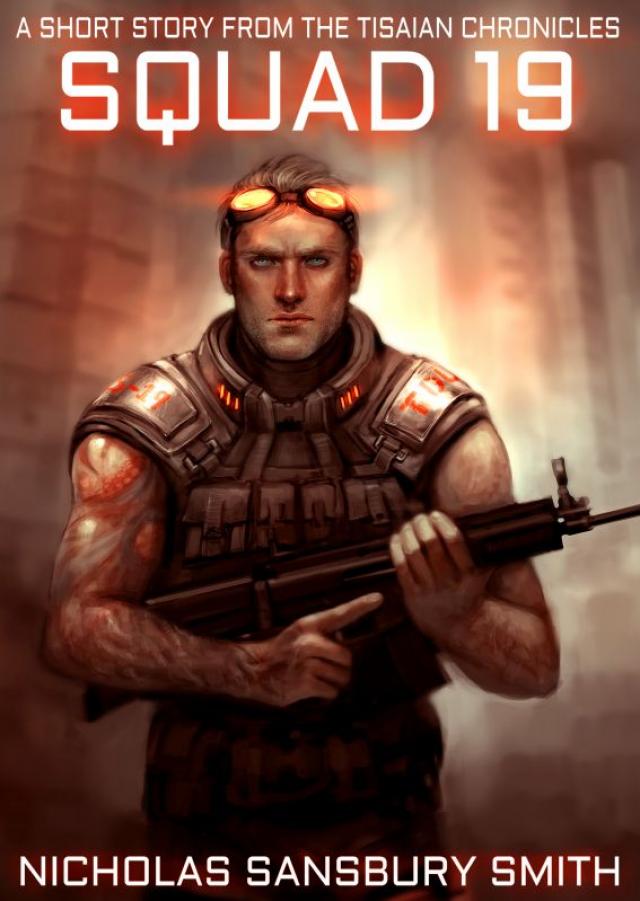


SQUAD 19
A SHORT STORY FROM THE TISAIAN CHRONICLES
By Nicholas Sansbury Smith
nicholassansbury.com
Edited by Michelle Browne
Artwork by Phoebe Smithers
ISBN 13: 978-0-9892447-2-5
Copyright © 2013 Nicholas Sansbury Smith
Smashwords Edition
All rights reserved. No part of this publication may be reproduced, stored in a retrieval system or transmitted, in any form or by any means, electronic, mechanical, photocopying, recording or otherwise, without the prior permission of the copyright owners.
“I do not know with what weapons World War III will be fought, but I know World War IV will be fought with sticks and stones.”
~Albert Einstein
Table of Contents
Part 1
Part 2
Part 3
Part 4
Part 5
About the Author
-1-
I have heard the revelation before. In fact, I’ve heard it so many times I’m beginning to believe it. You know the old saying, “the strongest instinct in humans is survival.” That was one of the first things I can remember ever being told that stuck with me, attached to my mind like a tumor. That’s the funny thing about your memories; sometimes you can remember a sentence or an image so clearly and yet have no idea who the hell you were with at the time.
In the old world, this statement was not as relevant, but after the bombs dropped everything fell apart so fast, it got relevant real quick. The EMPs had the same effect on our infrastructure as frying oil has on ice cream. And those who survived the initial blasts had to deal with being teleported back to the Stone Age. Food supplies dwindled, disease spread unchecked, and violence took the lives of most everyone else.
The rules changed overnight.
Whenever I relive the first few years in my head, I always divide the survivors into two groups: the strong and the weak. It was Darwinism—survival of the fittest. If you were in the second group, you probably didn’t make it long. Even with the help of others, the weak didn’t have a ticket to this new world.
Sometimes I forget why the nuclear missiles rained down on the world. It’s ironic. The world was destroyed over Biomass, the same resource that keeps the cogs and gears of the world I live in now moving. The rest isn’t important; just another story in a book jammed full of death and misery.
As I look back on the first few years after the Biomass Wars, I almost find myself laughing. Never would I have ever categorized myself in the first group. I was always mediocre at sports, spending more time on the sidelines than on the field. I enjoyed television way too much and often found myself living vicariously through the characters of my favorite shows. My mom used to tell me my cell phone was an extra appendage I had grown. I never went anywhere without it.
I lacked the killer instinct the strongest of the survivors had ingrained in their DNA. It was something I never had. I still don’t know how I survived those first few years. I still don’t know if I am glad I did. It’s kind of like biting into something and not knowing if it is really good or really bad—one of those things you just aren’t sure about. There are still good days and bad days. When I wake in the morning, it’s a 50/50 shot whether I’m glad to be alive. Pretty good odds for a card game, but not so good if you’re playing Russian roulette.
So as you can imagine, I didn’t transition very well to this new world. I will never forget those pesky leeches I used to get on my legs at Boy Scout camp—the ones that just wouldn’t let go. In the first few months and years after the bombs, I was like a leech, not wanting to let go of the past.
No internet? How was I supposed to communicate with all of my online friends?
No cell phones? You mean I can’t text anyone and I have to actually talk to them in person?
I remember asking myself those questions and concluding I should commit suicide. After all, it was becoming pretty common. Why not jump on the suicide train? End it now. God forbid I never get to use my iPhone again.
But I didn’t. For whatever reason, I chose to live. To fight. To survive. Over time I transitioned into the new world and found my spot. It’s ironic, now that I look back on my journey, to see where I ended up.
I brush the stitching on my uniform with a quick flick of my index finger, and a sense of pride washes over me. Squad 19, TDU. If you don’t know what that stands for, you’ve probably been living in a locked bomb shelter for the past 30 years. This, now that I think about it, could be possible. So I’ll just go ahead and tell you.
TDU stands for Tisaian Democratic Union. We’re the freedom fighters trying to piece together the broken world, one bullet at a time. We are at war with the Council of Royal Knights, the corrupt army of the last hub of civilization: Tisaia. The government has become increasingly totalitarian since the steel walls were erected around the State. It’s the irony of the new world—now that the government has enough to provide for everyone, they stockpile it for fear it will all disappear like it did after the Biomass Wars.
A dip in the road shocks me back into reality. I fall to the side against the bed of the pickup truck and grab my gas mask, making sure the filter doesn’t come loose. The brakes hiss as the truck slowly rolls to a stop. This isn’t good. We are still at least an hour’s ride from camp.
I turn and stand to see the passenger door swing open. Ajax’s massive frame steps out and pounds the hood with a gloved fist. “It’s overheating again, man. And we have less than a quart of coolant left. At this rate, we’re going to burn the damn engine up before we get back to camp.”
In the distance I see a thick, dark cloud stretching across the gray sky. It’s the type even rookie squad members can identify—one that doesn’t take prisoners. Even behind my thick goggles, I can tell it’s definitely a massive dust storm.
I climb across the bed of the pickup and jump over our precious cargo attached to the side of the truck—jugs of Biomass. My boots hit the dirt with an audible thud, sending a mushroom cloud of dust into the air, but I’m not around for it to soil my uniform.
“That’s not our only problem,” I yell into my mask. My voice is muffled and the wind is picking up, but Ajax shoots me a glance and follows my finger towards the cloud.
“SHIT!” the veteran squad member yells. He quickly goes to work, flipping up the hood and peering inside. His shemagh scarf whips wildly against the exposed skin where his gas mask should have been. Instead, a week’s worth of facial hair fights back against the cotton garment. A few months back he directly disobeyed my order and discarded his mask, arguing that “a bullet is going to kill me before cancer does.” Normally, I would have disciplined him or any other soldier for failure to obey an order, but he had a point. I have a hard time arguing against the truth. Besides, he’s the largest man I’ve ever known, with a receding mop of blond hair and a set of stoic blue eyes. A typical Anglo-Saxon from the old world, a modern day Viking. Usually, I don’t argue with him.
I try to peer under the hood, but Ajax dwarfs me and I have to peek around his shoulder to get a look into the engine compartment. “We got a storm barreling down on us,” I yell over the growing wind.
Ajax doesn’t flinch. “I can see,” he grumbles, continuing to twist a screw off the radiator. With one final twist of his wrench, the screw pops off and, in slow motion, clanks onto the timing belt like a basketball off the rim and tumbles deep into the bowels of the engine compartment.
“Mother…!” he yells, his voice trailing off in a swirl of wind before he can finish his sentence.
“It’s ok. I have a couple more in the toolbox.” I reassure him with a pat on the shoulder before racing back to the bed of the pickup.
“Nathar, what’s the ETA on that storm?” I ask through my head mic.
Static crackles over my earpiece for a few seconds before the young voice of our driver bleeds through. “I don’t know, sir. Judging by our mobile radar—which, I should add, I don’t trust…” the soldier pauses before making his best guess. “We have about 15 minutes before things start getting dicey.”
I grab the tool box from the truck bed and stop for a split second to watch the storm. Sure enough, it’s a nasty one—the largest I’ve seen out in the open—and for a moment I feel naked. A memory of an old friend finds its way into my consciousness, his skin ripped away from the dust storm he found himself caught in. I shudder. My squad won’t suffer the same fate. They don’t get to die until I give them permission.
I squat and open the toolbox, rummaging through its contents swiftly. Seconds later, I’m running back to the front of the pickup with a rusted screw tucked away in my gloved hand.
“We need to get the radiator off and patch this leak,” Ajax grumbles as soon as I return. A gust of wind catches his scarf and whips it into my face, temporarily blinding me. I brush it away and help him pull the radiator box out from the tangled mess of wires.
From a quick glance, it’s amazing the truck even runs. If it weren’t for the TDU’s mechanics, the truck would be rusting away in some salvage yard. The camp’s vehicle depot is called Frankenstein’s Garage for a reason. It’s made up of decades-old cars and trucks, pieced together by parts salvaged in the Wastelands and stolen from inside the walls of Tisaia. I’ve risked my life for more than one timing belt or quart of oil in my career.
The radiator box is jammed. I pull my .45 from my belt and beat on the box with the metal handle. The hiss of the wind drowns out the ringing of metal on metal. Ajax groans, the
I watch Ajax pull some putty from his pocket and carefully plug a small rust hole that is still leaking coolant. He nods in my direction. “That should hold it.”
Together, we position the radiator box back into its compartment, and with one last strike from the handle of my .45, it clicks back into place. I reach into my pocket and hand Ajax the screw before I forget. With a sigh of relief, I suck in a breath of filtered air and turn to watch the storm while Ajax reconnects the tubes.
The gray sky is split in half by a wall of darkness that slowly creeps towards us. It reminds me of an oil spill, the dark liquid engulfing everything it touches.
I ignore it and turn to Ajax, who slams the hood. “Well?”
He shrugs. “Not sure if she will hold, but we are out of time.”
I nod and race to the back of the pickup. “Get us the hell out of here, Nathar,” I say into my head mic as I climb into the rusted-out bed of the truck. The storm comes into focus again, and I begin to regret my decision to take the single cab. Being exposed in the back is not my idea of a good day even if we can outrun it. But I am the squad leader, and risking my life comes before my men risking theirs.
I tap the roof of the cab with my pistol and tumble to the metal skin of the bed as Nathar punches the gas. A cloud of earth explodes from under the back tires, and I reach for something—anything—to keep me from sliding around.
In seconds, we’re speeding down the dusty remnants of the highway, weaving in and out of the graveyard of charred vehicles. Normally I am fascinated with the artifacts from the old world and could stare at them all day, but I can see the inky darkness of the storm cloud inching towards us, and my eyes dart nervously back and forth.
“How’s the temperature gauge looking?” I shout into the head mic.
Static fills my earpiece just as a strong gust of wind peppers my jacket with dirt. The small fragments of poisoned earth find their way inside the aged cotton and sting my bare skin.
“Holding steady for now, boss,” Ajax responds.
A flash of lightning rips across the sky and illuminates the storm in its entirety. For a split second I see the image of a face, but when I blink it’s gone—nothing but a figment of my imagination. The Wastelands have a way of deceiving even the strongest minds. I’ve seen soldiers who have killed with their bare hands, only to be broken by a night outside the protection of the Tisaian walls. There is nowhere to hide on the dry and poisoned surface. No vegetation, no trees, no life at all.
My eyes dart back to the hungry storm, which is at least a mile across and growing by the second. That’s the magnificent thing about the storms that ravage the barren surface—the more they consume, the larger they get. Like a whale sucking krill down its gullet, the cloud’s hunger is unquenchable. The horizon is gone, the gray sky now completely consumed by the storm.
Lighting rips through the darkness again, and I can feel the heat of the storm growing. It has to be moving at a rate of 75 mph, much faster than the small four-cylinder engine can carry us.
“How far are we from the camp?” I yell into my mic again. My right hand begins to twitch, a sign I’m beginning to get nervous. I put it in my coat pocket and sit on it.
“Somewhere between ten miles and I don’t freaking know!” Nathar fires back.
Great. Now we’re lost. I crawl to my knees and peek over the cab, blinking as wind peppers my goggles with small chunks of dirt. The wind-ravaged landscape stares back at me. It is barren, with not a single structure in sight. I can’t even remember what grassy fields look like, or forests. A memory of my parents’ backyard tries to creep into my mind before a pea-sized rock smashes into the right lens of my goggles and prompts me to sit back down.
I can see the teeth of the beast now. There are mini cyclones tearing through the middle of the storm, eating everything in their path. I watch a boulder get sucked into the monster and follow it as it gets spit back into the sky. The rock sails towards us, and in the millisecond it takes me to blink, it crashes to the earth a hundred yards away. I hear it crash. Or at least I think I can. Another trick from the Wastelands? It’s happening to me now; I’m losing it.
You can’t lose it, Obi.
Leadership requires bravery. I know the lives of my men depend on it. I slap myself in the face, momentarily forgetting I’m wearing a gas mask. The plastic quivers but doesn’t shift, and the life-saving breathing apparatus stays in place. Slowly, I take in a mouth full of filtered air. Get as much as you can. Your brain needs oxygen. Feed it.
“How’s it looking up there?” I yell.
More static fills my head, but now it has oxygen. I can think. The static is just an inconvenience.
“I picked up the highway again. We should be less than a few miles from the camp,” Nathar replies.
My eyes dart back to the storm. A flash of lightning strikes a hundred yards away, pulverizing the earth and leaving behind a black crater.
“PUNCH IT!” I scream.
I can feel the tires resist as the engine sucks in more precious Biomass. This time I’m ready and hold onto the railing of the pickup. The truck evens out, and I can feel relatively solid ground beneath us. Nathar has indeed found the road.
We pass another stretch of vehicles, their charred metal skins flashing by. I watch a school bus, which is still recognizable by a hint of yellow, get sucked into the storm. It’s tossed like a toy and blasted into the sky before disappearing into the darkness. The edge of the storm is now frighteningly close. Its deafening roar drowns out Ajax’s voice over the radio. I finally make it out. “How are you doing, boss?”
How do you think I’m doing? I’m about to get skinned alive by a leviathan made of billions of particles no larger than the pebbles I used to fill my childhood fish tank.
I grab the railing of the truck bed again just in time to hear Nathar shout, “Hold on!”
The truck rears hard to the left and races across the barren ground. The heat from the storm burns every inch of exposed skin. I try to cover my arms by pulling on the coat, but it’s no use. The warmth penetrates even my thick boots. If we don’t make it to camp soon, I’m toast. I grit my teeth and hold on, dreaming of a cold shower and the soft caress of a woman. For a moment I can picture Juliana, her silky black hair and dark brown eyes. But a jolt rocks me back to reality as the tires climb over the top of several rocks.
The rocks mean we are almost to Camp Salvation, tucked deep in a valley where a lake used to be. I don’t need to peek over the cab to know where we are.
I laugh at the irony, coughing into my mask. The taste of manufactured plastic disgusts me. But what bothers me more is the fact we are literally minutes away from the base, with the storm barreling down on us, stalking us like a predator across the desert. If we don’t make it, if I’m sucked into the cyclone, my skin ripped from my bones, I’m going to haunt this place. Not just because of how horrible my luck is, but because I founded Camp Salvation. And I refuse to die inches away from her safety.
It is not to be. My luck has run out. I have finally lost the game of Russian roulette. My breathing becomes labored as the edge of the storm finally devours us. Even the filter can’t produce enough oxygen to keep my brain functioning. Darkness consumes me, but I’m not sure if it’s from the storm or lack of air. Bright stars dance across my vision. The truck trembles and shakes. I can hear the faint sound of voices over the radio and feel the heat eating at my skin and clothes.
A dip in the road. Or are we being lifted into the air? Anger. Confusion. Darkness. Heat.
I close my eyes and drift away.
“Obi. Wake up, you son of a bitch!”
Silence.
Fire crawling across my legs, my arms, my neck.
“Put it out!” I scream.
I can feel hands holding me down. Strong hands and a pair of weaker ones. I open my eyes, and there she is. Juliana.


