Callahans secret, p.1
Callahan’s Secret, page 1


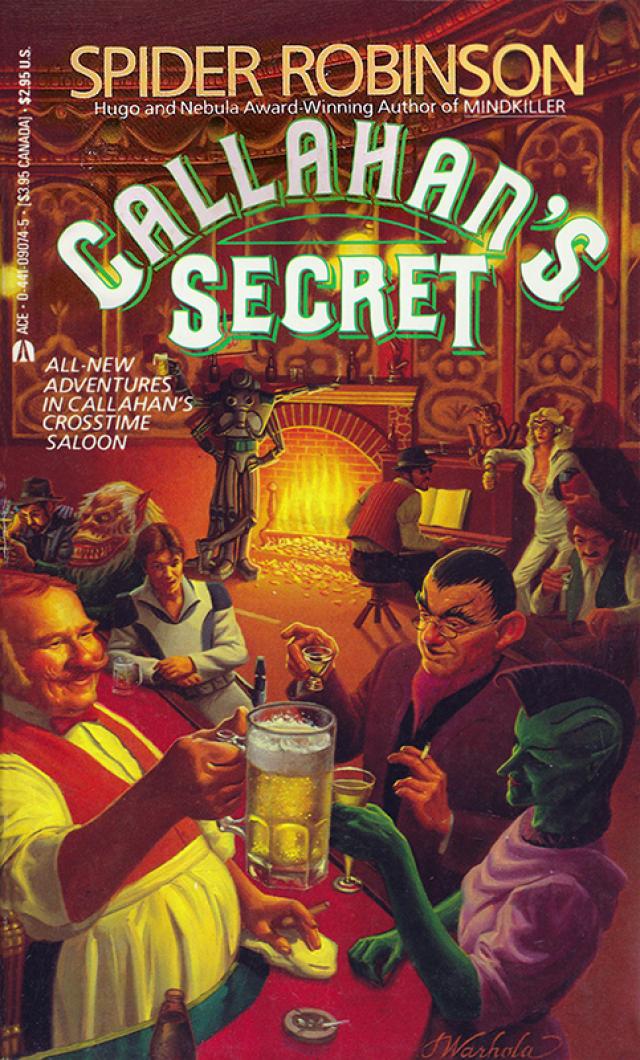
A MOST DEMANDING CUSTOMER…
Jake, the guitar player at Callahan’s Place, felt the universe spinning around him as the presence of the evil Beast, who had traveled across space to enslave Callahan’s resident alien Mickey Finn, came closer and closer.
“I have nearly reached you now. Soon I will be physically present, and able to restart the slave Finn,” the Beast said telepathically.
“He’ll find a way to beat you. He won’t let his wife down!” Jake protested.
“I will promise him that if he…fights my war for me, I will revive his people, and give them a planet to use as they wish. This one will do admirably…”
“Robinson is the hottest writer to hit science fiction since Ellison, and he can match the master’s frenetic energy and emotional intensity, arm-break for gut-wrench.”
—Los Angeles Times
Books by Spider Robinson
CALLAHAN’S CROSSTIME SALOON
TIME TRAVELERS STRICTLY CASH
MINDKILLER
NIGHT OF POWER
CALLAHAN’S SECRET
TIME PRESSURE
All the stories in this volume previously appeared in Analog Science Fact / Science Fiction magazine; copyrights have been reassigned to the author by Davis Publications.
All characters in this book are fictitious. Any resemblance to actual persons, living or dead, is purely coincidental.
CALLAHAN’S SECRET
An Ace Book / published by arrangement with
the author
PRINTING HISTORY
Berkley edition / July 1986
Third printing / December 1986
Ace edition / January 1988
All rights reserved.
Copyright © 1986 by Spider Robinson.
This book may not be reproduced in whole or in part,
by mimeograph or any other means, without permission.
For information address: The Berkley Publishing Group,
200 Madison Avenue, New York, NY 10016.
ISBN: 0-441-09074-5
Ace Books are published by The Berkley Publishing Group,
200 Madison Avenue. New York, NY 10016.
The name “ACE” and the “A” logo
are trademarks belonging to Charter Communications, Inc.
PRINTED IN THE UNITED STATES OF AMERICA
10 9 8 7 6 5 4 3 2 1
For Eleanor Wood,
and Susan Allison
TABLE OF CONTENTS
Foreword
The Blacksmith’s Tale
Pyotr’s Story
Involuntary Man’s Laughter
The Mick of Time
FOREWORD
There’s something we have to get absolutely clear right at the outset, and if you think you detect a dangerous gleam in my eye, you are perfectly right.
Ordinarily I am rather a hard man to insult. This is partly because I am blessed with a self-confidence so pervasive that it is frequently mistaken for smugness by less fortunate souls, and partly because I am abnormally lazy even for a writer—if you’re insulted, you’re supposed to do something about it, so I usually decline to take offence even when offered some.
I’m especially hard to insult professionally, as I am willing to shamelessly admit, having practiced many of the most disgusting and heinous vices in literature—I freely confess here and now that in the twelve years since I gave up honest work I have committed editorship (twice!), agentry (also twice), and book reviewing (multiple counts), and at least one grand jury is still considering allegations of literary criticism which I have given up denying.
To my own mild surprise, however, I discover that I do have some small shreds of literary pride left, and I wish to preserve them…so there’s something we’ve got to get straight. No kidding around, now, God damn it; I’m serious. Pay attention:
Yes, this is a book of stories set in the tavern known as Callahan’s Place.
Yes, it is the last such book.
Yes, there were others.
Okay, there were two such others.
All right, dammit, yes, Berkley is packaging all of them as a unit, with coordinated covers and so forth.
Nevertheless and notwithstanding, and we’d better be straight on this or there’s gonna be blood in the scuppers: I have not written a trilogy.
Repeat: not. It just so happens, by chemically pure chance, that this series of stories has reached its conclusion coincidental with the completion of the volume immediately following the one that succeeded the first one. That does not make it a trilogy.
In the first place it is not booby-trapped like most trilogies are. Neither of those first two volumes ended in the middle of a story, leaving you in midair in plot terms (although the first one, admittedly, did leave Mike Callahan literally in midair). If you have never read a Callahan’s Place book before, you should find this as good a place to start as any: since these yarns were designed for magazine publication, each is self-contained, and you should feel no need for any wordy What-Has-Gone-Before synopsis. If you have the first book but missed the second, it won’t cripple your appreciation of this one. If you feel you want to own all three volumes, who am I to tell you what to do with your money?—but I didn’t plan this whole thing to sucker you into laying out extra dollars, like Chico Marx with his “tootsie-frootsie ice-a cream” routine.
In the second place, it was not my idea to end this series or cycle or saga or whatever you want to call it (and I don’t care what you call it as long as you don’t call it a trilogy). That was done for me, by events beyond my control, and believe me, nobody is sadder about it than I am—no, not even my publishers, my editor, my agent, the people who currently own the TV and film options, or my more substantial creditors, all of whom have been heard to express dismay.
Of course it’s a financial disaster for me, but I don’t care about that. (I also don’t much mind having red-hot bobby-pins rammed up underneath my fingernails.) It’s a professional disaster as well, since now I’ll have to think up all my own plots rather than simply dramatizing the yarns that Jake tells me—but after all, I have published seven books in which Callahan’s Place is never mentioned, so the increased creative demand shouldn’t prove too arduous. (I’ll simply give up eating on days ending in “y”.) There’s even a vague feeling of something like relief in leaving the nest of Callahan’s and going out into the world to make my own way; twelve years is a long time to spend in any bar.
And still a part of me wishes fervently that it didn’t have to end this way.
I’m going to miss Mike a lot.
Association with Callahan’s Place has certainly made life interesting this past dozen years—and usually pleasantly so. It got me out of the sewer, for one thing (see the Foreword to CALLAHAN’S CROSSTIME SALOON). It has made me a great many friends I might not otherwise have met, and one or two enemies I’d have acquired sooner or later anyway. And it has been responsible for some memorable moments. (Catch me at a convention sometime, and ask me about the reader who invited me aboard his nuclear submarine—or the one who called at 5 A.M. threatening to commit suicide if I didn’t tell him how to get to Callahan’s, right now.)
But fate has taken a hand, as they say, and the Callahan’s Place saga/series/cycle (just don’t use that “t” word) seems to have reached its conclusion with this volume.
Does that mean, necessarily, that it has reached its completion? Will there never be another story set in that splendid fiction?
Well, in a way, from a certain perspective, I hope so. I know I’ve always been rather glad that Giovanni Guareschi stopped writing about Don Camillo when he did, and the recent explosion of tourism has ruined the planet Arrakis for me forever. You can work a good thing to death, and beyond. It may be time for Callahan’s Place to tumble over the Reichenbach Falls…
On the other hand, I’m certain that there are Callahan’s Place stories Jake has never told me, things that happened in the past that he hasn’t gotten around to reporting—he hints at a couple in the pages that follow. Right now, however, for reasons that will probably become clear before you’ve finished this book, he doesn’t much want to talk about Callahan’s—and besides, for reasons that should also shortly become clear, he’s too busy. But I’m at least intuitively certain that there are still a few stories he could tell if he felt like it.
Just don’t look to see them any time soon—if ever.
Last thoughts, before I go:
In the final chapter of this book, Jake reveals more than one “Callahan’s Secret.” One of them—you’ll know it when you get to it—is, rather literally, I’m afraid, potential dynamite. Consequently I must ask you to keep the secret, and above all to try and ensure that your copy of this book does not fall into the hands of anyone above the rank of corporal in any military establishment on Earth. Perhaps I should have suppressed the story altogether. But I’ve been sleeping a lot easier since Jake told me, and so I’m going to take a chance and trust you. We should be safe—if anyone in military planning circles read science fiction, we probably wouldn’t all have gotten into this fix in the first place. But keep it to yourself, okay?
And remember: no matter what anybody says, this is NOT a trilogy…
So long, Michael. It’s been a privilege to know you. Thanks for the laughs. And, come to think of it, for the tears, too. “Shared pain is diminished; shared joy is increased”—you taught me that a long time ago.
I’ll miss you, I will.
Halifax,
April 8, 1985
&nb
CHAPTER 1
___________
The Blacksmith’s Tale
ONCE I BOUGHT a watch whose battery was rated for one year. The next time I gave it a thought was when it failed—four years later. Something familiar cannot be odd, until it stops.
Similarly, there is no set opening lime at Callahan’s Place. Once I came by at three in the afternoon, to talk to Callahan about something, and found that the place had been open for over an hour; another time I arrived at 7 P.M. and Mike was just opening the door. But somehow, for the better part of a decade, it never struck me that the Place was always open when I arrived—until the night it wasn’t.
Nearly nine o’clock of a warm wet summer evening, and the door was shut tight. Only dim light came through the windows, nothing like the warm cheery glow the Place has when it’s open, and the only thing in the parking lot besides my own car was a big beat-up van I didn’t recognize.
The rain complicated things. I don’t mind rain a lot, and I like it when it’s warm—as it was that night—but it had been coming down hard for the last fifteen minutes, and so the note posted on the door was only partly legible. I could translate “empor rily losed f r enovat tons,” and “doo pens at,” but the time at which the doo’ would ’pen was three blurs, all rounded at the top. Perhaps “9:00,” perhaps “9:20” or “9:30.” Or perhaps it read “8:30,” and the job, whatever it was, was running overtime. Worst, there was a big long blur after the time. It might have said “9:00 sharp,” but it could just as easily have been “3:00 Friday.”
When that watch battery I mentioned earlier finally failed, I buried it in my backyard, respectful of its magnificent achievement. But that was after reflection. My first reaction was acute annoyance. I thought my watch had failed me.
So it was now. I could think of several ways to go kill some time—but how much time? Meanwhile I was getting soaked. So I did what I don’t think I would have done under other circumstances.
I opened the door and walked in.
I knew it wouldn’t be locked, because there is no lock on that door. In the dozen years I’ve been coming to Callahan’s, there’ve been four attempted afterhours burglaries that I know of. None of them used the front door; none bothered to try. (Callahan dealt with them situationally. One is now a regular customer, and never mind which one; another, a hard-guy type, got two broken elbows.)
But I should have knocked first, and waited for Mike to open the door or holler “Come in,” and gone away if he didn’t.
Which he wouldn’t have—there was no sign of him when I had closed the door behind me. But I failed to notice; once I’d wiped my glasses dry, I was too busy being thunderstruck.
Do you remember that time I told you about once, when I walked into Callahan’s to find a mirror behind the bar, where no mirror had ever been before? And it disoriented me so much that I mistook my reflection for an approaching demon, with “horns” that were really the brim of my Stetson hat? This was like that. Something as familiar as Callahan’s Place is not supposed to change. The watch battery is supposed to last forever. I may have actually twitched and squeaked, I don’t know.
The light was as bad as it had been that other time, with the mirror, and so once again my brain, trying to resolve unexpected data into a pattern, made a first approximation that vaguely matched something in its files and served me up a trial hallucination. For a predator such as man, a wrong guess can be preferable to a slow one.
What I thought I saw, off to my left, a few yards away, was a giant ebony snake, maybe three feet in diameter, coiled around a tree, scales shimmering in the semidarkness. Tree and snake appeared to extend up through the ceiling without rupturing it.
I blinked and it wasn’t a snake, it was an immense DNA double helix clinging to a barber pole, pulsing dully with life. So I blinked again.
(First the predator brain searches the file of Dangerous Things. If that doesn’t work, it tries Nondangerous Living Things. Only then does it calm down and search all the other files. Two seconds, tops.)
It was a spiral staircase up to the roof.
“Cushla machree,” I said softly.
What had made it seem to be a double helix was the heavy railing which paralleled the stairs. The “scales” were the spaces between the railing supports. The apparent shimmering and/or pulsing was because one of the very few lights in the room, a small fluorescent behind the bar, was flickering rapidly.
I said (prophetically enough) that I would be dipped in shit, but I relaxed. I was beginning to understand.
Mike Callahan lets his customers take their drinks up on the roof if the weather’s agreeable. There’s a dumbwaiter to ferry cash down and drinks up. But until now the only access for humans and most other customers had been a vertical ladder and hatch. Some of the regulars had trouble getting up the ladder due to age or infirmity. Certain others could get up just fine—but found that the added ballast of four or five drinks seriously disrupted their balance on the way down. Something about the center of gravity shifting, Doc Webster said. Just a few days before, Shorty Steinitz had broken an ankle—and here was Callahan’s response.
“Hey, Mike,” I called out, and got no answer. The curtain behind the bar was closed. I had gall enough to enter Callahan’s bar uninvited, but not his living space. I called his name once more and wandered over to inspect the new staircase.
It was a cast iron joy to behold. I’m totally ignorant about such things, but I could tell that it was old, and beautiful, and very well designed. You could not fall down that staircase. You couldn’t even bark your shin. It was so well installed that it looked like it’d been there for years—except for the odd bits of welding spatter in the sawdust on the floor—and indeed it fit right in with the atmosphere of Callahan’s Place. Ornamented rather than starkly functional, subtly and ingeniously worked in ways I was not competent to appreciate even if the light had been adequate, it would not have looked out of place in a cellar jazz joint or a monastery, might have done time in both. It invited one to climb it.
So I did.
The footing was secure, the risers precisely the right height, the treads precisely the right depth. It had to be a modular assembly. A single giant staircase, even if it had happened to fit through the front door, would have required trucks, cranes, dollies, rollers, block and tackle and much time—whereas an assembly job this size could conceivably have been installed in a single day by two or three big skilled men. But it was so cunningly assembled that it was hard to be sure. This had to have cost Callahan a bundle.
I wound my way around and up until I stood in a sort of hut with a door opening onto the roof. I thought about rainwater spilling down into the bar below, but when I experimentally opened the door a crack, there was no flood. I pushed it open and the everpresent sound of rain went from bass rumble to treble hiss. It seemed to be easing up.
The rain did not spill indoors because the floor of the hut was slightly higher than the roof. But you did not have to remember to step down; there was a short ramp. I know little more about carpentry than I do about iron work—but I know good design when I fail to trip over it. It figured that Mike Callahan would hire the best man available to do surgery on his Place.
The door closed quickly; some unseen damping mechanism kept it from slamming; in the rain it made no sound at all. I walked around the hut once, admiring it…then walked around it again, admiring the countryside.
I’m sure you know the strange, special magic of high places. Have you ever been on one at night? In the warm rain?
To be sure, Callahan’s roof is a wonderful place from which to view the world in nearly any weather. The land falls sharply away to the north and east, and incredibly for Long Island (even for Suffolk County) it is largely undeveloped, raw trees as far as you can make out. To the south and west, beyond the parking lot, runs Route 25A, sparsely lined with garishly lit sucker traps. (Fairly heavy traffic, but Callahan doesn’t get a lot of transient trade. The parking lot is hid by tall hedges, the driveway is inconspicuous; the only sign is the one over the front door.) Beyond the highway you can just make out one of the more expensive subdivisions, well zoned, landscaped and cared for; on Christmas Eve, with a couple of Irish coffees warming your belly and all the lights blazing in the distance, it looks…well, Christmassy.