Creation node, p.2
Creation Node, page 2
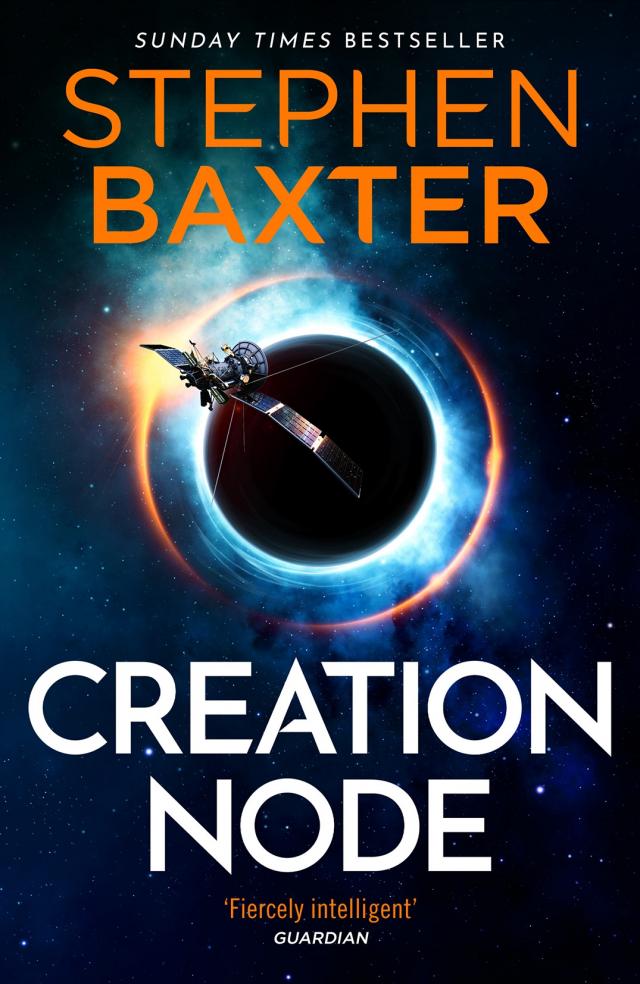


The event horizon was a place where the escape velocity itself was the speed of light. Nothing material could escape, because nothing material could reach lightspeed.
Hild nodded. ‘I’ve seen such images of the Galaxy-centre hole. On a much larger scale. You have a zone called the ergosphere where light itself is dragged aside and pummelled. Beautiful imagery … And these must be the first images taken of such effects around a primordial black hole.’ She smiled. ‘Good work, Salma.’
Salma didn’t smile back. ‘Thanks. But there’s something else.’
Hild studied her. ‘You’re building up to something, aren’t you? I know you. All this is preamble, to something you’re not sure about. Just tell me what you have.’
Salma took a breath. What she was building up to was indeed outrageous, she knew. But it also seemed to be true. And Hild was still smiling, for now.
‘You know that black holes aren’t truly black,’ she began.
‘OK,’ Hild said slowly. ‘Hawking radiation, right?’
‘Yes. I suppose you know the basic mechanism.’
Hild didn’t reply, forcing Salma to plough on.
‘Nothing material can escape a black hole’s event horizon – but there is a catch. In the extreme conditions near the event horizon, the gravity is so intense that some packets of energy can be folded down into short-lived particles—’
‘Energy to mass. Virtual particles, correct?’
‘Correct. A particle and its antimatter opposite. And it can happen that one of that pair will fall into the black hole, while the other escapes. And that is Hawking radiation, stuff escaping from the black hole, as if the gravity field is bleeding energy through its own strength.’
‘OK. And you looked for this radiation, and detected it—’
‘There’s a lot of it, coming out of this hole. The Hawking radiation. More than the theory would suggest – as far as I can check it, understand it.’ She hesitated.
Hild was smart enough to wait for what might follow.
Salma said carefully, ‘And it isn’t just a, a quantum hiss. The Hawking radiation.’
That made Hild stare. ‘What? So if it’s not just a hiss—’
‘Captain, this is why I called you. There’s structure in there. I think. I think there’s a message in the Hawking radiation.’
There. It was out.
She looked at Hild nervously. ‘Does it sound as dumb to you as it does to me?’
Hild opened her mouth, closed it. ‘I – no, it doesn’t sound dumb. Outlandish, but—’ She glared at the viewscreen. ‘You can’t get much more outlandish than where we are already, right?’ She looked again at Salma. ‘Message. You mean structure in the radiation?’
‘Bullshit,’ Boyd broke in, over the comms, without warning. ‘Listening in, here. Can you blame me? Yes, information can be stored in a black hole. When a body collapses down into a hole, the data that characterised that body can be retained, down to a quantum level. In a sense. And the area of the black hole is proportionate to the information it holds. As if it’s covered by tiny quantum-scale tiles, each black or white or … But you can’t get information out of there. Didn’t your buddy Hawking prove that?’
Hild said, ‘But aren’t there theorems that show that information, quantum information, can never be lost, just – moved around?’ She winked at Salma. ‘Anyhow, since when were you a cosmology fan, Boyd?’
‘Since I woke up one day on a mission to nowhere with nothing to read, except textbooks on the black hole I might have been heading for. It was that or the days-late sports results from Earth …
‘Hawking radiation, though. That’s a real phenomenon. You’re right about that, Salma. OK. As you said, at the event horizon you’ll get a bit of energy, of information, that gets stretched by that boundary and transmutes into two particles, one of matter, one of antimatter, one of which falls back into the hole, the other goes flying off. And having lost a bit of energy the black has evaporated, just a little more … But it’s all just random. Any information encoded into that surface, such as the black hole’s history of formation, is lost as the stay-behind particle falls back to the event horizon. You can’t get information out of a black hole. Which has always been a paradox, I grant you, because quantum information isn’t supposed to be destroyed, ever.’
Hild nodded to Salma. Put him right.
Salma plucked up a bit of courage. ‘That’s not quite right, Boyd. There are theorems that show—’
‘Proved in later life by your buddy Hawking, by the way,’ Hild said.
‘That show that the particle pair created at the horizon stay entangled – still linked by quantum mechanics ‒ as one stays behind and the other flies off. And if you can capture that escaped – partner – then, through that entanglement, you can reconstruct the data that had been trapped at the event horizon.’
Boyd hesitated. Then he said, ‘OK. Prove it.’
Hild smiled at Salma. Do it.
Salma tapped a screen. ‘Boyd, look at this plot. This is the leakage radiation coming out of the hole. And you can see there’s structure ‒ there are clearly defined pulses of different but repeated lengths. Sets of those pulses, evenly spaced, with uniform, repeated contents. All incredibly rapid, very compressed, but it’s there. Structure. I haven’t got too far with any analysis of it. Once I thought I saw the Fibonacci sequence—’
Hild laughed out loud. ‘The one where you add up the previous two terms? One. One. Two. Three. Five. Eight … A simple signal. My God. And if this black hole really is a survivor from some older universe, it’s a signal from – someplace else.’ She shook her head. ‘Those old SETI guys must be turning in their graves. They were looking in the wrong place the whole time. Instead of looking for alien signals from out of the stars, they should have been looking at the edge of our own Solar System. Or across the boundaries between universes …’
There was a term in there Salma didn’t know. ‘Sss … eighty?’
‘Never mind.’ Hild drifted out of her chair. ‘Salma, you have already paid off the value of the food you eat – and you eat like a hero. You were right to call me in.’
‘And me,’ Boyd said.
Salma thought she could hear his grin. Boyd pushed you, but he appreciated good work.
Hild went on, ‘We’ll get the whole team on this as soon as. And if you’re right we can start to download all this to the Outpost, and they can start negotiating with the Earthside universities and think tanks, for support with an extended analysis—’
The Outpost, orbiting just inside the heliopause, the physical boundary of the Solar System, was the nearest thing the Conservers had to a fixed base.
Hild chewed her lip, ‘Although I imagine the Outpost will have to negotiate politically. There’s going to be pressure for a wider scrutiny. More ships, proper scholars. Something like this might go as high as President Mason’s office—’
But Salma shook her head. ‘I don’t want to wait for all that.’
Hild frowned. ‘Then what?’
‘Hild—’
‘Captain Hild.’
‘I … I got carried away. Look, I prepared an experiment. I haven’t run it yet, not without your say-so.’
‘What experiment?’
‘I recorded the Hawking stuff. The information. I couldn’t make sense of it, but I thought it was a message, you see. And I thought we could play some of it back. At Nine. You know, bathe it with a laser spot. We can’t produce gravity waves, and we don’t know the meaning of the message, but we could send back the same pattern. Just to see – just to show we understood.’
‘My God,’ Hild said softly.
That was a strange archaism to Salma.
She ploughed on, ‘We can’t – translate – whatever’s coming out of it. But if we echo it back, at least that would show intelligence is out here, wouldn’t it? And we could do more than just reflect the signal back. Make it obvious we are intelligent. We could speed up the signal, chop it around to show it’s not just random reflections. And maybe if there is intelligence in there, it could recognise what we’re doing, and – well, respond?’
‘Respond? How?’
But Salma had thought no further.
After a few more seconds, Hild snapped, ‘Do it.’
‘What?’
Hild grinned. ‘The reply. Of course we should try this. You’re right. We seem to have received an information-rich signal from some … intelligence. Maybe it’s signalling precisely because it can sense the artifice of our ship, our technology. Somehow. Or … I don’t know. Of course we should reply. And you’re right about the timing. A signal exchange with the Outpost would take a lot of hours right now, given our relative positions. And besides, what could the Outpost tell us that we don’t already know? What the hell is there to wait for? Have you got it set up now?’
‘Well, yeah. Are you sure?’
‘Do it. I take full responsibility … No. Wait.’
She took over the comms and gave the rest of the crew a hasty heads-up.
When she was done, she grinned. ‘That is one of the more unusual ship-wide announcements I’ve ever had to make. Probably since you were born yourself, Salma. Nice to keep them on their toes. OK. Set it up.’
Heart pounding, Salma murmured instructions to the ship’s systems.
It took only an hour to set up the reflected signal.
The sending itself was silent, of course, high-frequency radiation bathing the ancient black hole with its faint heat. But Salma could see from her instruments that the transmission was working, in that the laser-delivered signal was indeed a faithful copy of the data delivered by the original Hawking radiation. She made sure the continuing feed from the black hole was being monitored too.
And then—
She took a breath. Two. Waiting to check first that the changes in the readings she saw were more than noise.
‘I think I’m detecting a change … Hardly a signal … I think it’s working!’
Hild made notes. But she seemed distracted, staring out of the window, at the Galaxy-centre light show.
And as Salma watched her displays, she saw an anomaly in the corner of her eye. An odd reading. ‘Something’s happening. The external hull temperature seems to be rising slightly. The ship’s hull …’
Hild pointed at the main screen. ‘Something’s happening? You think?’
She pushed her way out of her chair, floated in the air, grabbed Salma by the collar, and pulled her physically over to the window, to face the star fields.
Not an easy manoeuvre in zero gravity, Salma knew.
‘Look at that.’
‘At what?’
‘Sagittarius. The star clouds. The centre of the Galaxy, damn it! Can’t you see?’
‘I don’t—’
‘Since when did the Galaxy centre have a bright red spot glaring out of it?’
And now Salma did see.
Hild tapped at readouts. ‘It lit up, according to the monitor here, to within a second of you sending that damn signal. We’ll have to tie down the sequence of events … It has the same spectrum as the background Galaxy, just more intense. I’m trying to get a perspective lock. If the red spot is actually somewhere close, light-seconds away, just happening to line up with the Galaxy centre, I should find it quickly—’
She was distracted by more displays.
‘Oh. And we’re detecting a heat rise. Minuscule, but … On the outer hull, I mean. Can that be connected to the red feature? … No, this makes no sense. The Galaxy centre is twenty-five thousand light-years away. If that’s real, if it’s not some artefact of the system—’ More unhappily tapped keys. ‘There can’t be any kind of causal link; the feature would have to be enormously energetic to be detectable from here. And whatever the mechanism, its – ignition – must have happened twenty-five thousand years ago. Given that the light-up we saw coincided with your feedback experiment.’ She checked a screen. ‘Umm, to within a second …’
She ran down.
Boyd called. ‘I hesitate to bring this up. If you’re looking for a connection … If Nine is a primordial black hole, and so maybe a survivor from another universe, so may the Galaxy centre be. It’s another primordial hole, and so maybe another survivor from – someplace else?’
They shared one silent, horrified moment. Wordless.
In a ghastly, speculative way, Salma realised, it all fitted together.
What does this mean? What have we done?
Hild shook her head. ‘No sense. This makes no sense. Keep monitoring. I’ll gather the rest of the crew. And I do need to talk to the Outpost at some point. And the Outpost needs to talk to Earth … I wonder how long it will be before President Mason herself hears about this.’
Salma stared at her displays. ‘Hild. Look at this. I think we’re getting another Hawking signal …’
So it began.
And elsewhere, elsewhen—
Far away across the quantum-froth multiverse – ‘far’ by a definition that would have meant little to most humans – it was as if the softest, most hesitant knock on a door had been made. And that knock was heard.
Later, humans would call him Terminus.
Much of his duty was simply to sit and wait. Wait by a door.
Scattered across every universe, in every bubble in the reality foam, there were what might have been called doors, or lesions, or portals – each a breach of a boundary. Humans might have labelled some black holes, but most were far more sophisticated than those crude ruptures in spacetime. But in a sense, they all worked the same way.
They connected universes.
Terminus did not know how the portals had been created, distributed. That had been done in an unimaginable before. But, he knew, they all had a single purpose. And his job was to wait and watch …
Wait for somebody, on the other side, in one target universe, to find one such portal. To reach out to that portal. To touch it – whatever that meant in terms of their own embodiment.
And after that, for that somebody, everything would change.
Now one such portal had loomed in his awareness. One such touch.
That was all Terminus needed.
To smile was a human reflex. Yet now, it could be said, Terminus smiled.
Meanwhile, elsewhere, the news of the discoveries in the Oort cloud spread across the human worlds.
3
High above Earth, Bheki Molewa, holding his husband’s hand – and waiting for the Presidential Science Adviser to show up – said, ‘Are you crying? Are you kidding me? It’s only Earth out there … You’ve been to much stranger places than this.’
For a moment Jeorg North, peering out of this grand old space elevator’s viewing window – staring out at the brilliance of Earth below – couldn’t reply.
Bheki was right, Jeorg thought. You didn’t need to be a psychiatrist, specialising in the psychological impact of long-duration spaceflight, to understand. Bheki himself was a pilot, and surely sympathised.
Jeorg had been out in deep space many times. Too many? His most famous mission, catching the eye of an introverted terrestrial public, had been piloting a prospecting trip to Ceres, the largest main-belt asteroid – a quasi-legal trip that had been watched carefully by the Lunar Consortium, who wanted to get their hands on the asteroid’s resources themselves. Possibly when and if Earth decided to license the mining of the body, or when the Consortium decided to go ahead anyway.
But as for Jeorg, he had gone out so often, and on such immense journeys, that in the end he had stayed too long in space, had risked his health, his chance of longevity – even his chance of a long marriage to Bhekiokwakhe Molewa, at his side now.
He had done this knowingly. For what exactly? Not the glory alone. Not the science data-collection that had been the object of most of his missions, and he had done well enough with that – evidently enough for the Science Adviser herself to come meet him in person up here, today, bringing, perhaps, a chance to go out once again – though he had no idea where. And she was late, Jeorg reminded himself …
He had done it all for no reason but to fly. To be the first, to Ceres, wherever. That was the reason he couldn’t sit still. Even if Earth drew him back at the same time …
Only Earth. He pressed his hand against the glass, and now Bheki covered Jeorg’s hand with his own, the backs of their two hands dark, the paler palms facing the glowing Earth.
He knew he wasn’t alone in this odd disturbance when he was in the proximity of Earth. Jeorg was only one pilot among many currently flying, but a lot had confessed to similar feelings when gazing at the home planet from space.
From here, suspended at geostationary orbit high over the Pacific Ocean, they saw Earth as a dish of water and cloud, a world ocean broken only by the elevator’s anchoring island far below – the mid-Pacific island itself artificial. But Jeorg had seen for himself how the works of twenty-third-century humankind had spread far out from the old shorelines, with raft cities floating over the drowned wrecks of coastal communities. Beauty and tragedy in a glance. Having given up so much of his life to space – and as many others had found – Jeorg thought it was cruelly paradoxical that returning to Earth always made him want to cry like a baby.
For long moments the two of them were silent, as if they were alone, orbiting the Earth in this enormous structure. You could never shake off the pull of the mother world, no matter how far you travelled.
… It’s only Earth …
A subtle tap on the door.
Science Adviser Elizabeth Vasta was immediately recognisable from her media appearances, though neither Jeorg nor Bheki had met her before. She was a small, compact woman, perhaps in her fifties. Strong-looking.
Jeorg felt relieved at the distraction.
They made brief introductions. Vasta wore a long, dark robe, a sombre black. As far as Jeorg could see, she’d added only one adornment: a simple pendant, a silver cage containing what looked like a pearl – a perfect sphere, also deep black. It seemed an odd choice, given the darkness of her robe. Black on black. A sentimental token, perhaps.