The thousand earths, p.41
The Thousand Earths, page 41


‘And demanding,’ Taiva Lapic said. ‘However, we will give you what you asked for.’
They sat this time in a much more spacious compartment in the Earth-orbiting habitat that hosted them. The floor was a lawn, authentic-looking grass, under a clear-to-invisibility dome. Some kind of craft sat on that scrap of lawn – small, sleek, bright green, it looked like a coffin on a sleigh, he thought gracelessly, or maybe a bobsled. He had no idea what it was.
But for once he was more distracted by the view than by a bit of technology. And what a view.
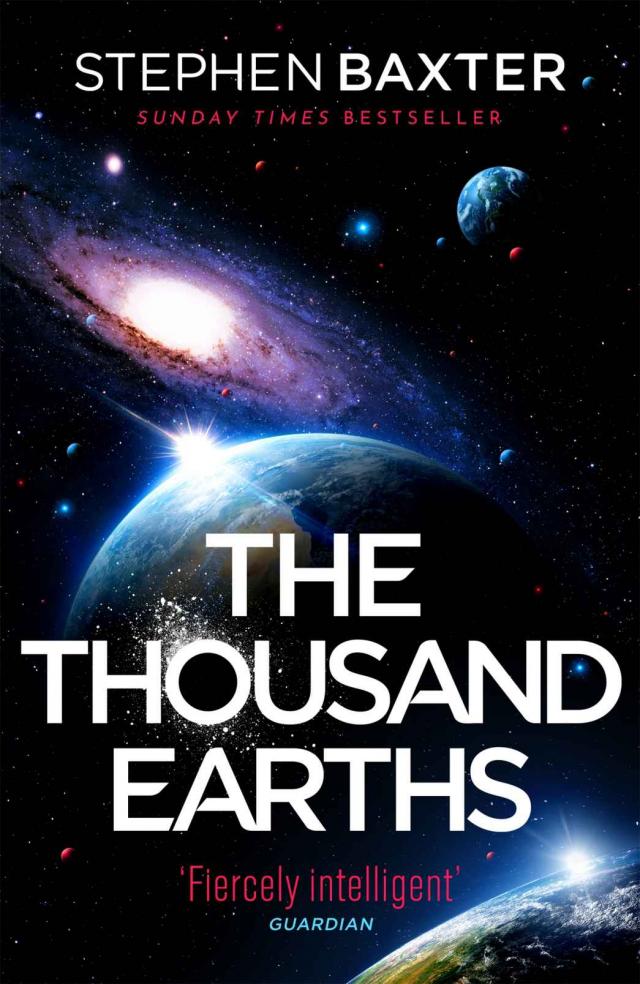
Sitting here, sourceless light bathed them, but did not wash out their view of the cosmic construction yard that filled the space above. A space where an Earth hovered.
John Hackett had seen Earth from orbit – the Earth, on which he had been born, when the Sun was still young and healthy. Now the ‘Earth’ that hung over his head was like a disc-shaped cut-out remnant of that brilliant low-orbit spectacle, framed by a wider disc of Substrate technology, a delicate filigree. The whole, ten thousand kilometres away, all but filled his view. And the island Earth was as bright as the old Earth seen from orbit, bright as a tropical sky.
This must be one of the first functioning Earth-islands to have been manufactured, he mused, and nearly complete. The foundation had been that semi-material sheet of Substrate, topped by a central layer-cake of rock, with atop a sprinkling of water, a dusting of dirt and life – and people – all set under a light cycle that mimicked the day-night spinning of the old Earth itself … It would be this way on all the new Earths, he had learned. Enough light to sustain a biosphere, nothing intense enough to burn you. There was something rich about the texture, much richer than the prototype he had been shown a decade before. It was the wrong geometric shape, but it did look like the surface of Earth to him – a slice of it, peeled off and hung up in space.
All sustained beneath a kind of simulacrum of a sky. No Sun behind it, but blue or cloudy during the days. On a clear night you couldn’t see the stars, because they were all dying.
But you could see the other Earths. Even now he saw some of them, still only a handful under construction, even fewer inhabited so far. But still, there they were, far off, glimmering silver panels with pale blue dots in the very centre. An astonishing sight – a heavens built by humans, with the materials of the Earth. Or anyhow, a construction in progress.
And all of this would last until the universe was a hundred times its already advanced age. It baffled him. It appalled him. It filled him with wonder. He wanted to hide under the covers from it.
And so he had decided to do what he had always done, he supposed.
Which was to travel …
Unable to take his eyes off the view, Hackett let himself be led to a chair. The rest of the group were sitting around a table.
As if reading his mind, Taiva said gently, ‘You always claimed to be a wanderer. How would you like to wander among a thousand such island worlds?’
‘How the hell? Not in my beloved Perseus.’
‘No, no. We’ve been talking it over. Any one of the Thousand Earths might be enough for most people. But you are John Hackett. And so – well, take a look.’
She gestured at the small craft on the lawn, gleaming, its hull a green as brilliant as the smartcrop grass-analogue of the lawn itself. He’d been distracted; he’d forgotten it was even there.
Taiva said, ‘Your Perseus is safe in an orbital museum, for now—’
He had checked, more than once.
‘—safe while you fly off around the Thousand Earths aboard that toy.’
That took a moment to sink in. ‘This is for me?’
Taiva smiled. ‘Go see.’
Hackett felt dazed. He got up from his chair and walked over to the ship.
Taiva followed him.
The craft was maybe the size of a very small car, as he had known them back in the day, during what he thought of as his first life.
The central body was actually more like an enlarged coffin, he thought – a coffin fit for Frankenstein’s monster, though, and that was another reference no other human in the universe would have understood, he suspected. And, he quickly learned from his companions, it was in fact essentially that – or anyhow a coffin upgraded with Substrate technology. He could live in this thing for centuries at a time, even longer, while its flawless engineering preserved his mortal body.
And while he slept, so they told him, he could sail among the Thousand Earths. Landing on one after another, as he chose.
He took a closer look. The green coffin-hull sat on a small tangle of engineering, none of which he recognised. He had had no input into its design. He pointed at the tangle. ‘The drive unit, I’m guessing.’
Taiva nodded. ‘If you can call it that. Look, we knew you would want to travel. So we have given you a ship capable of travelling between the Thousand Earths. As for the drive – you understand that all the islands will be sustained, and bound to each other, by a complex network of fields. Translation: that’s what stops them folding up, or drifting off, or crashing into each other.’
‘Wow,’ Hackett said. ‘Crashing? That would make a hell of a disaster movie.’
‘No meaningful semantic content,’ Taiva said, ‘is all my translation suite can tell me about that remark.’
‘Sorry. I’ll shut up.’
‘A network of fields, then. And that’s what your ship will climb through, how it will propel you. By tapping the structural fields of the wider system. Obviously there are security and safety protocols. You won’t so much pilot it as – make polite requests of it. If the various smart systems are agreeable, the ship will be picked up from the surface of one island – like the one up there – and transported across space to wherever you wish to go – so long as no harm is done to anybody, or any thing.’
‘No stunt flying, then.’
‘No meaningful semantic content again. But I can guess. Look, Hackett, this is serious—’
‘I know. I’m listening. I’m very grateful.’
He reached out and touched the sleek hull, for the very first time.
It seemed to shiver.
‘Oh, wow. Why does it do that?’
‘As a sign that it recognises you. It won’t let anybody else aboard without your permission …’
‘I … This may be the most beautiful thing I’ve ever seen.’ He pointed up at an island Earth. ‘Except maybe for that. You people are quite remarkable, you know.’
‘Thanks,’ Taiva said dryly.
Icsoba stood and walked over to the ship herself. ‘It is beautiful. But is this what you want – all that you want?’
He took her hand. ‘Well, you know me, Icsoba. I’m a traveller. Have been ever since … since I lost my roots on my own old Earth. I travelled far across space, and through time, in my trusty old Perseus.
‘And I figure that it’s meaningless for me to stop now, to stop in any one place … But on the other hand it’s meaningless to travel far. I mean: across the universe. We know there’s nothing out there but brooding stars and drifting galaxies, don’t we? Nothing like us – unless Ssagla’s SETI search came up trumps.’ He gestured at the sky. ‘But, look at this! The sky is going to be full of island worlds, worlds full of people, and when they fail there will be more, and more … Who knows what people will achieve? Who knows what they might become? And who knows what I might be able to contribute? I can share my homespun wisdom with future ages.’
Taiva glanced around at the others. ‘You do know he isn’t kidding.’
‘Damn right I’m not kidding,’ Hackett said. ‘Look, I’m not the only wanderer from the deep past, right? We aren’t unique, surely? We can’t be. Have you ever thought that maybe we relics might serve some evolutionary purpose?’
Icsoba said hesitantly, ‘Yes, actually. I think we – unite. We blaze trails. We go further. We discover. And we stitch the whole human race together as one family. Because we, at least, remember.’ She looked down at her hands, one folded over another. ‘That’s what I think of, when I miss home. At least I remember. And that’s what I will take to these new worlds.’
Hackett reached over and rubbed her back. ‘That’s exactly it, kid. What drives me on too—’
But Rava broke in, disrupting the moment. ‘John Hackett. Give me your ship. You have this new craft. The Perseus. Give her to me.’
That startled him.
‘My Perseus? Why the hell would I do that?’
‘Because she wasn’t built to be a museum piece,’ Rava said. ‘And neither was I – any more than you. I’m a traveller not much detached in time from you, remember. Let me go and explore some more. Let us go. I mean, what’s the alternative, to let her hang there in some orbital museum until her hull plates sublime away?’
He thought that over. ‘Will you take care of her?’
And she considered that. ‘I swear that Perseus will have an honourable death.’
He nodded, curtly, not letting himself think about it any more. But he silently promised himself he would go visit the old tub before he left.
And he stood by the sleek new craft, hesitantly touching it again. As if he was transferring his loyalty from one ship to another, he thought. ‘It doesn’t seem real. Sometimes all of this – my extraordinary life – feels like some strange dream.’
‘Your ship is real enough,’ Icsoba said. ‘Will you call it Perseus II?’
He looked at the compact, bright green craft once more. ‘I was thinking of that, yes. But I think maybe that will just be confusing. Myself and this ship – we’re going to be a unit as long as I survive, aren’t we? So, let’s reflect that.’ He stroked the hull. ‘Myself and my ship.
‘I am Perseus.’
He looked into the inhabited sky. ‘When can I leave? … Oh, but there’s one person I want to try to look up in that Substrate of yours. It’s a long shot but you never know. Been meaning to do this for a trillion years, I guess, so I owe her. Her name was Denise Libby, and we used to be married …’
Mela and John Hackett
The last twenty days c. AD one hundred trillion years
74
Day 20
It was not until the twentieth day, when her father came stumbling out of the Dam’s access door, heading across the crowded ground towards what was left of the young-old township they had come to call New Procyon – not until then did a fragment of hope lodge in Mela’s mind.
Until then, she realised, she had more or less reconciled herself to her own death – and the imminent death of her world, her people, all she had loved and fought for. The story was over.
After all there were just twenty days left for the whole world, or so Vitae the Perseid calculated. And fewer than that for Mela and her people, far from the centre, far from the Heartland Mountains at the middle of the world. Indeed, for her the end could come at any time. So close in, the surges of the Perimeter became less and less predictable.
Why not be reconciled to it? She had lived for forty-two years – probably more time than half the world’s surviving population had enjoyed.
So, this morning of the twentieth day before she died, her chores done, she set out alone for once, and found a place to sit, and just – looked. And the dying world, twenty days out, was putting on a pretty good show.
To the north, the great smooth face of the imperial Dam, no more than a few kilometres away … smooth still, yes.
But even from here she could see the great cracks Vitae had spotted some days ago, cracks that seemed to be spreading, growing, with branches running off across the huge face of the structure.
Of course the Dam would start to crack, Vitae had said, as the land before it crumbled and fell away. The foundations of the Dam must soon be fatally undermined.
‘It will fail within two days,’ Vitae had said to her just yesterday. ‘We may or may not live a little longer than that … We’ll see.’
Meanwhile, to the south, no more than a short walk away, there was the Tide.
Once far away, far to the south – a thousand kilometres away when she had travelled there with her family – now it was here. She could see flashes like lightning – and, in the air, she smelled the ozone tang of lightning too, a strangely active smell. And she heard the hiss and steaming of the River as that great flow poured against the Tide, and its water flashed to vapour.
The Perimeter was here. And all the people left alive in the world, she realised, outside the inner lands of the Empire itself, were crammed into a strip no more than a few kilometres wide, all around the Heartland Mountains and the central imperial terrain.
Yet people lived, here in their last home, in the shacks and lean-tos made from the materials they had dragged up here, even as the Perimeter had marched towards their camps. They moved about, they worked, they made meals. Nearby, Mela saw a man repairing torn trousers that he might never wear again.
Children played.
Earlier, some older kids had organised foot races to and from the Dam. Laughing, playing, fighting. Mela had seen how they cast strange double shadows now, from the light of the sky, and the eerie horizontal glow of the Tide.
But, further in the distance, Mela made out a line of folk, old and young, families together, queuing patiently by a deepshaft – itself no doubt a relic of a long-vanished town. Selta the doctor stood by to soothe any final panic, and Vitae the cleric was there, no doubt murmuring words about the love of Perseus into which these suicides were about to be received.
Mela knew that Selta, no believer, intended to use the deepshaft herself, in a calm moment, before the Tide reached the Dam. Mela felt oddly confused herself as she considered this, this cool, rational plan of one of her closest friends. There was nobody wiser than a doctor.
Mela wondered if she would choose that option herself when the moment came. A question she hadn’t asked herself before. A question everybody faced.
That was when, as she mulled this over, everything changed.
She saw one of the Dam’s access doors open. And emerging from it came Peri, another close ally from all the way back to Procyon, running towards her, with a man, older, slow, in imperial purple, limping after her.
The older man was Tenn, Mela’s father.
Soon she could hear Peri shouting. ‘Mela! You must come! It’s Tabor. Your brother! He’s wrecking everything …!’
Mela stood up. ‘My damn family,’ she muttered.
As she ran, she yelled for Vitae to come over.
She could see the Perseid hesitating before the line of supplicants at the deepshaft. But Selta seemed to reassure him that she would stay. So Vitae came away, and together they hurried over to Peri and Tenn.
By the time they met them, Tenn was bent over, wheezing. Peri, the tough survivor from Procyon, now looking stern and smart in her imperial-purple Household Guard uniform, stood by him, supporting him.
Vitae, gasping for breath himself, bent over and rubbed Tenn’s back. ‘Oh, my. Oh, my word. Are you all right? Perhaps we should fetch Selta—’
‘Leave your doctor be.’ Tenn said, standing straight with an effort. He was still wheezing, ghastly pale. He turned to his daughter. ‘Mela. You must come.’
She took his hands. His whole body shuddered as he dragged in deep breaths; his palms were clammy. She said, ‘If the world wasn’t about to end I’d recommend you go back to bed.’
He eyed her sideways, with a glint of his old humour showing through the exhaustion. ‘No more jokes,’ he said. ‘You must come and help.’
Peri nodded. ‘There’s fighting in the palace. Oh, they have been fighting for weeks – a last chance for coups and counter-coups, allies and enemies of the child-Empress squabbling like children themselves, even as the world crumbles around us.’
‘But it’s your brother, Mela,’ Tenn said. ‘Your brother. He’s the real troublemaker. Discipline is breaking down in the Household Guard, just as everywhere else across this benighted world. Tabor would never have become an officer, but he’s senior in the other ranks – and he has gathered quite a following. He always was a thug among thugs. Like a gang leader perhaps … And now is his moment, now he makes his move, in all this … chaos.’
Mela said, ‘What does he want, to rebel? To become Emperor for half an hour himself? Why not let him? What difference does it make?’
‘No,’ Tenn said. ‘Not that. It’s all much smaller scale than that. He means to destroy something far more important than a mere empire. Just because he believes he can, I think. Or, perhaps steal it for himself. Vitae understands.’
The priest nodded grimly. ‘There have been rumours spread by Perseid sympathisers about this. He may do great harm, Mela.’
‘Come on,’ Peri said now. ‘All of you. We have to go, now.’ She grabbed Tenn’s arm, and nodded to Mela. ‘Help me with your father.’
Mela, bewildered, did as she was told.
With Mela on one side of Tenn, Peri on the other, soon they were half-jogging back towards the small doorway in the face of the Dam which, Mela saw, Peri had left open.
She glanced back at Vitae. The priest was already struggling to keep up.
‘Just go,’ he called. ‘Don’t mind me …’
‘No. We need him,’ Tenn called between gasps. ‘We need a Perseid.’
‘Why?’ Mela demanded. ‘What is my brother trying to do?’
Peri said, ‘You know he despises the Perseids. Nobody knows why—’
Tenn grunted as he stumbled along, ‘It’s because he always despised me, his father. When he got to Sirius he took to the imperial purple, Starrist purple, as if born to it. The Starrists believe humanity means nothing to the cosmos, that our lives are no more than games to be played out. And for a Starrist, in this final hour, what better game than to destroy the hopes of all those who dream of Perseus? For Tibor, what better than to smash the hopes of his own father? The most destructive thing he can think of. What better than to steal the chance of a life beyond the coming of the Tide? That’s how he wants to mark the end of the world – and there’s a twisted calculation that there is the faintest chance of saving his own wretched life, or so he believes. Oh, but the damage he might do in the process – if the legends of the Perseid’s tomb hold any truth – oh, it’s all my fault. Mine and your mother’s, Mela. How we have failed him! How we have failed the whole world!’
They sat this time in a much more spacious compartment in the Earth-orbiting habitat that hosted them. The floor was a lawn, authentic-looking grass, under a clear-to-invisibility dome. Some kind of craft sat on that scrap of lawn – small, sleek, bright green, it looked like a coffin on a sleigh, he thought gracelessly, or maybe a bobsled. He had no idea what it was.
But for once he was more distracted by the view than by a bit of technology. And what a view.
Sitting here, sourceless light bathed them, but did not wash out their view of the cosmic construction yard that filled the space above. A space where an Earth hovered.
John Hackett had seen Earth from orbit – the Earth, on which he had been born, when the Sun was still young and healthy. Now the ‘Earth’ that hung over his head was like a disc-shaped cut-out remnant of that brilliant low-orbit spectacle, framed by a wider disc of Substrate technology, a delicate filigree. The whole, ten thousand kilometres away, all but filled his view. And the island Earth was as bright as the old Earth seen from orbit, bright as a tropical sky.
This must be one of the first functioning Earth-islands to have been manufactured, he mused, and nearly complete. The foundation had been that semi-material sheet of Substrate, topped by a central layer-cake of rock, with atop a sprinkling of water, a dusting of dirt and life – and people – all set under a light cycle that mimicked the day-night spinning of the old Earth itself … It would be this way on all the new Earths, he had learned. Enough light to sustain a biosphere, nothing intense enough to burn you. There was something rich about the texture, much richer than the prototype he had been shown a decade before. It was the wrong geometric shape, but it did look like the surface of Earth to him – a slice of it, peeled off and hung up in space.
All sustained beneath a kind of simulacrum of a sky. No Sun behind it, but blue or cloudy during the days. On a clear night you couldn’t see the stars, because they were all dying.
But you could see the other Earths. Even now he saw some of them, still only a handful under construction, even fewer inhabited so far. But still, there they were, far off, glimmering silver panels with pale blue dots in the very centre. An astonishing sight – a heavens built by humans, with the materials of the Earth. Or anyhow, a construction in progress.
And all of this would last until the universe was a hundred times its already advanced age. It baffled him. It appalled him. It filled him with wonder. He wanted to hide under the covers from it.
And so he had decided to do what he had always done, he supposed.
Which was to travel …
Unable to take his eyes off the view, Hackett let himself be led to a chair. The rest of the group were sitting around a table.
As if reading his mind, Taiva said gently, ‘You always claimed to be a wanderer. How would you like to wander among a thousand such island worlds?’
‘How the hell? Not in my beloved Perseus.’
‘No, no. We’ve been talking it over. Any one of the Thousand Earths might be enough for most people. But you are John Hackett. And so – well, take a look.’
She gestured at the small craft on the lawn, gleaming, its hull a green as brilliant as the smartcrop grass-analogue of the lawn itself. He’d been distracted; he’d forgotten it was even there.
Taiva said, ‘Your Perseus is safe in an orbital museum, for now—’
He had checked, more than once.
‘—safe while you fly off around the Thousand Earths aboard that toy.’
That took a moment to sink in. ‘This is for me?’
Taiva smiled. ‘Go see.’
Hackett felt dazed. He got up from his chair and walked over to the ship.
Taiva followed him.
The craft was maybe the size of a very small car, as he had known them back in the day, during what he thought of as his first life.
The central body was actually more like an enlarged coffin, he thought – a coffin fit for Frankenstein’s monster, though, and that was another reference no other human in the universe would have understood, he suspected. And, he quickly learned from his companions, it was in fact essentially that – or anyhow a coffin upgraded with Substrate technology. He could live in this thing for centuries at a time, even longer, while its flawless engineering preserved his mortal body.
And while he slept, so they told him, he could sail among the Thousand Earths. Landing on one after another, as he chose.
He took a closer look. The green coffin-hull sat on a small tangle of engineering, none of which he recognised. He had had no input into its design. He pointed at the tangle. ‘The drive unit, I’m guessing.’
Taiva nodded. ‘If you can call it that. Look, we knew you would want to travel. So we have given you a ship capable of travelling between the Thousand Earths. As for the drive – you understand that all the islands will be sustained, and bound to each other, by a complex network of fields. Translation: that’s what stops them folding up, or drifting off, or crashing into each other.’
‘Wow,’ Hackett said. ‘Crashing? That would make a hell of a disaster movie.’
‘No meaningful semantic content,’ Taiva said, ‘is all my translation suite can tell me about that remark.’
‘Sorry. I’ll shut up.’
‘A network of fields, then. And that’s what your ship will climb through, how it will propel you. By tapping the structural fields of the wider system. Obviously there are security and safety protocols. You won’t so much pilot it as – make polite requests of it. If the various smart systems are agreeable, the ship will be picked up from the surface of one island – like the one up there – and transported across space to wherever you wish to go – so long as no harm is done to anybody, or any thing.’
‘No stunt flying, then.’
‘No meaningful semantic content again. But I can guess. Look, Hackett, this is serious—’
‘I know. I’m listening. I’m very grateful.’
He reached out and touched the sleek hull, for the very first time.
It seemed to shiver.
‘Oh, wow. Why does it do that?’
‘As a sign that it recognises you. It won’t let anybody else aboard without your permission …’
‘I … This may be the most beautiful thing I’ve ever seen.’ He pointed up at an island Earth. ‘Except maybe for that. You people are quite remarkable, you know.’
‘Thanks,’ Taiva said dryly.
Icsoba stood and walked over to the ship herself. ‘It is beautiful. But is this what you want – all that you want?’
He took her hand. ‘Well, you know me, Icsoba. I’m a traveller. Have been ever since … since I lost my roots on my own old Earth. I travelled far across space, and through time, in my trusty old Perseus.
‘And I figure that it’s meaningless for me to stop now, to stop in any one place … But on the other hand it’s meaningless to travel far. I mean: across the universe. We know there’s nothing out there but brooding stars and drifting galaxies, don’t we? Nothing like us – unless Ssagla’s SETI search came up trumps.’ He gestured at the sky. ‘But, look at this! The sky is going to be full of island worlds, worlds full of people, and when they fail there will be more, and more … Who knows what people will achieve? Who knows what they might become? And who knows what I might be able to contribute? I can share my homespun wisdom with future ages.’
Taiva glanced around at the others. ‘You do know he isn’t kidding.’
‘Damn right I’m not kidding,’ Hackett said. ‘Look, I’m not the only wanderer from the deep past, right? We aren’t unique, surely? We can’t be. Have you ever thought that maybe we relics might serve some evolutionary purpose?’
Icsoba said hesitantly, ‘Yes, actually. I think we – unite. We blaze trails. We go further. We discover. And we stitch the whole human race together as one family. Because we, at least, remember.’ She looked down at her hands, one folded over another. ‘That’s what I think of, when I miss home. At least I remember. And that’s what I will take to these new worlds.’
Hackett reached over and rubbed her back. ‘That’s exactly it, kid. What drives me on too—’
But Rava broke in, disrupting the moment. ‘John Hackett. Give me your ship. You have this new craft. The Perseus. Give her to me.’
That startled him.
‘My Perseus? Why the hell would I do that?’
‘Because she wasn’t built to be a museum piece,’ Rava said. ‘And neither was I – any more than you. I’m a traveller not much detached in time from you, remember. Let me go and explore some more. Let us go. I mean, what’s the alternative, to let her hang there in some orbital museum until her hull plates sublime away?’
He thought that over. ‘Will you take care of her?’
And she considered that. ‘I swear that Perseus will have an honourable death.’
He nodded, curtly, not letting himself think about it any more. But he silently promised himself he would go visit the old tub before he left.
And he stood by the sleek new craft, hesitantly touching it again. As if he was transferring his loyalty from one ship to another, he thought. ‘It doesn’t seem real. Sometimes all of this – my extraordinary life – feels like some strange dream.’
‘Your ship is real enough,’ Icsoba said. ‘Will you call it Perseus II?’
He looked at the compact, bright green craft once more. ‘I was thinking of that, yes. But I think maybe that will just be confusing. Myself and this ship – we’re going to be a unit as long as I survive, aren’t we? So, let’s reflect that.’ He stroked the hull. ‘Myself and my ship.
‘I am Perseus.’
He looked into the inhabited sky. ‘When can I leave? … Oh, but there’s one person I want to try to look up in that Substrate of yours. It’s a long shot but you never know. Been meaning to do this for a trillion years, I guess, so I owe her. Her name was Denise Libby, and we used to be married …’
Mela and John Hackett
The last twenty days c. AD one hundred trillion years
74
Day 20
It was not until the twentieth day, when her father came stumbling out of the Dam’s access door, heading across the crowded ground towards what was left of the young-old township they had come to call New Procyon – not until then did a fragment of hope lodge in Mela’s mind.
Until then, she realised, she had more or less reconciled herself to her own death – and the imminent death of her world, her people, all she had loved and fought for. The story was over.
After all there were just twenty days left for the whole world, or so Vitae the Perseid calculated. And fewer than that for Mela and her people, far from the centre, far from the Heartland Mountains at the middle of the world. Indeed, for her the end could come at any time. So close in, the surges of the Perimeter became less and less predictable.
Why not be reconciled to it? She had lived for forty-two years – probably more time than half the world’s surviving population had enjoyed.
So, this morning of the twentieth day before she died, her chores done, she set out alone for once, and found a place to sit, and just – looked. And the dying world, twenty days out, was putting on a pretty good show.
To the north, the great smooth face of the imperial Dam, no more than a few kilometres away … smooth still, yes.
But even from here she could see the great cracks Vitae had spotted some days ago, cracks that seemed to be spreading, growing, with branches running off across the huge face of the structure.
Of course the Dam would start to crack, Vitae had said, as the land before it crumbled and fell away. The foundations of the Dam must soon be fatally undermined.
‘It will fail within two days,’ Vitae had said to her just yesterday. ‘We may or may not live a little longer than that … We’ll see.’
Meanwhile, to the south, no more than a short walk away, there was the Tide.
Once far away, far to the south – a thousand kilometres away when she had travelled there with her family – now it was here. She could see flashes like lightning – and, in the air, she smelled the ozone tang of lightning too, a strangely active smell. And she heard the hiss and steaming of the River as that great flow poured against the Tide, and its water flashed to vapour.
The Perimeter was here. And all the people left alive in the world, she realised, outside the inner lands of the Empire itself, were crammed into a strip no more than a few kilometres wide, all around the Heartland Mountains and the central imperial terrain.
Yet people lived, here in their last home, in the shacks and lean-tos made from the materials they had dragged up here, even as the Perimeter had marched towards their camps. They moved about, they worked, they made meals. Nearby, Mela saw a man repairing torn trousers that he might never wear again.
Children played.
Earlier, some older kids had organised foot races to and from the Dam. Laughing, playing, fighting. Mela had seen how they cast strange double shadows now, from the light of the sky, and the eerie horizontal glow of the Tide.
But, further in the distance, Mela made out a line of folk, old and young, families together, queuing patiently by a deepshaft – itself no doubt a relic of a long-vanished town. Selta the doctor stood by to soothe any final panic, and Vitae the cleric was there, no doubt murmuring words about the love of Perseus into which these suicides were about to be received.
Mela knew that Selta, no believer, intended to use the deepshaft herself, in a calm moment, before the Tide reached the Dam. Mela felt oddly confused herself as she considered this, this cool, rational plan of one of her closest friends. There was nobody wiser than a doctor.
Mela wondered if she would choose that option herself when the moment came. A question she hadn’t asked herself before. A question everybody faced.
That was when, as she mulled this over, everything changed.
She saw one of the Dam’s access doors open. And emerging from it came Peri, another close ally from all the way back to Procyon, running towards her, with a man, older, slow, in imperial purple, limping after her.
The older man was Tenn, Mela’s father.
Soon she could hear Peri shouting. ‘Mela! You must come! It’s Tabor. Your brother! He’s wrecking everything …!’
Mela stood up. ‘My damn family,’ she muttered.
As she ran, she yelled for Vitae to come over.
She could see the Perseid hesitating before the line of supplicants at the deepshaft. But Selta seemed to reassure him that she would stay. So Vitae came away, and together they hurried over to Peri and Tenn.
By the time they met them, Tenn was bent over, wheezing. Peri, the tough survivor from Procyon, now looking stern and smart in her imperial-purple Household Guard uniform, stood by him, supporting him.
Vitae, gasping for breath himself, bent over and rubbed Tenn’s back. ‘Oh, my. Oh, my word. Are you all right? Perhaps we should fetch Selta—’
‘Leave your doctor be.’ Tenn said, standing straight with an effort. He was still wheezing, ghastly pale. He turned to his daughter. ‘Mela. You must come.’
She took his hands. His whole body shuddered as he dragged in deep breaths; his palms were clammy. She said, ‘If the world wasn’t about to end I’d recommend you go back to bed.’
He eyed her sideways, with a glint of his old humour showing through the exhaustion. ‘No more jokes,’ he said. ‘You must come and help.’
Peri nodded. ‘There’s fighting in the palace. Oh, they have been fighting for weeks – a last chance for coups and counter-coups, allies and enemies of the child-Empress squabbling like children themselves, even as the world crumbles around us.’
‘But it’s your brother, Mela,’ Tenn said. ‘Your brother. He’s the real troublemaker. Discipline is breaking down in the Household Guard, just as everywhere else across this benighted world. Tabor would never have become an officer, but he’s senior in the other ranks – and he has gathered quite a following. He always was a thug among thugs. Like a gang leader perhaps … And now is his moment, now he makes his move, in all this … chaos.’
Mela said, ‘What does he want, to rebel? To become Emperor for half an hour himself? Why not let him? What difference does it make?’
‘No,’ Tenn said. ‘Not that. It’s all much smaller scale than that. He means to destroy something far more important than a mere empire. Just because he believes he can, I think. Or, perhaps steal it for himself. Vitae understands.’
The priest nodded grimly. ‘There have been rumours spread by Perseid sympathisers about this. He may do great harm, Mela.’
‘Come on,’ Peri said now. ‘All of you. We have to go, now.’ She grabbed Tenn’s arm, and nodded to Mela. ‘Help me with your father.’
Mela, bewildered, did as she was told.
With Mela on one side of Tenn, Peri on the other, soon they were half-jogging back towards the small doorway in the face of the Dam which, Mela saw, Peri had left open.
She glanced back at Vitae. The priest was already struggling to keep up.
‘Just go,’ he called. ‘Don’t mind me …’
‘No. We need him,’ Tenn called between gasps. ‘We need a Perseid.’
‘Why?’ Mela demanded. ‘What is my brother trying to do?’
Peri said, ‘You know he despises the Perseids. Nobody knows why—’
Tenn grunted as he stumbled along, ‘It’s because he always despised me, his father. When he got to Sirius he took to the imperial purple, Starrist purple, as if born to it. The Starrists believe humanity means nothing to the cosmos, that our lives are no more than games to be played out. And for a Starrist, in this final hour, what better game than to destroy the hopes of all those who dream of Perseus? For Tibor, what better than to smash the hopes of his own father? The most destructive thing he can think of. What better than to steal the chance of a life beyond the coming of the Tide? That’s how he wants to mark the end of the world – and there’s a twisted calculation that there is the faintest chance of saving his own wretched life, or so he believes. Oh, but the damage he might do in the process – if the legends of the Perseid’s tomb hold any truth – oh, it’s all my fault. Mine and your mother’s, Mela. How we have failed him! How we have failed the whole world!’