

Tqf18 qxd, p.1
Traitor Comet, page 1
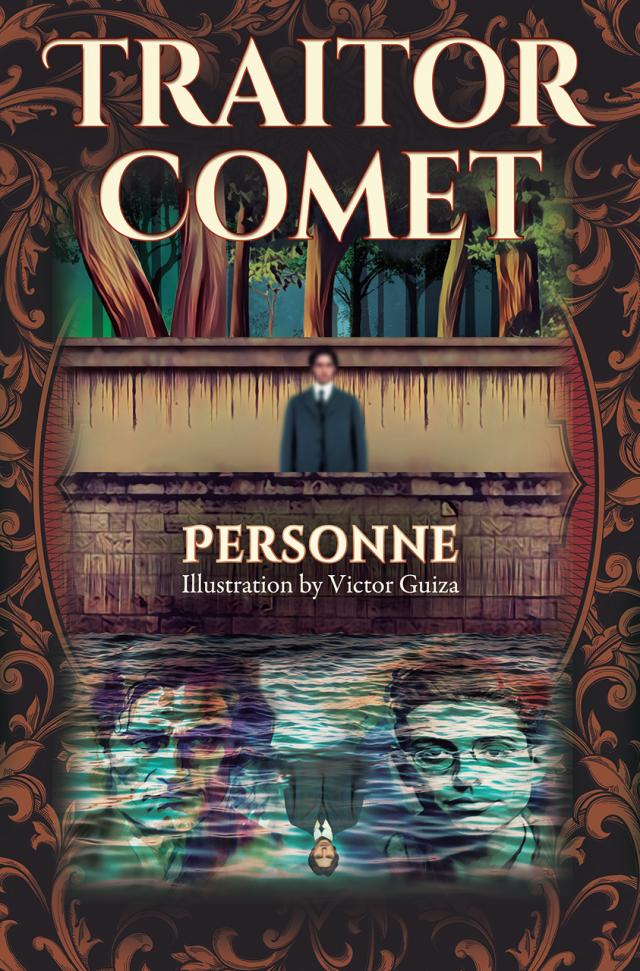


Traitor Comet
All Rights Reserved.
Copyright © 2023 Personne
v4.0
This is a work of fiction. The events and characters described herein are imaginary and are not intended to refer to specific places or living persons. The opinions expressed in this manuscript are solely the opinions of the author and do not represent the opinions or thoughts of the publisher. The author has represented and warranted full ownership and/or legal right to publish all the materials in this book.
This book may not be reproduced, transmitted, or stored in whole or in part by any means, including graphic, electronic, or mechanical without the express written consent of the publisher except in the case of brief quotations embodied in critical articles and reviews.
Outskirts Press, Inc.
http://www.outskirtspress.com
Illustrations by Victor Guiza © 2023 Personne
Outskirts Press and the “OP” logo are trademarks belonging to Outskirts Press, Inc.
PRINTED IN THE UNITED STATES OF AMERICA
To the freethinkers
TABLE OF CONTENTS
PART ONE
CHAPTER 1
CHAPTER 2
CHAPTER 3
CHAPTER 4
CHAPTER 5
CHAPTER 6
CHAPTER 7
PART TWO
CHAPTER 8
CHAPTER 9
CHAPTER 10
CHAPTER 11
CHAPTER 12
CHAPTER 13
CHAPTER 14
CHAPTER 15
CHAPTER 16
This novel series is a work of fiction, based on real events. Characters have been created and events conflated to highlight certain conflicts, but Artaud’s and Desnos’s lives are followed as accurately as possible.
PART ONE
CHAPTER 1
In my unconsciousness it is always other people that I hear.
—Antonin Artaud
May 1926
I STARED DOWN at my body.
Standing naked and barefoot on that cold wooden floor, I gripped the curtain that hung around my bedstead and looked at it, the body. The clock on the wall clicked its weighted chains and chimed, making me start. Stupidly I blinked, but the grotesque body on the bed remained undeniably real.
I heard a sound behind me at the door, and I whirled in terror—as if caught in a crime—and at the back of my churning mind I hoped a neighbor had come, Helmut. I opened my mouth but could not call out to him, my nearest neighbor, Helmut Heumer, my friend. A sudden force of wind nudged the door inward with a creak. A beam of light through that crack fell upon the eye of the thing on the bed. It stared into eternity, and I stared at it. Then, steeling myself, I bent down to examine the face that had hardened.
For the first time in my life what I saw was not the rippling distortion in pond water or the image in a glass, and nor was this the normal, faceless experience of self, with the peripheral locks of hair and eyelashes and nose tip extending from one’s unseen center. What I saw was me, what had to be me. It—I—was sprawled, as if having fallen back. The black hair was matted and filthy, the blue eyes clouded and staring. My stomach felt filled with both ice and hot acid, sickened as I was by the sight of the decay, this greying flesh, the body giving up its liquids, its smells. My heart which should have been inside that chest was beating furiously within mine.
Finally I turned from it. I staggered and found myself gripping my small writing table. Now I looked down at my familiar scrawl across pages written just last night. My emphatic, exultant arguments were nonsense, the result of a long illness, vanity, and a loneliness as deep as disease. The stub candle had burnt itself out, its wick a small dead twig in a puddle of white wax like the twig of a man over there, lying in his dank sheets.
I was dead. I was dead! Numbly I turned around, glaring at my possessions as if to catch them in a lie, accusing this small, single-roomed cottage that had never before betrayed me as people had. Everything looked the same: the table, my manuscript and the ink bottle, the stool pushed back and overturned last night in my haste to vomit, the dishes encrusted and abandoned near the fireplace. The door was the only source of light, and I crossed the floor to nudge it open wider.
The sun rose, dispersing the clouds. A bird landed on a nearby branch, sat swaying on it for a moment, then flew off. I was not disembodied—I could feel my hands, the cold floor beneath my feet, my dry mouth. The surge of my heart in my ears was as clear as footfalls. I had woken up naked on the bare wooden floor like the drunkard I used to be. But why would I be naked when the body on the bed was still clothed in my shirt and overalls unless my soul had shed him like a proper coat? I was dead.
I waited, looking around at my tiny house which seemed to be waiting for me to awaken, to rise from the bed, to light a fire in the fireplace and fill the air with steam and stamp my feet across the floor as usual. I let out a small breath, almost a moan. What now? Would this worldly apparition fall from view as one drew aside a curtain, to reveal…death itself? God Himself?
I stood and trembled, and I imagined each tick of the clock as a figure passing by me in a strange, silent procession of faceless men. Tomorrow, and tomorrow, and tomorrow… Naked and alert I waited, not daring to move for fear that would be the moment God would descend, but impatience gnawed at me. Beyond my door the sun pierced the branches. Insects buzzed around the body on the bed and the breeze blew warmer, stirring the dust at my feet and the hair on my neck.
Again I looked back at myself. My hands were my hands, having their familiar lines but they were soft and uncalloused, the skin as satin as a newborn’s. Now I traced my fingers along the rosy, perfect envelope of my skin. Moles, freckles, they were there, but no sunburn and no war scars in my thigh. No scars.
I pulled the door open and walked outside to stand on the rough path. The ground was dewy and as rocky as I remembered it. Was this the New Earth—Armageddon, Christ’s Return, hallelujah and amen? Uncertainty knotted my stomach as I tried to feel enthusiastic. I would have thought the world would have ended during the Great War, not overnight almost a decade after the Armistice.
“If Christ has indeed returned,” I said aloud, mostly to hear my own voice, “then nothing can harm me—’And the lion shall lie down with the Lamb.’” The words suddenly sounded ridiculous, like the patriotic slogans my platoon had recited as we charged into battle. My voice was my voice, but thin from nervousness. Realizing I was afraid frightened me all the more.
You blasphemous fool! I fell to my knees and “Dammit,” was my prayer as I wobbled to my feet again, holding my knee. It bled; I’d knelt on a sharp stone. I wiped at the cut and slapped at the insects that were already attacking. Reluctantly I went back inside for clothes. My skin chafed against the stiff, heavy garments.
Once dressed I felt better, so I set about tidying the place. I turned the stool upright and set the dirty dishes in a pan of cold water. I swept the pine boards with that leaking broom which dropped a trail of straws to the door. Then, standing again at the bed, I took a moment to steel myself.
I grasped the thing beneath its shoulders and strained to drag it. The body had to be buried, and quickly. Many times I had seen a corpse, but only once had I lingered near someone long dead, and I was not prepared for this bloated, rigid husk. It was incredibly heavy, and nothing could have prepared me for the full onslaught of stinking flesh, the urine, the bile. From the sheen on the skin and the stiffness it had probably been dead around ten hours but that was only a guess.
I pulled it with the sheet and managed at last to drag the body outside and far from the house, past my plowed field. Then I went to the barn for a shovel. My farm was a clearing surrounded by forest, and among those trees anyone could be watching, so I passed my sleeve across my forehead and quickly stepped onto the shovel’s blade, driving it into the dirt. Furiously I dug. Soon enough I hit rock, as I had my first planting season and every season after that. The grave would have to be a shallow one, as my furrows in this rocky land were shallow and still largely unproductive.
As I was tipping the body into the hole I noticed marks below the left ear, and I caught the thing by its shoulder to stop it as it fell. Kneeling in the dirt, I pulled back the grimy hair to see the marks up close. They formed a circle of six small welts, standing out scarlet against the chalky skin beneath the ear.
I sat up abruptly, my eyes automatically scanning my small farm although no one else was in sight. The welts! Until recently I had not believed the tales. My hand flew to my neck. I felt carefully under each ear, but my skin was smooth. Welts were rising instead on my palms, blistering so quickly in this skin, not the skin of the man who had worked this land and lived on this farm, but the skin of an infant.
“Oh, Heavenly Savior,” I moaned, “who am I? What am I…?”
Shaking, I looked up. The sky in its cloudless blue seemed empty to me, abandoned. I looked up into that sky and felt as if I fell upward into a void. My body could be injured, and time still passed. Here I was on an ordinary weeding day planting this… this thing between my crops and the forest. I saw my old wounds on this body, the scars marked on that thing in the grave, the work-roughened hands, the scars on the arms and on its right thigh that I should have had, scars that until this morning I did have. Here I was and I was still me, but there in the grave was me, Geoffrey Wilhelm Weidmann.
“God!” I shouted and leaped away from the hole. I ran in crazy circles, gasping, my fingers tearing at my arms until I forced them to stop. I staggered toward the
“Yes, I’ll run,” I decided aloud. Soon the villagers would come for me too, my so-called neighbors in Spital who were being driven to near-hysteria by these rumors of the circle of welts. They would descend on me, waving sticks and tools and throwing stones just as they had done to that unfortunate man, that hapless, wizened vagrant who had awakened one morning to find a scarred and dead double lying at his side in the grass.
My flesh crawled and something made me look down. I leaned a fist against the tree’s trunk and stared at that blackened space before me in the long grass. Yes, the stories were true. First the crater, and then the welts; I had seen that for myself, but one of those parasites had attached itself to me last night while I lay helpless, and the dead double was the proof. Let him rot. I would leave now, saddle my horse Gelb and ride.
Yet a severe voice rose above the cacophony of my dread. Calm yourself, it said, and think. If I buried this body, soon enough weeds would cover the grave as they covered my field each year despite my best efforts. I rarely had visitors. If I let the sun touch my skin my healthy, bronzed appearance would return, and then I’d make a trip into town and speak pleasantly to everyone as before. Who would ever know? sang that voice of purpose.
Calmer now, I ignored the pain in my feet and started back to the grave to pick up the shovel. The patter of hooves made me stop. Beyond my house in the trees I saw movement, following the path—a horse and rider. Damn!
I crossed my plowed field again and ducked into my barn. I opened Gelb’s stall and grabbed her bridle off its hook, but the horse shied from me. “Sssh, Gelb,” I hissed, startled at my sudden, inexplicable fear of the animal. She pawed the straw on the floor with her foot, her eyes wide, her nostrils flaring. With a whinny she bucked in her stall.
“Easy. Easy, Gelb,” I said. The words sounded tense, not reassuring. I started for her again, and gentle Gelb laid back her ears and snapped her teeth at me.
The hooves on the path pounded louder and stopped nearby. Searching for excuses, I went back outside to see a lone horse tethered next to my house. My fist clenched automatically, and I walked quickly to stand in the doorway. He was just settling his huge girth on my rough-hewn stool. Beside him sat a large bag—another bribe, a sack of food, I was sure. As I watched, his incredulous gaze swept the room that, despite its dishevelment, was nearly bare except for the table and the bed and a few shelves.
“I sent you provisions,” he scolded me. “What did you do with them? Sell them, like last time? To buy the seed you fail to grow?”
“Get out.”
“Don’t you even have a ‘hello’ for your father?”
I swallowed a dry lump in my throat. “Don’t misunderstand me. It’s not safe for you here. A swarm of parasites threatens the area. There is a pestilence.”
My father threw back his head and laughed. “So you are concerned for me?”
I made what must have seemed a desperate gesture, for he sobered then. “The village is indeed full of wild stories, Geoff,” he said. “Creatures falling from the sky, a plague of welts, sudden doubling of cattle and of people… Insane talk. I could hardly make sense of it—when people speak at all. Most of your neighbors are as tight-lipped as ever. Nothing changes around here.” He waved a hand at me. “It was a meteor shower and Spital’s so-called plague is ignorance.”
I brushed past him and quickly surveyed the room. I felt my father’s blue eyes pierce me as I looked up the fireplace flue. Nothing. His question was lost to me as I stood in confusion, turning around and around to survey the barren room.
“Ignore the stories if you will—I did at first,” I told him, “but I have seen one of these creatures. I thought it harmless.” Suddenly I imagined two of him, two fathers doing battle with each other, instead of him always battling with me.
“Nonsense!” he snorted. “Meteorites don’t live.” When my father’s gaze fell to the broken crockery on the floor and traveled toward the bed with its missing sheet, I knelt and hurriedly picked up the pieces. “You just don’t want me here, Geoffrey.”
“No, I don’t. Isn’t that plain enough?” I dropped the pieces in the far corner and stood up.
My father grimaced and leaned an elbow on the table, regarding me. My God, he’d gained weight since I last saw him—and that was two years ago—but he had not lost his hair. Though now white, it was still as thick as mine. And no matter how old my father became he remained agile and strong enough for me to remember to choose my words carefully. I’d never been as powerful as he was and even now he could best me, especially in my weakened state.
“You didn’t answer my question,” he said. “Will you marry again?” I blinked at him, bewildered. He pressed, “A girl here—if you can find one in Spital? Would I even know it if you did?”
I muttered, “Marry again—are you serious?” Suddenly I felt tired. I turned to the bed. “Help me flip this straw-tick.”
“Or perhaps you’ll take off, just disappear,” my father continued to goad me, leaning forward. “God knows how I’d ever find you then.”
On second thought I did not want his help and I pulled out the lumpy mattress alone. I glared at him over my shoulder. He watched me struggle to flip the straw-tick. After it fell back into place on the rough bed frame, I found a clean sheet, shook it out and threw it down, and sat on the mattress to remove my boots. With another glare at him I stuck my feet under the blanket to hide their blisters and leaned back against the wall, suppressing a shudder. My father pushed his thick white hair back with his hand. I saw he still wore his wedding band from his marriage to my mother. Still.
I couldn’t look at him then, but he pressed on. “Perhaps you’re planning to leave, perhaps with Helmut Heumer or another neighbor. How would I know? You don’t write me, so I had to come here. I’ll do anything to prevent you completely disappearing from my life.”
I murmured, “When you came in, did you disturb anything? Did you happen to notice a sort of starfish—?”
“Answer my question, dammit!” he roared, pushing himself off the stool to tower over me. He reached me in two long strides and flung a finger beneath my nose. “If you cannot live with me or answer my letters, then speak. I gave you this land and allow you to use it. Show me the respect I am due for raising you in my house.”
“You’re in my house now,” I retorted mildly, surprised at my composure. Any other time we would have been already nose to nose and screaming. “Show me some respect.”
“Your house,” he sneered. “Who do you think you are?”
In place of his face I saw the face of the dead man in this bed. No matter what, I would never forget the sight of that face. It didn’t look how I imagined myself to look. My gaze drifted out the door. The grave was not visible from here, yet I saw that face, that stiff, unfamiliar and familiar face in death with those strange welts on his neck.
Suddenly, I started to laugh. Dry, hissing laughter convulsed me, laughter that seemed to shake a knot of tension from my chest as if I were vomiting. I burst out, “Why can’t you leave things alone? You can’t fight me if I don’t fight you. No matter what, you’re ashamed of me—the fanatic, the failure. Yes, I sold those provisions you sent and now I wish I hadn’t.”
My laughter ended in a stricken, hollow voice, unfamiliar to both of us. He sighed, and I think he nodded. His hand traveled the width of his forehead, wiping away beaded sweat. It was going to be a hot day. “You’ll never tell me, will you?” he muttered.
I furrowed my brow. “Tell you what?”
“About Marianne.”
At this name I flinched.
“Yes, Geoff. Your wife. You’ll never tell me what really happened to her.”
“You think I killed her,” I retorted, “so what is there to tell?”
“Ahh—” he grunted and sat down again. We leaned forward like two boulders about to crack each other. I wiped my face and sat looking obstinately away from him, conscious of my sweat, of my grimy, smarting feet, and of my stomach which was growling so loud I wondered if he heard it. Out in the meadow beyond my field lay a dead body and I trembled, wanting my father to safely leave, wanting to find the parasite and kill it as the villages instructed each other to do, wanting to eat and to sleep. Sleep.


