

Extremis, p.60
To Love Like Venus, page 60


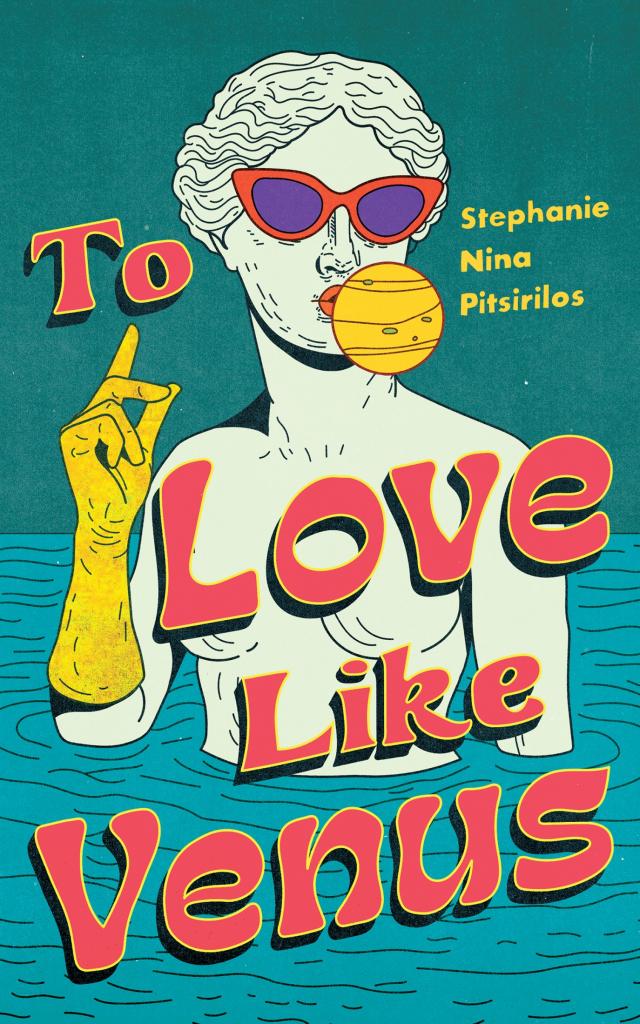
To
Love
Like
Venus
Also by
STEPHANIE NINA
PITSIRILOS
Event Horizon:
Stories of No Turning Back
The Funeral Singer
. . . and a galaxy of short stories and zines
To
Love
Like
Venus
|| a novel ||
Stephanie
Nina
Pitsirilos
Portions of To Love Like Venus were first featured in the book Event Horizon: Stories of No Turning Back (Janus Point Press, 2024) in a short story and a comic written by Stephanie Nina Pitsirilos: “Event Horizon,” with art by Cris Delara and Armando Ramirez, photography by Cyrus Amir Boquín, and design by Aaron Guzman; and “In the Name of Love,” with sequential art by Eric Nguyen, letters by Gabriela Downie, and photography by Cyrus Amir Boquín.
TO LOVE LIKE VENUS
© 2026 by Stephanie Nina Pitsirilos. All rights reserved.
Published by Janus Point Press, a registered trademark and publishing imprint of Zoe Health, LLC.
New York, NY 10025
Earth, Laniakea Supercluster
www.januspointpress.com
Thank you for buying, borrowing, or discovering an authorized edition of this book. You are respecting artists and the publishing industry, and thus making the galaxy a more beautiful and meaningful place. No part of this publication may be reproduced in any form without the prior permission of the author or the publisher, with the exception of excerpts and quotes for critical essays and reviews. This is a work of fiction. Any references to real (or imagined) historical events, places, and people are used fictitiously. This book and its cover art were authored by humans without the use of AI, from concept to content. Contact us at jpp@januspointpress.com.
Publisher’s Cataloging-in-Publication Data
Names: Pitsirilos, Stephanie Nina, author.
Title: To love like Venus / Stephanie Nina Pitsirilos.
Description: New York, NY: Janus Point Press, 2026.
Identifiers: LCCN: 2025915629 | ISBN: 978-1-958077-11-5 (hardcover) | 978-1-958077-12-2 (ebook)
Subjects: LCSH Man-woman relationships. | Love—Fiction. | Family—Fiction. | Future, The—Fiction. | Cyberpunk fiction. | Science fiction. | BISAC FICTION / Literary | FICTION / Women | FICTION / Science Fiction / Cyberpunk | FICTION / Romance / Science Fiction
Classification: LCC PS3616 .I87 T65 2026 | DDC 813.6—dc23
Jacket and cover design by Barış Şehri
Interior design by Lewelin Polanco – THE COSMIC LION
Human Authored™, Reg #: 8387896, https://authorsguild.org/human
ISBN:
Hardcover 978-1-958077-11-5
Ebook (epub) 978-1-958077-12-2
Dear K,
What if?
“Εγώ ο θάνατος.
Εγώ η μνήμη, ανήμερη.
Εγώ η θύμηση της τρυφεράδας του χεριού σου,
εγώ ο καημός της χαλασμένης μας ζωής.”
“I, death.
I, memory, savage.
I, the memory of the tenderness of your hands,
I, the sorrow of our ruined life.”
—Marina (Rena Hadzidakis)
“State of Siege”
To
Love
Like
Venus
1
She still had some time before meeting him. Alita busied herself wandering the museum’s classical wing. This section of the Metropolitan Museum of Art—really, all artifacts of the Greco-Roman world depicting human bodies—had a haunting quality Alita was never able to shake, on account of long-ago words from her mother. During a childhood visit to this museum Alita had asked her about the statues’ origins, a sensible question for a little girl immersed in a hall of endless, naked stone bodies. Her mother answered this way: Statues are people who have died. Perhaps her phrasing worked for adult ears. But not so for a child. What Alita’s child ears heard, her mother speaking like the tongue of the priestess Pythia (sparse in words but full of story) was: When you died, your skin calcified into stone, you were displayed naked with floodlights, exposed and exhibited in a mansion of stone death, a mute spectacle to a passing parade of people. You were worshipped but not touched, and you yourself could no longer feel. Worse yet, this condition was something that could be shared: If you felt the coldness of the stone of the statue—if you touched the stone of anything that the statue was pedestaled upon and felt its coolness—you would become a statue, too. Alita actively avoided touching her skin to the museum’s stone walls, its stone stairs. Alita did not want to become a statue.
The statues on display depicted young adult bodies in their aesthetic and reproductive prime. Males had chiseled muscles incongruously paired with adolescent-sized pubic patches—the sexual tastes of ancient Greece. Marble in the form of fleshy women, with orbed breasts and hair thick, curled, and full of life. Like Alita’s, now. She was that age, too. For vanity’s sake, sure, life could take her now, have her installed there in all her youthful glory. But she didn’t believe in such myths anymore, despite the uneasiness she still felt. And neither did her mother, for her mother denied ever telling her such a thing in the first place when Alita asked her in adulthood.
She had one hour until meeting Jean. Calculating the time it took to walk across the park, plus the subway ride downtown (her device flashed the estimation): She had these twenty-five minutes to spare. What would she tell Jean? This was less a question than what he’d tell her, and, even more, why she felt compelled to meet him.
The statue she stopped in front of was a Venus derivative, part of a special exhibit on loan from Greece and at the Met for a limited time. The head was lopped off, as were the arms and much of the legs, leaving just the vital torso, pubic area, and thighs. Whether a barbaric act of vandalism against the female pagan or a natural consequence of being weathered by time, the divine female was reduced to a triangle. But what a delightful triangle it was, partially robed in a sheer chiton draped over the breasts, erect nipples, a stomach that announced itself by the contour of the omphalos. Then: the delta.
Here was where Alita’s thoughts left her. She was not so much visiting the museum as finding a place to park her physical body while the rest of her drifted through the netherworlds of calculated, adult decision-making—in her, often in the guise of dreaming. But a body she did have, even if she denied it at the moment, and she ought to have noticed that while she wished to penetrate the embodiment of love—the puzzle she was trying to crack at this moment—the statue’s chiton actually crisscrossed in straps against the chest, separating the breasts into two compartments, more military badges than free-floating orbs inviting human hands to caress or mouths to suckle. This was Alita’s grave, mortal mistake: to assign to the body flesh rituals that also opened her heart to men, when really, she was born under a different star, constructed for a life where men were but tools in a military game, not something to give enamored permission to mount her.
The Romans merged sexual allure with the victories of violence, and all might have been well, and would have been well for Alita, if women were worshipped in this complete way. Forgotten, too, was how the gods inhabit epithets, as well as possess claims to their own exclusive children.
Alita looked up at the museum clock, wondered where the twenty-five minutes went, and set out to meet Jean.
…
He had chosen the closest thing left to a tavern. Its occupants were not neighborhood staples—New York with its tenants of tourists. But the place had a healthy selection of drafts and did not stock exotic ingredients for prissy cocktails. Food was an afterthought. The grand exception to its lack of modernity was its bathrooms. Here, the establishment committed the indecent act of having dimmed lights, black-tiled walls, and a black toilet bowl, masking every public-bathroom sin committed and thwarting the savviest detective skills of anyone with a sense of hygiene, even Alita.
Alita told the hostess that she was meeting someone, then scanned the room to find him. He was not reliable in carrying his device, so she didn’t bother to ask hers whether he was there. But he stood out among the twentysomething crowd, with his telltale salt-and-pepper hair and the violent jerk his body made on occasion, the legacy of a bad drug trip in another life. Then there was the way his face lit up when he saw her.
“Hello, Jean,” she said, approaching the table. “It’s been a while.”
He smiled, rising from his seat. “There you are, you little whore.”
He hugged her. After a moment, she pulled away and sat down.
“It’s good to see you, even in this gloomy place.” She laid her purse on her lap.
“You don’t go out enough.” His smile was still there. “You look great. Really turned into the looker we said you would.”
Alita’s eyes scanned the brief menu that had popped up on her device.
“What can I get you two?” a waitress asked.
Alita wasn’t sure how long she had been standing there. Not many places had waiters anymore. To be social, Alita ordered a beer, then waited to hear Jean’s customary order of seltzer and lime.
“House red.”
Alita looked up. “Jean, you don’t drink.”
The waitress turned around and walked back to the bar.
“Just a few sips. Doc said it does the heart good.”
Alita crossed her arms against her chest. “And you gave him your full history when that came up?”
“She didn’t ask.”
Alita let it go.
“So . . .” he began. “This guy . . .”
“Him.”
“Did you sleep with him yet?”
She lowered her eyes to the floor. “No.”
“What the hell is wrong with you?” Alita felt his annoyance leap across the table. “You’re not a virgin anymore. Put out.”
Alita rolled her eyes, her finger tapping her left arm. “I was planning on getting to it this weekend. Today’s Friday. Don’t you believe in courtship?”
“So, you came to ask my permission?” He leaned toward her, clasping his hands on the table.
She was wrong to have come.
“Go ahead. Bang his brains out.”
“That’s not why I’m meeting you,” she said curtly. “I don’t need that from you. Anymore. I just wanted you to know about him.” She looked away.
He leaned back again in his seat. “He sounds wonderful. Not like those young schmucks. What did you ever see in them?”
Alita smiled, now leaning her body across the table, toward Jean. “Firm, strong, youthful bodies,” she answered. “Ravenous appetites.” She watched his eyes move to the glass of wine arriving at the table. Alita thought to change the subject. “How’s retirement?”
Jean laughed, and at once the mood changed. “Splendid. Took a trip to Moscow. Dear God, they have superb prostitutes.”
“Marvelous. I’m sure they’re great anywhere.”
“Except . . . one thing bothered me.”
“What?” Alita asked, looking up as she sipped through the beer’s froth.
“They wouldn’t take my money. They wanted me to—get this—buy them shoes.”
“Shoe shopping?”
“Yeah. Shoes! Take my money, dammit. Don’t make me help you look sassy for your next damn john.”
“Perhaps it’s the larger picture. Not just the money. The company.”
He shrugged.
“Kind of like how you like to invite me—”
But he didn’t let her finish. “My doctor started me on Viagra.”
“You, with the heart condition? Great doc.”
“It’s okay if I take it once in a while.”
“Like the wine?” She gestured toward his glass, half empty.
“Yes,” he answered, clutching the goblet.
The image was misplaced. And how sternly he had answered her, as if to remind her of her place. But he had no power over her place anymore, she reminded herself. She was a grown woman now.
“Except,” Alita continued. “That, too, doesn’t take into consideration the whole picture.”
“Death is no joke,” he offered, his arm outstretched and dangling from the top rail of the chair. He had an old-fashioned silver watch on (the kind with a dial and real metal hands), the hairs of his arm tucked beneath its band. “I’m not denying that. Been there twice, saw the River Styx.”
“You’ve told me that story already. Don’t repeat.”
“Worth repeating. Anyway, with Viagra I can—”
“I’ve seen the commercials. Jean . . .”
“Will you please stop calling me by my name?”
“Only if you start calling me by mine.”
They stared at each other, neither responding to the spar.
She had had enough. The game was old, she had no use for it now, there were no lessons to extract, reconnaissance notes to take from the great enemy. Except one—perhaps the reason she came, despite how profoundly stupid it would be to trust anything coming from this source in that regard, and despite her having picked up the smallest hints that his life was spiraling out of control and sliding away from hers. He had confirmed this to her now, at the table. Maybe she really did come seeking permission.
“In all your stories,” Alita pressed. Because now, why not simply ask? “Do you know what’s missing?”
“Besides the obvious?”
“Love.”
His response was quick. “A story your ovaries invented to trick you into spreading your legs for motherhood. Come, darling. You’re grown up now.”
“Jean!” Alita slapped the table hard.
“What?” He looked into a corner of the room, speaking to the air. “It’s too late for me. Numbed by the years, and probably the numbers.” His eyes returned to her. He raised his finger, shaky with a slight tremor, and pointed straight at her face. “You’re young. You find it, you hold on to it. Tight.” He leaned back in his chair as his body succumbed to a soft, involuntary jerk. She had gotten so used to them, it was just a part of him.
Alita leaned back in her chair, too, considering if she was really there. Had she heard right? He’d acknowledged that love existed. It had utility. It was not a myth, or a guise, but an integral part of life. “We’ve been having this argument for years. Now you say this to me? What’s changed?”
“The years are adding up. And I finally realized you aren’t going to sleep with me.”
It had been a ten-year card game, and now the cards were laid out across the table. His cards, to which she ascribed more of a universal tarotlike quality than a simple paper game of jostling mathematics. She had told Jean about him. She gained a sense of peace. It seemed that they were done. If that were true, it meant she had grown up, was in control over her own life, and was of the age so worshipped and on display at the museum. But alive.
Alita looked up at the clock behind the bar—another relic. “I have to go.” She stood up, resting her purse on the table. “He’s waiting for me.” She opened the purse and began to pull out her device to pay.
“Keep it, darling,” Jean said, waving his hand. “It was my pleasure.”
“Money well spent.”
“Sleep with him.”
“I will, Jean. But not for the reasons you would.” She leaned in and pecked his cheek.
“Here,” he said before she walked away. “Bought you these.” He rustled a black, compostable deli bag that had been sitting on the floor beside his chair. From it, he pulled out a bouquet of white daisies and handed them to her.
She looked at them, then him.
“You know I love you, right?” he asked her.
“Yes, Jean. I do.”
Alita left Jean with his drink, turning away to walk into what had become the summer night. It would be the last time she would see him—the color of the flowers told her that. As did their conversation. Now she knew fully what she had to do.
2
Alita Melusine stole my son from me on a balmy summer night. I’d always told him to find a woman like the sister he never had, and what does he do but bring home Ishtar. All those years of good studies, the best schools . . . he might complain how I took him from his friends when we moved to a better school district, but a mother does what is best for her son. Of course I noticed which girls were giving him the eye. Friends are one thing.
Family! Family comes first, blood, and not the antagonist who stirs the hormones. Family is where your allegiance should be, good son. But after all the years he spent following the track I set up for him, the vixen trapped him. She’s a beauty, no doubt—the most lethal of nature’s creatures are. Of all the horrible qualities I attribute to her, it is her mouth that is most abominable. She has no shame in opening it, as I’m sure it is with the other end, too. It is the problem of these New York women, I warned him . . . Get a wife like a sister! Educated, but knowing that her place is by the side of her husband, leading the household. Educated to show she is a professional, sophisticated enough to snag a husband of the upper class, catch his eye while studying in the university library. But to open her mouth? And this one, I hear, strays in the clubs.
Oh, I know the art of seduction as well—but it has a far different goal than of that Ishtar. To think that, when in the throes of my objection, when she traveled from Babylon with Kaveh to visit me, the wench actually said to me: Would you rather I wear a burlap sack? Her words betray all the disrespect and contempt she has for me.


