Worlds collider d world.., p.1
World's Collider: A Shared-World Anthology, page 1


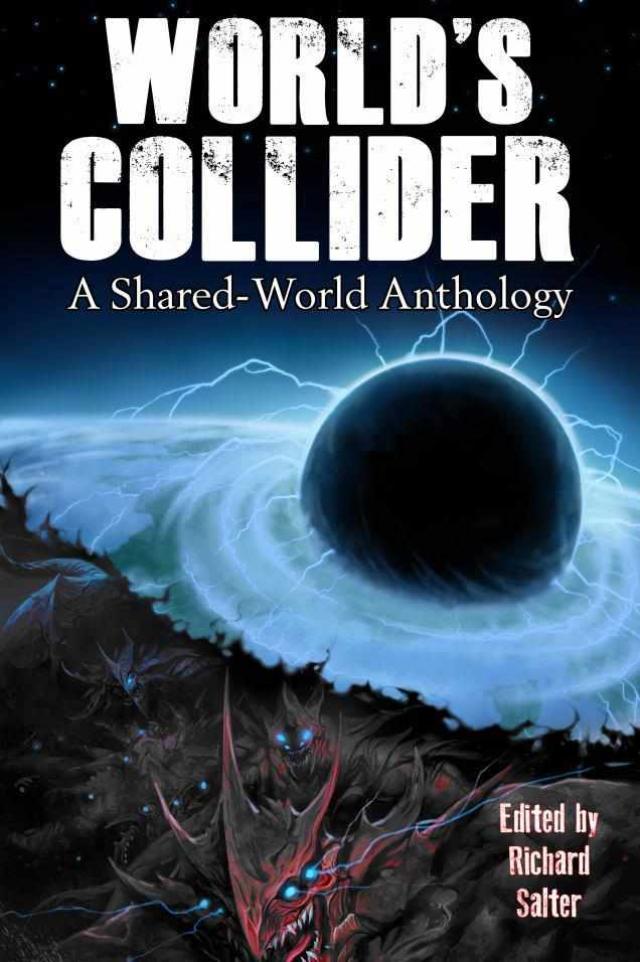
World’s Collider: A Shared-World Anthology
Copyright © 2012 by Richard Salter
This edition of World’s Collider: A Shared-World Anthology
Copyright © 2012 by Nightscape Press, LLP
Cover illustration and design by Lukas Thelin
Cover lettering by Robert S. Wilson
Interior layout and design by Robert S. Wilson
Interior illustration by Carolyn Edwards
Edited by Richard Salter
All rights reserved.
First Electronic Edition
Nightscape Press, LLP
http://www.nightscapepress.com
CONTENTS
The Construction of World’s Collider
Richard Salter
Wraith Lights
Jonathan Green
Innervisions
James Moran
KEEP CALM and CARRY ON - Part One
David N. Smith & Violet Addison
The Rise and Fall of the House of Ricky
Kelly Hale
KEEP CALM and CARRY ON - Part Two
David N. Smith & Violet Addison
Displacement
Aaron Rosenberg
KEEP CALM and CARRY ON - Part Three
David N. Smith & Violet Addison
The Coming Scream
Simon Kurt Unsworth
Doors
Paul Pearson
Closure
Pete Kempshall
Black Whispers
Trent Zelazny
Collisions
Dave Hoskin
What Little Boys Are Made Of
Nicholas Blake
Beyond the Sea
Dave Hutchinson
Caught
Elise Hattersley
Basher
Jonathan Templar
Lead Us Not
Megan N. Moore
The Last CEO
Jordan Ellinger
Twitchers
Richard Wright
Lost Souls
Steven Savile & Steve Lockley
KEEP CALM and CARRY ON - Part Four
David N. Smith & Violet Addison
Contributors
THE CONSTRUCTION
OF WORLD’S COLLIDER
This book is unique. Before you roll your eyes and skip this introduction, hear me out. Plenty of intros start by claiming something similar, but this time I really mean it. This anthology isn’t like most others.
There have been shared-world collections before, where all the stories take place in the same universe and share some common elements. There have been so-called mosaic novels before like Robert Asprin’s Thieves’ World or Paul Cornell’s Life During Wartime. But I think World’s Collider separates itself from its predecessors by assuming the characteristics of a novel. Told by multiple writers, with their own unique styles and ideas, they will each thrill and unnerve you. Some stories will make you think and a few will make you cry. Each story in this collection could stand alone as an individual, apocalyptic tale. But taken as whole, read in order, one after the other, a story emerges. A 21-part story with twists and surprises, themes and recurring characters, and most importantly, a common narrative.
An anthology posing as a novel? Or possibly a novel posing as an anthology.
When I was commissioning stories, I chose a mix of those that could be adapted to fit a larger narrative; and some that were so delicious in their own right, I just had to include them. Some stories had to be edited quite a bit to make them fit; others were specially commissioned to fill a gap in the narrative. All are just great stories.
You might be wondering why I didn't just write a novel about a big rift that opens in the middle of Europe, and all the terrible things that emerge from it. I do plan to write a novel next, now that this anthology is delivered, but I didn’t want to impose my ideas on other writers in this case. What made putting together World’s Collider such a thrill was the melting pot of ideas. So many concepts and characters, and places for the storyline to go. There’s no way I could have come up with all this cool stuff on my own. Most of the story elements in this book came from the contributors, not from me. The result, and the overall storyline, really is completely unique, because with a different set of writers involved you’d be reading a radically different book. I wasn’t interested in mapping out a plot line and assigning chapters to different writers. Instead, World’s Collider grew from the elements of the stories.
I want to take this opportunity to thank a number of folks, without whom I wouldn’t have had a hope of completing this project. Firstly to all the writers, you are a talented bunch and highly entertaining to be around. The writers’ Facebook group was often overflowing with good humor, terrible puns, and double entendres. Just ask them about the mustard.
I don’t want to single any of them out, but I will anyway. A special thanks to Elise Hattersley for volunteering to beta read the manuscript and helping out with the writer interviews for my website, (http://www.richardsalter.com). I also want to thank Dave Hutchinson for stepping in to fill a gap with a specially commissioned story, which he wrote and turned in within two weeks—astonishing! To James Moran for introducing our main protagonist in just 2,000 words. And lastly (for the writers) to the class acts that are Steven Savile and Steve Lockley. Mr Savile was commissioned to write the final story some time back, but due to being a busy bee he couldn’t start until quite late in the day. He was given an impenetrable brief by an editor who kept changing his mind and moving the playing pieces around, and had the Herculean task of making sense of all the plot threads while telling an exciting story. He stuck with the project even after breaking his arm(!), whereupon he enlisted the help of Mr Lockley to complete what I think is an excellent and exciting finale. Thanks to you guys and all the amazing writers who worked so hard to blow an enormous hole in the centre of Europe.
Many thanks to the gracious Carolyn Edwards, who produced the gorgeous “Tower” image that adorns the cover page and the promotional postcards. Thanks to Lukas Thelin of Foxrain for the cover—a real beauty, and to Steven Savile (again) for hooking us up. Huge thanks go to Robert Shane Wilson, Jennifer Wilson, and Mark Scioneaux of Nightscape Press. As a new publisher, they went to bat for World’s Collider as soon as it was available, and they won me over with their personal commitment, their great ideas, and their respect for the writers. Thanks guys and may Nightscape live a long and healthy life.
A heart-felt thanks to you, the reader, who may just be sampling this anthology or perhaps you’ve already bought it. I hope we won’t let you down.
And lastly thanks to Jennifer, my long-suffering wife, who wondered if I would finish editing this infernal manuscript so I could pay her some attention, or at least take the kids to the park so she could have a lie down. It’s all done now, my love.
Now, about that novel…
Richard Salter, June 2012
WRAITH LIGHTS
by Jonathan Green
She doesn’t know what’s worse; the screaming howls or the sound of pounding footsteps echoing along the passageway behind her.
She doesn’t dare look round. She already knows what she’ll see, and it’s nothing good. She daren’t look down either, even though she can feel her feet slipping from under her, so she keeps going, half-running and half-sliding on the blood-slick tiles.
And then there’s the lab door in front of her.
Suzie’s at the door, screaming, the look on her face one of blind panic and abject horror. And seeing that, even though she knows she shouldn’t—that nothing good can possibly come of it—she looks round…
“Jackson, take a look at this, will you?”
Penny glances up from scanning the reams of dot matrix print-out and puts her polystyrene cup of coffee on the counter in front of her. “What?”
“Just come and have a look,” Bosley says.
Penny unfolds her legs and gets up from her chair. Crossing the lab she peers over her team-member’s shoulder at the digitized data display on the screen in front of him. He doesn’t need to tell her what she should be paying particular attention to; the spike is obvious. The results speak for themselves.
“What is that? Electromagnetic?”
“It shouldn’t be,” Bosley huffs in annoyance. “I mean how could it be?”
Penny gasps. “Not gravitational, surely?”
The rumble of plastic wheels on the tiled floor tells them they’ve got the attention of the third person in the lab now.
“What are you looking at?” Suzie asks bringing her chair rolling to a halt with judicious application of her feet against the floor.
“I don’t know. I mean I really don’t know what to make of it,” Bosley says, clearly bewildered. “And what’s more, we haven’t even run the experiment yet.”
“Charles needs to see this,” Penny says, turning to Suzie. The Chinese-American programmer is painfully beautiful, with her silk-smooth hair and perfect complexion. She may only be wearing jeans, Converse and a Harvard hoodie but she still looks far more stylish than Penny feels about herself.
The lab door opens and a man with a shock of blond hair shoulders his way into the room, his hands full of bag-wrapped sandwiches.
“Okay
“Never mind that, Brunner,” Bosley says, beckoning the blond man over. “Take a look at this.”
Brunner plonks the food down on a desk and joins the others at Bosley’s terminal.
“Scheiße!” Brunner swears, momentarily reverting to his native tongue.
“You could say that,” Bosley agrees, steepling his fingers together in front of his face and touching his fingertips to his lips.
“Is that”—Brunner peers more closely at the data-diagram on the screen—“gravitational?”
“We haven’t even run the test yet!” Penny interjects.
“Where’s Stockwell?” Brunner asks. “He needs to see this.”
“I know,” Penny agrees. “Suzie Q?”
“He was still checking the Collider last I heard,” Suzie replies. “I’ll buzz him.”
“No, it’s all right,” Penny says, already halfway to the door. “I’ll go. I could do with the exercise. Besides, knowing Charles, he probably hasn’t even got his phone on him.”
Seeing Bosley again, like that—more beast than man now—is more than she can bear and a ragged scream escapes her own tortured lungs.
She turns back to Suzie and the lab door. She can see others behind it—security guards, engineers and other CERN staff—but she can’t tell if they’re trying to push the door shut or holding it open for her.
The sight of Bosley and the fear-fuelled adrenaline rush send her careening onwards. But in that moment she loses purchase and her trainers slip on the smeared tiles. Her lurching flight sends her to the floor in a sprawl.
Her grasping hands try to get a grip, as if she intends to pull herself along the floor, but cannot. And behind her the animalistic snarls and pounding footfalls are only getting closer with every passing second…
Penny finds Charles Stockwell, the project’s team leader, atop an extendable platform before the gaping mouth of the Super Collider’s solenoid.
Every time she sees it like this, Penny can understand why the uninitiated call it the black hole machine.
“Charles!” she calls over the thrum of magnets and machinery that fills the vast, man-made cavern.
The middle-aged physicist continues with what he’s doing, apparently lost in his work.
Tilting her head back, one hand on the dome of her plastic hard hat to stop it falling off—her dyed auburn locks spilling out from beneath it around her shoulders—she calls again. “Charles!”
The man frowns and peers closer through the dark aperture at the open heart of the immense machine.
“Charles!”
He turns and sees her then, looking like he’s waking from some unsettling dream. He appears old; older than she has ever seen him look before, old and grey. His skin has acquired an unpleasant waxy pallor. He doesn’t look well.
There is a faraway look in his unfocused eyes.
“I…”
“What is it, Charles? You look like you’ve seen a ghost.” She laughs humourlessly.
“It’s just that I…” He hesitates. “I thought I saw someone.”
It suddenly feels uncomfortably cold in the Collider chamber. It’s May in the world above but down here it suddenly feels like winter. Cold sweat prickles on the skin at the base of her spine.
“Saw someone? Where?”
The man glances at the aperture in the machine again. “There.”
“But, Charles,” she says with forced laughter, “that’s impossible. It was probably just your reflection.”
He stares at her blankly, like some geriatric pensioner suffering from dementia.
There’s something unnerving about the vacant look on his face. The man’s highly regarded in his field, the proud owner of three doctorates.
For a moment she forgets why she’s there, and then, “Charles, there’s something you should see.”
“Huh?”
“In the lab.”
“The lab?”
And then the fog of confusion suddenly clears, as if he has just had a Road to Damascus moment.
“Oh yes, the lab. Of course.” He puts a hand to the platform controls. “I’ll come down.”
Hands close around her ankles, her calves, her thighs, fingers that feel like clawed talons digging into the taut flesh of tensed muscles.
She kicks and screams, raging against the dying of the light. And then her furiously pin-wheeling legs are free again and she catches the thing in the mouth—she can’t think of it as Bosley anymore, she won’t let herself—breaking teeth and caving in its nose to boot.
She feels hands on her shoulders and screams again.
Only it’s not one of the infected, it’s Suzie.
And then she’s on her feet somehow, and racing for the door, screams of encouragement drowning out the savage baying of the things behind her…
“It’s happened again,” Bosley says as Penny re-enters the lab, Charles traipsing after her like a lost puppy, a hangdog expression on his crumpled face.
“What?” Penny can’t believe what she’s hearing. “But we haven’t even—”
“Run the test,” Bosley finishes. “Tell me about it.”
He breathes out loudly through his nose, resting his closed mouth on his steepled fingers once more.
“What has?” Stockwell asks.
They show him. What little colour is left in the old man’s face drains from his cheeks. He looks ill, like death barely warmed up.
“Charles, are you all right?”
Penny finds the team leader a chair and guides him towards it. He mutters something in reply and sits down. With all that’s going on, it is a few moments before Penny’s subconscious processes what it thinks she heard him say.
She takes an uncomfortable step back from the old man. Is she imagining things or did he really say—
“Look, we need to run a diagnostic check,” Brunner says vehemently, his voice rising in pitch and interrupting her barely conscious thoughts.
“Way ahead of you,” Suzie replies from her terminal. “I’ve run the diagnostic twice. The software’s fine. Those results are genuine. Those fluctuations are what the sensors are picking up.”
“But we haven’t even run the test yet!” Penny cries, exasperated, as if simple repetition of the facts will help solve the mystery.
“And yet there’s nothing wrong with the software,” Suzie insists.
“What about the hardware?” Brunner asks.
“I don’t think so.” Everyone turns to look at Stockwell. “And once you eliminate the impossible, whatever remains, no matter how improbable…”
“Must be the truth,” Penny finishes for him. “But what truth? What are we witnessing here?” She points an accusing finger at Bosley’s terminal screen.
The Large Hadron Collider was always about making the big discoveries, things no one had ever seen before—perhaps never even contemplated. She feels she should be feeling excited by this, but instead, rather than joyful elation, she is unnerved, unsettled.
She feels scared.
The others do too. She can see it in their faces.
“So,” she says, ever the pragmatist, “what do we do now?” All eyes turn to their distant team leader once more. “Charles?”
“Hm?” The old man appears distracted. And his complexion isn’t any better.
“Charles, what’s the matter?” Penny demands. “Try to stay focused. What do we do now?”
Usually she’d have a few ideas herself, but not this time.
“Look, I say we run the diagnostic test again,” Bosley says, waving away Suzie’s protests, “and get back down to the Collider and check the hardware for ourselves, just to be sure. Is that all right with you, Charles?”
“I saw something moving,” Stockwell mutters as he stares vacantly into space.