

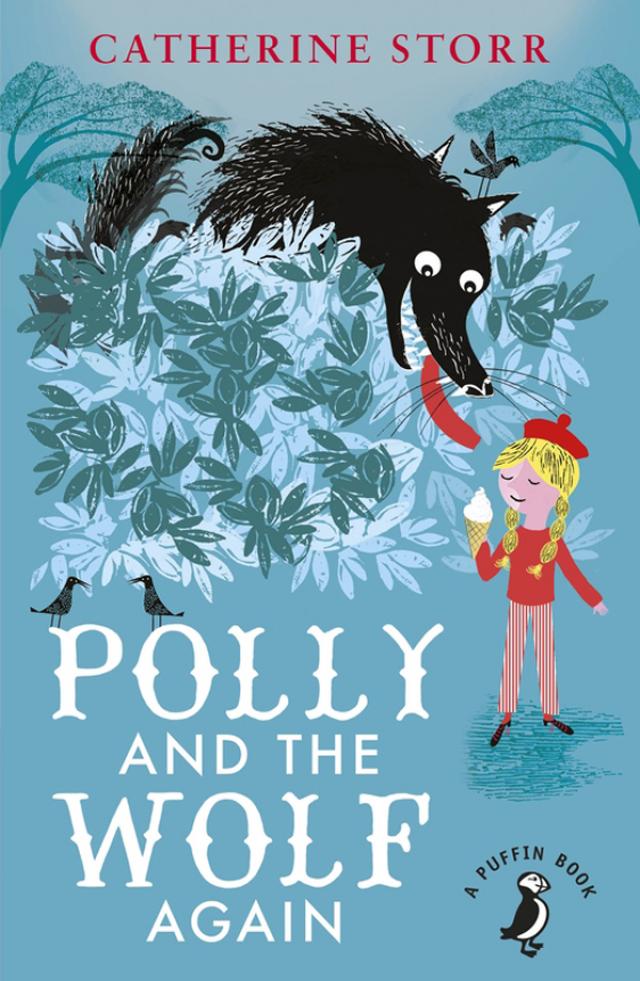
Polly and the wolf again, p.1
Polly and the Wolf Again, page 1


Contents
1. The Clever Wolf and Poor Stupid Little Polly (1)
2. The Clever Wolf and Poor Stupid Little Polly (2)
3. Father Christmas
4. The Hypnotist
5. The Deaf Wolf
6. Cherry Stones
7. Wolf into Fox
8. The Riddlemaster
9. The Kidnapping
CATHERINE STORR was born in 1913. She was educated at St Paul’s Girls’ School in London and then at Newnham College, Cambridge, where she read English Literature. Although her ambition was always to be a writer, she decided to study medicine and went on to work as a psychotherapist. Catherine was married in 1942 and in the same year had the first of her three daughters. She returned to her writing and created short stories for her young daughters, including the adventures of Clever Polly and the Stupid Wolf, which has remained in print ever since it was first published in 1955. Catherine wrote more than thirty much-loved books for children and young adults, which have been translated into many different languages. She died in 2001, aged eighty-seven.
Books by Catherine Storr
CLEVER POLLY AND THE STUPID WOLF
POLLY AND THE WOLF AGAIN
1. The Clever Wolf and Poor Stupid Little Polly (1)
The wolf sat at home in his kitchen, where he usually enjoyed himself so much; his elbows were on the table, and he was chewing, but there was no feeling of peace, of comfortable fullness, of not being likely to be hungry again for several hours, which was how the wolf liked to feel in his own house.
The table was covered with sheets of paper. Some of them had only a word or two written on them, some had a whole sentence. Most of them were blank.
Presently the wolf sighed, spat out the object he had been chewing – it was a pencil – and tried again. On a large, clean sheet of paper he wrote, laboriously:
‘One day the Clever Wolf caught Polly and ate her all up!’
He stopped. He read what he had written. Then he read it again. He put the pencil back between his teeth and began to search among the sheets of paper for something. When he found it, he opened it flat on the table and leant over it, spelling out the longer words as he read. It was a book.
But reading did not seem much more satisfactory than writing. Every now and then the wolf snarled, and at last he shut the book up with a snap and pushed it away from him; but as he did so, his eyes fell on the cover, and the name of the book, printed there in large black letters:
CLEVER POLLY AND THE STUPID WOLF
‘It’s so unfair!’ he muttered angrily to himself. ‘Clever Polly, indeed! Just because she’s managed to escape me for a time. And calling me stupid! Me! Why, I always used to win when we played Hide the Piglet as wolf cubs. “Stupid Wolf!” I’ll show them. I’ll write a book full of stories which will show how clever I am – far cleverer than that silly little Polly. I’ll start the story of my life now, and then everyone will be able to see that it’s not me that is stupid.’
He pulled another sheet of paper towards him.
‘I was born,’ he began writing in his untidy sprawling hand, ‘in a large and comfortable hole, in the year –’
He stopped.
‘Well, I know I’m about eleven,’ he said to himself. ‘So if I take eleven away from now, I shall know when I was born. Eleven away from … eleven away from … What am I taking eleven away from?’
‘I’ll do it with beans!’ he thought, encouraging himself. ‘It’s always easier with beans.’
Leaving his pencil on the table, he got up and fetched a large canister of dried beans from a shelf over the stove. He shook a small shower out on the table; one or two fell on the floor.
‘Nine, ten, eleven,’ counted the wolf. He tipped the spare beans back into the canister.
‘But I’m taking eleven away from something,’ he remembered. He looked doubtfully into the tin and tipped it a little to see how full it was. The beans made an agreeable rattling sound as they slid about inside, and the wolf shook the canister gently several times to hear it again.
‘There seem to be an awful lot of beans in there,’ he said aloud. ‘I wonder just what I’ve got to take eleven away from?’
He sat down to consider the point. Could it be eleven? He spread the eleven beans out on the table and looked at them. Then he took eleven beans off the table, counting them one by one.
‘Eleven away leaves none. So eleven years ago was nothing. The year nothing. It seems a very long time ago.’
The wolf was puzzled. It did certainly seem a very long time ago, but it still didn’t sound quite right. He could not remember ever having seen a book which gave as a date the year nothing.
‘It can’t be right,’ he decided. ‘It must be eleven away from something else. I wonder what it is? Who could I ask to tell me?’
There was, of course, only one answer to this, and five minutes later the wolf had walked down the path through the garden to Polly’s front door and was ringing her bell.
‘I’ll talk to you from up here if you don’t mind,’ said Polly’s voice from the first-floor window. ‘Yes, Wolf, what can I do for you today?’
‘You can tell me what I have to take eleven away from.’
‘Eleven? Why eleven?’
‘Because that is how old I am.’
‘Why do you want to take how old you are away from anything?’
‘Because I want to know what year it was.’
‘What year what was?’
‘The year I was born in, of course. Silly!’ said the wolf triumphantly. ‘I said it was Silly Polly and you are! What do I take it away from?’
‘Nineteen fifty-seven.’
‘And what do I have to do with it?’ the wolf asked, now thoroughly muddled.
‘You take that away from it.’
‘What’s That?’
‘Eleven. Well, that’s what you said,’ Polly answered, a little confused herself.
‘Don’t go away,’ pleaded the wolf. ‘Let me get it straight in my head. I take eleven away from nineteen and then from fifty-seven and then –’
‘No, stupid. Not from nineteen, from nineteen hundred and fifty-seven; and then the answer is the year you were born in!’
‘Nineteen hundred!’ said the wolf, appalled.
‘And fifty-seven.’
‘Nineteen hundred and fifty-seven. I don’t think I’ve got enough beans,’ said the wolf gloomily.
‘I don’t see how beans come into it,’ Polly said. ‘It’s years you’re counting in, not beans.’
‘It’s beans while I’m actually counting,’ the wolf said firmly. ‘And you’re sure the answer is the year I was born?’
‘Certain.’
‘Thank you. Good morning,’ the wolf called over his shoulder, as he trotted away down the garden path. He went home, sat down at his kitchen table and began to count out beans.
‘A hundred and thirty-three, a hundred and thirty-four, a hundred and thirty-five … Bother.’
The hundred and thirty-sixth bean was a very highly polished one. It slipped out of the wolf’s paw, leapt nimbly into the air, fell on the floor, and rolled under the cooking stove.
‘Bother, bother, BOTHER!’ the wolf said out loud. He looked into the canister. There were only seven or eight beans left: he could not afford to lose one. He got down from his chair and lay flat on his front on the floor to look for the missing bean. It lay out of reach, right at the back of the cooker, against the wall, in company with a burnt chestnut and a very dirty toasting fork.
‘My toasting fork!’ the wolf exclaimed, delighted to see it again; it had been missing for several months. He retrieved the fork, dusted it with his tail, and used it to poke out the bean.
The wolf dusted the bean, said solemnly out loud, ‘One hundred and thirty-six,’ and put it on the table.
He gave a triumphant wave of his useful tail. Several beans were swept off the table and disappeared under various pieces of furniture.
‘Oh —!’ cried the wolf, enraged. He sat down at the table, staring angrily at the remaining beans. He tipped up the canister and added the rest of the beans to the pile he had already counted.
‘A hundred and thirty-seven, a hundred and thirty-eight, a hundred and … What’s the use when I want nineteen hundred and something? I’ll never be able to count the whole lot!’
He absent-mindedly put the last bean in his mouth. It wasn’t too bad. He ate another.
‘Easier with a spoon,’ he murmured a minute or two later, and going to the dresser fetched a battered tablespoon. With its help he ate another two dozen beans fairly quickly.
‘That’s funny!’ he thought after the second spoonful. ‘I believe I generally eat these cooked. Very absent-minded I seem to be getting.’
He fetched a saucepan, filled it with water, and put it on the fire. When the water was boiling he tossed in the remaining beans, salt, pepper and herbs. He fried some rashers of bacon, an onion and a few mushrooms in a pan, and when everything was cooked he mixed it into a glorious mess together, added a tomato and, in a very few mouthfuls, swallowed the lot.
‘Ah,’ he said, wiping his mouth on the back of his paw, ‘that’s better. Now, let me see – What was I doing?’
He looked round the kitchen and his eye fell on the empty canister.
‘Oh!’ he said aloud. ‘Bother!’
‘Never mind,’ he said. ‘They tasted much better than they counted. Besides it would have taken me ages to get up to nineteen hundred and fi
He picked up the last sheet of paper he had written on and tore it across several times. Then, sitting down, he pulled another towards him and wrote in a bolder hand:
THE CLEVER WOLF AND POOR STUPID POLLY
‘Fortunately,’ (the wolf wrote), ‘I was born.’
2. The Clever Wolf and Poor Stupid Little Polly (2)
A few days later Polly was looking longingly in at the window of her nearest bookshop, rehearsing to herself what she would buy if she had enough money, when she realized that someone large and dark was standing by her side. The wolf was gazing through the glass and was murmuring the titles aloud to himself.
‘Fairy Tales. Hmm. Well-Known Fairy Tales. If they’re well known already, who wants another book about them? Grimm Fairy Tales – that sounds more interesting. I like grim stories as long as they’re really frightening and full of crunching bones and blood and things!’
‘Don’t be beastly, Wolf,’ Polly said, rather sharply.
The wolf jumped.
‘You frightened me,’ he said reproachfully. ‘I didn’t know you were there.’
‘I was here first,’ Polly reminded him.
‘I daresay. I was looking at the books and I stopped noticing you. When I get my nose into a good book,’ the wolf went on dreamily, ‘I get carried away.’
‘Don’t show off, Wolf,’ Polly said. ‘I know you can read, but I don’t believe you ever get lost in a book unless it’s a cookery book. When I was in your house there wasn’t a book to be seen.’
‘I get them all out of the library,’ the wolf said hastily. ‘And anyhow now I’m not just reading, I’m writing a book.’
‘Oh, Wolf!’ cried Polly, very much impressed. ‘How wonderful. What’s it about?’
‘Us,’ the wolf said. ‘Well, me really. Mostly me, but a little you. Only you don’t last very long, of course.’
‘Why of course?’
‘Because I eat you up. Very soon. Because in my book I am Clever and you are Stupid. It’s quite different from that silly book that was written about us before.’
‘It must be.’
‘This,’ said the wolf, puffing out his chest, ‘is terrific. It’s a Guide to Wolves on how to catch conceited little girls who pretend to be clever.’
‘I’d like to read it, please,’ Polly said.
‘Well –’ the wolf said, shifting uneasily from one leg to another. ‘It’s not as easy as it sounds. Have you ever written a book, Polly?’
‘No. I’ve written letters.’
‘So have I. Dozens. Hundreds. If I added up all the letters I’d written there’d be plenty of whole words among them, too. But still, have you ever tried to write a book?’
‘I wrote the beginning of a story once,’ Polly said.
‘Pooh!’ cried the wolf, ‘the beginning! That’s the easy part. Anyone can begin a story – you just say, “Once upon a time there was a nice juicy little girl,” and there you are.’
‘Is it the ending you can’t do?’ Polly asked.
The wolf looked thoughtful. ‘Not exactly,’ he said, ‘I think it’s the middle. I always seem to get to the end quicker than I meant to, and then the story seems too short. How long would you think a book ought to be, Polly?’
Polly thought hard. ‘About a hundred pages,’ she suggested.
‘Oh NO!’ the wolf said, horrified. ‘Not a hundred pages of writing. A short book, Polly.’
‘Oh, I see,’ Polly said. ‘Well – twenty pages?’
‘That’s an awful lot,’ the wolf said sadly.
‘It couldn’t be less than ten,’ Polly said, ‘or it wouldn’t count as a book at all. Have you written any of it at all yet, Wolf?’
‘Of course I have. Lots of it.’
‘I wish I could read it,’ Polly said.
‘Well, I might have a copy on me. Wait a minute and let me look.’
The wolf opened a dilapidated string bag and searched inside it among a sheaf of dog-eared sheets of paper. At last he extracted a small school exercise book with grey paper covers and handed it modestly to Polly.
On the outside front cover was printed:
STUDENTS’ EXERCISE BOOK
Below this was a space for the name and class of the student. This was filled in: NAME – Wolf. CLASS – Upper.
Polly opened the book and looked inside.
‘Once upon a time,’ she read, ‘there was a very clever Wolf. He knew a stupid girl called Polly. One day he ate her all up.’
A line or two farther down the page, the author had tried again.
‘Fortunately I was born. My mother and father were wolves, so naturally I was one too. I am clever, though some people call me stupid which I am not, only they are so stupid themselves they can’t see I am the Clever one. One day I caught Polly and ate her up.’
Over the page was a third attempt.
‘It was a lovely day,’ the wolf had written, ‘and the Clever Wolf went out for a walk. Suddenly he saw poor stupid little Polly, so he jumped on her and ate …’
Here the masterpiece abruptly ended. The rest of the book was empty.
‘What do you think of it?’ the wolf asked eagerly.
‘Well,’ Polly said kindly, ‘I think it’s very good as far as you’ve got. But it’s not very far, is it? I mean there’s got to be a bit more than that to make a proper book, hasn’t there?’
‘You mean the stories aren’t long enough?’
‘No, I don’t think they are. They seem somehow – well, like you said, they haven’t any middles.’
‘I know,’ the wolf said in despair, ‘but what can I do about it? You see my wolf is so clever, he catches Polly at once and eats her up. There’s none of this TALK that goes on in that other book,’ the wolf said scornfully. ‘Why, talk is all they ever do. Quite different from me. So when I’m writing about it they don’t talk, they just do things, and what I do, in my book, is I eat you up.’
‘Yes, I see,’ Polly agreed. ‘Only it doesn’t make such a good story.’
‘It’s a wonderful story!’
‘All right, it’s a wonderful story – for you, at any rate. But it isn’t long enough.’
‘It will be if I write some more of them.’
‘You can’t.’
‘Yes I can, easily. I wrote those three without any difficulty –’
‘But you can’t put all those three into your book.’
‘Why not?’
‘Oh, you Stupid Wolf!’ Polly cried, exasperated. ‘How can you have three stories, one after another, about us, if you’ve eaten me up in the first one? Where am I supposed to come from in the second and the third, if I’m inside you before they ever begin?’
‘Oh,’ the wolf said. ‘Funny, I never thought of that. And they were such good stories, too,’ he added sadly. ‘Never mind,’ he said suddenly, ‘I always said all this talk won’t get us anywhere.’
He looked hastily up and down the street. There was no one about. The wolf turned and pounced on Polly.
But it wasn’t on Polly. She had opened the door of the bookshop and slipped inside. Just in time. Through the window, the infuriated wolf saw her speak to the proprietor, who went away to the back of the shop and came back with a heavy-looking volume.
With hardly a glance at the window, Polly propped the book up on a shelf so that the wolf could see its title as she began to read.
How to Deal, the title read, with Dumb Animals.
3. Father Christmas
One day Polly was in the kitchen, washing currants and sultanas to put in a birthday cake, when the front door bell rang.
‘Oh dear,’ said Polly’s mother, ‘my hands are all floury. Be a kind girl, Polly, and go and open the door for me, will you?’
Polly was a kind girl, and she dried her hands and went to the front door. As she left the kitchen, her mother called after her. ‘But don’t open the door if it’s a wolf!’
This reminded Polly of some of her earlier adventures, and before she opened the door she said cautiously through the letter box, ‘Who are you?’
‘A friend,’ said a familiar voice.
‘Which one?’ Polly asked. ‘Mary?’


