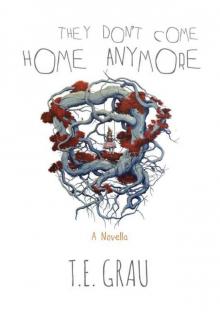
The nameless dark a coll.., p.1
The Nameless Dark: A Collection, page 1
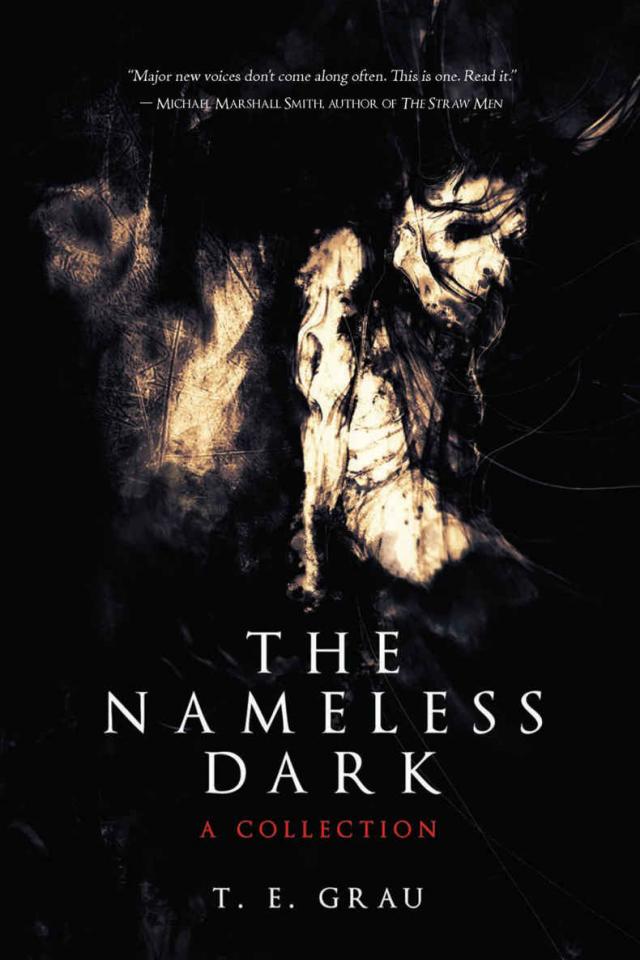


Views of The Nameless Dark
“Debut collections rarely exhibit such literary deftness and raw power. The Nameless Dark is brutally poetic and poetically brutal. The shadows evoked by T.E. Grau have teeth, and they shall endure.”
— Richard Gavin, author of At Fear’s Altar
“Some authors become contemporary favorites of mine on the merits of only a story or two. Such was the case with T. E. Grau. With his first story I was exposed to, ‘Free Fireworks,’ he seized my attention, and when I read ‘The Screamer’ I was flat-out sold. He’s never disappointed me since. Even as a relative newcomer, he’s writing stories that can stand tall alongside those of much more established writers of modern weird fiction. His stories are sometimes tragic, sometimes blackly humorous, often cast a probing gaze at society, and may very well do all these things within the borders of a single tale. His range is especially to be admired, his settings diverse but always convincing and immersive. A story like ‘The Mission’ reads like a feverish blend of Cormac McCarthy and H. P. Lovecraft, but is all Grau: wildly imaginative, fiercely gripping, brazenly unpredictable.”
— Jeffrey Thomas, author of Punktown
“In The Nameless Dark, T. E. Grau finds the sweet spot between terror and acceptance, horror and beauty, the unusual and the familiar — both frightening and touching at the same time. Not an easy task. These unsettling stories grab your heart and squeeze — a sensation that is both terrifying and like coming home.”
— Richard Thomas, author of Disintegration
“T.E. Grau’s odd, edgy stories shine a new light into the dark corners of human experience. These stories shine with smart prose, clever — often quirky — insights, and enough weirdness to make any genre fan froth at the mouth with glee. Start reading Grau before he hits big, then you can say you were one of the first.”
— Gary McMahon, author of Pretty Little Dead Things and The Concrete Grove
“More than any other genre, perhaps, horror is defined by its places — from the snowy streets of Lovecraft’s Kingsport to the windswept beaches of James’ Seaburgh or the ancient hills around Machen’s Caermaen. In such places the alien exists alongside the familiar and the horrific mingles with the beautiful. T.E. Grau’s The Nameless Dark follows in this same tradition, evoking within its pages a world of haunted landscapes: blasted cities and barren deserts, suffocating jungles and sun-bleached plains.”
— Daniel Mills, author of The Lord Came at Twilight
“The Nameless Dark is a horribly good collection from the incredibly versatile T.E. Grau, featuring stories ranging from the nihilistically bleak to the darkly humorous. You’ll find harrowing accounts of modern day life alongside stories of an old west that’s wild with monstrous things, Lovecraftian horror holding hands with the Ligottian. Each story is written with a clear love for language, the prose evocative, heartfelt, and often heartbreaking, providing observations of human nature that are wickedly astute and well considered. The stars must have been right when he wrote this because Grau has created magic here, magic of a very dark kind. The Nameless Dark is an excellent collection — I loved it.”
— Ray Cluley, author of Probably Monsters and Within the Wind,
Beneath the Snow
THE NAMELESS DARK
A Collection
T.E. Grau
Foreword by Nathan Ballingrud
Copyright © 2015 T.E. Grau
Introduction copyright © 2015 Nathan Ballingrud
ALL RIGHTS RESERVED. No part of this work may be reproduced or utilized in any form or by any means, electronic or mechanical, including photocopying, microfilm, and recording, or by any information storage and retrieval system, without permission in writing from the publisher. No Mythos creatures were harmed in the making of this book.
These stories are works of fiction. Names, characters, places, and incidents are products of the author’s imagination or are used fictitiously.
Published in 2015 by Lethe Press, Inc.
118 Heritage Avenue • Maple Shade, NJ 08052-3018
www.lethepressbooks.com • lethepress@aol.com ISBN: 978-159021-463-3 / 1-59021-463-3
Cover image by Arnaud de Vallois.
Cover design: Inkspiral Design
Interior design: Silvia Moreno-Garcia
“The Screamer,” first published in Urban Cthulhu: Nightmare Cities (ed. by Henrik Harksen, H. Harksen Productions, 2012) / “Clean,” first published in The Fog Horn #2 (ed. by Quinn Emmett, 2014) / “Return of the Prodigy,” first accepted for publication in Cthulhu Fhatagn! ( ed. by Ross E. Lockhart, Word Horde, 2015) / “The Truffle Pig,” first published in Tales of Jack the Ripper (ed. by Ross E. Lockhart, Word Horde, 2013) / “Beer & Worms,” first published in The Best of the Horror Society 2013 (ed. by Scott M. Goriscak, 2013) / “White Feather,” first published in World War Cthulhu (ed. by Brian M. Sammons & Glynn Owen Barrass, Dark Regions Press, 2014) / “Transmission,” first published in Dead But Dreaming 2 (ed. by Kevin Ross, Miskatonic River Press, 2011) / “Mr. Lupus,” purchased for publication in Mark of the Beast (ed. by Scott David Aniolowski, Chaosium Inc.) / “Free Fireworks,” first published in Horror for the Holidays (ed. by Scott David Aniolowski, Miskatonic River Press, 2013 / “Love Songs from the Hydrogen Jukebox,” first published in The Children of Old Leech (ed. by Ross E. Lockhart & Justin Steele, Word Horde, 2014) / “The Mission,” first published by Dynatox Ministries/Dunhams Manor Press, 2014.
Contents
Acknowledgements
What Calls Us to the Dark
Tubby’s Big Swim
The Screamer
Clean
Return of the Prodigy
Expat
The Truffle Pig
Beer & Worms
White Feather
Transmission
Mr. Lupus
Free Fireworks
Love Songs from the Hydrogen Jukebox
Twinkle, Twinkle
The Mission
About the Author
Deep into that darkness peering, long I stood there, wondering, fearing, doubting, dreaming dreams no mortal ever dared to dream before.
Edgar Allan Poe
The Raven
“I do not love men: I love what devours them.”
André Gide
Prometheus Illbound
For my two girls
For Ivy, my bones, my home, my Dream Girl waiting for me on the last ring of Saturn. I am yours and you are mine. Tout est noir, mon amour. Tout est blanc. Je t’aime, mon amour. Comme j’aime la nuit.
And for Angelina, my magic child, my sunrise and eternal source of hope in this world of dancing brutes.
To the stars, my loves. To the sea. This book belongs to you two alone.
The Nameless Dark is written in loving memory of Michael and Kathleen Powers, Charles “Chip” Grau, Nubar Papazyan, and Mikael Hovanessian.
Acknowledgements
Many have aided me on this journey into prose, culminating with this first collection of fiction, and rightly have my deepest gratitude for their support and generosity, but I especially want to thank Steve Berman, Nathan Ballingrud, Laird Barron, Paul Tremblay, Jordan Krall, Ross E. Lockhart, Jeffrey Thomas, Michael Marshall Smith, Adam Nevill, Matt Cardin, Ray Cluley, Michael Kelly, Thomas Ligotti, Lawrence Block, Ellen Datlow, S. T. Joshi, Tom Lynch, Brian Sammons, Michael Abolafia, Paul Carrick, Scott David Aniolowski, the Grau/Curtis families, the Telalyans, the Papazyans, the Oganesyans, The High Plains/HT Crew, Grigor & Vardui, Angelfish, and, of course, Ives Hovanessian, who steered me onto the track, coached up my stride, and then ran far ahead, twirling and singing and forever showing me The Screamer. Her fingerprints are all over these tales.
What Calls Us to
the Dark
Imagine a church. Not built by any human hand, not enclosed by any structured walls nor a place of sanctuary in any inhabited city, this church is felt rather than seen. Imagine you have descended into the earth to find it. Volumes of stone separate you from the surface of the world, where you have left the light behind. To bring light to this place would be a sacrilege. You’re a pilgrim, and this is a holy place.
But you’re not alone; many have come. We’ve come because someone is down here telling stories, and stories that come from the nameless dark come with their own peculiar illumination, a kind which can’t be found in the sunlight. We need them, as much as we need the fables which give us our illusions of order and safety. Maybe we need them even more.
In the hands of the best storytellers, there is no greater pleasure than losing yourself in horror.
Case in point: T.E. Grau.
The first story I ever read by Grau was “The Mission.” It’s a tale set in the Old West, about a group of unlikely soldiers tracking two Lakota warriors across the Nebraska plains, and who eventually stumble across something fantastically strange and terrifying. I didn’t know what to expect. What I got was prose moving across the page with the lean, efficient elegance of a dancer.
“Ebke snorted. Didn’t care for a damned thing in the whole wide world, including his own hide. The kind of man who was just born hollow, who just went where he was supposed to. Didn’t matter, though. When the chips were down and the dander up, it’s always light versus dark. To hell with this New World.”
Crisp, tough language. It suggests the pared cynicism of the gathered men, their resignation to unhappy truths and a disdain for the florid and inessential. One does not imagine they would tolerate a gregarious soul in their company.
And, a short while later:
“Farm boys ain’t exactly expert trackers. Good to have at your side in a saloon dust up, as those coffee can fists always found purchase, but rosy-cheeked plowboys weren’t born bloodhounds like those with a more suspicious nature.”
Read that paragraph aloud. Listen to the rhythm of it. It’s full of rolling muscle. The cadence of it is picked up repeatedly by clusters of stressed syllables, pounding like an old steam train: “coffee can fists,” “rosy-cheeked plowboys,” “born bloodhounds.” It’s elegant, strong, and precise. Consider, too, the expert use of figurative language. I’m more jealous of “those coffee can fists always found purchase” than I can tell you. Prose like this is a pure joy to read.
It comes early in the story, and although I’d been enjoying it right from the start, it was when I came across that line that I knew for sure I was in expert hands. Grau knows what he’s doing, and he does it damn well. After that, I surrendered completely to the story, like slipping into a river’s hard current, and was carried to further unexpected rewards.
I won’t tell you what the soldiers find at the end of the story — that’s a pleasure I’ll leave to your own discovery — but I will tell you that when they did find it, I think I might have actually exclaimed aloud with happiness. It’s straight from the old school Weird Tales-style pulps, something which might have crawled out of a Clark Ashton Smith fever dream. This story would have delighted Farnsworth Wright, and might have nestled comfortably in a table of contents between CAS and Robert E. Howard.
Except, perhaps, for one crucial detail, which I’ll come to in a moment.
The Nameless Dark is an unapologetic love letter to the ghoulish adventurism of the old pulp aesthetic. The ghost of H.P. Lovecraft haunts many of these tales, drifting brazenly through stories like “The Truffle Pig”, one of the most audaciously inventive Jack the Ripper stories I’ve ever read; “White Feather”, an examination of cowardice and outrageous courage in Revolutionary America; and “Free Fireworks”, a war story shot through with love, beauty, and glory-laden horror. “Beer & Worms” is a simple tale of friendship and fishing, with a stinger ending you can envision being illustrated by Jack Davis in an issue of Tales From the Crypt. In “Transmission” and “The Screamer”, isolation and the constant simmering insanity of contemporary life are the hinge-points for transcendent horrors. The bleak cosmology of Laird Barron is the backdrop for “Love Songs from the Hydrogen Jukebox”, another period piece, this one set in ‘60s San Francisco, where so many lost or damaged souls became fodder to the appetites of more powerful, dangerous personalities. It’s one of the best stories in the book.
But there is, as I said, a crucial difference that sets Grau’s writing apart from the grandfathers of the weird tale. He is cognizant of the cultural assumptions and short cuts his characters indulge in. The racism and the misogyny that can make reading Lovecraft and Howard such a vexing experience are replaced here by a cultural self-awareness that forever eluded those writers. You’ll find those traits in some of the characters, to be sure; Grau is too honest a writer to engage in the wish fulfillment of a truly democratic depiction of the world. But, as is especially clear in the contentious relationship of the soldiers in “The Mission” — and in the terrible insight which accompanies their final discovery — the author refuses to relegate anyone to a caricature. Everyone bears the weight of a life.
In this way, he is the writer I wish Lovecraft and Howard could have been.
T.E. Grau is a large-hearted writer. He’s a generous writer. The themes that unite these seemingly disparate stories — loneliness, isolation, threats against the family, or the desire to belong to a family — are made potent by this. This is what gives the horror its teeth.
And we want our horror to have teeth. We need it to. It is designed to hurt us even as it thrills us, so that we may survive the hurt and become wiser because of it. This is what brings us here, to this unlit church, down in the black belly of the earth. We’re here to weep over the doomed love which entangles us all, and to suffer for our hopes. We’re here to feel the cool air of the crypt, and to tremble at the way it calls our lives to attention. We’re here to honor all the beauties and the horrors of the world.
We’re here to bend the knee to the nameless dark.
Nathan Ballingrud
Asheville, North Carolina - April 8, 2015
Tubby’s Big Swim
The fat horsefly flew in a wide circle, tethered by a length of thread taped to the desktop. The buzz of its wings was deep, sonorous, more majestic than flies are often given credit.
Alden’s chin rested on his crossed arms and his small eyes followed the insect. “Bertrand,” the boy said, giving proper name to the airborne thing. A small dish of sugar water was set up on the edge of the desk, as was a miniature perch fashioned out of picture wire. “Bertrand the Fly Boy,” Alden announced. The naming was complete.
The boy continued to watch, noting the change in flight path, the figure eights, the frustrated zigs and zags, marveling at the variety. But after a time, the circles became concentric, growing tighter and tighter, until Bertrand spiraled downward, pitched to one side and landed in the dish, legs twitching, wings rippling the surface of the thick water.
Alden sighed, pulled back the tape and held up the dripping fly in front of his large, perfectly round face. The leash had become a noose. All of them died. Every single one. No matter how much care and effort and love he put into their survival. They all eventually died right in front of him.
He gave the fly one last look, before letting it drop out of the open window onto the noisy street below. “So long, Bertrand.”
Alden opened the front door to the three-story brownstone and trudged down the steps on thick ankles squeezed into last year’s shoes, a large glass pepper jar under his arm. He was hunting bigger game this time, and needed a receptacle worthy of his prey.
He walked up the sidewalk, trying to fold in on himself to avoid the attention of the older kids gathered across the street, laughing and cursing just loudly enough to infect the block while keeping out of earshot of their parents almost certainly screaming at each other somewhere inside their building. School would be starting soon, and kids were overheated and under-stimulated after three months away from their studies, itching for an excuse to take down a straggler that didn’t fit the herd.
Alden and his mother Regina had moved to this downtown neighborhood two weeks ago after the owner of Pinewood Park grew tired of wrestling with his mother in her room. The night before they left, the man gave her a black eye. An hour later, she gave him a gift in return—a dropped match on the shag carpet soaked in vodka. The cloud of black smoke that rose in the distance behind their station wagon as they sped out the gate was beautiful, like the breath of a dragon. Alden sure wished he could trap one of those, because dragons lived forever.
Now in this new city that looked so old to him, he missed the trailer and its rectangular simplicity. It was just him and his mother, for the most part, and there were lots of critters living in the chaparral on the other side of the chain link fence. Lizards, spiders, rolly pollies, earwigs—even scorpions, when he could find one. He caught each of them in turn, but they all eventually went the way of Bertrand, the way of the trailer and the smile in his mother’s eyes. Things died so quickly, which made Alden wonder how many days any of us had left.
Across the way, the group of boisterous kids gave chase to a neighborhood cat, hurling soda bottles and insults at the terrified feline as it skittered toward the other side of the street, leaping over the curb and passing right in front of Alden, stopping both of them. The cat and the boy stared at each other.
“Hi, kitty,” Alden said, bending down to offer his hand for a sniff, just as an untied high top kicked the animal out of view. The cat screeched bloody murder as it arced through air, landing awkwardly on its side with a weird thump, before limping into the alley and disappearing behind a pile of stuffed trash bags. Alden thought that cats always landed on their feet. This one sure as heck didn’t. City cats must live by different rules.