Cold grey stones, p.1
Cold Grey Stones, page 1


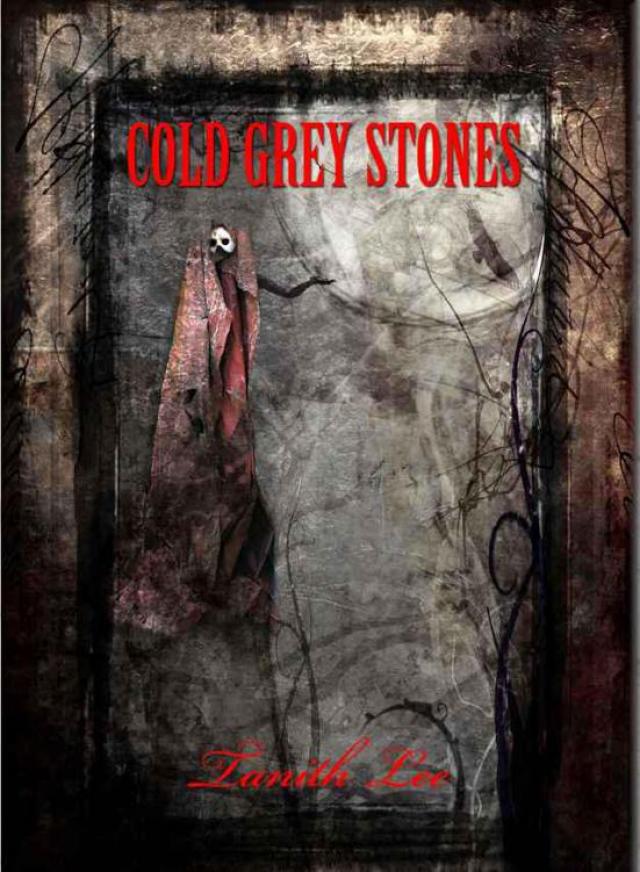
Cold Grey Stones
Tanith Lee
Imaginings
An imprint of
NewCon Press
England
First edition, published worldwide January 2012
by NewCon Press
This collection copyright© 2012 by Ian Whates
All stories copyright © by Tanith Lee
“Clockatrice” copyright © 2010, originally appeared in Fantasy Magazine
“Malicious Springs” copyright © 2003 originally appeared in Interzone
“The Heart of Ice” copyright © 2008, originally appeared in Weird Tales
“Callinnen” copyright © 2008, originally appeared in Malorn
“En Forêt Noire” copyright © 2004, originally appeared in French in Emblèmes Spécial No. 1, and in English in Realms of Fantasy (2005)
“The God Orkrem” copyright © 2011, originally appeared in Fantasy Magazine
“The Greyve”, “Fr’eulogy”, “In the Country of the Blind”, “My Heart: a Stone”, and “Killing Her” copyright © 2012 and are all original to this collection
All rights reserved, including the right to produce this book, or portions thereof, in any form.
Also available as ISBN: 978-1-907069-27-7 (hardback)
Cover art by John Kaiine
Cover design by Andy Bigwood
Minimal editorial interference by Ian Whates
Text layout by Storm Constantine
eBook design by Tim C. Taylor
Contents
Introduction
Clockatrice
Malicious Springs
The Greyve
The Heart of Ice
Calinnen
En Forêt Noire
Fr’eulogy
The God Orkrem
In the Country of the Blind
My Heart: A Stone
Killing Her
About the Author
Break, break, break,
On thy cold gray stones, O Sea!
And I would that my tongue could utter
The thoughts that arise in me.
Break, Break, Break,
Tennyson
In Praise of Happy Accidents
An Introduction
Ian Whates
I first discovered Tanith Lee’s writing while on holiday (in Spain, I think). As ever, I had underestimated how much reading I would do in two weeks and, with several days’ holiday still remaining, had finished all the books I’d brought with me. The local shops offered very little by way of science fiction and fantasy, but on one of the revolving stands bearing assorted paperbacks were two books with eye-catching covers. These were The Book of the Damned and The Book of the Beast, both by Tanith Lee; an author I’d heard much about but had never actually read.
Not my usual fare by any means, but there was nothing else of interest to be had, so I bought them. This proved to be one of the wisest impulse buys I’ve ever made. Within the first few pages of The Book of the Damned I was completely hooked; on the characters, on the setting – Paradys, surely the most vividly realised city since Fritz Leiber’s Lankhmar – but most of all on the writing.
Through her careful choice of words and expert sculpting of phrases, the author managed to bring the narrative to life. I could feel the horror, feel the lust, feel the torment of the characters whose lot was laid bare within these pages; I could taste the decadence and magic that permeated every brick and stone of this ancient, gothic city.
Despite the books’ brevity I became totally immersed, and emerged at their conclusion blinking up at the daylight and questioning whether the world I returned to was any more real than the one I’d left between the covers of these Secret Books of Paradys.
Tanith’s writing does that; seduces you and transports you to realms of her imagining. It comes as no surprise that she has won a brace of World Fantasy Awards and a British Fantasy Award, nor that her work has been shortlisted for the Nebula. The only mystery is that she hasn’t won more.
There is surely no better way to launch the new Imaginings project than with a volume by Tanith Lee. Eleven wonderful and rich-textured stories, two of which appear in print for the first time and five of which have never appeared anywhere before – one of these had yet to be completed when we started putting this volume together (yes, it genuinely is that new) – and all of which deserve to be treasured.
On that long ago book-hungry holiday, I stumbled by happy accident upon one of the finest writers it’s ever been my privilege to read. Little did I imagine that twenty-odd years later I would not only be fortunate enough to count Tanith and her husband John as dear friends, but I would be publishing an entire collection of her stories.
For all of the above reasons, I am proud to unveil Cold Grey Stones by Tanith Lee, volume 1 of Imaginings. Enjoy.
Ian Whates
November 2011
Clockatrice
Dare I say, like the genius composer Shostakovich, I’m fascinated by clocks – be they working or retired. One day I bought a medium-size clock, lacking all insides, (it has since received an effective face and hands) and clothed in thin slabs of green onyx, with little gilded feet that peculiarly resemble birds with upraised wings. My husband (John Kaiine) called it the Clockatrice. And my mind at once began to work out how that deadly creature, the cockatrice, which turns any viewer into stone, might be connected to a clock. The result of my mental game follows.
I
Poor girl. Beautiful Diana, named for a goddess, and barely sixteen years of age. Just after midnight she descended through the gardens to meet her lover. And before any clock could strike one, she was as beautiful as she was dead.
The gardens at Sessonby are still very fine, but back then, in the 1590s, they had a reputation, being influenced by startling new discoveries, and even alchemy. Mazes of topiary cut in extraordinary forms (swans, minotaurs), looping paths that led to groves dominated by such items as gigantic bronze astrolabes. These indicated the place was full of magical clues. They were clever gardens, where also nocturnally sometimes hares appeared, spirit-like, from the park outside, wolfish foxes, or snakes with enamelled skins – creatures of sorcery and impulse. The Queen herself, the Great She, Elizabeth, had visited Sessonby.
Diana had no thought for the Queen, even though Diana’s hair was hennaed to amber, fashionably, to honour the Queen’s own tresses, (or, by now, her wigs.)
The moon however, Queen of Night, did exercise some authority. Full this evening, it hunted things as it moved westward, striking between screens and curtains of leaves. A stone satyr, for example, with sly, sidelong eyes, or an owl of marble that seemed to alight on spread wings below the steps. And Diana, too. For whenever it could, the moon splashed her with illumination, her blonde yellow dress with its shield-stiff bodice, the tops of her tender breasts above, her white face, and her hands flitting to the narrow gate.
Outside the gate opened a glade. This was of course contrived, and at its centre stood a shadow clock, based on an artefact of the ancient Egyptians, as perhaps authorized by Elizabeth’s own Magus, John Dee. The way the sun fell on the clock would tell the hours. But at noon the clock’s position must be reversed in order to monitor the hours after. Tonight the clock looked spitefully alert. Instead of daylight the moon boiled white across its brazen spike. And beyond loomed the huge pine trees, which Diana’s great grandfather had planted in the time of Henry VII, the Tudors’ first bloody-handed king.
It was said a stag had been killed on the spot and buried whole there, the tree then planted in its vitals. Nourished by the feast the pine grew to vast height and girth.
Diana had never liked the pine, and maybe this story was the cause. She had had an old nurse as well in childhood, who said the pine was unnatural and ate any small animals that strayed near it. Even a little child, once.
A tremendous silence had filled the gardens. Diana noticed that especially now she herself had ceased to move. Quite often, inflamed by a full moon, a bird might sit singing. (Just as moths were stirred up, and fluttered about.) Tonight no bird sang. Not a thread of wind silked the branches. The foreign shrubs had congealed to black linen and gave off no perfume.
Why had she made a promise to meet her lover here? They had slight need to be hasty, or furtive, she and Robert, for they were betrothed and soon to be wed. Some fancy of his, and she had acquiesced, as a wife must learn to do. But see, he had failed her, had not bothered to arrive after all. She should return at once to the house.
The moon slipped a notch along the sky, and a single ray shot between the leaves like a white spear.
A curious odour was on the air. It suggested – chickens, Diana thought, yet too something tindery, corrosive, and old.
And then she did hear a sound, which was not the wind through the leaves, nor the rustle of her dress. It was high above her.
Unwillingly she lifted her gaze, up, up the length of the pine tree, among its bristled knots of needles. What did she see? Something? Only a black shadow, shifting and turning, and then the moon’s relentless ray slithered on a length of substance almost like chainmail, the half-metallic armour of a serpent or a lizard.
Astonished, Diana stared. She could make nothing of it, and yet her heart beat with tremendous blows. She wished immediately to run away. But the noise came once more, that strange thin hissing, and the faint stink on the air blew over her, through her, and she could not move. She could not lift one foot from the ground, not even one hand to cover her eyes that would not close. Then silence fell back into the garden. It filled her up. It drowned her from within. Her heart had frozen. Diana was a thing of petrified material. She was colourless, amber and blonde all gone away, gray like the satyr, moon-like as the marble owl. She had been changed to stone, and as stone they found her the next day, in the glade below the pine tree. Where you may see her still. Tonight even, if you wish.
“Certainly there’s a statue there of a young girl,” he said, “in authentic Elizabethan clothes. Obviously tourists get told the story of what happened, and how she was turned to granite.”
“Do they believe it?”
“Do you?”
“Yes.”
“Christ,” he said, and laughed.
“Christ,” she answered briskly, “could of course undo any evil spell and set her free. Are you expecting Him to visit?”
Robert Trenchall frowned at her. He had a strong, dark face and the sort of brooding eyes she had seen already in pictures of him in various magazines. His black hair was attractively long, hanging just over the collar of his leather jacket.
Probably she should resist the urge to challenge him. He could always have her thrown off his property. She was not even a journalist, only a freelance photographer.
“Last night,” Dru continued, now she hoped in a calm, pacifying way, “you said we could see the statue.”
“I did. But no one took me up on it.”
She thought he must hate it all, allowing people to traipse about the gardens and the rest of the estate of Sessonby. His aunt, the late, famous artist, Vera Reive, had left it to him, with all its debts, five years before. He was seldom here save in the line of duty, which must drag him away from his other work in the theatre, and with music. Dru recalled an interview in which he said he would have loved Sessonby, had it not been for the constant need to prostitute the place, (tours, weekends, Historical Nights) in order to secure its upkeep.
The previous evening had been part of just such a junket. An expensive, lavish dinner in the grand dining room, and the appropriate music and story-telling by Trenchall and a pair of his actor friends. The last tale, dramatically relayed just after midnight, was the legend of poor Diana Sesby, who in 1594 became literally petrified by the breath of a cockatrice, hatched in the pine tree at the foot of the gardens. Indeed, no one had taken up Trenchall’s offer of viewing the stony corpse. Possibly his scowl had deterred them. Or the pouring English rain.
But it was 10 a.m. now, and full light of a May morning.
“So where,” she said, “should I go?” Then realizing, she added sweetly, “aside, obviously, from hell?”
“Sorry,” he said, scowling now at his combat boots, firmly embedded in early summer mud.
“That’s OK. It must be – difficult. But I am interested.”
“I’ll take you there,” he said.
“There’s no –”
“It’s fine. The way the gardens are now, you might get lost. No, I don’t mean because you’re some dumb damn stupid woman. The mazes are overgrown, and the steps, of course, partly gave way years back. Just bear with me, and I’ll guide you down.”
Dru glanced at him. Her guide into the dark. For even at this pre-noon hour, she had already seen the world of the gardens below was steeped in shadow, sombre and unsure.
“Thanks,” she said. And went with him along the swampy lawn.
Diana Sesby still stood in the tangled glade. The pine tree was still there too, towering up, no doubt grown taller since the sixteenth century.
The whole space was determinedly blank, despite the bright sunlight. It might have been roofed by a dome of polarized glass.
Dru edged around the statue. It was the only one, the satyr and the owl were missing, as was the mysterious shadow clock. She could not be sure the remaining sculpture was genuinely Elizabethan, but the carven garments looked authentic, the stiff bodice and ornately arranged hair. Even the long string of – presumably – pearls. One omission though, no ruff behind the neck. Which was a little odd. Ruffs had been a fashion must in the 1590s.
Dru had thought Trenchall would leave her once he had shown her how to negotiate the steps. But no, he was loitering, watching.
Raising the Olympus, she aimed and took a slanting shot of the petrified girl.
“Not digital, then?” Trenchall remarked.
“No.” She framed another lower shot. Straightening, she said, “One puzzle. If something turns you to stone, why do your clothes turn too? I mean, flesh and blood and bone and hair – fine. That’s living matter, or only recently dead, like hair-ends and nails. But a dress? A necklace… I’m no scientist, but that makes no sense to me. Never has.”
“Hey, maybe it didn’t happen, then. Maybe she’s only a statue.”
“Except…” said Dru. She leaned forward and peered into the statue’s face. Diana Sesby, if it was she, had been a good seven inches shorter. Which made it easier to stare down and to see – “My God,” Dru said. He did not respond. “I assume other people have noticed this, er, detail?”
“Yes.”
Dru, however, realigned the camera for a close-up. He had the courtesy to keep quiet as she angled in on the tiny moth, caught there just above the girl’s stone temple, at the edge of her immutable hairline. The moth was also formed of stone, and chiselled with an incredible, one might say a needless, delicate accuracy. The wings were thin enough to be translucent. Two minuscule antennae were just visible against the tendrils of human hair.
Trenchall said, “And yes, it resembles the proper sort of moth for the time. And yes, it seems to be part of the statue, matching stone, etc. But I wouldn’t bet on its credentials. A cunning fake is much more likely.”
Sunday evening was to be the banquet in the old hall, under the rafters in “a shining forest of candles,” as the brochure put it. It was the climax of the weekend, but Dru missed it. The reason being that she was instead up in Robert Trenchall’s private rooms.
His invitation had arrived about an hour before the official meal was due to start. One of the house gofers brought it, smiling and non-committal.
Dru wondered if Trenchall frequently chose a single young woman from the medley of guests. And if he did, was it a perk for him or a prize for her? She could politely refuse. But she had always quite fancied him. She liked his music enough too. Besides, she was curious. Even if they did not end up in the sack, she had no objections to seeing some of the house that lay off the public route.
In fact, his flat, as he called it, was very plain and very much modernized, with pale walls and darkly pale curtaining, and only contemporary abstract pictures that, while Dru thought them quite good, were not to her taste. Outside the high windows the gardens shaded rapidly under more threatening clouds. A necessary wood fire had been lit in the main room, un-Elizabethan but warming.
Trenchall greeted her with easy grace, as if they had known each other some while, and theirs was a liaison of mutual if light-hearted respect. They ate smoked salmon, steaks, strawberries, and drank a French white wine sturdy enough to cope with pink fish, red meat, and scarlet fruit.
“I’m glad you like the wine,” he said. “I thought you would. I chose it with you in mind.”
“Really. How thoughtful.”
He grinned. Oh, irresistible. “I imagine,” he said, “you’ll be working this up, I mean the tour here, into something you can sell.”
“No,” Dru said. “I can’t afford to pay estate fees for using any of the Sessonby legends professionally. Let alone pictures from the grounds. It was just personal interest.”
“In other words, you’ll devise something different enough, then rip us off.”
Dru looked at him cautiously. It had all been going so well. “I don’t do that, Mr. Trenchall.”