

The others, p.1
The Others, page 1


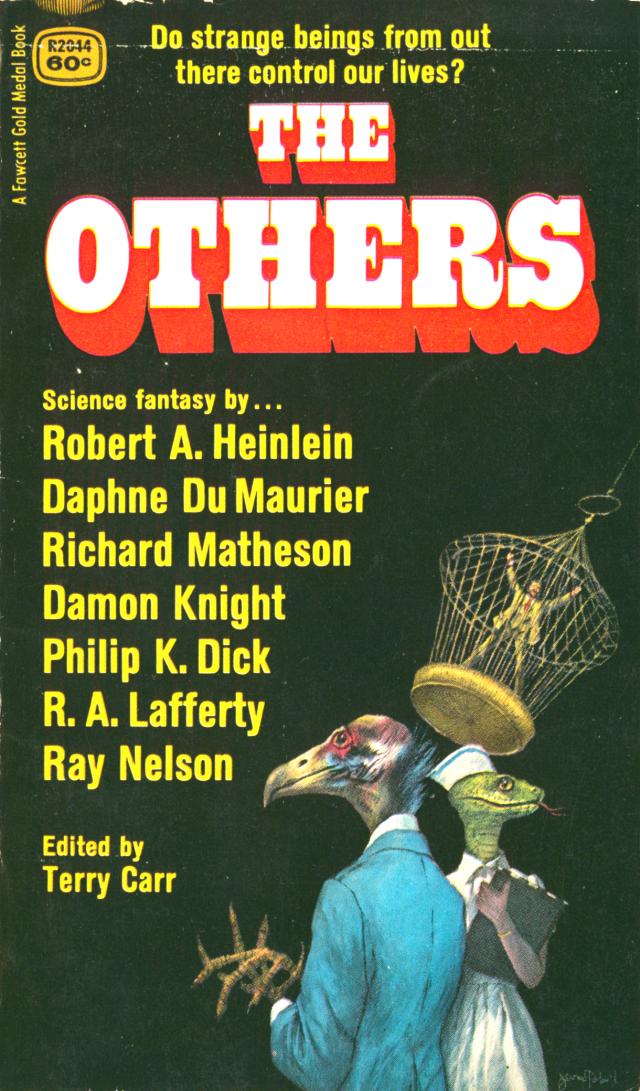
Are there other intelligent beings in the universe?
Are some of them watching us, waiting for their chance to take over?
Or are they already in control?
Disturbing and fascinating answers to these questions can be found in this masterful collection of stories by some of the world’s great writers of science fiction and fantasy.
THE
OTHERS
edited by
Terry Carr
A FAWCETT GOLD MEDAL BOOK
Fawcett Publications, Inc., Greenwich, Conn.
Member of American Book Publishers Council, Inc.
All characters in this book are fictional, and any resemblance
to persons living or dead is purely coincidental.
Copyright © 1969 by Fawcett Publications, Inc.
ROOG by Philip K. Dick. Copyright © 1952 by Mercury Press, Inc. Reprinted by permission of the author and his agents, The Scott Meredith Literary Agency, Inc., 580 Fifth Avenue,
New York, N.Y. 10036.
THE BLUE LENSES by Daphne Du Maurier. Copyright © 1959 by Daphne Du Maurier. Reprinted from The Breaking Point by permission of Doubleday & Company, Inc., and the author’s agent, John Cushman Associates, Inc.
SHIPSHAPE HOME by Richard Matheson. Copyright © 1955 by Richard Matheson. Reprinted by permission of Harold Matson Co., Inc.
EIGHT O’CLOCK IN THE MORNING by Ray Nelson. Copyright © 1963 by Mercury Press, Inc. Reprinted by permission of the author.
THE SIX FINGERS OF TIME by R. A. Lafferty. Copyright © i960 by Galaxy Publishing Corp. Reprinted by permission of the author and the author’s agent, Virginia Kidd.
BE MY GUEST by Damon Knight Copyright © 1958 by King-Size Publications, Inc. Reprinted by permission of the author and the authors agent, Robert P. Mills, Ltd.
THEY by Robert A. Heinlein. Copyright © 1941 by Street & Smith Publications, Inc. Copyright © 1969 by Robert A. Heinlein. Re-’ printed by permission of the author and the author’s agent, Lurton Blassingame.
All rights reserved, including the right to reproduce this book or portions thereof.
Printed in the United States of America
Contents:-
Roog by Philip K. Dick
The Blue Lenses by Daphne Du Maurier
Shipshape Home by Richard Matheson
Eight O’Clock in the Morning by Ray Nelson
The Six Fingers of Time by R. A. Lafferty
Be My Guest by Damon Knight
They by Robert A. Heinlein
Roog
by Philip K. Dick
“Roog!” the dog said. He rested his paws on the top of the fence and looked around him.
The Roog came running into the yard.
It was early morning, and the sun had not really come up yet. The air was cold and gray, and the walls of the house were damp with moisture. The dog opened his jaws a little as he watched, his big black paws clutching the wood of the fence.
The Roog stood by the open gate, looking into the yard. He was a small Roog, thin and white, on wobbly legs. The Roog blinked at the dog, and the dog showed his teeth.
“Roog!” he said again. The sound echoed into the silent half darkness. Nothing moved or stirred. The dog dropped down and walked back across the yard to the porch steps. He sat down on the bottom step and watched the Roog. The Roog glanced at him. Then he stretched his neck up to the window of the house, just above him. He sniffed at the window.
The dog came flashing across the yard. He hit the fence, and the gate shuddered and groaned. The Roog was walking quickly up the path, hurrying with funny little steps, -mincing along. The dog lay down against the slats of the gate, breathing heavily, his red tongue hanging. He watched the Roog disappear.
The dog lay silently, his eyes bright and black. The day was beginning to come. The sky turned a little whiter, and from all around the sounds of people getting up echoed through the morning air. Lights popped on behind shades. In the chilly dawn a window was opened.
The dog did not move. He watched the path.
In the kitchen Mrs. Cardossi poured water into the coffeepot. Steam rose from the water, blinding her. She set the pot down on the edge of the stove and went into the pantry. When she came back, Alf was standing at the door of the kitchen. He put his glasses on.
“You bring in the paper?” he said.
“It’s outside.”
Alf Cardossi walked across the kitchen. He threw the bolt on the back door and stepped out onto the porch. He looked into the gray, damp morning. At the fence Boris lay, black and furry, his tongue out.
“Put the tongue in,” Alf said. The dog looked quickly up. His tail beat against the ground. “The tongue,” Alf said. “Put the tongue in.”
The dog and the man looked at one another. The dog whined. His eyes were bright and feverish.
“Roog!” he said softly.
“What?” Alf looked around. “Someone coming? The paperboy come?”
The dog stared at him, his mouth open.,
“You certainly upset these days,” Alf said. “You better take it easy. We both getting too old for excitement.”
He went inside the house.
The sun came up. The street became bright and alive with color. The postman went along the sidewalk with his letters and magazines. Some children hurried by, laughing and talking.
About 11, Mrs. Cardossi swept the front porch. She sniffed the air, pausing for a moment.
“It smells good today,” she said. “That means it’s going to be warm.”
In the heat of the noonday sun the black dog lay stretched out full length under the porch. His chest rose and fell. In the cherry tree the birds were playing, squawking and chattering to each other. Once in a while Boris raised his head and looked at them. Presently he got to his feet and trotted down under the tree.
He was standing under the tree when he saw the two Roogs sitting on the fence, watching him.
“He’s big,” the first Roog said. “Most Guardians aren’t as big as this.”
The other Roog nodded, his head wobbling on his neck. Boris watched them without moving, his body stiff and hard. The Roogs were silent, now, looking at the big dog with his shaggy ruff of white around his neck.
“How is the offering urn?” the first Roog said. “Is it almost full?”
“Yes.” The other nodded. “Almost ready.”
“You, there!” the first Roog said, raising his voice. “Do you hear me? We’ve decided to accept the offering, this time. So you remember to let us in. No nonsense, now.”
“Don’t forget,” the other added. “It won’t be long.”
Boris said nothing.
The two Roogs leaped off the fence and went over together just beyond the walk. One of them brought out a map and they studied it “This area really is none too good for a first trial,” the first Roog said. ‘Too many Guardians…. Now, the northside area-”
“They decided,” the other Roog said. “There are so many factors-”
“Of course.” They glanced at Boris and moved back farther from the fence. He could not hear the rest of what they were saying.
Presently the Roogs put their map away and went off down the path.
Boris walked over to the fence and sniffed at the boards. He smelled the sickly, rotten odor of Roogs and the hair stood up on his back.
That night when Alt Cardossi came home, the dog was standing at the gate, looking up the walk. Alf opened the gate and went into the yard.
“How are you?” he said, thumping the dog’s side. “You stopped worrying? Seems like you been nervous of late. You didn’t used to be that way.”
Boris whined, looking intently up into the man’s face.
“You a good dog, Boris,” Alf said. “You pretty big, too, for a dog. You don’t remember long ago how you used to be only a little bit of a puppy.”
Boris leaned against the man’s leg.
“You a good dog,” Alf murmured. “I sure wish I knew what is on your mind.”
He went inside the house. Mrs. Cardossi was setting the table for dinner. Alf went into the living room and took his coat and hat off. He set his lunch pail down on the sideboard and came back into the kitchen.
“What’s the matter?” Mrs. Cardossi said. -
“That dog got to stop making all that noise, barking. The neighbors going to complain to the police again.”
“I hope we don’t have to give him to your brother,” Mrs. Cardossi said, folding her arms. “But he sure goes crazy, especially on Friday morning, when the garbage men come.”
“Maybe he’ll calm down,” Alf said. He lit his pipe and smoked solemnly. “He didn’t used to be that way. Maybe he’ll get better, like he was.”
“We’ll see,” Mrs. Cardossi said.
The sun came up, cold and ominous. Mist hung over all the trees and in the low places.
It was Friday morning.
The black dog lay under the porch, listening, his eyes wide and staring. His coat was stiff with hoarfrost and the breath from his nostrils made clouds of steam in the thin air. Suddenly he turned his head and leaped up.
From far off, a long way away, a faint sound came, a kind of crashing sound.
“Roog!” Boris cried, looking around. He hurried to the gate and stood up, his paws on the top of the fence.
In the distance the sound came again, louder now, not as far away as before. It was a crashing, clanging sound, as if something were being rolled back, as if a great door were being opened.
“Roog!” Boris cried. He stared up anxio usly at the darkened windows above him. Nothing stirred, nothing at all.
And along the street the Roogs came. The Roogs and their truck moved along, bouncing against the rough stones, crashing and whirring.
“Roog!” Boris cried, and he leaped, his eyes blazing. Then he became more calm. He settled himself down on the ground and waited, listening.
Out in front the Roogs stopped their truck. He could hear them opening the doors, stepping down onto the sidewalk. Boris ran around in a little circle. He whined, and his muzzle turned once again toward the house.
Inside the warm, dark bedroom Mr. Cardossi sat up a little in bed and squinted at the clock.
“That damn dog,” he muttered. “That damn dog.” He turned his face toward the pillow and closed his eyes.
The Roogs were coming down the path now. The first Roog pushed against the gate and the gate opened. The Roogs came into the yard. The dog backed away from them.
“Roog! Roog!” he cried. The horrid, bitter smell of Roogs came to his nose, and he turned away.
“The offering urn,” the first Roog said. “It is full, I think.” He smiled at the rigid, angry dog. “How very good of you,” he said.
The Roogs came toward the metal can, and one of them took the lid from it.
“Roog! Roog!” Boris cried, huddled against the bottom of the porch steps. His body shook with horror. The Roogs were lifting up the big metal can, turning it on its side. The contents poured out onto the ground, and the Roogs scooped the sacks of bulging, splitting paper together, catching at the orange peels and fragments, the bits of toast and egg shells.
One of the Roop popped an egg shell into his mouth. His teeth crunched the egg shell.
“Roog!” Boris cried hopelessly, almost to himself. The Roogs were almost finished with their work of gathering up the offering. They stopped for a moment, looking at Boris.
Then, slowly, silently, the Roogs looked up, up the side of the house, along the stucco, to the window, with its brown shade pulled tightly down.
“ROOG!” Boris screamed, and he came toward them, dancing with fury and dismay. Reluctantly the Roogs turned away from the window. They went out through the gate, closing it behind them.
“Look at him,” the last Roog said with contempt, pulling his comer of the blanket up on his shoulder. Boris strained against the fence, his mouth open, snapping wildly. The biggest Roog began to wave his arms furiously and Boris retreated. He settled down at the bottom of the porch steps, his mouth still open, and from the depths of him an unhappy, terrible moan issued forth, a wail of misery and despair.
“Come on,” the other Roogs said to the lingering Roog at the fence.
They walked up the path.
“Well, except for these little places around the Guardians, this area is well cleared,” the biggest Roog said. “I’ll be glad when this particular Guardian is gone. He certainly causes us a lot of trouble.”
“Don’t be impatient,” one of the Roogs said. He grinned. “Our truck is full enough as it is. Let’s leave something for next week.”
All the Roogs laughed.
They went on up the path, carrying the offering in the dirty, sagging blanket.
The Blue Lenses
by Daphne Du Maurier
This was the day for the bandages to be removed and the lenses fitted. Marda West put her hand up to her eyes and felt the crepe binder and the layer upon layer of cotton wool beneath. Patience would be rewarded at last. The days had passed into weeks since her operation, and she had lain there suffering no physical discomfort but only the anonymity of darkness, a negative feeling that the world and the life around were passing her by. During the first few days there had been pain, mercifully allayed by drugs, and then the sharpness of this wore down, dissolved, and she was left with a sense of great fatigue, which they assured her was reaction after shock. As for the operation itself, it had been successful. Here was definite promise. A hundred percent successful.
“You will see,” the surgeon told her, “more clearly than ever before.”
“But how can you tell?” she urged, desiring her slender thread of faith to be reinforced.
“Because we examined your eyes when you were under the anaesthetic,” he replied, “and again since, when we put you under for: a second time. We would not lie to you, Mrs. West.”
This reassurance came from them two or three times a day, and she had to steel herself to patience as the weeks wore by, so that she referred to the matter perhaps only once every twenty-four hours, and then by way of a trap, to catch them unawares. “Don’t throw the roses out. I should like to see them,” she would say, and the day nurse would be surprised into the admission, “They’ll be over before you can do that.” Which meant that she would not see this week.
Actual dates were never mentioned. Nobody said, “On the fourteenth of the month you will have your eyes.” And the subterfuge continued, the pretense that she did not mind and was content to wait. Even Jim, her husband, was now classed in the category of “them,” the staff of the hospital, and no longer treated by her as a confidant.
Once, long ago, every qualm and apprehension had been admitted and shared. This was before the operation. Then, fearful of pain and blindness, she had clung to him and said, “What if I never see again, and what will happen to me?” picturing herself as helpless and maimed. And Jim, whose anxiety was no less harsh than hers, would answer, “Whatever comes, we’ll go through it together.”
Now, for no known reason except that darkness, perhaps, had made her more sensitive, she was shy to discuss her eyes with him. The touch of his hand was the same as it had ever been, and his kiss, and the warmth of his voice; but always, during these days of waiting, she had the seed of fear that he, like the staff at the hospital, was being too kind. The kindness of those who knew toward the one who must not be told. Therefore, when at last it happened, when at his evening visit the surgeon said, “Your lenses will be fitted tomorrow,” surprise was greater than joy. She could not say anything, and he had left the room before she could thank him. It was really true. The long agony had ended. She permitted herself only a last feeler, before the day nurse went off duty—“They’ll take some getting used to and hurt a bit at first?”—her statement of fact put as a careless question. But the voice of the woman who had tended her through so many weary days replied, “You won’t know you’ve got them, Mrs. West.”
Such a calm, comfortable voice and the way she shifted the pillows and held the glass to the patient’s lips, the hand smelling faintly of the Morny French Fern soap with which she washed her, these things gave confidence and implied that she could not lie.
“Tomorrow I shall see you,” said Marda West, and the nurse, with the cheerful laugh that could be heard sometimes down the corridor outside, answered, “Yes, I’ll give you your first shock.”
It was a strange thought how memories of coming into the nursing home were now blunted. The staff who had received her were dim shadows, the room assigned to her, where she still lay, like a wooden box built only to entrap. Even the surgeon, brisk and efficient during those two rapid consultations when he had recommended an immediate operation, was a voice rather than a presence. He gave his orders and the orders were carried out, and it was difficult to reconcile this bird of passage with the person who, those several weeks ago, had asked her to surrender herself to him, who had in fact worked this miracle upon the membranes and the tissues which were her living eyes.
“Aren’t you feeling excited?” This was the low, soft voice of her night nurse, who, more than the rest of them, understood what she had endured. Nurse Brand, by day, exuded a daytime brightness; she was a person of sunlight, of bearing in fresh flowers, of admitting visitors. The weather she described in the world outside appeared to be her own creation. “A real scorcher,” she would say, flinging open windows, and her patient would sense the cool uniform, the starched cap, which somehow toned down the penetrating heat. Or else she might hear the steady fall of rain and feel the slight chill accompanying it. “This is going to please the gardeners, but it’ll put paid to Matron’s day on the river.”


