The mercy makers, p.1
The Mercy Makers, page 1


This book is a work of fiction. Names, characters, places, and incidents are the product of the author’s imagination or are used fictitiously. Any resemblance to actual events, locales, or persons, living or dead, is coincidental.
Copyright © 2025 by Tessa Gratton
Excerpt from Six Wild Crowns copyright © 2025 by Holly Race
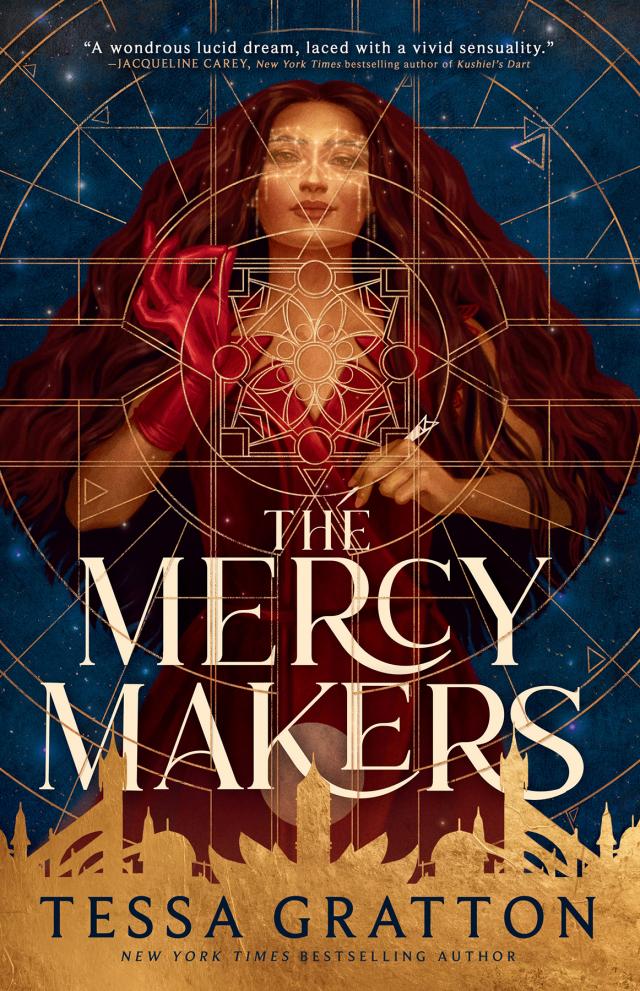
Cover design by Stephanie A. Hess
Cover illustration by Eleonor Piteira
Cover copyright © 2025 by Hachette Book Group, Inc.
Map by Tim Paul
Author photograph by Natalie C. Parker
Hachette Book Group supports the right to free expression and the value of copyright. The purpose of copyright is to encourage writers and artists to produce the creative works that enrich our culture.
The scanning, uploading, and distribution of this book without permission is a theft of the author’s intellectual property. If you would like permission to use material from the book (other than for review purposes), please contact permissions@hbgusa.com. Thank you for your support of the author’s rights.
Orbit
Hachette Book Group
1290 Avenue of the Americas
New York, NY 10104
orbitbooks.net
First Edition: June 2025
Orbit is an imprint of Hachette Book Group.
The Orbit name and logo are registered trademarks of Little, Brown Book Group Limited.
The publisher is not responsible for websites (or their content) that are not owned by the publisher.
The Hachette Speakers Bureau provides a wide range of authors for speaking events. To find out more, go to hachettespeakersbureau.com or email HachetteSpeakers@hbgusa.com.
Orbit books may be purchased in bulk for business, educational, or promotional use. For information, please contact your local bookseller or the Hachette Book Group Special Markets Department at special.markets@hbgusa.com.
Library of Congress Control Number: 2025932663
ISBNs: 9780316578790 (trade paperback), 9780316578806 (ebook)
E3-20250422-JV-NF-ORI
Contents
Cover
Title Page
Copyright
Dedication
Map
Falling 1: Strand of silk
2: The Little Cat’s daughter
3: Prison
4: The Little Cat’s apostate
5: Hypotheticals make the world go round
6: The red moon
7: Establishment
8: Engagement
9: A slip of silk
10: The Moon-Eater’s Mistress
Flow 11: The little cat
12: Poor fairy
13: The numen
14: The beautiful twilight
15: Between the sun and the memory of the sun
16: The cult of Silence
17: Shades of brutality
18: Girls’ night
Ecstatic 19: The demon of beauty
20: Apostasy
21: Every kind of courage
22: Essentially
23: Through with around toward
24: Euphemisms
25: About mercy and its costs
26: The Day of Final Mercy
27: We pay for what we do
28: Graffiti
29: Unrest
30: The nature of empire
31: Even the red moon fell from the sky
32: The lie of love
33: The last thread of silk
34: The assassin
Rising 35: The mouth of chaos
36: Bittor
37: Husband and wife
38: Sunderer
39: Always binding
40: The craftmask
Acknowledgments
Discover More
Extras Meet the Author
A Preview of Six Wild Crowns
To everyone who remembers what radicalized them
Explore book giveaways, sneak peeks, deals, and more.
Tap here to learn more.
FALLING
Without Silence, there is nothing to break.
—Word of Aharté
Strand of silk
High above the sharp-edged palace of the Vertex Seal, the moon hangs motionless.
And far beneath it, a young god struggles.
There is a line in the sister works Word of Aharté and Writings of the Holy Syr that has been debated for nearly all the centuries since the two pamphlets were published. In Word of Aharté, the line reads: “My empire will fall on a strand of spider silk.” In Writings, the line is: “Can an empire trip and fall on a mere strand of silk?” The prophetic tone of the former stands out in the otherwise practical Word, while the irreverent humor of the latter is typical of Writings. What strikes scholar-priests most deeply is that both Aharté and the Holy Syr would comment so specifically on the same thing, but as if they disagreed on those very specifics.
It is not a translation issue, for both works were composed in pure mirané—the first known examples, in fact. Perhaps it is a conversation between the goddess and her wife that they continued in the pages. Though the Holy Syr explained so many of Aharté’s laws to us in her Writings, we are supposed to put faith in the goddess’s word over that of her wife, given that she is a goddess. But you know it is not spider silk that brings down the Vertex Seal.
An alarum trembles through the glazed-brick walls of the hidden fortress of Isidor the Little Cat, but his daughter, Iriset mé Isidor, does not hear it.
Tucked down against the geometric tiles in her workshop, she carefully lifts her crystal stylus, drawing a line of force up from her planning vellum into the air. She holds her breath as she completes the connection of this corner line to the seventh squinch supporting the dome of the spell.
A prodigy at architectural design, she discovered by the age of thirteen how to disrupt the threads of force humming through the walls without the use of null wires, creating a workspace devoid of interference. It is convenient when building an intricate scale diagram for a new invention—much less so when under attack from soldiers of the Vertex Seal.
The delicate dome she’s building vibrates with ecstatic force, signaling she’s completed the internal structure correctly. Iriset releases her breath and smiles smugly, leaning back onto her bare heels. Sweat drips down her spine to the loincloth she wears to work; she prefers as much of her skin open to the air as possible, in order to feel the slightest change in the forces around her. The nape of her neck, inner wrists, and small of her back are particularly sensitive, and so, she’s recently discovered, are her lips. Her mask is folded beside her knee, along with her red robe, jacket wrap, and pantaloons.
The design diagram is beautiful.
Exquisite lines of shimmering silver architecture display the plan for a low, wide dome built of all four forces—rising, falling, ecstatic, and flow—that are the basic elements of her craft. The dome is meant to be settled over a small-scale model of Moonshadow City, and when connected to the Holy Design via illegal interface, it will reveal the places where architecture has shifted or changed since last the dome was applied, and therefore reveal where new security measures are set to capture her father.
Just in time for his birthday.
The door to her study jerks open. Hard alarum threads sweep inside, buzzing along the tile floor. Iriset shrieks and reaches out, trying to capture the alarm before it hits the first edge of the diagram, but her bare hands can’t grasp the threads. “Bittor!” she snaps as the structure collapses in upon itself, dome wavering first, then unraveling. “You always knock when I’m working! You know that! You…”
Her gaze meets the dilated cat-eyes of the man panting in the arched doorframe. There is blood on his face, and blood on his unsheathed sword.
The hairs on Iriset’s arms and neck and small of her back rise: the alarum! Now that the study is breached, she hears pounding chaos from the stairway beyond Bittor. A shock of fear freezes her in place on hands and knees.
Bittor charges inside. “Give me your silk glove,” he orders. In his left hand is a burning candle.
Iriset grabs her red robe and throws it over her head, then shoves her arms through the tight sleeves. Bittor never commands her! He has no right. “Why? What’s happened?”
Instead of answering, he stalks directly to the north curve of her study wall and puts the candle flame to the lowest of the layered orb webs.
The spiderwebs catch in a flash, curling in on themselves and drifting suddenly unattached from the white tile walls. She sees the fat-bottomed spiders scurrying for safety, but Bittor is faster, smashing them with the butt of his sword.
“What are you doing? Leave them alone!” Iriset yells.
“Your silk glove, now,” Bittor says, sparing her a fast glance before putting the flame to a cluster of scrolls and half-sketched diagrams piled upon a kneeler. “And put on the rest of your clothes! Get two floors up to the blue landing. The army has taken your father, and you cannot be found in here with the designs. Is your spider mask here?”
“Father…” she says, slowed down by the crisp smell of her work turning to ashes. Rising force fills the air, stifled by tarnishing smoke. A scream sounds outside the room, and a huge tremor shakes the tower. Iriset leaps for her low desk and grabs up the glove woven of spiderwebs and the finest worm silk. She clutches it to her chest, nails digging too roughly into the delicate material. It’s her greatest invention, and Bittor is setting her work on fire. Grief grabs at her when she looks at the smears on th
Bittor says, “Give it to me and go, Iriset.” He sweeps everything off her desk, kicks a floor pillow and raggedy braided rug into the pile, and drops the candle into it all. A smolder begins immediately.
Iriset stares at the disaster blossoming around her. There in the pile, knocked off her desk, is the glinting black spider mask. Fire reflects wildly the facets of the lower eyes. It won’t get hot enough to crack the chips of smoky quartz, but the glue will melt.
“Isidor said I should tell you, ‘Sign Amakis,’” Bittor says.
The code is a slap across her mouth. It’s her mother’s name, and by invoking it, Isidor invokes the bond Iriset swore when she turned seventeen, in order to remain in his court as an adult. She swore to protect herself above all else.
Bittor steps close and takes the silk glove. Then he kisses her. Surprise opens her mouth under his, and she gasps at his lips. Bittor rarely instigates. Quickly she puts her hands to his jaw and kisses back. It might be the last time, if the day doesn’t go well for them.
Though in the Little Cat’s court it is known they are friends, if not that they are lovers, outside Iriset and Bittor could easily be mistaken for born family: Both are colored like dark desert peaches, with pink lips and the square jaw of the Lapis Osahar dynasties. While her eyes are sandglass brown, Bittor has rare cat-eyes, with slit pupils and vivid sea-green-blue irises filling most of the space between his lids. Hundreds of years ago apostatical human architects designed the eyes for one of Bittor’s ancestors, and unlike most apostasy, this manipulation bred true through generations, popping up here and there. The Silent priests determined the children are at no fault for the apostasy of their ancestors and are thus allowed to live. But Bittor’s gaze is disconcerting to say the least. He doesn’t mind, as his eyes give him a boost as a night-thief and escape artist. Iriset has tried to examine them with her stylus when he is most relaxed, postcoital. Bittor says it’s one thing for her to seduce him in order to study his masculine-presenting body and how the four forces interplay within him during sex; it’s quite another for her to act like she’s eager to dissect him.
Bittor pushes away. He stares at her, pupils narrowing to slits as the fire grows behind her. “When they take you,” he orders, “make sure everyone knows you are the daughter of Isidor the Little Cat, and you won’t be harmed. Not by the Vertex Seal, not by your fellow prisoners.”
Iriset sets her teeth. Bittor is the Little Cat’s escape artist: He’ll have a way out. “Why can’t I go with you?”
“That isn’t his command,” Bittor says simply.
Nobody will go against her father except her. She says, “They have my father already?”
Bittor nods, and frowns beneath his thin beard. His voice is low as he says, “There is nothing you can do, and you can’t get down to the street. They are below us, on nearly every level, surrounding the whole Saltbath precinct, and brought with them investigator-designers who drove hard falling forces down through the streets in case we had tunnels. They knew, Iriset.” Darkness colors his cheeks and he bares his teeth helplessly.
“Someone betrayed us,” she says calmly. Too calmly.
Bittor ignores it. “Do not let them think you know what you know of design.”
“I know what I am bound to protect,” Iriset says. Herself. She’s not allowed to protect her father or Bittor, nor any of the cousins of the court. She must prioritize her own life, not claim her mask-name. She must allow fire to strip away all the evidence of her discoveries. Rising force inside Iriset lifts painfully, a yearning pressure.
Bittor kisses her again, and then pushes her toward the door. “Go, Iriset.”
Iriset snatches her clothes and red silk mask off the floor and obeys.
The air outside the study is cool with morning breezes from the windcatchers carved into every level of the tower, but that wind brings sounds of battle and desperation: steel clashing and cries of pain, the shaking of stone and ecstatic force. Iriset dashes to the wide spiral stairs up and up along the outer edge of the tower. Her bare toes hardly touch the limestone bricks, and her fingers skim along the smooth white stucco walls, until she spills up into the blue landing.
Untouched yet with violence, the landing is a small sitting area with two levels: one of perfect mosaic tiles in the shapes of blue gentians, the second layered with rugs and pillows in every shade of blue beside a huge lattice window spanning nearly half the entire curved wall. The glittering lattice snakes that usually wind through the cutouts, soaking in sunlight, are nowhere to be seen. Hiding, she hopes, sparing another brief thought for her poor dead spiders.
Iriset sits hard on the second level and pulls on her pantaloons, knotting them around her waist under her robe, and adjusts the laces at her ankles. She shoves her arms into the short jacket and ties it under her breasts, but loosely in case she needs to run or scream or fight. Finally, she pins the red silk mask to her hair, tucking it up so that a quick tug will let it fall over her eyes.
By now Iriset hears voices just below, methodical and ordered: soldiers searching the levels of the tower.
She stands. Through the soles of her feet she feels the tower’s architecture trip and startle. Fear disrupts her body’s design, an influx of ecstatic energy. She’s unused to being afraid under either name she’s used: Safe as Isidor’s daughter, coddled by murderers and thieves. Safe as Silk, too, thanks to her own skills and the Little Cat’s favor. Now Iriset needs to balance her inner design for calm. Fear serves nothing once its warning is made.
Hard boots clomp up the stairs to the landing.
She is Iriset mé Isidor, and even in his absence she will make her father proud.
Her father, so tough and sly he rules the Moonshadow City undermarket. He is slight and wiry, hardly larger than her, yet he commands respect through his reputation and deeds. He would not give Iriset sympathy, were he here, but snap at her to lift her chin and face the consequences of their choices with eyes clear. Wear her mask demurely, be what he needs her to be in that moment—a daughter sheltered and no threat to the empire. Keep her criminal identity secret. Survive what comes next so that she can make better, slyer choices in the future.
Just as the first soldier’s head appears in the well, Iriset jerks the red edge of her mask down. It brushes her nose and falls just to her lips.
The world turns hazy red as she peers through the thin silk.
The soldier’s own cloth mask wraps tight around their hair and face, leaving only a slit for their eyes, a blatant white that continues down in a uniform of lacquered armor over a short white robe and pants and thick boots: all clearly displaying the crimson splatter of their work. Their short sword is dark with smears of it. Behind them come more soldiers, identical in uniform and size, who stop around Iriset in a half ring. One says, in an impatient fem-forward voice, “Who are you, girl?” The speaker’s eyes are black, the slit of skin visible a darker brown than her companions’. None are the mirané brown of Moonshadow’s ruling ethnicity.
“Iriset mé Isidor,” she says boldly.
“The Little Cat has a daughter?” one of the other soldiers says.
Iriset doesn’t move.
The woman soldier darts a hand out and Iriset recoils, expecting a slap, but the woman only rips the mask off her face.
Anger flushes rising force up her spine, and Iriset struggles not to show it. If this woman will not give her the little respect of the mask, what else might be taken from her?
“Get her out of here,” the commanding soldier says, and her soldiers obey with grabbing, hard hands, dragging Iriset down the spiral stairs.
This is what Iriset does not know about the attack on the Little Cat’s tower: The city army of the Vertex Seal has been targeting her specifically for over a year. Or rather, targeting Silk.
Rumors of Silk’s existence have filtered through the gossip of the small kings of the Holy City for nearly seven years now. She is said to be a prodigy at design who invented a wondrous—and proprietary—material called craftsilk that every architect in Moonshadow would like to get their hands on. But Silk doesn’t share. She works exclusively for the Little Cat, and rumors accuse her of everything from creating design nets for cheating at cards to illegal human architecture that can disguise the features of Isidor’s thieves and spies so they can slip into the halls of power or infiltrate a rival’s bank. Some say Silk can cause a heart attack with a kiss of ecstatic force, others that she merely helps the Little Cat toy with his prey, using tricks of flow to keep a rival awake for questioning or wearing a mask of a Seal attendant’s face to whisper here and there, shifting the tides of scandal. Perhaps she is a rumor only, or an amalgam of several talented designers in the Little Cat’s employ. The latter opinion held the most favor for a while, until Silk herself began publishing brief, passionate papers that edged extremely near a pro-human-architecture stance. In the third paper she directly refuted the rumors she was several people.