

Edmond hamilton, p.1
The Wheel of Fortune, page 1


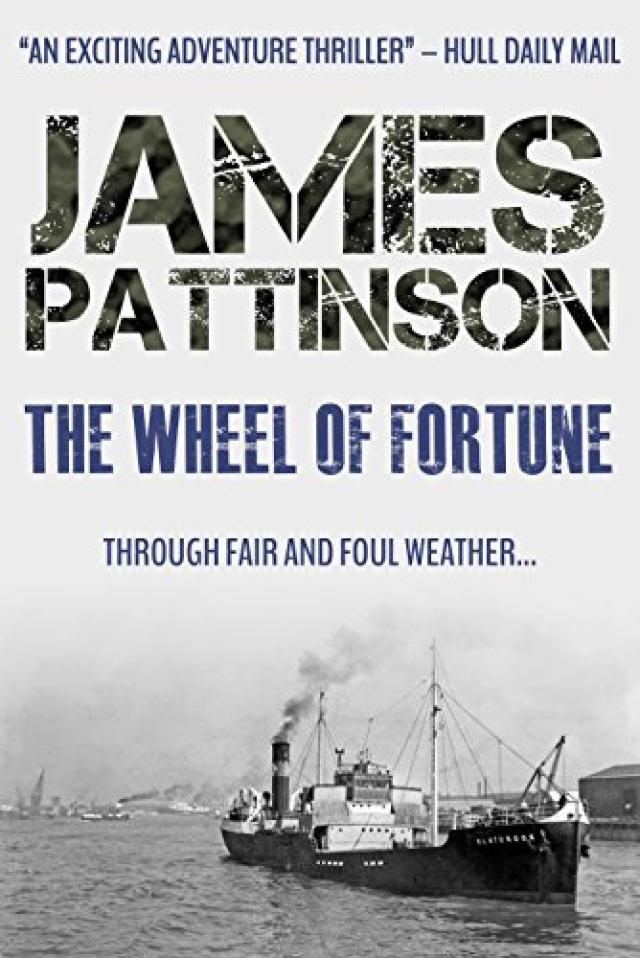
The Wheel of Fortune
James Pattinson
© James Pattinson 1955
James Pattinson has asserted his rights under the Copyright, Design and Patents Act, 1988, to be identified as the author of this work.
First published in 1955 by George G. Harrap & Co. Ltd.
This edition published in 2018 by Endeavour Media Ltd.
Table of Contents
CHAPTER I
THE STEEP ATLANTIC STREAM
CHAPTER II
AT FIRST SIGHT
CHAPTER III
THE WORLDLY HOPE
CHAPTER IV
THE STORM-BLAST
CHAPTER V
A BOOK OF VERSES
CHAPTER VI
THE DRUNKEN SAILOR
CHAPTER VII
THE EXPERT
CHAPER VIII
BOUND FOR RIO GRANDE
CHAPTER IX
SWEET MUSIC
CHAPTER X
A FEW PATERNAL ACRES
CHAPTER XI
BUMP IN THE NIGHT
CHAPTER XII
HIS SIGHTLESS SOUL
CHAPTER XIII
IN A GAOL
CHPTER XIV
THE GOOD SHIP
CHAPTER XV
A WIDE, WIDE SEA
CHAPTER XVI
THE MIRACLE
CHAPTER XVII
COMPANIONS GONE
CHAPTER XVIII
THE BLUE SKY
CHAPTER I
THE STEEP ATLANTIC STREAM
It was the Western Ocean rolling to meet them with the west wind driving it. It came in a long swell, grey under the grey sky; it put its shoulder to the Wheel of Fortune, as though it would force her back the way she had come, back along her own trail of churned-up water, back past Malin Head and the Mull of Kintyre, the Isle of Man and the Crosby lightship, over the Mersey bar and into that same Liverpool dock from which she had sailed.
But the Wheel of Fortune was an old hand at that game; she had played it so many times and in so many oceans; wind and wave might beat against her, but she would press onward, ever on beneath the restless thrusting of her propeller. She was tireless, a wanderer, tied to no sea-lanes, no well-marked lines upon the surface of the globe: a tramp, with all the tramp’s erratic movement, here one day, the next vanished like a migrating bird.
The wind was boisterous and cold; it flicked the high heads of the advancing waves and turned them with a miracle of sudden age into white-haired ancients, Old Men of the Sea tossing their hoary manes threateningly and breathing with a damp, salt breath that was the blown spume.
John Baxter felt that chilling breath upon his cheek, and it set the blood tingling in his veins. He rested his elbow on the iron bulwark and, gazing out across the broad expanse of white-flecked sea, was glad, even exultant, knowing that this was what he had so long desired.
“Western Approaches!” he muttered; and his mind went back to the days when he had watched from the heaving deck of a destroyer the convoys moving in: the long, slow columns of ships loaded with arms and food for a beleaguered and defiant island, the tankers wallowing, half awash, with the deadliest of cargoes — high-octane petrol, ready at a touch to vomit skyward in a billow of smoke and flame. What a game it had been, keeping them in position, coaxing, threatening, chaffing them. “Move up, Clover Leaf; you’re lagging!” “Could you make less smoke, Excelsior? What’s that you’re burning — old rope?” Mothering, guiding, protecting them; feeling for those slow grey ships an affection, hating to lose them, taking such loss as a failure, a stain upon the record.
But that had all ended five years ago. Lord! How the time had slipped away! Now ships passed alone and unmolested across the Atlantic, and there were no longer any convoy regulations to plague such vessels as the Wheel of Fortune carrying her four or five thousand tons of cargo whither she might desire.
Yet the Western Ocean had not altered: it was still the same, unpredictable, a creature of strange moods and passions, now towering in a frenzy of uncontrollable rage, now smiling with all the unctuous guile of the hypocrite who hides the evil of his nature beneath a smooth and bland exterior.
“A graveyard,” said Laratee; “full of bones and dead ships. What if they was all to come to the surface — all at once? My God! what a show it’d be! All them thousands of ships, all them tens of thousands of poor drowned sailors. And there’s a many of ’em I’d know too — shipmates what’ll never sail in no more ships — not in this world, anyhow.”
John Baxter passed a hand over his short fair hair and felt it damp, sticky with salt. “Viking blood,” his father had once said to him; “that’s what you’ve got in you.” Well, perhaps it was so; that blood filtering down through centuries of breeding from some Scandinavian ancestor, giving him his strong, big-boned frame, his blue eyes and blonde head.
And there was the contrast with Laratee, a contrast in almost every respect. Laratee was grotesque; there was a lack of proportion about him. Scarcely more than five feet in height, he was so thin that one might have thought his body was just a bundle of sticks held together by clothes. Yet on top of this frail pedestal was set a monstrous head. Perhaps on a six-foot man it would not have appeared so large, so abnormal; but on Laratee it was like a sculptured caricature.
His hair was black, thick and curly, lapping his brow like a great tide of frothing ink. Black, too, were his eyes, set deep below cheek-bones that stood up like two rocky eminences from the graven plain of his thin face. It was a face which seemed to have no flesh to it. It was as though an envelope of skin had been stretched tight over the framework of bones; they showed through it everywhere from the pointed tip of his chin to the hard bulge of his forehead. Yet the face had character, though it were but the character of suffering.
And these two men shared a cabin eight feet square.
Baxter was not truly a seaman, not as was Laratee, who from the days of his youth had known no other life. Baxter had come to it under the stress of war, and when war ended he had gone back to a job that was as far removed from seafaring as could well be imagined. In the normal course of events the years he had spent as a naval rating would have been no more than an interlude in a life predestined to be devoted to the cause of banking.
His father was a bank manager; his grandfather had held a similar post. In the bank were uncles and cousins. Inevitably when he left the Navy it was to the bank that he returned, to the task of counting money, stamping cheques, recording other men’s fortunes.
But, having tasted the excitement and ever-changing interest of that other existence forced on him by war, he found in this peace-time way of living a lack of something essential to his spirit. The four walls of the bank seemed a prison cutting him off from all that should give to life a zest and brightness. He resolved to escape.
His father was surprised, perhaps a little disappointed; but he attempted no dissuasion.
“I suppose you know what you’re doing, John. You’ve thought it over carefully?”
“Very carefully.”
“Well — ” The older man seemed rather at a loss. This was a thing that had never happened before; it was difficult to understand. “Well,” he said, “I hope you don’t regret it later.”
John said, “I don’t think I shall.”
His father crossed to the window and stood looking out into the garden. He could not understand why anyone should wish to leave the bank, which was secure, unshakeable, like the house founded on a rock. So secure; so absolutely secure. He failed to realize that to some this very security might be as a blanket, stifling, suffocating, to be cast off at all costs.
“The chrysanthemums are looking well,” he said. “It’s a good year for chrysanthemums.”
He turned and gazed again at his son, and John saw the puzzled frown puckering his forehead, drawing the skin into folds like ribbed velvet.
“If you get to Cape Town,” he said, “look up old George Denton, won’t you? Give him my regards. Always meaning to write to him. Never seem to have the time. So much to do; such a lot. Not troubled with sea-sickness, are you? Lucky. I remember crossing the channel — now when would that be? Years ago — before you were born probably. But your mother never was sick — used to enjoy it — I never could.”
He went to the window again.
“Never seen better chrysanthemums — never.”
With Constance it was different — and more difficult. It had always been understood that he was to marry Constance. Every one took it for granted. Their names were always coupled — Connie Legge and John Baxter; they were invited to the same parties; they partnered each other at tennis, went to shows together. It was a photograph of Constance that John had carried in his wallet on active service, to her that he had written and from her that he had received his most regular mail. Like everyone else he had supposed that eventually he would marry her, and it had never occurred to him to look deeply into his own heart and ask the question, “Do I really love her?” That also had been taken for granted.
Constance was rather like the bank — secure, something you came back to after the War. Unlike the bank she raised objections to his second departure.
“You mean you’re going to be a common seaman?”
“If any seaman is common, yes.”
Constance had a classic beauty of feature — some called her a Grecian type — but the outlines of her figure were inclined to flatness.
“Do
“No.”
“But surely it is ridiculous to throw up your career and run away to sea. I suppose you think it’s romantic.”
“It’s not exactly running away to sea, as you put it. I’m going back to sea. If I wasn’t a trained sailor I don’t suppose I could do it. Things are not like the old days; you have to know the job; there’s a seamen’s pool, trade union — it’s all different”
She snapped her fingers impatiently. “Have you considered my feelings at all? Am I supposed to be perfectly contented waiting for you to come back?”
Baxter felt a twinge of conscience. Perhaps he was not being quite fair to Constance. She was twenty-five, getting on for twenty-six; no doubt she was keen to be married and now saw her hopes fading into the distant future.
He said lamely, “I’ll be coming back. Don’t worry.”
Her lips were cold when he kissed her, and her body was tense in his arms, almost hard.
“Don’t worry,” he repeated. “I’ll come back, Connie.”
It embarrassed him to see the tears trickling down her nose. He had not seen her weep before, had never supposed her capable of so much emotion. The fact that he was unable to experience an equal distress at the parting made him feel guilty.
When Baxter joined the Wheel of Fortune it was Laratee who showed him the way about, helping him to fit into the new mode of life. He would always be thankful to the little man for that.
But it was not Laratee that he encountered first; it was Connell, the bos’n. Connell saw him mounting the gangway and came down the boat-deck ladder at a run.
Connell was tall, with a hunch to his shoulders, so that his hands hung down in front of him like bunches of bananas starting to go rotten. He weighed about thirteen stone, but he did not look heavy because of his height and his leanness. He was compressed, a man of bone and muscle and sinew.
Then there was the colour of him; he was a red man; red hair crept from under his peaked cap, red eyebrows sprouted ferociously like spiky grass, and a red moustache straggled above and around his mouth. It was difficult to judge his age; he might have been fifty; he might have been considerably more.
When he spoke the voice came almost as a shock; it was incongruous; it did not fit the man.
“You joining ship?” he asked; and the voice was high and fluting, like a voice that has started to break and has become lost half-way — the voice neither of a man nor of a boy.
He looked at Baxter with his pale, faded eyes, searching out the lineaments of this new face. Then his gaze dropped to Baxter’s hands, and there was a movement under the moustache which might have been a lip raised sneeringly.
“What’s your name?”
“Baxter.”
“Baxter!” He repeated the name in his fluting voice, but he did not lift his gaze.
“You don’t look like a seaman to me.”
John guessed what he meant. The hands on which the bos’n’s gaze was fixed were soft and white; there was no grime under the nails, no callosity in the palms, none of the scars of rough work. They were the hands of a clerk, of an office worker, and to Connell that seemed contemptible. Suddenly John was ashamed of those hands, as though they had been disfiguring blemishes. He wanted to hide them.
“I have been ashore for some time.”
Connell repeated this statement, changing the person. “He’s been ashore for some time.”
Then he said, “You don’t talk like a seaman neither.” John answered nothing to this, and after a while Connell ceased to stare at the hands and began to walk away. Over his shoulder he fluted: “I expect you’ll share Laratee’s cabin — midships. There’s no spare bunks aft.”
There was a doorway in the midships accommodation leading to a passageway with white-painted sides and bright red under foot. As John stepped inside, as his shoes clattered on the deck, there touched his nostrils that strange mixed odour which he felt would always be to him as the very breath and essence of life at sea. It was an odour concocted of hot oil, fresh paint, and rich cooking, and it came fanning up from the inside of the ship, warm and pungent as the breezes of the Spice Islands.
There was a man coming up the passage. He had a sweat-rag knotted about his neck, and his face was smeared with oil.
“I’m looking for a fellow called Laratee,” Baxter said. “Can you tell me which cabin is his?”
The man pushed greasy fingers through his hair. “Sure I can, mate. Here, I’ll show you.”
He turned and went back a little way, knocked sharply on a white-painted door, turned the handle, and pushed it open. “Larry,” he said. “Here’s some one to see you.”
That was how John first saw Laratee, with his great head and black startled eyes. Like an animal, he thought, surprised in its lair. Laratee had been in the act of rolling a cigarette, and he paused with the paper open in his fingers and the dark, stringy tobacco lying ready upon it. He looked scared, frightened into immobility, a petrified, staring doll.
“May I come in? I believe I’m to share this cabin.” Laratee relaxed suddenly, and his fingers came to life, rolling the cigarette with mechanical precision.
“Oh, yes — yes, a’ course.”
He put the cigarette in his mouth and helped to lift Baxter’s suitcases over the raised threshold. Then he closed the door. “You’re coming with us? You’ve signed on?”
“Yes.”
He looked at John, forgetting to light the cigarette, fingering the black stubble on his chin. He looked at John’s hands, as the bos’n had done, and though he said nothing it was obvious that he too guessed that here was a man new to the life of a merchant seaman.
He stepped across the room and opened one half of a steel wardrobe that reached from the floor almost to the ceiling.
“This is yours,” he said.
He closed the wardrobe door and pointed to two drawers fitted beneath the bunks.
“One of those is yours as well. I’ve got the bottom bunk at present, but if you want it, that’s okay. Just say the word an’ I’ll shift. No trouble.”
John shook his head. “No, no; you keep the bottom one. The top one will do me quite well.”
“You’re sure? I can easy change — easy.”
He seemed eager to ingratiate himself. His fingers were trembling, as though from a passionate desire to please. It was rather like a dog fawning on its master. John felt that it was vaguely distasteful.
“I’ll take top bunk.”
“Just as you like,” said Laratee, “just as you like. I’d’ve shifted.”
Suddenly the tobacco-smoke got into his wind as he lit his cigarette, and he began to cough. Spots of colour appeared in his cheeks, and the water came into his eyes. Then he stopped coughing and remarked:
“They’ve given you a rummy sort of a devil for a cabin-mate. Oh, yes, a rummy sort, an’ no mistake.”
John was to remember those words often in the months that followed. He was to realize just how true they were. Laratee was indeed a strange cabin-mate.
The Wheel of Fortune pushed on through the hills and valleys of the ocean, butting the waves with her iron horn, casting the foam away to port and starboard of her black-painted hull. And suddenly, low in the western sky, the sun broke through in all the bright red glory of its dying embers. Streaks of sunlight lay like bars of gold upon the turbulent breast of the sea, touching the wave-tips with gilded scintillations, so that they shivered and danced and glittered like stars that had dropped out of the sky and been caught up in a great heaving net. But soon the lower rim of the sun had dipped beneath the horizon, and, quenched by the leaping waves, its fire became a glow, dull and sullen. And soon, very soon, it had gone, leaving only as the mark of its passage a blush upon the cheeks of the western clouds, as though perhaps they had ventured too near the heat and had their faces scorched.
“Come on,” said Laratee. “Come and get some grub.”
CHAPTER II
AT FIRST SIGHT
Captain Haggard was by way of being a deity. From the crew he was remote, a mind directing the ship, a mind with which they had no intercourse. He was a tall, spare figure with an effect of stillness that was somehow impressive. There were no gestures about him; his hands rarely seemed to move from the pockets of his jacket or oilskin, and his feet were so accustomed to the slope and movement of a deck that he never appeared to be thrown off-balance even in the heaviest weather.


