

H l gold ed, p.1
H L Gold (ed), page 1


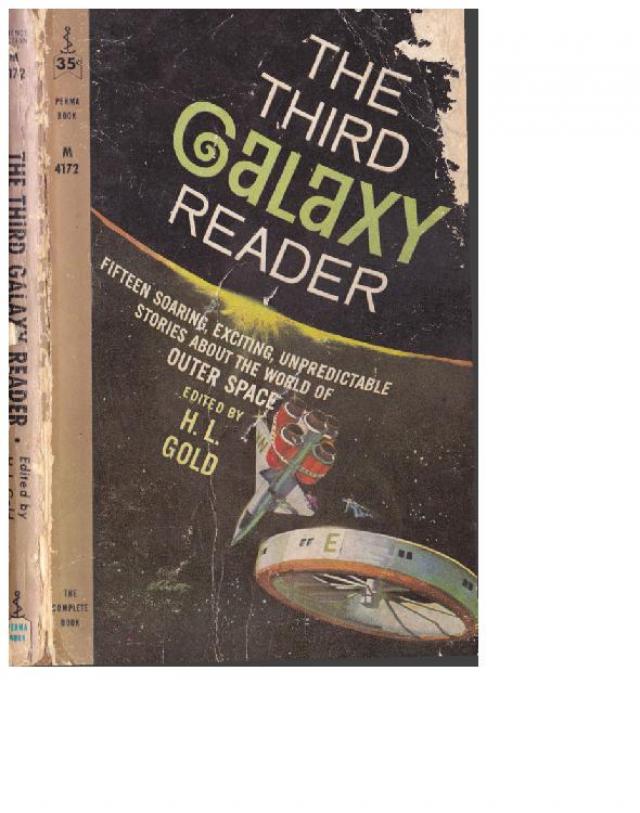
Program Notes
There is no way of setting the birth date of science fiction. Some authorities claim that Plato was the father. Other authorities trace paternity back to Homer, the Bible.
All authorities on science fiction are not authorities to all other authorities.
When the haystacks are finally scattered and the shining needle bearing the birth date of science fiction is triumphantly held aloft, it will stay aloft only long enough to be thrust into one footnote or another.
No matter. We’re not concerned with that dim-distant event. What counts is that, unlike any other form of literature, science fiction can specify year, month, day, hour, minute, and second as The Moment When Science Fiction Came True.
It was October 4, 1957, the date of the launching of Sputnik I. The Russians have yet to announce the exact time—it’s been determined by astronomers calculating backward from the statement that Sputnik was allowed to orbit twice, to make sure it would stay up, before the news was released, but that calculation is dependent on hitherto unreliable sources.
Since then, news break has followed news break. Whenever one lands on the front pages, my phones ring and reporters say: “Well, congratulations! Another prediction panned outl” And I say: “Thanks on behalf of the writers and readers, but science fiction isn’t in the prediction business.” And they say amiably: “Of course not. But what else are you guys working on these days?”
And I tell them.
And they make notes and ask questions that are explained.
And the write-ups appear, and each succeeds in its quest for color—my face turns red with embarrassment and frustration.
If interviews are called for—and they are—science editors and not reporters should be assigned the job. It’s not that science fiction is difficult or dull or intimidating, only that regular newsmen have to be briefed all the way and find themselves with more to say than they have room for and are forced to condense the sense out of their material. If you read any articles that quote me in laughable fashion, please credit me with being only half as much of an ass as I sound in the newspapers, and don’t blame the reporters; they’re laymen sent to do an expert’s job.
But this is not a complaint against journalistic malpractices. It’s an alert, a distant early warning, so to speak, that newspapers—and the public—can expect more such startling headlines, and still more, and more and more, as science makes science fiction come true at greater and greater speed, and so be less startled or shocked or alarmed when the headlines appear.
The countries of the world are uniting in the most massive assault yet on the mysteries of this planet of ours. The land and the air and the sea are being invaded in force, and the chill and challenging void above the air and the fiery metal under the land and the restless black deeps beneath the sea, and the news of victories will explode on the front pages like daily communiques in a war that can only accelerate, never slow down.
The casualties will be laws that were never quite laws, comfortable dogmas that “stood to reason” and don’t stand at all when tested, all sorts of notions of what is and isn’t possible or true, plus things that will come as blinding surprises to people who never even thought of them.
Few of those stunned people will be writers or readers of science fiction.
For those headlines will not explode out of nothingness, as though unthought of, unspoken of, unwritten of until they burst. They began as ideas, and ideas are the heart of the matter in science fiction.
But I said that science fiction is not in the prediction business and yet I am saying here that if we check back through the files we will discover that all or practically all the discoveries to be announced have appeared in one or more stories. There is no contradiction. To see why there is not and to prepare for the coining headlines, we need a working definition somewhat like this:
Science fiction is fiction based upon scientific speculations that have not been proved untrue.
The key, of course, is “that have not been proved untrue.” Any speculation that complies with this definition is legitimate, however outrageous it may seem. Once an idea has been thought of, the biggest step has been taken toward realization. So:
First comes the thought . . .
Then speculation . . .
Then experiments . . .
All of which fail . . .
Except the one that succeeds . . . either in proving or disproving, for disproof is also a success; the dead ends have to be explored before they can be signposted, and, like a maze whose dead ends have been sealed off, the disproofs often make the next trip swift and sure to the logical new exit.
Mostly, the proofs that something cannot be achieved show merely that it cannot be achieved with existing methods or an orthodox approach. A breakthrough is needed. Breakthroughs are never comfortable and tidy. They wreck structures of theory, convictions, skills, turn costly machinery to obsolete junk, stockpiles and inventories and know-how to deadly sea-anchors that must be cut even sooner than possible. And all because of an idea that someone thought of.
If not for these wrenches, though, we would still be living in caves and using stone implements—the finest and most luxurious, to be sure, the absolute ultimate in polished tunnels and eversharp flints, for improvement is the easiest part of invention. But improvement can be carried only as far as perfection, and then, when you want something better, a wholly new approach is called for.
It may be human to try to salvage as much as you can of the old ways, but it isn’t good economics or sound thinking. Airplane design, for example, was refined to the last seam and curve, and motors beefed up until the old standard of one horsepower per pound was a pathetically modest requirement—and the propeller, no matter how feathered and faired, began actually holding back the plane.
There was only one thing to do and it had to be the most radical solution. The propeller was creating the holdup; scrap it.
It’s not surprising that the research had already been done and so jet motors were available. As far as theoretical reasoning was concerned, jets too were outmoded and rocket motors were to be had. They still are. We just have to adapt them to human tolerances of acceleration and deceleration. Being improvement, it will be done quite quickly.
But we in science fiction and scientists in basic research can see, even now, before manned rockets are a reality, that there are—to us—intolerable limitations to rocket travel:
They need an enormous amount of fuel to lift a small payload.
They will take a great time to slow down enough to land, either for intercontinental or interplanetary travel.
They are only good enough for right now in lumbering from one inner planet to another at no more than tens of miles a second; when we head for the outer planets, the trips will last years, which is downright poor economy, besides the inhuman burden that would impose on the crews.
Improved to the last imaginable—or unimaginable—ton of thrust per microgram, rocket ships would nevertheless be held to just under the speed of light, 186,000 miles a second. That’s good enough for getting around in our solar system, but it’s disastrously slow for interstellar travel. At the speed of light, Alpha Centauri is four and a half years away, and other star systems in this one little galaxy of ours are as distant as 100,-000 light-years. The speed of light won’t do. Impractical.
But what are the practical answers? In every single instance, the most impractical solution has been to cling to what has been practical. The converse is true: The most practical solution is the seemingly most impractical. The more ruthlessly and totally the accepted theories and methods are routed out, the more swiftly and satisfactorily the new will be found.
Regard you, by way of substantiation:
Jules Verne knew, of course, that such antique notions for getting to the Moon as rising with the dew, being towed by birds or with balloons under the armpits, were in keeping with the knowledge of their day, when it was not even suspected that no air lay between Earth and her first and largest satellite. He had an excellent idea of the thrust needed to break free of Earth’s gravity, the distance to be traveled, and the conditions and hazards of travel. So, working with slide rule, sky maps, firing tables, and such, and adhering devoutly to the science of his own day, he shot his passengers from a gigantic cannon braced deep in the ground. Naturally, they couldn’t land on the Moon and take off again, so he contented himself with a sweep around it and back again.
H. G. Wells, on the other hand, being, as Verne said, a completely impractical visionary, simply abolished gravity with cavorite, a wondrous substance that he didn’t bother to analyze or justify; he couldn’t, because it wasn’t known to the science of his day.
Nor is it known to ours—but there never was and never will be a Verne-type Earth-Moon cannon, while researchers are in business-like fashion checking in every day to work on a well-financed, well-directed anti-gravity project. They expect to have it solved in forty years. If they are wrong at all, it is on the side of conservatism; nearly every sound conjecture in science fiction and basic science has been too cautious.
Anti-gravity is the answer to the unacceptable, wasteful ratio of fuel to payload. And it will go right on being visionary and impractical—until the day it hits the headlines—to those who don’t read science fiction, or science journals, which sound remarkably like science fiction in all but entertainment value.
But anti-gravity combined with rocket thrust, even if they reach the speed of light, cannot overcome the limitation se
So science fiction abolishes the concept of straight-line travel, just as Wells abolished gravity because it was an obstinate nuisance, and we go by way of sub-space, hyper-space, inter-dimension, and the like, arriving in less time than it would take to travel from one planet to another in our solar system by conventional means. We don’t have to justify our radical measures any more than Wells did his; the science doesn’t yet exist to support more than a hypothesis. That, however, is a good bit more substantial than Wells’s was.
Will interstellar travel come about just as it is described in science fiction? If it does, it would be remarkable, almost miraculous—the one example of such long-range speculation, dependent on principles and techniques and materials that we can only guess at, proving out in practice. We know the problems and we know in advance what won’t work, so we try to find those that might.
Might, mind you, not will. That is why science fiction is not in the prediction business.
Planes, submarines, ground cars, air conditioning, date back—in ideas laid out in detail drawings—to Leonardo da Vinci. He was restricted to muscle and spring-drive power. He needed the intemal-combustion engine, but think of the theoretical work, lab testing, geology, chemistry, metallurgy, and all the industries required to mine, smelt, forge, deep-soil drill, refine, pipe, and ship—just to get him that modest engine and a supply of fuel and lubricant. And a fat lot of good all that would do him without a storage battery, the development of which took still more research and interrelated industries.
But assume those were possible and, had we not gone past his original thinking, we would fly in flap-wing planes that could only outfly birds by some now negligible multiple; travel in submarines with self-contained air, like the diving bells of his period; bump along on ground cars with wooden wheels; smother in soaked air conditioning because his coolant was running water.
Some crust, eh, daring to speculate on inventions that lay centuries in the future? No, ideas are living things when they are bom, and someone has to give birth to them, whether prematurely or not is not the standard to apply. Ideas are always bom prematurely, in the sense that turning them into reality takes time and work and money.
And what of serendipity—the happy accident, like the discovery of penicillin? It’s an outsize factor in discovery and invention, and will become more so rather than less. But so will the promptness of recognition, and science fiction can take credit for that—our greatest proportion of sale to population is in towns where scientific installations are the principal industry—and science fiction is the sharpest goad to speculation when a serendipitous event takes place. Because of it, a lag of a full decade, as with penicillin, is highly unlikely.
But will the conjectures in this anthology come about? Maybe, maybe not—they haven’t been proved untrue yet. More important, they’re fun to read, an enjoyable way of getting a brain massage.
Limiting Factor
BY THEODORE R. COGSWELL
Is there a Homo superior in the audience? This story is printed primarily for youl
The beautiful girl slammed the door shut behind her and for a moment there was silence in the apartment. The blond young man in baggy tweeds looked at the closed door uncertainly, made a motion as if to follow her, and then stopped himself.
“Good boy,” said a voice from the open window.
“Who’s there?” The young man turned and squinted out into the darkness.
“It’s me. Ferdie.”
“You didn’t have to spy on me. I told Karl I’d break off.”
“I wasn’t spying, Jan. Karl sent me over. Mind if I come in?”
Jan grunted indifferently and a short stocky man drifted in through the window. As his feet touched the floor, he gave a little sigh of relief. He went back to the window, leaned out, and looked down the full eighty stories to the street below.
“It’s a long way down there,” he said. “Levitation’s fine, but I don’t think it will ever take the place of the oldfashioned elevator. The way I look at it is that if man was intended to fly, he’d have been born with wings.”
“Man, maybe,” said Jan, “but not superman. Want a drink? I do.”
Ferdie nodded. “Maybe our kids will take it as a matter of course, but I just can’t relax when I’m floating. I’m always afraid I’ll blow a neuron or something and go spinning
down.” He gave a shudder and swallowed the drink in one gulp. “How did it go? Did she take it pretty hard?”
“Tomorrow will be worse. She’s angry now and that acts as a sort of emotional anesthetic. When that wears off, it’s really going to hurt. I don’t feel so good myself. We were going to be married in March.”
“I know,” said Ferdie sympathetically, “but if it’s any consolation, you’re going to be so busy from now on that you won’t have much time to think about it. Karl sent me over to pick you up because we’re pulling out tonight. Which reminds me, I’d better call old Kleinholtz and tell him he’ll have to find himself a new lab technician. Mind if I use your phone?”
Jan shook his head mutely and gestured toward the hallway.
Two minutes later, Ferdie was back. “The old boy gave me a rough time,” he said. “Wanted to know why I was walking out on him just when the apparatus was about ready for testing. I told him I had a sudden attack of itchy feet and there wasn’t much I could do about it.” He shrugged. “Well, the rough work’s done, anyway. About all that’s left is running the computations and I couldn’t handle that if I wanted to. It’s strange, Jan—I’ve spent a whole year helping him put that gadget together, and I still don’t know what it’s for. I asked him again just now and the tight-mouthed old son-of-a-gun just laughed at me and said that if I knew which side my bread was buttered on I’d get back to work in a hurry. I guess it’s pretty big. It’s a shame I won’t be around to see it.” He moved toward the window. “We’d better be on our way, Jan. The rest will be waiting for us.”
Jan stood irresolute and then slowly shook his head. “I’m not going."
“What?”
“You heard me. I’m not going.”
Ferdie went over to him and took him gently by the arm. “Come on now, boy. I know it’s hard, but you’ve made your decision and you’ve got to stick to it. You can’t pull back now.”
Jan turned away sullenly. “You can all go to helll I’m going after her.”
“Don’t be a fool. No woman is worth that much.”
“She is to me. I have been a fool, but I’m not going to be any longer. I was a pre ty happy guy before you people came along. I had a job I liked and a girl I loved and the future looked good. If I backtrack fast enough, maybe I’ll be able to salvage something. Tell the rest I’ve changed my mind and I’m pulling out.”
The short stocky man went over and poured himself another drink. “No, you’re not, Jan. You aren’t enough of a superman to be able to forget those poor devils down there.” He gestured at the peaceful city that spread out below them. “There won’t be any trouble in our time,” Jan said.
“Or in our children’s,” agreed Ferdie, “but there will be in our grandchildren’s and then it will be too late. Once the row starts, you know how it will come out. You’ve got an extra something in your brain—use itl”
Jan looked out into the night and finally turned to answer. Before he could, an angry voice suddenly boomed inside his head.
“What’s holding you up over there? We haven’t got all night!”
“Come on,” said Ferdie. “We can argue later. If Karl is wound up enough about something to telepath, it must be important. Me, I’ll stick to the telephone. What’s the point to having a built-in transceiver, if you have to put up with a splitting headache every time you use it?” He stepped to the window and climbed up on the sill. “Ready?”
Jan hesitated and slowly climbed up beside him.
“I’ll go talk to Karl, anyway,” he said. “Maybe you’re right, but it still hurts like hell.”


