

Tamarind sky, p.1
Tamarind Sky, page 1


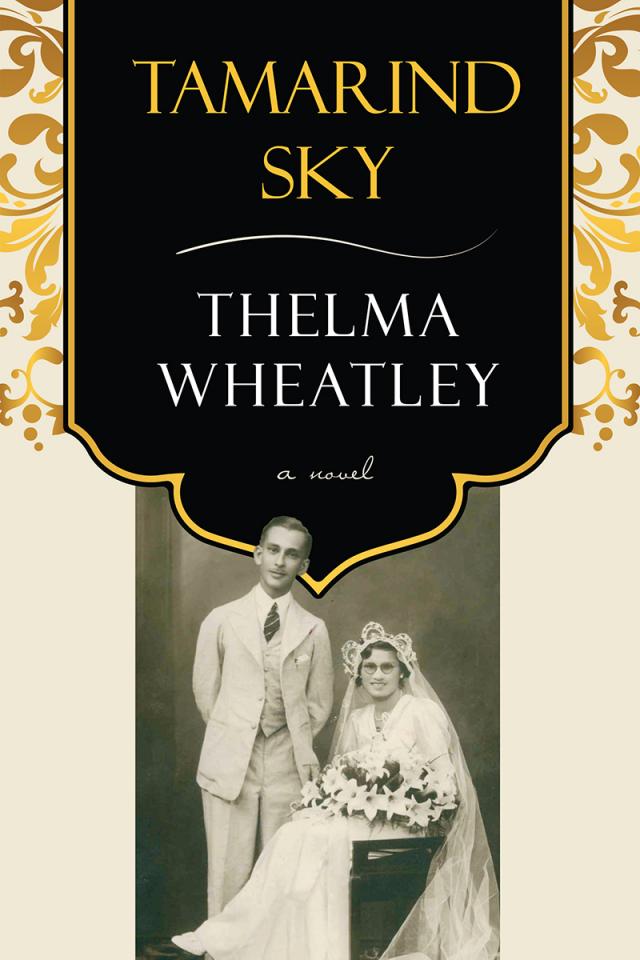
TAMARIND
SKY
Copyright © 2020 Thelma Wheatley
Except for the use of short passages for review purposes, no part of this book may be reproduced, in part or in whole, or transmitted in any form or by any means, electronically or mechanically, including photocopying, recording, or any information or storage retrieval system, without prior permission in writing from the publisher or a licence from the Canadian Copyright Collective Agency (Access Copyright).
We gratefully acknowledge the support of the Canada Council for the Arts and the Ontario Arts Council for our publishing program. We also acknowledge the financial support of the Government of Canada.
Cover design: Val Fullard
eBook: tikaebooks.com
Tamarind Sky is a work of fiction. All the characters portrayed in this book are fictitious and any resemblance to persons living or dead is purely coincidental.
Library and Archives Canada Cataloguing in Publication
Title: Tamarind sky : a novel / Thelma Wheatley.
Names: Wheatley, Thelma, author.
Series: Inanna poetry & fiction series.
Description: Series statement: Inanna poetry & fiction series
Identifiers: Canadiana (print) 20200203541 | Canadiana (ebook) 20200203614 | ISBN 9781771337335 (softcover) | ISBN 9781771337342 (epub) | ISBN 9781771337359 (Kindle) | ISBN 9781771337366 (pdf)
Classification: LCC PS8645.H41 T36 2020 | DDC C813/.6—dc23
Printed and bound in Canada
Inanna Publications and Education Inc.
210 Founders College, York University
4700 Keele Street, Toronto, Ontario, Canada M3J 1P3
Telephone: (416) 736-5356 Fax: (416) 736-5765
Email: inanna.publications@inanna.ca Website: www.inanna.ca
TAMARIND
SKY
THELMA WHEATLEY
a novel
INANNA PUBLICATIONS AND EDUCATION INC.
TORONTO, CANADA
For Angus
and
Thomas Orchard
Periya Dorai
Madeniya Tea Estate,
Kegalla, Ceylon
ALSO BY THELMA WHEATLEY
NON-FICTION:
“And Neither Have I Wings to Fly:” Labelled and Locked Up in Canada’s Oldest Institution
My Sad Is All Gone: A Family’s Triumph Over Violent Autism
Our heart is the place where we have to look for our deepest experiences.
—Anagarika Govinda
PART ONE
TORONTO, 1967…
1.
THERE’S SOMETHING ABOUT FATHER-IN-LAW I’m not sure of. The faded old British Union Jack flutters again on the roof of the bungalow, the imperious red, white, and blue stripes tattered and worn, a remnant of the Empire. I’m sure he took it down when we went away. My new father-in-law peers through the kitchen window as we turn in to the driveway. “They’re here, Mildred pet. They’ve come!” Exclamations of delight as Aidan and I step inside. We’ve been married one day.
“Welcome back, son, and … er … Selena.” Father-in-law offers me a perfunctory peck on the cheek.
“Aiyo!” Mother-in-law hugs us warmly, her dark face glowing. “Married in Wales one day and next day here in Toronto. You must be suffering jet-lag.”
I think, she’s my mother-in-law now, we are bonded by family.
“Hail to the newlyweds,” drawls Scottie, Aidan’s younger brother. “Daddy raised the flag in your honour.”
Scott’s fiancée, Darleene, who is sitting next to him at the table, smiles hugely. “Congratulations! Wow! How did the wedding go yesterday?”
She’s slim but solid, attractive with big, bright Canadian teeth and large grey eyes, like topazes. “It’s our turn next,” she gushes. She and Scottie are getting married next weekend at St. Raphael of All Angels Catholic Church, Mother and Father-in-law’s parish in Willowdale. She and Scott were high-school sweethearts, and now they’re attending York University together. They’re awfully young to be getting married.
“Well, that’s love,” cries Felix. “Ah, youth!”
Scott has won a big scholarship—it’s enough to put them through school and get them a cheap apartment in the married quarters of the college. He’s in environmental studies and already guaranteed a good government job when he graduates. My in-laws, Jack and Mildred Gilmor, have done well in Canada.
“We’ve brought photos of Wales and a film of the wedding to show you,” says Aidan with a cheerful smile. I feel a secret wave of gratitude towards him—of course he’s keeping the truth of our wedding to himself, what a debacle it was.… But that was yesterday, already the past.
“Two weddings in the family in one month, spanning two countries and an ocean,” marvels Felix. “It must be wedding season.”
Felix is Father-in-law’s first cousin, another Gilmor. He rises from his seat and shakes Aidan’s hand in a pleasing, old-fashioned way. “Congratulations, old chap. Selena, you’re as beautiful as ever, a veritable blushing bride—ah, that golden-blonde hair of yours, those sky-blue eyes!”
He’s very tall, over six feet, and thin, with a long curved nose and slanting eyes. After two weeks in Wales, surrounded by white people in a small village on the outskirts of Cardiff, the brownness of my new Sinhalese relatives is a shock. Of course, I know I’ll soon not notice, and it won’t matter, which is the very thing Mother fears: that eventually I won’t even notice. Felix, for instance, has very dark skin, bluish-black, that’s different from the others. “Oh, that’s his Tamil blood on his grandmother’s side,” Aidan had said casually when we first met. Tamil blood? What was that? I guessed, of course, but the words sounded so furtive. (What would Mother make of it?) I hadn’t been sure then what race a Tamil exactly was. (Dravidian, one of the oldest in the world.) One did not ask, of course. There are some things one just does not touch upon.
Mother-in-law has laid out a feast in celebration. The table is loaded with bowls of rice, chicken curries, brinjal, dhal with spinach, and dried salt fish mixed with shredded Maldive fish that makes it piquant. Not to mention the maloom, chutneys, and pickles. There’s a distinct foul odour that I try to ignore. “That’s Bombay duck. I’ve cooked it especially for Jack, but I think you may like the taste too, Selena,” says Mother-in-law. “I got it from Dalah’s Indian Mart on Yonge Street.”
“It all looks wonderful. Thank you so much.”
“Hmph.” Father-in-law heaves himself into a chair and opens a beer.
Mother-in-law puts down a pot of freshly brewed tea. “Ah, Uva tea from the Burundi district—I’d know that aroma anywhere,” says Felix, sniffing. In Ceylon, Felix was something called a tea-taster, working for a leading proprietor, Carson and Cumberbatch; he sipped little cups of tea all day, delineating its grade and essence. The managers of the Colombo Tea Auction used his judgements to set their prices. “Very pukkah. My God, years ago now, another lifetime….”
He’d been a bit of a ladies’ man, too, according to Aidan. He had had several broken engagements to beautiful Eurasian and Tamil girls, but never married any of them. Aidan had been too young to understand the implications at the time. (And what might such a liaison have meant in old colonial Ceylon, one wonders?) I look at Felix with interest. He’s part of Father-in-law’s elusive life as a tea planter, a life that has been subtly closed to me. For I’m coming to understand that I would likely not have married Aidan Gilmor, nor would Darleene be engaged to Scott, if we, two memsahibs, had been in Ceylon at such a time in its colonial history.
“Fiona said to go ahead and start eating without her—she’s running late at the office,” says Mother-in-law. Fiona is Aidan’s older sister.
Darleene is already munching on tasty mini-samosas that Mother-in-law has made herself. “You must teach me how to make these,” she cries.
“It is very easy.”
Summer breezes flow through the open window, bearing intoxicating sweetness from the flowers on the trellis. A blue jay screeches from the top of the spruce. This part of Willowdale, though modest, is entrenched in trees and cottage gardens.
The kitchen is small and cramped, hot but for an old insert fan over the stove. A stove, a fridge, and a large table take up all the space. The bungalow is also small. It is familiar to me by now—just three small bedrooms, an old-fashioned washroom with a pull chain, a living-room, and a kitchen. Yet once, in the forties, a Canadian family raised four children in this place. The house has a white frame with a pretty green roof and trim, and a side porch half collapsing under the weight of honeysuckle and clematis vines. The beautiful garden is its saving grace. It consists of an enormous double lot filled with apple trees, flowering currant bushes, and Father-in-law’s vegetable patch and flowerbeds. A towering cedar hedge dominates one side; it was constructed as a barricade against the neighbour, Mr. Babbit, after some dispute long forgotten. A grand old weeping willow droops in the front yard, its long flowing branches covering a small trailer permanently parked underneath. The tree sweeps the driveway, regularly dropping an array of branches and sap over Father-in-law’s Buick—“that bloody willow.”
The bungalow is one of hundreds of similar modest homes in Willowdale. Known fondly as “veterans’ houses,” many of them were built by the Canadian government for returning soldiers after the Second World War, mostly in this seemingly pleasant, middle-class neighbourho
“Beer, Aidan?”
“Thanks, Daddy.”
“More gin, Felix, old chap?”
“Thank you. Gordon’s London Dry is still my drink. And generous with the tonic, please, Jack. Have to think of my stomach.”
I surreptitiously observe Father-in-law as I eat. His fair English-like features are clear-cut and chiselled next to Aidan’s dark, powerful face with deep-set eyes. Aidan obviously takes after Mother-in-law’s Sinhalese side of the family in Ceylon, I note thoughtfully. He is dark skinned, with a strong, stocky build like Mother-in-law. It’s something I hadn’t really taken in during the first throes of romance when we met here in Willowdale six months ago. Now I can’t seem to keep myself from scrutinizing these members of my new family, my new in-laws. Each one is subject to my hidden, dark scrutiny. But what is it I’m trying to clarify? I’d tried to explain to Mother before the wedding that Aidan was half British and half Sinhalese, and that the family was from Ceylon, the island at the foot of the Indian subcontinent where all the tea comes from. “He calls himself Eurasian,” I’d added cautiously.
“Huh. Heinz fifty-seven varieties, you mean!” Mother had tossed her fair, greying curls in scorn. They frame a lean, patrician face that she is proud of.
“What was in your head, Selena?” she’d hissed. We were closeted in the bedroom for a talk while Dad took Aidan out to see Cardiff Castle, obviously a pre-arranged move. What she meant was, how could I get involved with a “coloured” man, and then bring him home to Cardiff to be wed in the village church, in front of all the neighbours! Too late, I realized my mistake. I’d not really noticed—or cared about—Aidan’s complexion during our torrid romance in Toronto. I’d only noticed how attractive he was. At that moment, I looked at him through Mother’s horrified eyes, at his dark-brown skin I’d barely registered.
I look cautiously at my new mother-in-law with her heavy Kandyan build and her dark swarthy skin, much darker than Aidan’s, if Mother but knew. Mother-in-law had been rejected for immigration to Australia under the colour bar in the 1950s. “Too dark,” the authorities had pronounced her passport photo. But fair-skinned Jack Gilmor, Aidan’s father, and Scott, Aidan’s light-skinned younger brother, had been accepted. They had “passed.” “Bloody hell,” my future father-in-law had reputedly snarled, knocking back a whisky. “What’s White? You tell me, bloody British!” They’d opted then to come to Canada. (This is one anecdote that must be kept from Mother.)
Scott is the fairest of the three Gilmor siblings, with light olive skin like an Italian. Handsome and slim, with thick, straight black hair and deep smouldering eyes, he could be a Hindu Bollywood star. He is Mother and Father-in-law’s obvious favourite.
There’s a sudden commotion. We all turn. Fiona, Aidan’s older sister, jerks open the metal storm door that smashes shut behind her. The glass panes rattle in the steel frame.
“What for trying to break the bloody door off its hinges, Fiona, pet?” says Father-in-law. Fiona irritates him. Her arrival always seems like an event.
“Enough, Daddy! Hi there, Aidan, Selena, welcome back from Wales. How did the wedding go? It was yesterday, wasn’t it? You must be exhausted.” She glances around the table. “Everyone’s here I see.”
Before we can answer, Fiona plonks down numerous packages of food on the counter, with crabs’ claws sticking out. “Enough for a siege,” remarks Felix.
“Here, Ma, cassava for Daddy—I know he likes it. And some crabs from the fish market that I got on sale. Also fresh dinner rolls since I know you always buy day-old.”
“What for bringing such things, Fiona? We have food plenty enough.”
“Ughh, peasant food from Ceylon! Pitu, dhal, maloom! Ma! You’re not serving Selena those smelly Ceylonese curries for her wedding celebration?” shrieks Fiona.
“Oh, but I like rice and curry,” I say quickly, seeing the hurt look on Mother-in-law’s face. She has a circular griddle on which she makes hoppers, which are like Western pancakes, puffed up.
“Me too,” says Darleene loyally. She’s tucking in to the hoppers as fast as Mother-in-law can turn them out. Soon, she and I will both be known as “Mrs. Gilmor”—three Mrs. Gilmors in the family.
Fiona is vivid and somehow admirable, having inherited a strain in the family genes that I haven’t yet encountered. Her round, painted, crimson lips remind one of a rose; her fine Sinhalese oval features are like porcelain. Her eyes flash, and her voice crackles imperatively. I can tell that she’s a fighter. Scottie told me once that the girls at the Kandy Convent boarding-school in Ceylon apparently used to call her “Mrs. Hitler.”
“Mrs. Hitler,” he drawls now, teasing.
“Enough, Scottie!” she flashes. “What would you know? You were in diapers.”
“Ach!” she turns to me. “I will cook you good German food when you come to my place, Selena. Black Forest ham, nice German strudel. Come in a few weeks to dinner once Scottie and Darleene’s wedding is over. The Germans know how to cook.”
Fiona is married to a German immigrant, Deiter Mueller, whose parents apparently ran a delicatessen in Stutgart. Fiona still tries to emulate them, in cuisine at least. Mother-in-law maintains equanimity. “Ugh,” goes Father-in-law.
“We used to have hoppers for breakfast at Holy Innocents, remember?” says Felix.
Holy Innocents Catholic College for Boys was the boarding school in Kandy that Aidan, Scott, Father-in-law, Felix, and another cousin, Colin, had attended long ago. Scottie had only attended for six months before the family emigrated.
“Not that Scott ate any Ceylonese food,” Aidan mocks. “Daddy had to pay a fortune for special Western food for you, Scott.”
“Yes! English cereal—cornflakes!” screams Fiona. “Can you imagine? In the tropics! And hot dogs!”
Scott smirks.
“He still eats kids’ cereals and hot dogs,” says Darleene.
“Well, I just didn’t like the smell of curries as a kid,” pouts Scott. He still doesn’t. He’s the “Canadian” in the family that my mother and father-in-law are so proud of, even though the role seems to involve rejecting their food. But he obligingly helps himself to a little rice and chicken. I make up for his reticence by serving myself extra hoppers and pitu and a great helping of chicken curry.
“See! Selena likes my food.”
“She’s just being polite, Ma. So, Darleene, your big day is coming up next at St. Raphael’s. You’ve invited everyone from our side, Ma?”
“Aiyo. Yes, yes. Colin is coming.”
“Colin!”
At once everyone is excited at the prospect of the three Ceylon cousins getting together again after so many years. Father-in-law had apparently sponsored Colin and Felix to come to Canada in 1958, after some riot. “And damn lucky we were to get out, too,” says Felix. They refer to that year as “the ’58.” I’m silent. My position as the English daughter-in-law pre-empts any query from me about the British Colonial Empire, about their past….
“Bloody hell,” says Father-in-law, knocking back a whisky, “damn British….”
“Aiyo, now then, pet….” Mother-in-law gives a warning glance towards me.
“Lally is invited, too,” needles Scott, knowing all about Fiona’s childhood rivalry with Lally.
“WHA-A-T? Lally’s coming to the wedding?”
“Well, of course she is,” says Mother-in-law sharply. “She grew up with you all on the estate, like a sister.” Lally is Mother-in-law’s youngest sister, part of the Gilmor children’s childhood.
“That means her husband Jan must be coming too. And their five kids,” protests Fiona. Lally and Fiona had both rushed into marriage as young women in 1957, as soon as they arrived in Toronto. Now, ten years later, Fiona is getting a divorce. (“Deiter wouldn’t let me out of the house.”)
“I said it would never work, marrying a German,” observes Felix. “They don’t use hausfrau for nothing.”
“Hell, I was only nineteen. I didn’t know what I was doing. I was crazy in love….”


