

The inconvenient indian, p.1
The Inconvenient Indian, page 1


Copyright © 2012 Thomas King
All rights reserved. The use of any part of this publication, reproduced, transmitted in any form or by any means electronic, mechanical, photocopying, recording or otherwise, or stored in a retrieval system without the prior written consent of the publisher—or in the case of photocopying or other reprographic copying, license from the Canadian Copyright Licensing Agency—is an infringement of the copyright law.
Doubleday Canada and colophon are registered trademarks
Library and Archives Canada Cataloguing in Publication
King, Thomas, 1943-
The inconvenient Indian : a curious account of Native People in North America / Thomas King.
eISBN: 978-0-385-67405-8
1. Indians of North America—History. 2. Indians of North America—Social life and customs. 3. North America—Ethnic relations. 4. Indians, Treatment of—North America. I. Title.
E77.K566 2012 970.004›97 C2012-902445-7
Cover and text design: Andrew Roberts
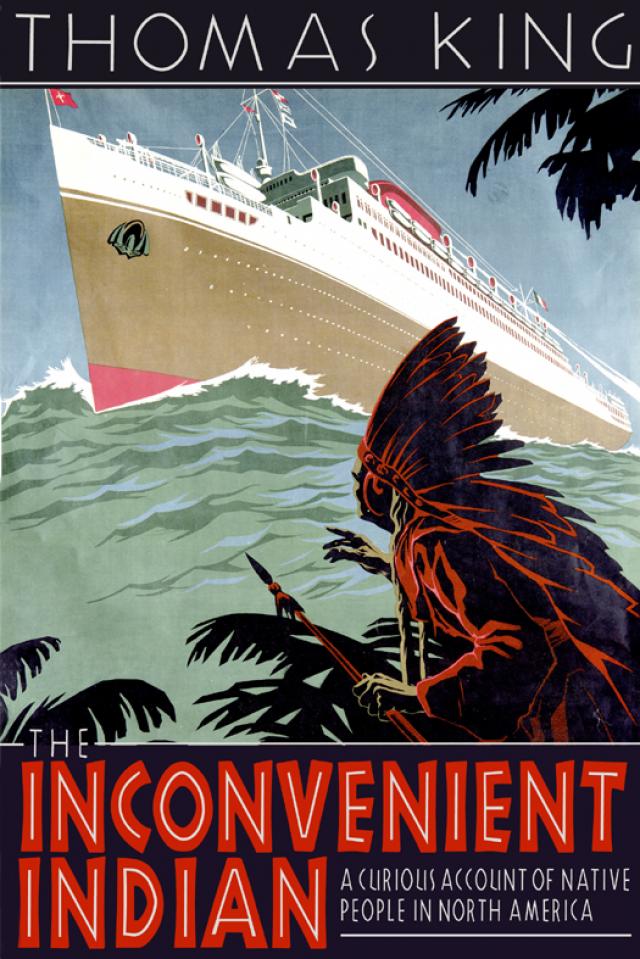
Cover image: Poster advertising the ‘Cosulich Line’ (colour litho), Italian School, (20th century) / Private Collection / The Bridgeman Art Library
Published in Canada by Doubleday Canada, a division of Random House of Canada Limited
Visit Random House of Canada Limited’s website: www.randomhouse.ca
v3.1
For the grandchildren I will not see.
CONTENTS
Cover
Title Page
Copyright
Dedication
Prologue: Warm Toast and Porcupines
1. Forget Columbus
2. The End of the Trail
3. Too Heavy To Lift
4. One Name to Rule Them All
5. We Are Sorry
6. Like Cowboys and Indians
7. Forget About It
8. What Indians Want
9. As Long as the Grass is Green
10. Happy Ever After
Acknowledgements
PROLOGUE
WARM TOAST AND PORCUPINES
I am the Indian
And the burden
Lies yet with me.
—Rita Joe, Poems of Rita Joe
ABOUT FIFTEEN YEARS BACK, a bunch of us got together to form a drum group. John Samosi, one of our lead singers, suggested we call ourselves “The Pesky Redskins.” Since we couldn’t sing all that well, John argued, we needed a name that would make people smile and encourage them to overlook our musical deficiencies.
We eventually settled on the Waa-Chi-Waasa Singers, which was a more stately name. Sandy Benson came up with it, and as I remember, waa-chi-waasa is Ojibway for “far away.” Appropriate enough, since most of the boys who sit around the drum here in Guelph, Ontario, come from somewhere other than here. John’s from Saskatoon. Sandy calls Rama home. Harold Rice was raised on the coast of British Columbia. Mike Duke’s home community is near London, Ontario. James Gordon is originally from Toronto. I hail from California’s central valley, while my son Benjamin was born in Lethbridge, Alberta, and was dragged around North America with his older brother and younger sister. I don’t know where he considers home to be.
Anishinaabe, Métis, Coastal Salish, Cree, Cherokee. We have nothing much in common. We’re all Aboriginal and we have the drum. That’s about it.
I had forgotten about “Pesky Redskins” but it must have been kicking around in my brain because, when I went looking for a title for this book, something with a bit of irony to it, there it was.
Pesky Redskins: A Curious History of Indians in North America.
Problem was, no one else liked the title. Several people I trust told me that Pesky Redskins sounded too flip and, in the end, I had to agree. Native people haven’t been so much pesky as we’ve been … inconvenient.
So I changed the title to The Inconvenient Indian: A Curious History of Native People in North America, at which point my partner, Helen Hoy, who teaches English at the University of Guelph, weighed in, cautioning that “history” might be too grand a word for what I was attempting. Benjamin, who is finishing a Ph.D. in History at Stanford, agreed with his mother and pointed out that if I was going to call the book a history, I would be obliged to pay attention to the demands of scholarship and work within an organized and clearly delineated chronology.
Now, it’s not that I think such things as chronologies are a bad idea, but I’m somewhat attached to the Ezra Pound School of History. While not subscribing to his political beliefs, I do agree with Pound that “We do NOT know the past in chronological sequence. It may be convenient to lay it out anesthetized on the table with dates pasted on here and there, but what we know we know by ripples and spirals eddying out from us and from our own time.”
There’s nothing like a good quotation to help a body escape an onerous task.
So I tweaked the title one more time, swapped the word “history” for “account,” and settled on The Inconvenient Indian: A Curious Account of Native People in North America. Mind you, there is a great deal in The Inconvenient Indian that is history. I’m just not the historian you had in mind. While it might not show immediately, I have a great deal of respect for the discipline of history. I studied history as part of my doctoral work in English and American Studies at the University of Utah. I even worked at the American West Center on that campus when Floyd O’Neil and S. Lyman Tyler ran the show, and, over the years, I’ve met and talked with other historians such as Brian Dippie, Richard White, Patricia Limerick, Jean O’Brien, Vine Deloria, Jr., Francis Paul Prucha, David Edmunds, Olive Dickason, Jace Weaver, Donald Smith, Alvin Josephy, Ken Coates, and Arrel Morgan Gibson, and we’ve had some very stimulating conversations about … history. And in consideration of those conversations and the respect that I have for history, I’ve salted my narrative with those things we call facts, even though we should know by now that facts will not save us.
Truth be known, I prefer fiction. I dislike the way facts try to thrust themselves upon me. I’d rather make up my own world. Fictions are less unruly than histories. The beginnings are more engaging, the characters more co-operative, the endings more in line with expectations of morality and justice. This is not to imply that fiction is exciting and that history is boring. Historical narratives can be as enchanting as a Stephen Leacock satire or as terrifying as a Stephen King thriller.
Still, for me at least, writing a novel is buttering warm toast, while writing a history is herding porcupines with your elbows.
As a result, although The Inconvenient Indian is fraught with history, the underlying narrative is a series of conversations and arguments that I’ve been having with myself and others for most of my adult life, and if there is any methodology in my approach to the subject, it draws more on storytelling techniques than historiography. A good historian would have tried to keep biases under control. A good historian would have tried to keep personal anecdotes in check. A good historian would have provided footnotes.
I have not.
And, while I’m making excuses, I suppose I should also apologize if my views cause anyone undue distress. But I hope we can agree that any discussion of Indians in North America is likely to conjure up a certain amount of rage. And sorrow. Along with moments of irony and humour.
When I was a kid, Indians were Indians. Sometimes Indians were Mohawks or Cherokees or Crees or Blackfoot or Tlingits or Seminoles. But mostly they were Indians. Columbus gets blamed for the term, but he wasn’t being malicious. He was looking for India and thought he had found it. He was mistaken, of course, and as time went on, various folks and institutions tried to make the matter right. Indians became Amerindians and Aboriginals and Indigenous People and American Indians. Lately, Indians have become First Nations in Canada and Native Americans in the United States, but the fact of the matter is that there has never been a good collective noun because there never was a collective to begin with.
I’m not going to try to argue for a single word. I don’t see that one term is much better or worse than another. “First Nations” is the current term of choice in Canada, while “Native Americans” is the fashionable preference in the United States. I’m fond of both of these terms, but, for all its faults and problems—especially in Canada—“Indian,” as a general designation, remains for me, at least, the North American default.
Since I’m on the subject of terminology and names, I should mention the Métis. The Métis are one of Canada’s three official Aboriginal groups, Indians (First Nations) and the Inuit being the other two. The Métis are mixed-bloods, Indian and English, Indian and French, for the most part. They don’t have Status under the Indian Act, but they do have designated settlements and homelands in Ontario, Manitoba, Saskatchewan, and Alberta. Many of these communities maintain a separate culture from their White and First Nations neighbours, as well as a separate language—Michif—which features components of French and Aboriginal languages.
Terminology is always a rascal. I’ve tried to use “reservations” for Native communities in the United States and “reserves” for Native communities in Canada, and “tribes” for Native groups in the United States and “bands” for Native groups in Canada. But in a number of instances, when I’m talking about both sides of the border, I might use “reservation” or “reserve” and “band” or “tribe” or “Nation,” depending on rhythm and syntax. I actually prefer “Nation” or a specific band or tribal name, and I try to use this whenever possible.
And Whites. Well, I struggled with this one. A Japa
There is an error in the text of the book that I have not corrected. “The Bureau of Indian Affairs” is the correct designation for the U.S. agency that is charged with looking after matters pertaining to Indians in that country, but for Canada, I have continued to use the “Department of Indian Affairs” even though the ministry is now called “Aboriginal Affairs and Northern Development Canada.” I simply like the older name and find it less disingenuous.
In the end, I’m not so much concerned with designing a strict vocabulary as I am with crafting a coherent and readable narrative.
One of the difficulties with trying to contain any account of Indians in North America in a volume as modest as this is that it can’t be done. Perhaps I should have called the book The Inconvenient Indian: An Incomplete Account of Indians in North America. For whatever I’ve included in this book, I’ve left a great deal more out. I don’t talk about European explorers and their early relationships with Native people. I haven’t written much about the Métis in Canada and, with the exception of the Nunavut Land Claims Agreement, I don’t deal with the Inuit at all. I touch on early settlement and conflicts, but only in passing. I spend a great deal of time on Native people and film, because film, in all its forms, has been the only place where most North Americans have seen Indians. I talk about some of the resistance organizations and the moments that marked them, but I don’t spend any time on Anna Mae Aquash’s murder or on the travesty of Leonard Peltier’s trial and imprisonment.
Nor do I talk about Native women such as Brenda Wolfe, Georgina Papin, and Mona Wilson, women whom Robert “Willie” Pickton murdered at his pig farm in British Columbia, or the Native women who have gone missing in Vancouver and along the highway between Prince Rupert and Prince George. Nor do I bring up the murder of Ditidaht First Nation carver John T. Williams, who, in 2010, was gunned down in Seattle by a trigger-happy cop.
While I spend time in the distant and the immediate past, I’ve also pushed the narrative into the present in order to consider contemporary people and events. This probably isn’t the best idea. The present tends to be too fresh and fluid to hold with any surety. Still, as I argue in the book, when we look at Native—non-Native relations, there is no great difference between the past and the present. While we have dispensed with guns and bugles, and while North America’s sense of its own superiority is better hidden, its disdain muted, twenty-first-century attitudes towards Native people are remarkably similar to those of the previous centuries.
Finally, no doubt, someone will wonder why I decided to take on both Canada and the United States at the same time, when choosing one or the other would have made for a less involved and more focused conversation. The answer to this is somewhat complicated by perspective. While the line that divides the two countries is a political reality, and while the border affects bands and tribes in a variety of ways, I would have found it impossible to talk about the one without talking about the other.
For most Aboriginal people, that line doesn’t exist. It’s a figment of someone else’s imagination. Historical figures such as Chief Joseph and Sitting Bull and Louis Riel moved back and forth between the two countries, and while they understood the importance of that border to Whites, there is nothing to indicate that they believed in its legitimacy.
I get stopped every time I try to cross that border, but stories go wherever they please.
1
FORGET COLUMBUS
Out of the belly of Christopher’s ship
a mob bursts
Running in all directions
Pulling furs off animals
Shooting buffalo
Shooting each other
…
Pioneers and traders
bring gifts
Smallpox, Seagrams
and rice krispies
Civilization has reached
the promised land.
—Jeannette Armstrong, “History Lesson”
WHEN I ANNOUNCED TO my family that I was going to write a book about Indians in North America, Helen said, “Just don’t start with Columbus.” She always gives me good advice. And I always give it my full consideration.
In October of 1492, Christopher Columbus came ashore somewhere in the Caribbean, a part of world geography with which Europeans were unfamiliar, and as a consequence, he was given credit for discovering all of the Americas. If you’re the cranky sort, you might argue that Columbus didn’t discover anything, that he simply ran aground on an unexpected land mass, stumbled across a babel of nations. But he gets the credit. And why not? It is, after all, one of history’s jobs to allocate credit. If Columbus hadn’t picked up the award, it would have been given to someone else.
The award could have gone to the Norse. They arrived on the east coast of North America long before Columbus. There is even evidence to suggest that Asians found their way to the west coast as well.
But let’s face it, Columbus sailing the ocean blue is the better story. Three little ships, none of them in showroom condition, bobbing their way across the Atlantic, the good captain keeping two journals so that his crew wouldn’t realize just how far they had drifted away from the known world, the great man himself wading ashore, wet and sweaty, flag in hand, a letter of introduction to the Emperor of the Indies from the King and Queen of Spain tucked in his tunic.
A Kodak moment.
And let’s not forget all the sunny weather, the sandy beaches, the azure lagoons, and the friendly Natives.
Most of us think that history is the past. It’s not. History is the stories we tell about the past. That’s all it is. Stories. Such a definition might make the enterprise of history seem neutral. Benign.
Which, of course, it isn’t.
History may well be a series of stories we tell about the past, but the stories are not just any stories. They’re not chosen by chance. By and large, the stories are about famous men and celebrated events. We throw in a couple of exceptional women every now and then, not out of any need to recognize female eminence, but out of embarrassment.
And we’re not easily embarrassed.
When we imagine history, we imagine a grand structure, a national chronicle, a closely organized and guarded record of agreed-upon events and interpretations, a bundle of “authenticities” and “truths” welded into a flexible, yet conservative narrative that explains how we got from there to here. It is a relationship we have with ourselves, a love affair we celebrate with flags and anthems, festivals and guns.
Well, the “guns” remark was probably uncalled for and might suggest an animus towards history. But that’s not true. I simply have difficulty with how we choose which stories become the pulse of history and which do not.
In 1492, Columbus sailed the ocean blue.
On second thought, let’s not start with Columbus. Helen was right. Let’s forget Columbus. You know, now that I say it out loud, I even like the sound of it. Forget Columbus.
Give it a try. Forget Columbus.
Instead, let’s start our history, our account, in Almo, Idaho. I’ve never been there, and I suspect that most of you haven’t either. I can tell you with certainty that Christopher Columbus didn’t discover the town. Nor did Jacques Cartier or Samuel de Champlain or David Thompson or Hernando Cortes. Sacajawea, with Lewis and Clark in tow, might have passed through the general area, but since Almo didn’t exist in the early 1800s, they couldn’t have stopped there. Even if they had wanted to.
Almo is a small, unincorporated town of about 200 tucked into south central Cassia County in southern Idaho. So far as I know, it isn’t famous for much of anything except an Indian massacre.


