

I am kavi, p.1
I Am Kavi, page 1


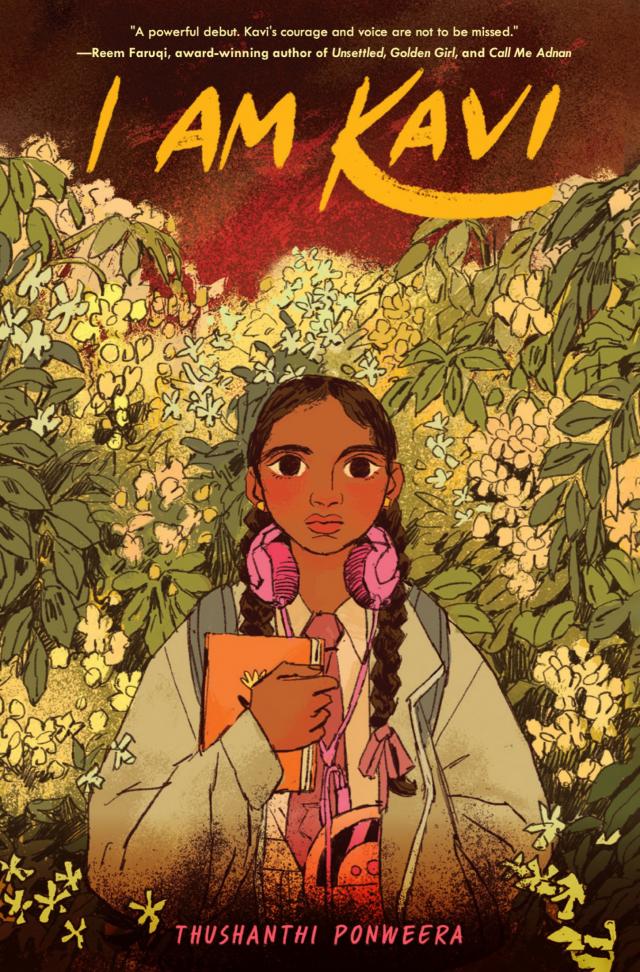
Copyright © 2023 by Thushanthi Ponweera
All Rights Reserved
HOLIDAY HOUSE is registered in the U.S. Patent and Trademark Office.
www.holidayhouse.com
Library of Congress Cataloging-in-Publication Data is available.
ISBN 9780823453658 (hardcover)
Ebook ISBN 9780823457274
a_prh_6.0_144900913_c1_r0
TO RAJIV.
FOR ACCEPTING ME
AND WAITING PATIENTLY
WHILE I LEARN
TO ACCEPT MYSELF
Cover
Title Page
Copyright
Dedication
Strings
Jasmine
Rituals
Daytime Amma
Siripala
Incomplete
Sinhala-Buddhist
Not anymore
The lump is up
Back then
Slow death
Heart attack
Statues
The hidden pool of emotion
After
Excuses
Distance
Now
The exam
Nighttime Amma
Stuck
Room
Sari and sarong
Not Done
One year
No choice
Guilt
Plans Unfolded
School
Curd and treacle
Sunil
Harmony
Closer
Happiness not allowed
Not all but some
Karma
Revise, memorize
A seed
Hope is
My plan
Success
Finally
Choices
Baba
Déjà vu
Unexpected
The consolation prize
Not consoled
I’m running
Moving forward
The messenger
Too late
Hard
Soft
Bigger and Better
The big city
First glimpse
Mala Nanda
Checkpoints and soldiers
Hunger
Being rich
Still
A way out
Big gates, big doors
The Palace
Thank you and goodbye
Unfamiliar
Garage access
The King and the Queen
Sasha
The lowdown
New school
The first day
Fitting in
Happy, fearless, popular
Too different
Not that different
Not yet
Invisible
Sasha says
Bad influence
Not what it seems
Practice makes perfect
Practice makes friends
Nethmi
Sulo
Broken English
Topics of conversation
What they talk about
My turn
Pansil
A bad Buddhist
Old House, New Paint
The challenge
They into We
This is me
Better this way
Ever since I lied
Shopping with Madam
Bulletproof
Ambulthiyal fish
Based on a true story
Not that simple
Just like that
Untouched
Good days
Hard days
10:1
The worst day
Uniform
Clothes: old vs. new
Separate
Mixed
Everything
Another plan
Borrowing not stealing
Mannequin
Beautiful
Bending the rules
Fizzy
Lights, camera, action!
Spotlight
Curtain call
And then
Like the Moon
The following day
Charity case
My place
The villain
First term tests
Unplaced
A good example
Assumptions
Big mistake
Cornered
Reality check
Avurudu
Pirith
Walls closing in
Take one
Take two
Take three
Final blow
The big deal
A true friend
Poya Day
Perspective
D-Day
Squirrels
Fangs
With your parents
Null and void
Crumbling
The next day
A total eclipse
Defenseless
War cry
Confrontations and Confessions
Shattered
Maid-class
Moonbeams
Numb
Holding it together
Careless vs. caring
The only reason
Goodbyes
Window seat
A rare chat
The voice inside
Armor
Connection
A new ritual
About what happened
Not yet
Concern
Convincing
Restless
Messengers
Emergency
Don’t go
Rebirth
Job description: Mother
Second chances
A letter
Start to finish
The good kind
Something like that
My new norm
I know now
The Sri Lankan Civil War
Acknowledgments
Author’s Note
Glossary
STRINGS
A VILLAGE IN THE ANURADHAPURA DISTRICT, SRI LANKA, MAY 1997
Jasmine
It’s still dark outside when I wake up.
That time when there is not enough moonlight
or enough sunlight.
The jasmine flowers glow incandescent
as they always do,
eagerly looking for my outstretched hands.
I pluck them swiftly,
glad that their sweet-smelling scent
overpowers the smell of manure
drifting from the direction of the cows.
I carry them to the tiny altar
in the corner of our garden
and light a fresh stick of incense.
The serene face of
the small stone Buddha
reminds me
to practice loving-kindness.
I’d love to have that kind of face—
the kind that makes everyone feel
instantly calm.
Then I remind myself
that the Buddha took
years and years of
searching,
suffering,
enduring
to achieve
all that calm.
I am only ten.
Searching,
suffering,
and enduring
can wait.
Rituals
are like strings that connect
me to Amma.
At times,
the only ones.
I started drinking tea when I was a toddler,
Amma says,
begging for sips from her cup
till eventually I had my own.
I’m yet to be promoted
to the level of plain-tea drinker.
Mine consists mostly of milk
still warm from the insides of the cow
Amma milked
mere minutes ago.
We both drink our tea the same way.
One hand hugs the cup,
one hand stays open,
a bit of sugar in its palm.
A sip from the cup,
a lick from the palm.
Sip,
lick,
sip,
lick.
The comforting sounds of pirith
from the nearby temple surround us
as they do every day at dawn,
till the rooster crows,
breaking the reverie—
our signal to get moving.
Amma stands,
reties her hair into a bun,
tightens her redda—the cotton cloth
that hugs the lower part of her body—
and heads outside.
She is referring to the empty cups.
Do it yourself.
I scowl back.
In my head of course.
Arguing with Amma is like
going to war.
You may win,
but not without a whole lot of
damage.
Daytime Amma
Daytime Amma
is not patient.
The grains fly out of her hands
as she throws them to the chickens,
gravy splatters her blouse while she cooks,
and the coconut-leaf broom swishes noisily
as she hurriedly sweeps the house.
I tell myself that
she may be faster
but that I do a better job.
I pause to pet the cows,
nuzzling their sweet noses,
thanking them for their milk;
and when I make mallung,
I cut the gotukola leaves as finely as possible
like you’re supposed to.
When Amma makes mallung,
the pieces are so big
we might as well have
plucked the leaves off the ground
and eaten them straight.
Even our little front porch is spotless
after I’m done sweeping it.
I feel rather proud of myself,
though Amma keeps telling me to hurry up
and doesn’t praise my work
like she used to.
Daytime Amma
is not patient.
The morning sunlight frames our shadows
as we walk past the cluster of small houses
around our own
and make our way to the common well.
This is where we wash—
ourselves,
our clothes—
to get ready for the day.
I, to go to school,
and she, to go to the paddy fields.
Amma draws the water,
the muscles in her arms pulsing
with each pull of the rope,
the metal bucket at the end of it
not spilling any water
thanks to her steady hands.
I tried doing it once,
but it was taking too long,
and by the time the bucket was up,
half its contents were out.
And daytime Amma
is not patient.
Siripala
At home,
my patience wears thin too,
as I try my best not to disturb
the sleeping lump of a man
covered in a sheet and
sprawled on the padura on the floor,
his tall body taking up
more space than it should.
I dress unhurriedly,
moving my arms slowly
through the sleeves of my school uniform,
the older one of the two I own,
hoping today won’t be the day
it finally rips.
The sleeping lump yawns,
his eyes still closed.
I finish the rest of my dressing-up routine
in record time.
Hurry up, the food’s getting cold,
Amma calls me.
Impatient again.
But this time
I’m thankful for it.
Anything to avoid
Siripala.
Incomplete
I step outside and walk around
to the back of the house,
dragging my hand over
its uneven wall and peeling paint,
to the makeshift kitchen
Thaththa built for us before he died.
It’s incomplete,
missing half a roof
that Amma is saving up
to finish.
She hands me a plate of manioc,
our regular breakfast.
Mine is arranged into neat lumpy balls
pre-dabbed with grated coconut
to allow for the most efficient eating—
our special discovery.
I gobble them up,
finish tying my hair and shoelaces,
and bend down to worship Amma.
Another ritual.
Another string.
Sinhala-Buddhist
I used to fling myself at her feet,
my forehead to her toes,
arms clasped above my head,
knees and elbows on the ground,
no holding back.
Just like my religion taught me.
A good Buddhist girl.
I would do this
every day without fail,
unquestioning in my devotion to her,
my mother,
who could do no wrong.
Just like my culture taught me.
A good Sinhalese girl.
Not anymore
Lately,
there is no head-to-toe contact:
my knees hover inches away from the ground,
and I only graze her feet with my fingertips.
If she’s noticed this lack of fervor
she hasn’t commented on it.
Thunuruwan saranai,
she says as she touches my head,
calling the powers of the Triple Gem—
the Buddha, Dhamma, and Sangha—
to protect me.
I mutter the words back to her
not really meaning them.
Not so good anymore.
The lump is up
As I walk away,
I glance back to see her handing
a cup of tea to the man who is now awake,
his thin body leaning on the doorframe,
his sarong hitched up between his knees.
I walk faster.
My fists clench around
the strap of my school bag,
squeezing,
squeezing.
I really should try and step it up
with the loving-kindness.
They say it matters the most when
it’s hardest to do.
And not to boast or anything,
but I’ve always been good
at the hard stuff.
Back then
It wasn’t like this back then.
We were like those typical pictures of “My Family”
that kids are told to draw during art class.
Mother, Father, Child.
Amma, Thaththa, me.
Holding hands,
smiling,
always smiling.
Most of the fathers in the other kids’ pictures
wore army camo
and carried a gun.
Mine did too for a few years,
until the uniform was replaced
with regular clothes,
and instead of two feet peeking out from
beneath the sarong,
I drew only one.
There was no gun hoisted on his arm
but there was a crutch.
It’s what he came back with
after nearly a decade at the front lines.
The lower part of his leg had exploded
along with the Claymore mine he had stepped on.
Slow death
The news calls soldiers like him
“victims of the war,”
but the government awarded him a medal
and called him a hero.
He looked at it often,
twirling it in his hand,
while rubbing the stump below his knee,
his expression
changing over months from pride
to something I couldn’t quite recognize.
Disgust?
Anger?
Regret?
But every night,
he held onto it while he slept,
that medal,
as if it were a part of him.
Something from the war to replace
something he lost.
Even the night he went to sleep
and never woke up.
Heart attack
So sudden!
So unexpected!
So young!
The people at the funeral seemed surprised
that Thaththa’s heart had failed him.
The same people who had stopped
praising him,
visiting him,
inviting him.
Hadn’t they failed him too?
Statues
I expected Amma
to be a bit more emotional
at the cremation
but she was pretty disappointing


